Key Highlights
-
The urdu alphabet uses the urdu script, and it goes from right to left.
-
urdu language writing is seen in the flowing nastaliq script that many people use in south asian languages.
-
urdu has 38 urdu letters. Most of them are consonants, but some of these also show vowels.
-
Many urdu letters are picked from arabic script and persian alphabets. The urdu script has added some more sounds to fit urdu words.
-
urdu writing is mostly phonetic, so the words often match how native speakers say them.
-
To start reading urdu, learning urdu letter shapes and how they link is the first step. This helps you say simple urdu words.
Introduction
If you live in Australia and want to take your first step into Urdu writing, you are in the right place. The Urdu alphabet may look strange at first if you read English most of the time. But once you know what to look for, the system has clear ways to follow. Urdu is one of the main South Asian languages, and it uses a script that flows. Its letters have their own shapes, sounds, and rules for joining. A simple overview can help make reading Urdu much easier for you.
The Basics of the Urdu Alphabet
The urdu language uses a writing style that comes from the arabic script. It is also shaped a lot by persian alphabets. That means if you have seen arabic or persian before, some urdu letters will look or sound the same. But urdu has extra letters to show its own sounds.
The basic letters in urdu include alif, be, pe, te, jim, chayh, re, seen, sheen, kaf, lam, mim, nun, wao, ye, and hamzah. You learn the sound for each letter with simple links. For example, b in ball, p in pen, and k in kite. The next parts will show this in a clear way.
How Many Letters Make Up the Urdu Alphabet?
The urdu alphabet has 38 letters. If you have been curious about the number of letters in urdu, that is the number most beginner guides talk about. This can give you a good starting point when you want to start your language learning.
Urdu uses what is called an abjad style of writing. In an abjad, consonants do most of the work in writing. Vowels often show up in other ways, or you understand them from the words around it. That is why people who learn urdu often see that urdu letters do not act the same way as english alphabets.
There is another thing you need to think about with urdu letters. All 38 signs are seen as consonants in the main system. But a few are used for vowel sounds, or a mix of consonant and vowel together. So, when you start to study urdu, do not think you will see the same clear split between consonants and vowels as you get in your own language. The way urdu shows the sounds will make more sense as you see the urdu letters, their number of letters, and sound patterns.
Names and Sounds of Each Urdu Letter
Each letter of the urdu alphabet has a traditional name and a sound value. Beginners usually learn them in groups, because many symbols have similar shapes. You do not need to memorise everything in one sitting.
Here is a short text table with common examples:
|
Urdu letter |
Name |
Simple pronunciation guide |
|---|---|---|
|
ا |
alif |
a as in alone |
|
ب |
be |
b as in ball |
|
پ |
pe |
p as in pen |
|
ت |
te |
t as in tomato |
|
ج |
jim |
j as in jam |
|
چ |
chayh |
ch as in chart |
|
ر |
re |
r as in Ray |
|
س |
seen |
s as in school |
|
ش |
sheen |
sh sound |
|
ک |
kaf |
k as in kite |
|
م |
mim |
m as in moon |
|
ن |
nun |
n as in nest |
Beyond these, Urdu includes letters such as khay, ghain, qaaf, wao, choti ye, bari ye, and hamzah. Some have no exact English match, so pronunciation improves best through repetition, careful listening, and writing practice by hand.
Unique Sounds Found in Urdu Compared to English
Yes, the urdu language has sounds that you do not really find in english. That is one reason why some learners think urdu is fun, but it can also be a bit hard when you start. There are a few consonants that sound deeper, stronger, or have more breath in them than their english neighbours.
Some good examples are:
-
ٹ and ڈ are strong retroflex sounds, more so than the usual english t and d.
-
ڑ gives a rolled, firm sound you do not get in english.
-
ع and غ are sounds made deep in the throat, which are not in english used day to day.
-
خ gives off a rough and breathy sound, kind of like when you say Khyber.
Vowels in urdu go a different way too. The urdu language uses short vowels, long vowel sounds, and adds helper letters, but not quite how it is done in english. The thing is, urdu is usually phonetic, so when you get used to hearing it, the spelling and the pronunciation seem to help each other out.
Understanding the Nastaliq Script
The nastaliq script is the main style that people use for urdu writing. It comes from old Persian ways of writing and is part of the big group of persian scripts that also belong to the arabic script family. For many learners, nastaliq is the easiest way to spot or tell that something is written in urdu.
You often see nastaliq in books, when you are studying lessons, and in printed text used across the urdu language. It goes from right to left and it doesn’t change for capital or small letters. This style looks smooth and is shaped by calligraphy. If you want to know why urdu looks the way it does, take some time to know the main things about this script next.
Key Features of Nastaliq in Urdu Writing
What makes the Nastaliq script special is how it looks smooth and sloped. This way of urdu writing is not stiff like block letters. Instead, it has a joined, artistic style and you can see this in a lot of south asian languages. This look comes from a long tradition of calligraphy.
There is also the direction you read. Urdu is written in horizontal lines from right to left. The script does not have upper or lower case letters like english. These days, english punctuation is used with urdu. It helps beginners feel comfortable, especially when they read short text.
This script does well as both a font for web or print, and as handwritten letters too, but printed and written nastaliq can look a bit different at first. Since Nastaliq often matches sounds to letters, learners find it easy to connect spoken words with the written ones. That makes it simple to grow your vocabulary in urdu and gets your reading up to speed and confidence up as well.
Differences Between Nastaliq and Other Scripts
The Urdu script comes from the Arabic script and Persian alphabets, but it is not the same as those. Urdu took on the nastaliq style because Persian had a big effect on it. After that, Urdu shaped the way people write the script to fit the sounds that are there in Urdu.
You can spot some key differences:
-
Urdu writing uses a smooth nastaliq style instead of the upright look that many learners think of when they look at Arabic script.
-
Urdu script has extra letters because the language needs more sounds.
-
Some letters may have a different sound or job in Urdu compared to the other variants.
-
Urdu writing often shows the real pronunciation of most everyday words.
So, what makes the Urdu alphabet different from Arabic or Persian? To put it simply, Urdu script takes the main idea from Arabic script and Persian alphabets. It keeps going right to left. Then the script adds what Urdu needs for its sounds and the way words look. That mix gives urdu writing its own feel but also links it to the bigger group of scripts used in the area.
Importance of Nastaliq in Urdu Culture and Learning
Nastaliq is important because it is more than just a way of writing. In urdu culture, it is tied to poetry, old print styles, and formal looks. When you learn nastaliq, you are not only memorising shapes. You are learning how urdu is often seen and used.
You see nastaliq in urdu media, textbooks, phrase lists, and alphabet charts. So, if you learn this script, it helps with reading in a useful way, not only for ideas. If you want to spot greetings, signs, or simple words, being able to read nastaliq gives you an edge.
When it comes to language learning, nastaliq helps you keep new vocabulary in your mind. If you look at the same word’s shape, sound, and meaning again and again, you know it better. That is why worksheets you can print, or writing the words many times, help beginners a lot. The script might seem hard or new at first, but if you keep working with it, it soon feels easy and handy.
Visual Guide to Urdu Letters
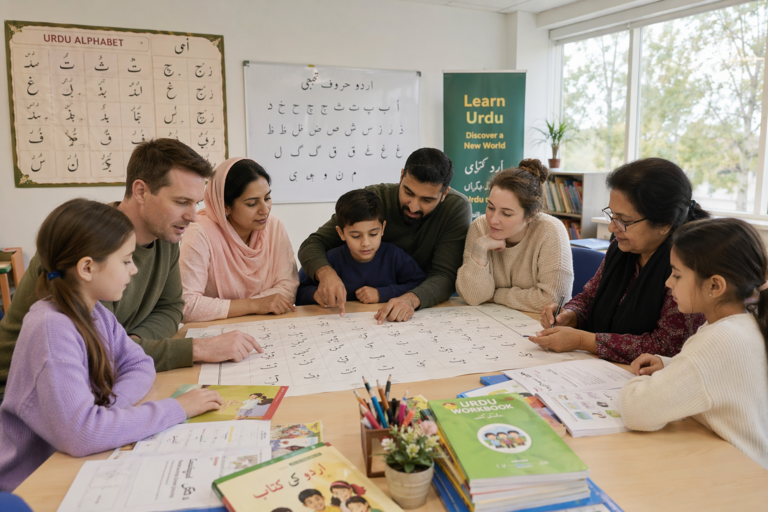
A visual guide is a great way to learn the urdu alphabet. Many urdu letters look alike, so seeing them together in a chart helps you spot patterns more quickly than just reading their names.
If you want a picture or chart of the urdu script, the best way is to use a simple table. This table should show each urdu letter, its name, and a clue for pronunciation in english. Once you have that, the next step is to see how these urdu letters change shape when used in words.
Urdu Alphabet Chart and Letter Forms
A chart gives you a quick visual guide to the urdu alphabet without overwhelming you. It helps you spot frequent letters, match them with sounds, and start building recognition before you try longer words.
Here is a compact text table:
|
Letter |
Name |
Typical sound |
|---|---|---|
|
ا |
alif |
a |
|
ب |
be |
b |
|
پ |
pe |
p |
|
ت |
te |
t |
|
ٹ |
the |
hard t |
|
ج |
jim |
j |
|
چ |
chayh |
ch |
|
خ |
khay |
rough kh |
|
د |
dal |
d |
|
ر |
re |
r |
|
و |
wao |
v/w or vowel support |
|
ی |
choti ye |
y/ee |
As you study the chart, remember that the basic shape of a letter may shift depending on where it appears. That is normal in Urdu. A printable guide or pdf worksheet can help you compare forms side by side until your eye becomes more confident.
Positional Variations: Initial, Medial, and Final Shapes
One big thing about the urdu script is that urdu letters can look a bit different depending on where they are. A letter will change its shape at the start of a word, in the middle, or at the end of a word. That does not mean it turns into another letter. It is the same urdu letter, just in its basic shape, made to join with other letters.
When people are learning urdu, these are the main places you see for urdu letters connecting:
-
initial form: the urdu letter is at the beginning of a word
-
medial form: the urdu letter comes in between other letters
-
final form: the urdu letter is at the end of a word
-
isolated form: the urdu letter is left by itself
At first, all these changes in shapes might look like extra work. But soon, they start to make sense, especially if you look at a chart with similar shapes. The simple way is to keep writing the same small urdu words by hand. That lets you see how urdu letters really act in every form.
Sample Words Using Urdu Letters
The best way to make letters feel real is to see them in simple words. This helps link shapes to sounds, meanings, and memories. Even just a few simple words can help your vocabulary feel more useful.
Some beginner examples from learning lists are:
-
ایک (aik) — one
-
کتاب (kitab) — book
-
نمک (namak) — salt
-
چائے (chaiy) — tea
When you know a few letters, you can start with urdu greetings and short phrases too. The urdu writing system is mostly phonetic, so copying simple words will help you see how letters join in the urdu script. It also trains your eyes to pick up the beginning of a word, what the middle looks like, and the ending shapes. You will start to get the flow without needing long explanations every time. This will help you pick up urdu and use these words every day with people around you.
Vowels, Consonants & Their Roles
Urdu handles vowels and consonants in a way that’s not the same as English. This part is pretty important. Most urdu letters are for consonants, but some of them also help show vowel sounds. Because of this, the urdu script is quite flexible, but it can be a bit of a shock if you are a beginner.
When you look at urdu grammar, the system is closer to an abjad than the english alphabets. In urdu, you hear about short vowels, long sounds, and letters that can support vowels. You don’t get a whole row of vowels like in English. When you know what each letter does, both pronunciation and reading in urdu become much simpler.
Vowel Marks and How They’re Used in Urdu
In the urdu language, vowel marks are called airaab. These are used to show vowels, often focusing on the short vowels like zabar. You will not find these marks in all texts, especially in writing used day to day. That is one reason why beginners use learning charts and get a lot of guided practice when starting out.
A very common mark in urdu is zabar. It tells you to say a quick a-type sound. Diacritics can show different vowel sounds, and these sounds may change depending on where the vowel is in the word. The way that sound is shown can change if it is at the start, in the middle, or right after a consonant.
Long vowels in urdu are made by putting together letters and using support characters. You will see letters like alif, wao, and ye help show long vowels. If you want to know how urdu words are written and how they link up, it is good to know that consonant shapes are used for the main frame. Vowel marks and extra letter helpers like alif make the pronunciation right. As you use these more, the system will start to make good, logical sense, and won’t be so hard.
Basic Consonants and Pronunciation Tips
Most urdu letters are consonants, so it is good to build your pronunciation skills there first. Start with the letters that are like English. Then, you can move on to sounds that do not feel familiar. Doing it this way gives beginners a fast win.
Useful consonants to learn first are:
-
ب be — b as in ball
-
پ pe — p as in pen
-
ت te — t as in tomato
-
ک kaf — k as in kite
After these, try to get the sounds like خ, غ, ٹ, and ڑ right, because they need more precision. Say each urdu letter out loud. Write the urdu letters twenty times in your notebook if you can. This simple way helps join what you see, say, and write. It helps you remember things for a long time. If the sound is new for your own language, do not rush through it. Native speakers learn these small things with time as well, so steady practice is the best way.
Special Characters Exclusive to Urdu
One thing that makes the Urdu alphabet different from the Arabic one is it has extra letters. These extra letters help with sounds you use in Urdu every day. Arabic does not need these sounds, so it does not include them. These special characters make Urdu writing fit the way people speak.
For example, the letters پ, ٹ, ڈ, ڑ, and ژ are there only for Urdu and a few related languages. These extra letters let you show the right sounds. If you did not have them, many words would not look or sound right when you write them.
There is also an important mark called hamzah. You write it like this: ء. It shows up in some words and marks where the sound changes. For Urdu beginners, there is no need to worry about these extra letters. The extra letters are there to make things easier for you. They help the writing system work in a way that matches how people talk every day. When you see them in lists and use them in practice words, you get used to them quite fast.
How Urdu Letters Connect in Words
Urdu letters often join together as you move across a word from right to left. This is a basic rule of the urdu script, and it changes how each letter looks at the start of a word, in the middle, and at the end of a word.
If you get the hang of these connection rules, reading urdu will not be as hard. You will stop seeing a long line of shapes you do not know. Instead, you will spot repeat patterns and joins you know. The examples below show the main rules for joining urdu letters. You can see how these look in simple, everyday words.
Rules for Connecting Urdu Letters
The main rules of the urdu script look simple once you get the hang of it. In urdu, letters join from right to left. Many of these letters change how they look based on where they are in a word. So, you learn a pattern, not just different rules for every letter.
Keep these easy urdu script rules in mind:
-
A letter can have an initial form when it is at the start of a word.
-
It can take a medial form when it joins on both sides of another letter.
-
It can show a final form at the end of the word.
-
Some basic letters don’t connect to the next letter the same way, so the next one will begin apart from it.
This is why it helps more to copy whole words rather than tracing single letters all the time. When you write these connected forms again and again, your hand picks up the flow of urdu much faster. With time, you do not break things down for each change. You will see and know the whole word shape at once.
Examples of Joined Letters in Everyday Words
You will find that reading joined letters gets easier when you focus on everyday words, not just single letters. This is when the urdu script really starts to make sense. Notice how the shapes join together as you read, and see how a letter might look different at the end of a word.
Take a look at some simple words like:
-
بہار (bahar) — spring
-
کتاب (kitab) — book
-
راستہ (rastah) — path
-
سیب (saib) — apple
Try the same thing with urdu greetings and short phrases from your early lessons. Write each word out slowly. Say each word out loud. Watch to see where one urdu letter finishes and the next one starts. If you do this often, you will answer that common question a lot of people have at the beginning: how do urdu letters join together in words? They join with the same patterns, and those get easier every time you read or copy some simple words.
Conclusion
In the end, learning the Urdu alphabet is not only about the letters. It is also about seeing a rich culture and getting better at talking with people. The Urdu script, like Nastaliq, has its own sounds and way of writing. When you learn these, you open up to new ways of connecting with the community. It does not matter if you are just starting out or want to get even better at it. Taking the time to learn this nice script can help you in so many ways. If you want to start learning Urdu, reach out any time for a free chat. Let’s keep this language journey fun and worth your time.
Frequently Asked Questions
How does the Urdu alphabet compare with Arabic and Persian?
The urdu script comes from the arabic and the persian alphabets, but it is not the same as those. Urdu uses the nastaliq style to write. It also has some extra letters. These extra letters help show the sounds that you get in urdu, but not always in arabic or persian.
Are there free resources or printable charts available for learning Urdu in Australia?
Yes. Beginners in Australia can use printable Urdu alphabet charts, worksheets, and PDF practice sheets from websites for beginners. These tools help because you can print them out, go over them offline, and write the letters by hand. This way, you get better at remembering and recognising Urdu letters fast.
What’s the best method for Australian beginners to start learning Urdu letters?
For beginners, it is best to start by learning a few Urdu alphabet letters at a time. Use a chart and say each sound out loud. Write each letter again and again in a notebook. This way of language learning is simple. It helps with retention and makes the Urdu language feel much less hard from the very first day.