Key Highlights
-
The german alphabet uses the basic latin alphabet, so it feels familiar for english speakers.
-
In standard german, you get 26 main letters, and there are some extra ones that change pronunciation.
-
Learners also need to know about Ä, Ö, Ü, and ß for clear reading and spelling.
-
Some letters you know, like W, V, and S, can sound different, especially at the beginning of a word.
-
A simple chart can really help your language learning experience and boost your confidence.
-
For australians, getting in some early practice with sounds and writing helps make the alphabet stick.
Introduction
If you want to have good german language skills, you need to start by learning the german alphabet. The letters might look a lot like the ones you see in English, but there are some special letters and sounds that can be tricky. This can trip you up when you are just starting out with german, especially if you know english. The good news is, you will see the patterns once you get into it. For people in Australia who are just starting german, learning the alphabet first is a great way to help with reading, spelling, saying words, and feeling good about using the language from the very beginning.
Understanding the German Alphabet: An Overview
The german alphabet uses the latin alphabet. This makes it easier for many Australians to learn. If you already know english, you will see that most of the letters look the same. This helps beginners start with something they know.
At the same time, people talk about the number of letters in two ways. Native speakers usually say there are 26 base letters in the alphabet. They add the umlauts and ß when they need to. But in writing, the extra forms are very important. The next parts will show you how that works.
The Origins and Structure of the German Alphabet
The german language gets its alphabet from the latin alphabet. The latin alphabet was used in much of Europe. It was in the Roman Empire, so that language and writing went far. In the place that would be Germany, the wealthy people changed the latin alphabet to fit the german language.
The german alphabet now has the same 26 standard letters as english, from A to Z. You can write them as uppercase or lowercase. There are five basic vowels and twenty-one consonants. So, when you learn the german language, it feels close to english in this way.
But, the full system of the german alphabet doesn’t stop there. Besides the 26 base letters, german uses extra ones: Ä, Ö, Ü, and ß. Some people even say it has 30 different letters because of these. So, if you wonder what letters show up in the german alphabet, you get the latin alphabet’s 26 plus the additional letters.
Key Differences Between the German and English Alphabets
For english speakers, the good news is german uses the latin alphabet too. You don’t have to pick up a whole new system of writing. This makes the start a lot easier than most beginners think.
There are a few things that are different, though. The main changes come from the way words sound and a few different letters. German speakers use the same alphabet as english, but the sounds are not always like the english equivalent. W is said like an english V. V can sound like F. S, at the beginning of a word before a vowel, will often sound like Z.
You’ll also see some different letters you don’t get in normal English. These are Ä, Ö, Ü, and ß. They change how german words are spelled and how you say them. Another thing to know is that german puts a big letter at the start of all nouns, no matter where they come in a sentence. So, while the alphabet looks much the same, the ways it is used, and the way it sounds, show that german has its own clear rules.
What Makes the German Alphabet Unique?
What makes the german language different is not a new script. It uses a script you know but with some small changes. These small changes shape german pronunciation. They also make it easy to spot written German once you know what to find.
The german language has some extra letters. There are three umlauts and the letter ß. You will not see these in normal English spelling. These additional letters can change german pronunciation, how words sound, and the way they are written. Now, let’s look at each group in detail so you can notice them easily.
Special Letters Found Only in German
Yes, the german alphabet has special letters that you won’t see in english. These are Ä, Ö, Ü, and ß. You find them a lot in german words, so it’s good for every beginner to get to know them early on. Don’t think of them as optional extras.
The first three are special vowels. They come from the standard letters A, O, and U, but the two dots over them show a different sound. A long time back, those dots started as a small ‘e’ next to the letter. Now, people write them with the two dots as their own forms in everyday german.
The last special letter is ß, which is called Eszett or sharp s. It is like a double s sound and you only see it in lowercase. It never goes at the beginning of a word. So, even if german and english have a lot of the same standard letters in the alphabet, these four special letters make german words look and sound different.
Introduction to Umlauts and the Letter ß (Eszett)
The special characters you find in the German alphabet are the German umlauts and the Eszett. The umlauts are Ä, Ö, and Ü. You write the umlauts as two dots above the letter. This little mark changes the pronunciation of the letter underneath it.
To put it simply, the Ä is much like the e in “melon.” The Ö sounds a bit like the i in “girl.” Ü does not have a sound that matches in English, so you might need some time to get used to it. Try to listen carefully when people speak. The small marks may look unimportant, but in German, they really matter.
The Eszett is not used for vowels. It is a special ligature and sounds like a double s. In limited text, people often type german umlauts as ae, oe, and ue. They write ß as ss. But, if your keyboard has the right keys, it’s always good to use the proper forms to help keep the right pronunciation of the letter.
German Alphabet Chart for Beginners
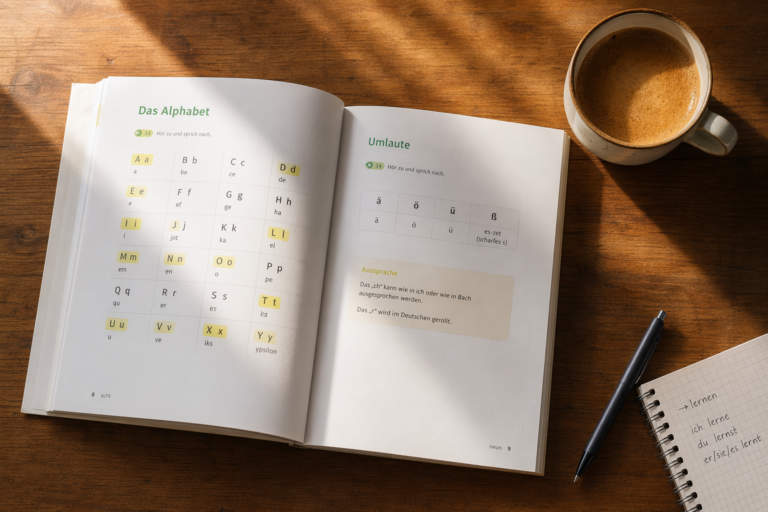
For beginners, keeping a german alphabet chart close by is one of the best ways to start learning. It shows all the letters in order and tells you the right pronunciation for each one. This is good help when you spell names, read signs, or learn basic german vocabulary.
Having a visual chart lets you look things up fast. You do not have to guess or use what you know from english. You can check how every letter gets said in german. This makes your practice right from the first go. Below, you will see a basic guide and then a visual chart idea for fast reference.
Full List of German Letters with Pronunciation Guide
If you want a clear pronunciation guide, start with the base alphabet used by native german speakers. The german letters come from the basic latin alphabet, but the letter names differ from English. Learning those names makes spelling much easier.
Here is a simple text table for quick practice:
|
Letter |
Pronunciation guide |
|---|---|
|
A |
ah |
|
B |
bay |
|
C |
tsay |
|
D |
day |
|
E |
ay |
|
F |
eff |
|
G |
gay |
|
H |
haa |
|
I |
eeh |
|
J |
yot |
|
K |
kah |
|
L |
ell |
|
M |
em |
|
N |
en |
|
O |
oh |
|
P |
pay |
|
Q |
koo |
|
R |
er |
|
S |
es |
|
T |
tay |
|
U |
ooh |
|
V |
fow |
|
W |
vay |
|
X |
ix |
|
Y |
uep-si-lohn |
|
Z |
tset |
German also uses Ä, Ö, Ü, and ß. Native german speakers often treat the first 26 as the spoken alphabet, then mention the extra forms when needed. Keep this chart handy while reading aloud, and the patterns will start to settle naturally.
Visual Chart of the German Alphabet for Easy Reference
A visual chart is best when it is simple, so you can see what you need in just a few seconds. Many people find it good if the chart shows uppercase and lowercase letters next to each other, and puts the spoken letter name right after. This way helps you to get faster at recognising each letter and also makes german pronunciation steadier.
You could organise your german alphabet chart into three blocks: vowels, consonants, and extra symbols. Doing it like this helps your eyes pick out the patterns and gives you space to add some useful notes like “W = English V sound” or “V = often F sound.” These tips help beginners so they do not make common mistakes with german pronunciation.
If you want to make your language learning experience better, print this chart or keep a picture of it on your phone. Use it when you spell your name, copy words, or check loan words like Xylophon and System. When you use a small visual chart like this a lot, it becomes a proper memory helper, not just a poster.
Getting Started: A Beginner’s Guide to Learning the German Alphabet
Getting started does not have to be hard. If you are a beginner, it is good to build your language skills step by step. First, get to know the alphabet. Listen to the sounds. Then, try to use them in short words. This way, you build a strong foundation without feeling too much pressure.
When the alphabet starts to make sense, german vocabulary will not feel so tough. You will see more patterns, spell words better, and read without stopping as much. Having a few handy resources and making simple habits are both helpful. Now, let’s look at the tools and ways that help people the most.
Essential Resources and Tools for Australian Learners
Australian learners get the best results with resources that use text, sound, and lots of repetition. The german alphabet might look familiar, but it is important to not skip listening. Hearing the letter names and learning the vowel differences is a big part of picking up the german language.
You can use simple things like:
-
Printable PDF worksheets for writing practice and going back over what you know
-
Audio alphabet recordings to hear the right letter names
-
Beginner video lessons that show german language pronunciation
-
A notebook to copy words and check your spelling every day
-
A phone or computer file for keeping a chart handy at any time
If you want audio or video help, you can use material that guides you to alphabet recordings, video lessons, printable sheets, and beginner-friendly study tools from german learning groups and public language sites. For people in Australia, the best way is to mix offline practice, lots of listening, and short daily reviews so you can hear and see the alphabet every day.
Tips for Practising Pronunciation and Spelling
The best way to get better at pronunciation and spelling is to practise a bit at a time, and do it often. Don’t wait until you learn every single rule. Start off with a few german letters, say them out loud and write them by hand. This routine really helps the sounds stick faster.
Try these simple methods:
-
Learn a few letters at a time, don’t do the whole set at once
-
Repeat an alphabet song or a poem out loud, it helps your memory
-
Write each letter many times, and quietly say it as you write
-
Find german letters in books, signs, or screens through the day
Bringing movement into it helps as well. You can trace big letters, and walk along the lines while you say them out loud. It might seem strange at first, but moving when you practise can help you remember more. If you want an easy way to remember the german alphabet, use sound, writing, and repetition together instead of just reading.
Step-by-Step Guide to Mastering the German Alphabet
A step-by-step guide is great because the german alphabet uses letters you know, but the sounds may be new to you. If you go too fast, your english language habits can mess up your german learning. Taking the slower way helps you hear the changes better and use them at the right time.
When you start with the basics of the german language, think about doing three things. First, get to know each letter and its sound. Then, practise writing them down and saying them out loud. After that, learn about umlauts and ß, and take your time with those. Doing everything in this order keeps it simple and helps you get better at german for a long time to come. Here is what you do at each stage.
Step 1: Familiarise Yourself with Each Letter and Sound
Start by getting used to the letters of the german alphabet as sounds, not just what you see on the page. Many of these shapes look like English letters, so you may want to guess, but try not to. Listen closely to the German names for each letter and say them out loud.
Watch out for letters that do not be what you expect. The W is said like a V in English. The V often gets spoken as an F. S at the beginning of a word, right before a vowel, sounds like a Z. Fixing these things early will make your german pronunciation much better.
It is also good to spot how the vowels be different. The german e is like the e you hear in the word “egg.” The i is like the ee in “feet.” When you see an e at the end, it is short and you always say it. If you learn these rules soon, the alphabet helps you with german pronunciation instead of just being something you need to rote learn.
Step 2: Practice Writing and Saying German Letters
Once you know the sounds, start to put them with writing and speaking. This step is big because when you see, say, and write german letters all at once, your memory holds onto them better. It is simple, but it helps.
Take a notebook and copy a few german letters each day. Do this again and again, with care. Don’t try to go fast. Say each letter when you write it. If you get some free time on the train, bus, or while waiting, use that to get some quick practice in. It is better than doing one big study at the end.
When you feel ready, spell easy things like your own name or where you live. You will see your language skills are getting stronger here. Uppercase and lowercase german letters matter a lot, since nouns must start with big letters. These small steps help make later writing and reading feel much easier after.
Step 3: Learn to Use Umlauts and ß Correctly
Now, let’s look at the forms in german that often make people stop for a moment: the umlauts and the Eszett. Umlauts are Ä, Ö, and Ü. These marks change how you say the vowels A, O, and U. They are not just there to look good. In german pronunciation, every one is a sign to speak the vowel a new way.
If you do not have a german keyboard, you can use ae, oe, and ue instead. This will help you get a good transcription, but the right umlauted vowel is best if you can use it. Be sure you do not think every time you see ae, oe, or ue, it stands in for an umlaut.
The Eszett, written as ß, is said like a sharp s sound. It sounds much like double s. You will only see it in lowercase, not at the beginning of a word. In text where you cannot use ß or if all letters are capital, you write ss instead. If you learn these bits early, you won’t make as many spelling mistakes with german, the vowels, or pronunciation as time goes on.
Conclusion
To sum up, learning the German alphabet can be a fun journey that lets you discover more about the german language and build new language skills. When you get to know the special letters and the way words sound in the german language, you open up a bigger world. You also get to have a good look at another culture. Aussies can use these tips to get better at german and enjoy the ride. If you are just starting or want to get better, the tips and resources in this post will help you pick up the alphabet, special letters, and pronunciation. Why not have a go at fluency now? Start today with our best resources and you will find the language learning experience worthwhile!
Frequently Asked Questions
Are there easy tricks to remember the German alphabet?
Yes. Try using simple tricks to remember the alphabet. You can sing an alphabet song, learn just a few letters at a time, and write them out by hand each day. If you want to remember the german alphabet, short and regular practice works better than long study sessions. When you join sound, movement, and repeating things, it helps your memory and your learning feels more natural.
How do I pronounce the umlaut letters in German?
In german, the umlaut makes the vowels sound different. Ä sounds like the e you hear in “melon.” Ö is like the i in “girl.” Ü does not have the same sound as any vowel in english. These sounds are a big part of the language, so it helps beginners to listen and practice a lot.
What is the purpose of the ß (Eszett) in German?
Eszett is a different letter in the german alphabet. You say it like a sharp s or double s. It shows the right spelling in some words. You only see it in lowercase. If you can’t type it, people in germany use ss instead, mostly in tight spaces or when writing all in capitals.
Where can I find audio or video resources to hear the German alphabet?
You can use beginner German alphabet tools that have audio, video, and practice sheets you can print. The material covers public language guides and learning platforms. These also help with German pronunciation. Pick tools that let you hear sounds as many times as you want. Use them along with an alphabet chart to make progress faster.