Key Highlights
-
The tamil alphabet is easier to learn when you break it down into simple steps.
-
Tamil vowels and tamil consonants work together in an easy-to-see way inside the tamil script.
-
You will find out how basic words come from simple sound mixes.
-
This guide shows what is different about Tamil compared to many other Indian writing systems.
-
You will get to know about grantha letters, vowel marks, and how the words are put together to read.
-
Some handy tips, charts, and easy memory ideas can help Australian learners get started with the right mindset.
Introduction
The tamil language is one of the oldest classical languages in the world. Its script draws many new learners, even today. For people learning in Australia, the tamil script may not look like other writing you know. But, it starts to make sense when you spot how the sounds match with the symbols. Tamil speakers use this written language in Tamil Nadu and in many other parts of the world. You may even meet some tamil speakers right here in Australia. If you want a simple place to start, this guide will help you read the system with less stress.
Key Features of the Tamil Alphabet for Australian Learners
At first, the tamil alphabet might look tough. But the writing system follows simple patterns. When you see how the vowels and consonants join together, many tamil words get easier to spot. This is important if you want to read signs, names, or some basic words that tamil speakers use.
The tamil language stands out because it has unique sounds. Its script is different from others. It also puts in grantha letters for some special sounds that it borrows. For people learning tamil in Australia, you are learning more than just new symbols. You get to understand a system with sound rules and a lot of cultural meaning.
Why Learn the Tamil Script in Australia
Australia is made up of people from many parts of the world. This includes tamil speakers from India, Sri Lanka, and a few other places too. If you learn the tamil script, you can connect better with neighbours, friends, classmates, or family members. Even reading a simple greeting like வணக்கம் can make a big impression.
There’s real value in picking up a written system tied to one of the oldest classical languages. Tamil has a long history, both in books and in how people talk every day. Learning the tamil script lets you see how words are built. For english speakers, it’s good to move past just using Roman spelling.
There are some practical reasons as well. When you can sound out signs, names or basic words you find in tamil nadu or other regions, you will notice that your confidence in tamil script grows fast. This can make your first lesson feel pretty good.
Unique Attributes of Tamil Letters Compared to Other Indian Scripts
Tamil script has a different look and sound from lots of other Indian scripts. The tamil script belongs to one of the oldest writing systems that we still use today. It stays short and simple, built on vowels, consonants, and forms that mix both.
Here are a few things that help beginners:
-
Tamil script uses unique retroflex consonants like ட, ண, ழ, ள, and ற.
-
It brings in grantha letters for some sanskrit words and sounds we get from other places.
-
People build basic words by putting clear vowel markers with consonants.
-
Some letters might sound close at first but show up in different parts of words.
If you are starting to learn, the tamil script stands apart because of its sound and the way it looks. The script does not follow other writing systems. It keeps its own feel, but it also adds special grantha letters when there are new or extra sounds.
Overview of the Tamil Script System
The tamil script is like using building blocks. You start with vowels and consonants. Then, you learn how to put them together to make bigger sounds. This way, the tamil language is not as hard as you might think at first.
The writing system for tamil has its own vowels. It also has pure consonants and some letters that mix the two. When you want to learn the basic tamil alphabet letters and their sounds, it’s good to see them as simple patterns, not just single shapes. This is the best way to begin before you go on to tables, see examples, and try out the sounds yourself.
Core Structure: Vowels, Consonants, and Grantha Letters
Tamil is usually taught in three main groups: tamil vowels, tamil consonants, and Grantha letters. The vowels are called uyir ezhuthukkal, sometimes described as life letters. The consonants are often treated as body letters because they need vowel support to become full spoken units.
Here is a simple text table:
|
Group |
Tamil term |
What it does |
Examples |
|---|---|---|---|
|
Vowels |
uyir ezhuthukkal |
Carry the main sounds on their own |
அ, ஆ, இ, ஈ |
|
Consonants |
mei ezhuthukkal |
Show body letters or pure consonant bases |
க், ச், ட், ப் |
|
Combined forms |
uyirmei ezhuthukkal |
Join vowel and consonant sounds |
க, கா, கி, கு |
|
Extra letters |
Grantha letters |
Represent borrowed or Sanskrit-based sounds |
ஜ, ஸ, ஷ, ஹ |
So, can you explain the Tamil vowels and consonants with examples? Yes: அ is a vowel, க் is a pure consonant, and க or கா are joined forms. That pattern sits at the centre of the whole script.
Script Direction and Reading Order in Tamil
Tamil script is read from left to right, just like English. That bit is easy if you already know how to read English. The hard part is not the way the script goes, but working out where the vowel sign sits around the main letter. Sometimes, it goes after. Sometimes, above. Sometimes, it even turns up before the main letter.
A quick guide to writing Tamil script is to start with learning the consonants first. After that, put the right vowel sign with it. For example, a vowel sign might fit next to the consonant, go on top, or come before. Even if the vowel mark comes first, you still say the full bit as one single sound.
When you begin to read, focus on simple words instead of single marks. Make sure you say the sound out loud when you see the letter. That method of articulation helps you link the shape, the spot of the sign, and its sound all in one go.
Introduction to Tamil Vowels (Uyir Ezhuthukkal)
Tamil vowels, called uyir ezhuthukkal, are the main sounds you learn in the script. You will see that they show up by themselves. You will also see that they change how consonants sound when used as a vowel sign or a vowel mark. So, they are important right from the start.
Learners should know that tamil vowels come in short sounds and long vowel sounds, and there are diphthongs too. When you notice these groups, things get more simple and clear. After that, you just start to learn each letter, see their main sounds, and find how they look in easy words.
List of Tamil Vowel Letters with Examples
The main tamil vowels, also called uyir ezhuthukkal, are first taught by themselves as single letters. These primary vowels give you the base tamil alphabet and show you how to say each letter. Some vowels have both a short and a long sound.
Here are some of the key tamil vowels:
-
அ: Makes a short a sound. It’s like the u sound in ugly.
-
ஆ: This one is a long aa sound. You say it with your mouth open for a bit longer.
-
இ: This vowel is a short i or a very short ee sound.
-
ஈ: Makes a long ee sound.
-
உ and ஊ: These are short and long u sounds.
-
எ, ஏ, ஐ, ஒ, ஓ, ஔ: These stand for e, long e, ai, o, long o, and au sounds.
It helps to look at simple examples too. ஓ can be used as its own word for an exclamation. ஈ can mean fly. This shows the tamil vowels are not just extra parts used with other letters. In the tamil script, uyir ezhuthukkal can be full sounds all by themselves.
Pronunciation Guide for Short, Long and Diphthong Vowels
Tamil pronunciation is all about how long you say the vowels. Short vowels are quick, and you cut them off fast. Long vowels last a bit longer when you say them. This difference in time is important, so try to listen for how long the vowel goes, not just how your mouth moves. So, the length of the vowel is a big part of the sound.
The short and long pairs in tamil are அ and ஆ, இ and ஈ, உ and ஊ, எ and ஏ, and ஒ and ஓ. Tamil also has diphthong vowels like ஐ and ஔ. These sounds mix things up a bit, so your mouth moves more. They do not sound as flat as a regular vowel.
When vowels go with consonants, their shape can change. The vowel by itself is one thing, but after a consonant it becomes a vowel mark. That makes the same sound look different on its own and in combo. If you want good tamil pronunciation, listen to each pair and say them out loud next to each other. This will help you hear and make the right sound, whatever vowel length or mark you need.
Introduction to Tamil Consonants (Mei Ezhuthukkal)
Tamil consonants are known as mei ezhuthukkal. These are called the pure consonants in the tamil script. They make up the base for many syllables in the language. On their own, they get written in a smaller form. This shows the consonant but doesn’t give you the full vowel sound.
If you are learning, you should not see consonants as full spoken letters, like in English. Instead, try to think of them as sound frames. When you add a vowel in, the tamil consonants then become fuller sounds. This way, they are easier to say and read.
The 18 Primary Tamil Consonants
The 18 primary tamil consonants are the main body letters you see in everyday reading. In the first lesson, these letters are shown as pure consonants with a stopping mark. Later, they come together as spoken sounds when you add vowels. This way, you can see the base shape before you hear how it sounds.
Some important groups are:
-
க், ச், ட், த், ப் are common starting consonants you will find in many basic words.
-
ங், ஞ், ண், ந், ன் are nasal consonants that people use in different ways.
-
ய், ர், ல், வ் make smooth, flowing sounds you often hear in tamil.
-
ழ், ள், ற் are special tamil letters. People need more practice with these than with other letters.
How do you write tamil consonants? First, you learn the pure consonant shape. When you add vowel markers, spoken forms like க, கா, கி, and கு appear. This helps make the set more useful. You will use these more than just remembering the names of letters by yourself.
Special Consonant Sounds — Including Grantha and Borrowed Letters
Not every sound you see in writing comes from the main set of Tamil letters. Tamil also has Grantha letters to show special sounds, mostly in Sanskrit words and some borrowed letters. This is why you might notice extra symbols in some charts besides the main set of consonants.
The common special Grantha letters that you will find are ஜ, ஸ, ஷ, and ஹ. You might also see the symbol form ஸ்ரீ. When you see bigger charts, there are even more forms linked to the older grantha script. These include letters for special sounds that the core Tamil set does not cover well.
So, what are Grantha letters in Tamil? They are extra letters that tamil speakers use when they need to write special sounds found in borrowed words, especially from Sanskrit. As a learner, it’s good to know them, even if you get to them after learning the main alphabet.
How Tamil Vowels and Consonants Combine
Tamil vowels and tamil consonants join together to make compound letters. These are called uyirmei ezhuthukkal. This is the part where the writing in Tamil starts to look alive, because you can read single sounds together as full syllables. You do not have to learn every form as something new. It is better to know the pattern of each vowel sign.
Most vowel signs stick onto letters in the same ways again and again. Still, some shapes change a bit, based on the letter they’re with. If you get how these combinations of consonants and tamil vowels work, tamil consonants, tamil vowels, and compound letters will not seem random. You will start to see a clear pattern in uyirmei ezhuthukkal.
Understanding Compound Tamil Letters (Uyirmei)
Uyirmei ezhuthukkal are letters you make when you join tamil vowels with tamil consonants. You will see these often because most of the words people say in tamil use these joined letters. You can think about them as having a consonant as the base that gets changed with a vowel mark.
For example, if you take க் and add அ, you get க. If you add ஆ, that turns into கா. If you put இ, you get கி. In the tamil script, each vowel follows the same kind of rule when you attach it to a consonant. This means when you know how one changes, it helps you work out the others.
So, what are compound letters in tamil and how do they form? They are made when a pure consonant gets a matching vowel mark. Some of these marks go after the letter, some go above, and some go before. This is just how the tamil script works, and it’s normal to see these changes.
With the tamil script, it helps to know these details when you start to read or write tamil consonants and tamil vowels.
Examples of Basic Tamil Syllable Formation
The best way to begin reading simple tamil words is to practise making each syllable. Don’t try to read long words straight away. First, see how one consonant looks with different tamil vowels. This is a system you can use any time.
Here are a few good examples:
-
க் + அ = க
-
க் + ஆ = கா
-
க் + இ = கி
-
க் + எ = கெ
When you get used to this, start with short tamil words from the source. You can try words like பூ, வீடு, முடி, and வணக்கம். Read the word slowly and say each part out loud. If you wonder, “How do I start reading basic Tamil words using the alphabet?”, this is the simplest way: learn one group of consonants, add lots of tamil vowels, and then try real words.
The Official Order of Tamil Script Letters
The way the tamil script charts are set up starts with the tamil vowels. After that, you see the tamil consonants. Then, you get rows where these letters are combined, along with a few extra letters. This order is used to help you understand how the script works, instead of just seeing all the letters as random marks.
If you want to know the order of letters in the tamil script on the official chart, it’s easy. You start with the vowels, then the consonants, and after that come all the combinations, set out in a chart. This simple set-up is why alphabet charts are so good for anyone who is new and wants to learn.
Using Alphabet Charts for Learning and Reference
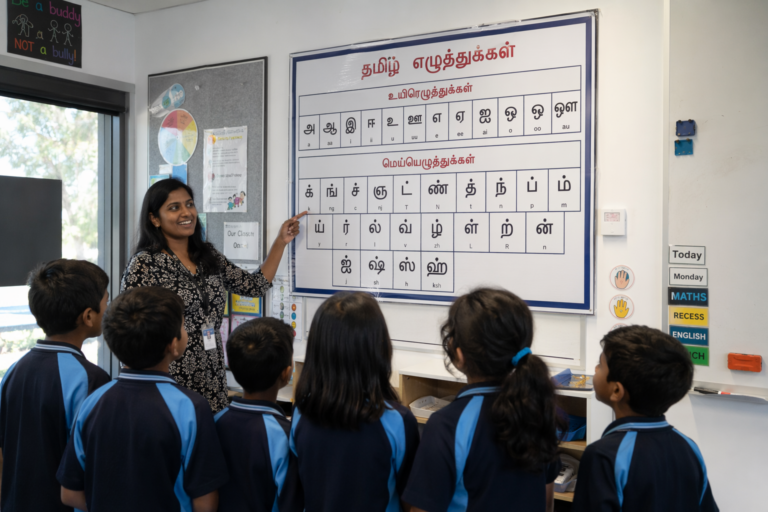
Alphabet charts be one of the best visual aids to help you learn tamil script. In the chart, you get vowels at the top and consonants down the side. The middle of the grid shows the combined forms, so you can look for patterns in the tamil vowels and tamil consonants fast.
This way is good because you do not have to remember all the letters at once. You can use table lists to pick a consonant and then move across its row to see how each vowel changes it. This turns a lot of confusing signs into an actual map you can use.
If you want a printable chart of the Tamil alphabets, there are some charts available online. The material suggests that you try writing out the whole grid with your own hand once or twice. That helps you use the chart as a real learning tool, not just as a page to look at now and then.
Printable Guides and Visual Resources for Australian Students
For Australian students, using printable charts and simple worksheets can make learning less tiring. You can keep a tamil script chart near your desk. Use it when you read or write basic words. The source also says you should copy the chart by hand. This helps you remember the letter forms better.
Here are some useful resources for you:
-
Printable charts that show the vowels at the top and the consonants on the side.
-
Handwritten practice pages where you copy one full row each time.
-
Mnemonic picture notes to help you remember how the tamil script letters look and sound.
If you want a printable chart of the Tamil alphabets, search for chart-style learning pages and beginner resources. These show you both the single letters and how they work together. For most people, visual aids are the best way to clear up confusion when learning new words.
Pronunciation Tips for Tamil Alphabet Learners
Good tamil pronunciation starts when you listen closely and repeat the sounds slowly. There are many tamil sounds that will be new if you only speak English, so take your time. Work on one sound group each time. Pay close attention to the mouth, the tongue tip, and how you use your breath.
One good method of articulation is to match close tamil sounds. Try to repeat these in short bits. It’s important to listen for retroflex consonants, as the tongue tip changes where the sound comes from. If you are new to tamil, the right pronunciation will come through steady practice, not rushing it.
Mapping Tamil Sounds to English Pronunciations
If you speak English, the easiest way to start with tamil pronunciation is to try to use English sounds. Don’t think they are all the same, but use them as a quick way to begin. This helps you get started. When you listen more, your ear will get better at telling the sounds apart. Many sources explain tamil sound values with words you know from English.
Here are some good ways to start:
-
அ is a short sound, like the vowel you hear in “ugly”.
-
ஆ is a longer and open aa sound.
-
ஈ is a long ee sound. ஓ is a long o sound.
These hints are helpful, but remember they are just a bridge for you. The real tamil pronunciation can be different, because it uses sounds that don’t sit just right with English, mainly with where your tongue goes and how long you hold a vowel. So, how can you say tamil letters when you speak English? Start with the english sounds you know as a helper. Then practise by listening and talking to change and fit the tamil sounds better.
Common Pronunciation Challenges and How to Overcome Them
One thing many people find hard with tamil pronunciation is knowing the difference between short and long vowels. It is also tough to deal with letters that feel the same in English, but in Tamil, the difference is clear. You might also find it tricky to say retroflex consonants, which need a tongue movement that does not feel natural.
To get better at this, slow down. Repeat pairs of sounds out loud and work out where your tongue goes. For retroflex consonants, your tongue should go back towards the roof of your mouth. That feeling matters more than just reading about the sound or the spelling.
Another important thing is to keep repeating. Good muscle memory builds up when you write, read and say the sounds many times. If you do not get the right pronunciation straight away, that’s normal. Tamil pronunciation gets easier with practice, and going over tough sound groups again and again will help a lot.
Strategies for Memorising the Tamil Alphabet
Yes, there is a simple way to start to memorise the Tamil alphabet. Break it into small groups. Then, link each shape to a sound. You can use mnemonics for help. This is handy, especially when the letters still look new to you. The source says a picture in your head helps you know the symbols faster.
You should try to use both your eyes and hands. Practice worksheets and writing drills are good to have. These will give you muscle memory. You start with single letters and soon get to basic words. Do not stress to get it all perfect in one day. The idea is to just get a bit more used to the letters each time you practise. This way, learning grows over time.
Mnemonics, Flashcards, and Practice Worksheets
The material here makes a strong case for mnemonics. It connects each shape of a letter to a picture that sticks in your mind. This helps the Tamil script feel less new or strange. For a lot of people, this is a good first step since it makes the building blocks easier to spot and remember.
You can make this even stronger by doing a few things:
-
Try using mnemonics for every new letter or sound.
-
Use flashcards. Put the letter on one side and the sound on the back.
-
Get some practice sheets to trace and write the letters.
-
Rewrite the full letter chart. This helps build good muscle memory.
Is there an easy way to remember the Tamil alphabet? The answer is yes. Use picture-based memory tricks. Go over small groups of letters at a time. Write out the whole chart a few times to help it stick. Flashcards are good for recall, but writing is just as important because your hand gets the feel for the shapes and you build strong muscle memory.
Recommended Mobile Apps and Online Tools for Aussies
For Aussies who want to learn at home, the best way is to use mobile apps and online tools. These options can help you with short and regular practice. The materials talked about in the list mention online resources, chart pages, and study through apps. These are great when you just need a quick look at the work and don’t feel ready for a full lesson.
Some helpful things to use are:
-
Mobile apps that let you see the tamil alphabet, hear the sounds, and try writing the letters.
-
Online tools that have chart layouts, visual aids, and simple lessons for those starting out.
-
Video or other class options where you can hear words said well, and learn how to spot the letters.
Are there mobile apps that help you learn the tamil alphabet? Yes, and they work best when you mix hand writing with review using charts. Apps help you see the script every day. But, you will learn even more if you also try to write the letters and speak out the words.
Conclusion
To sum up, learning the Tamil alphabet helps you get into a rich culture. It also makes it easier for people in Australia to talk and connect with others. The alphabet has its own set of vowels and consonants. When you understand how they work, you get better at learning the language. This also helps you value Tamil books and customs even more.
If you use easy tricks like mnemonics, turn to online tools, or practice often, you can enjoy learning. It will also be more useful. Each small move you make gets you closer to speaking well. If you want to get started or need help, you can book a free session with our team today.
Frequently Asked Questions
What is the easiest way for an Australian beginner to start learning Tamil script?
The best way to start is to learn the tamil script by looking at small groups of letters with visual aids. Begin with the vowels first. Then, try out one row of the consonant mix after that. It’s good for beginners to keep a chart right next to your notebook. Read each sound, write it down, and say it out loud. This will help you get to know the tamil script, a bit at a time.
Can I learn to write and recognise Tamil letters online or with a mobile app?
Yes. Many people in Australia start learning with online lessons and a phone app to practise tamil letters each day. These things help you see the shapes, listen to the sounds, and go over charts fast. You will get better at tamil script if you write it by hand and say the sounds out loud too.
Are Tamil alphabet resources available locally in Australia?
Yes. In Australia, you can find many ways to learn. These include groups in the community, easy-to-follow online tamil language materials, and guides you can print and use at home. If you want to learn the tamil language, start with a clear tamil alphabet chart and some easy worksheets. People in local Tamil-speaking groups can also help you find more ways to study.