Key Highlights
-
The Somali alphabet is written with Latin letters, and this way of writing started in 1972 for the Somali language.
-
The writing system is mostly phonetic. That means how you say words usually matches what you read.
-
The Somali alphabet has five vowels, 21 consonants, and some important digraphs like kh, dh, and sh.
-
Some sounds in Somali are not in English. You have to use your throat or tongue to make them.
-
Long vowels are important. Vowel length can change what the word means.
-
For Australians, learning the Somali alphabet and the Somali language helps with better communication. It also shows respect for the culture.
Introduction
The Somali alphabet is good to know if you live or work in Australia, where many people from all over the world meet. The Somali language is full of stories and history, and people talk in it a lot. The writing for Somali now uses the Latin script, which started in 1972. This change made it easy for all Somali speakers to write stories, news, and simple messages using the same alphabet.
If you want to get started, this guide explains the Somali alphabet using simple words. You will see all the letters, learn what they sound like, and know how to get the pronunciation right. This will help you become more confident with the Somali language.
Understanding the Somali Alphabet in an Australian Context
You can often hear the Somali language spoken in homes, parks, schools, and places that give help to people in Australia. Learning the Somali alphabet is a good way to get a better idea of how this writing system works. This helps, too, if you live with native speakers or in a family who use Somali each day.
The Somali alphabet uses Latin letters. There are 21 consonants and five vowels. There are also some digraphs, which are two letters that make just one sound. Some of these alphabet letters look much like the ones used in English here, but their sounds can still be different. When you want to understand more about Somali, it is a good idea to start by looking at the letters and script.
Overview of the Somali Latin Script
The Somali Latin alphabet is the official writing system for the Somali language. People started using it in 1972. This gave everyone a single way to write Somali for school, the news, and chatting every day. Before this, Somali culture was passed on by talking, with lots of poetry and stories.
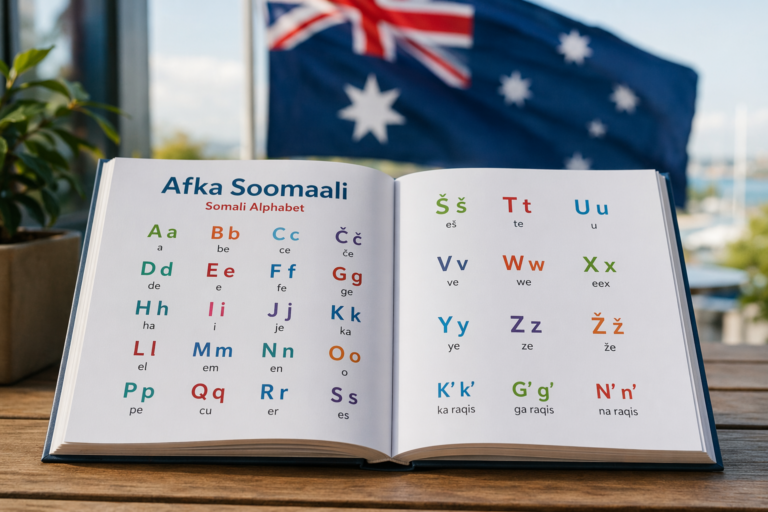
So, which letters are part of the Somali Latin alphabet? The main consonants are b, t, j, x, d, r, s, g, f, q, k, l, m, n, w, h, and y. There are some digraphs too, like kh, sh, and dh. When it comes to vowels, the alphabet uses a, e, i, o, and u. There are long vowels as well, and you write these with two of the same letter, like “aa” or “ii”.
One good thing to know about this writing system is that it does not use the letters p, v, or z. At first sight, it might look a bit like English because it uses letters from the Latin alphabet, but Somali has its own set of rules, sounds, and patterns. The way people say the letters is different to English, and the language has its own feel too.
Why the Somali Alphabet Matters for Australians
For Australians, the Somali alphabet is helpful. It lets you talk and share ideas more clearly with the Somali people near you. The alphabet makes it easier to say Somali words, not just guess from the way English works. If you know the basic system of the Somali alphabet, Somali pronunciation looks clear, not hard.
You don’t have to be fluent to get the benefits. Just knowing some Somali can change how you hear names, greetings, and many words you use every day. Somali spelling mostly sounds like it looks. So, the alphabet gives you a quick way into speaking the language.
-
It helps you read Somali words and be more sure of them.
-
It cuts down on mix-ups from using English spelling habits.
-
It helps you talk with respect in Australia.
-
It is a good start for understanding how Somali words sound and for learning new words.
The Structure of the Somali Alphabet
The Somali Latin alphabet is made using a plain, sound-based plan. It has vowels and consonants that fit with the way people say the words. This can make it easy for people who are learning Somali. Still, there are some special characters and digraphs that make Somali grammar and how people speak it a bit different to English.
When you look at the Somali alphabet, there are 21 consonants and five vowels. If you want to show long vowels, you just write that vowel twice. Some books for learning Somali use an apostrophe to show a glottal stop. Now, let’s go over the number of letters in the Somali Latin alphabet in a clear way.
How Many Letters Are in the Somali Latin Alphabet?
If you ask how many letters are in the Somali Latin alphabet, the common teaching answer is 26 symbols in practice: 21 consonants and five vowels. The standardized orthography is based on the letters of the English Latin alphabet, but it does not use all of them in the same way.
Some sources highlight the main single letters, while others also point learners to digraphs such as kh, sh, and dh because they function as key sounds in Somali reading. Long vowels are not separate letters, but double vowel spelling is essential.
|
Category |
Details |
|---|---|
|
Vowels |
a, e, i, o, u |
|
Long vowels |
aa, ee, ii, oo, uu |
|
Consonants commonly taught |
b, t, j, x, d, r, s, g, f, q, k, l, m, n, w, h, y |
|
Important digraphs |
kh, sh, dh |
|
Other symbol often taught |
apostrophe for glottal stop |
|
Not used in standard Somali |
p, v, z |
That structure makes the Somali Latin alphabet compact, practical, and easy to scan once you know the sound rules.
Consonants and Vowels: What Makes Somali Unique?
One thing that makes the Somali language special is how the vowels and consonants work in speech. Somali has five vowels. Each one can be short or long. So, if you hold the sound for a bit longer, the grammar or meaning of the word can change.
The consonants have some sounds that English speakers might find odd. Letters like x, c, q, and the digraphs kh and dh ask for tongue or throat moves you don’t use much in English. This is why spelling Somali words with the Latin script can look quite different, even when you know English letters.
Some basic examples will help you get it. You see the letter b in baraf, d in dab, g in gabar, q in qalin, x in xaas, and sh in shinbir. The long vowels show up in words like geel, jiir, nool, and suun. These show that Somali pronunciation can be clear and easy to teach once you learn the patterns.
Pronunciation Guide for Somali Letters
The Somali alphabet is much easier to say out loud if you think about it as a sound-based system, not like English. In the Somali language, the letters always sound the same way and vowels are very important for meaning.
You will notice the glottal stop in Somali. It is sometimes marked with an apostrophe in some guides. You should also listen to long vowels. Making them short or long can create a new word. So, compare the pronunciation of the Somali alphabet with English. This will help a lot with getting these sounds right.
Key Differences in Pronouncing Somali and English
The biggest thing about Somali language pronunciation and English is the way they sound out words. Somali spelling usually makes it clear how words should sound. English spelling, though, does not always help with this. Even though spelling gives a guide, some Somali letters stand for sounds that many Australians might not pick up on right away.
There are a few things about Somali that you will notice. The glottal stop is one of them. It shows a quick pause in speech, like when you say “uh-oh”. Somali has some digraphs too, like kh, sh, and dh. These are pairs of letters used for one sound, and in Somali, they do not sound like they would in English.
-
Kh is a raspy sound made at the back of the throat, like the “ch” in “loch”.
-
Dh is made with the tongue curled, and it is not the same as the English “th”.
-
The letters Q and X make sounds that come from even further back in the throat than the English K or H.
This is the reason why Somali can look easy to read on paper, but when you say it out loud, it sounds very different compared to English.
Practical Tips to Master Somali Sounds
A good way to start with Somali sounds is to keep it simple. Pick a few easy words and say them again and again. Listen to how they sound and match them with the Somali writing. The writing system is close to the sounds, so you will build confidence fast with this method.
Listening is just as important as reading when you practise. Native speakers can help you hear the change between short and long vowels or tell you how q and k are not the same. If you record yourself, you can see where your pronunciation sounds too much like English.
-
Practise easy words like xalwo and qalin each day.
-
Listen to native speakers through audio or videos and check your own voice.
-
Keep a close eye on long vowels, since vowel length can change a word’s meaning.
-
Use flashcards or charts that show Somali writing with the right sound.
Take your time and repeat often. Somali sounds can seem odd in the beginning, but with more practise your ear will get used to them. With help from native speakers and listening out for long vowels, you will do well with your Somali pronunciation.
Special Features of the Somali Alphabet
The Somali alphabet uses the Latin script, like English does, but it’s not just the same letters copied over. In the somali language, there are some special characters used. These include things like digraphs and the apostrophe. They help readers get the right sounds from each word.
Some of the letters in the somali alphabet make different sounds than what people in Australia expect when they see english letters. So, the somali letters can look familiar on paper because it’s the latin script. But, when people say these words out loud, they can sound different. The next sections will talk about the different sounds in somali. You will see which letters look like english, but might be used a new way.
Unique Letters and Sounds Not Found in English
Some sounds in the Somali alphabet do not match any in everyday English. This is one reason why people learning the Somali language need to listen closely. You can’t just go by spelling alone. The script looks familiar. But the way you move your mouth to say these sounds is not the same.
A few of the most different sounds come from deep in the throat or with a curled tongue. The glottal stop makes a short pause in words. English speakers are not used to this break in the middle of a word.
-
Kh is a rough sound from the throat. It is like the ch in “loch” from Scottish English.
-
Dh is said with your tongue curled back.
-
The apostrophe means a glottal stop, which is a quick hold in the voice.
You will also find c, x and q as very special in the Somali alphabet. These are some of the sounds that make Somali stand out with its own way.
Letters Common with English but Used Differently
Many of the letters in the Somali alphabet come from the letters of the English Latin alphabet, but the way they are used is not always the same. This can throw off people who are new to Somali. You might see a letter that looks the same as in English, but it can sound different.
Vowels are a clear example of this. Vowel sounds in Somali are more steady, and if you see a double vowel, like aa or oo, that always tells you it’s a longer sound. In English, vowels often sound different from word to word, but in Somali, vowels are more regular. After you stop trying to use English rules, the way Somali works makes more sense.
-
A double vowel like aa or oo means the sound goes for longer; it’s not just for show.
-
Some letters, like x and q, might look easy because they’re simple in the Latin script, but the sound is not what you’d think if you’re used to English.
So, while the Latin script and some letters of the English Latin alphabet might look the same, there are sounds in the Somali alphabet that are not found in English, even if the writing looks similar.
The History of the Somali Writing System
The history of the Somali alphabet is tied to the way people in Somalia see themselves and live. For a long time, the Somali language was shared by talking, using poems, and memory. There was no single way to write things down for everyone in the country.
Before the system used now, there were a few different ways for people to write Somali. Some used the Arabic script, others tried Osmanya, and other forms were also put forward. In 1972, Somali leaders picked a system based on Latin letters for everyone. It brought all schools and the government together under one writing system. If you want to know why this change happened, it helps to know about the history of the Somali alphabet, and how each writing system came with its own path for the Somali people.
Evolution from Traditional Scripts to the Latin Alphabet
The writing system that people use for Somali today took time to come about. Before 1972, Somali was mostly known for its strong oral traditions. There was not just one alphabet that everyone used. People kept stories, poetry, and what they knew alive by telling each other, not by writing it down.
As time went by, there were a few scripts tied to Somali writing. One was the arabic script, and another was the Osmanya alphabet. These choices showed that people wanted to put their language down in writing, even before everyone used the same system.
The big change happened in 1972. The Supreme Revolutionary Council picked the Somali Latin alphabet as the new national way to write. Shire Jama Ahmed and other scholars were a part of this work. The latin alphabet helped bring everyone to use one system. It made it easier for people to read and write, and helped move Somali from mostly being spoken to being written down in schools and public life.
Somali Script Variations: Arabic, Osmanya, and More
Yes, there is a story behind the somali language and its writing, before the latin alphabet became the main way to write it. Somali writing showed up in a few different ways. Some early writing used the arabic script, because of the tie with the arabic language, and some used new scripts that people in Somali made themselves.
Osmanya is a well-known script that comes up when people talk about this. There were other ideas too, like the Borama and Kaddare scripts. These all show the way scholars of somali were always looking for a good fit to write their own language.
-
Arabic script was used some of the time. This happened mainly because somali and the arabic language are close, especially in religion.
-
Osmanya, Borama, and Kaddare scripts let us see somali had a history of local ways to write before people picked latin letters.
One thing that helped was the somali language committee. The group worked with other scholars of somali to talk through the choices and how spelling rules would look. In the end, though, the somali latin alphabet became the standard and the alphabet that all people now use today.
Conclusion
To sum up, getting to know the Somali alphabet is more than just book learning. It lets you see and understand the rich history and culture of Somalia. As more people in Australia spend time with different groups, knowing the Somali Latin script can help you talk to each other and feel more at home. When you learn the sounds and look into how the alphabet has changed over time, you get closer to what makes the somali language special. Enjoy the time you spend learning the alphabet, and if you want to know even more about the Somali language, you can ask for a free chat any time.
Frequently Asked Questions
Are Somali vowels pronounced differently from English vowels?
Yes. In Somali language pronunciation, vowels are often more steady than in English. Somali also has short and long vowels that are easy to tell apart, and how long a vowel is can change the meaning of a word. Vowels in English can sound different in different words, but Somali vowels usually stick to clear sound patterns.
Where can I find printable charts for the Somali alphabet?
Printable charts for the Somali alphabet are easy to get if you look in Somali language lesson books, alphabet courses, or beginner resources. These materials show the Somali Latin alphabet and its writing system. The best charts show all the consonants, vowels, long vowels, and give example words with help for pronunciation.
Is there an online Somali keyboard for typing the alphabet?
The Somali alphabet uses the latin script, so you can type words on a normal keyboard without any trouble. Lots of people just use the latin alphabet when they write Somali every day. If you want to get the apostrophe fast or have a go at spelling in the Somali latin alphabet, an online keyboard can help. When it comes to somali writing, using the latin script is easy because the keyboard matches the somali alphabet.