Key Highlights
-
Most people in Australia who start learning the punjabi language see the alphabet written with the gurmukhi script.
-
The main punjabi writing system is called gurmukhi, and that is connected to guru angad dev.
-
People usually begin to study independent vowels, then the vowel signs, and after that, the main consonant sounds.
-
A simple way to teach is to show the 35 main gurmukhi letters first to new learners.
-
People in Australia can mix up the shapes of the letters that look the same when starting to learn.
-
Easy to follow alphabet charts, lots of practice with sounds, and reading a text again and again help you get the punjabi language faster.
Introduction
If you want to start reading the Punjabi language, the first thing to do is learn the gurmukhi script. This script comes from Guru Angad, who is the second Sikh Guru. It is the main way people write Punjabi. Most people begin learning Punjabi with the 35 main letters. You also need to know the vowels, vowel signs, and a few other special marks. When you understand how all of these parts come together, reading simple words in Punjabi gets a lot easier.
The Punjabi Alphabet in Australia: An Overview
Across Australia, many people first get to know the Punjabi language through music, family talk, or getting involved in the local community. That first interest often leads them to want to learn about the Punjabi alphabet and the full Punjabi writing system.
Most beginners start with Gurmukhi, as it is the usual way to write the Punjabi language in a simple and clear way. New learners often mix up letters that look the same, get stuck on the different consonant sounds, or are unsure where to put vowels. If you know about these early problems, it can help you keep an eye out and study with care from the start. The next sections will talk about why learning Punjabi is worth it and how the alphabet can help you as you go along.
Why Learn Punjabi in Australia?
For many people in Australia, the Punjabi language is not something strange or far away. You hear it in songs, at family events, in the community, and when you talk with Punjabi speakers. The more you hear it, the more reason you have to really learn the Punjabi language, not just pick up a few easy words.
There are some main reasons for this, both useful and personal:
-
You get to match spoken Punjabi with how it’s written.
-
You can spot names, learn basic signs, and pick up common words with more comfort.
-
Once sounds and letters start clicking, it’s much easier to use memory tips.
One more reason is that there are set ways in the alphabet. Lots of people see that going over what you learn, trying out short writing, and listening to sounds side by side helps you learn the Punjabi language faster. If you keep at it, the letters won’t feel random — they start to look set in order and make sense.
The Importance of the Punjabi Alphabet for Beginners
When you start out, the Punjabi alphabet is more than just a list you need to remember. The main function of it is to help you join the sound, the look, and the meaning of letters in the gurmukhi script. If you do not have this base, even words you hear all the time can be tough to read.
A beginner should focus on these two things first:
-
the core set of letters most people call the main alphabet
-
how each letter is linked to a basic sound, not the way people spell things in English
This is important. Punjabi has its own way of handling sounds. You learn faster and better if you hear the sound of a letter, write it, and then spot it in a small word. With this step-by-step way, it will be easier to say words the right way. It also helps set a good base for vowel signs, tone, and building other words later on.
Understanding the Gurmukhi Script
The gurmukhi script is the main way that most people learn to write Punjabi. It goes back to Guru Angad, who was the second Sikh Guru. The gurmukhi alphabet often gets shown in books and learning tools for Punjabi.
To put it simply, people use Gurmukhi because it lets you write Punjabi sounds in one standard way. That helps learners read and say words more easily. It also makes it clear how Punjabi can look different in other scripts, even though it is all the same language. This is why you might see Punjabi written in more than one way.
Origins and Unique Features of Gurmukhi
Gurmukhi is very important in history, and it goes back to the time of Guru Angad Dev, who lived in the 16th century. This script gave Punjabi a strong written shape. The name “Gurmukhi” means “mouth of the guru,” showing its deep link to religion and culture.
This script has some unique features that help all learners. It has an orderly structure where you can learn the letters, vowel marks, and extra marks in a simple line. Many of the letters in Gurmukhi match well with those in Devanagari, so people who know Devanagari find it easier to pick up Gurmukhi.
You will see right away that the letters join along a horizontal line at the top. Some letters look a lot like each other but do not sound the same, so you have to look closely. It is important to keep a sharp eye from your first lesson.
Gurmukhi vs. Other Scripts Used for Punjabi
Punjabi is not shown in just one style. Most students learn it by starting with the gurmukhi script. But you may also see the punjabi language in the shahmukhi script. This means the same way people say their words can look very different when written down.
The main things that stand out:
-
Gurmukhi is written from left to right. Shahmukhi script is written from right to left.
-
Gurmukhi is the usual punjabi writing system for one group. Shahmukhi comes from a Perso-Arabic way of writing.
-
Shahmukhi is called an abjad. People often write it in a style called Nasta’liq.
For people in Australia learning punjabi, this is good to know. Most beginner books and sites show gurmukhi script. But if you later see punjabi language in other indian languages or scripts from close places, you will get why it can look so different, even though people speak the same language.
The Building Blocks: Punjabi Vowels and Consonants
Every writing system gets easier when you know its basic parts. In the gurmukhi script, people start with the gurmukhi alphabet by looking at both vowels and consonants. Each letter in gurmukhi has its own vowel sound or gives one of the main consonant sounds.
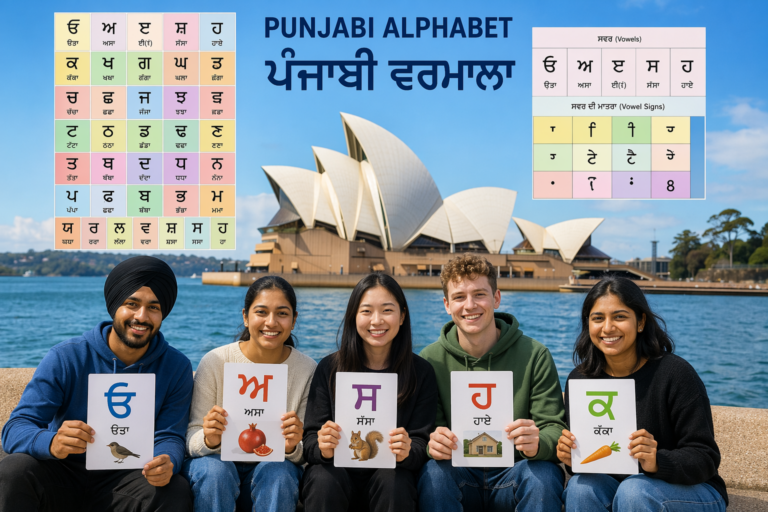
When you are new to this, you will usually learn the independent vowels before you move on to the list of consonants. Many courses show you the 35 main letters first. Then, they talk about how the vowel signs and other forms can change the way pronunciation works. Once you know these building blocks, the gurmukhi script will not seem as hard. It becomes much more manageable for most people.
The Complete Set of Punjabi Vowels (Svar)
Punjabi vowel learning starts with a small but important group. These notes talk about five vowels, each with both a small and big sound. Later, you see how the system grows into vowels like ਅ, ਆ, ਇ, ਈ, ਉ, ਊ, ਏ, ਐ, ਓ, and ਔ. These are the core vowel phonemes for people who are just starting out.
A few main things to know:
-
Some letters act as parent vowel bearers to help other vowel signs.
-
A vowel can stand on its own as an independent vowel form. Or it can be marked with a vowel sign next to another letter.
This is important because the base letter shape gives a different vowel sound when you use different signs. When you practise these patterns bit by bit, you start to hear the open sounds better. You also see how each written change fits in with how Punjabi is said.
The 35 Punjabi Consonants (Vianjan) Explained
Most starter lessons cover 35 Punjabi consonants. People often call these the main letter set in Gurmukhi. The notes also show 30 basic consonants side by side, to help you see which gurmukhi letters match sounds in North Indian languages. This can be handy for when you start to hear all the different consonant sounds.
You should look out for three things:
-
some letters look nearly the same but have different sounds
-
some are the same as Devanagari, but others look a bit like it though they are not
-
a few subjoined letters sit under a full letter, not on the main line
When you are just starting out, it is smart to split plain, unaspirated consonants from the stronger ones. Try to practice them as pairs. This makes it easier for you to hear which is which, not just guess by how the letter looks.
Basic Sounds and Pronunciation Guide
A good guide to pronouncing the gurmukhi alphabet starts with listening first before you look at spelling. You get a much better idea of the sound of gurmukhi alphabet letters if you learn one vowel sound and just one set of consonant sounds at a time.
In Punjabi, there is a system of contrasts. The pitch of the voice and how your mouth moves both change the sound. This often surprises people who are new to it. Go slowly, practise, and compare pairs of letters out loud. When you do this, your ear will start to pick up the small differences in the sound of gurmukhi alphabet. Noticing these differences helps you a lot when reading and speaking.
Pronouncing Punjabi Vowels Correctly
Punjabi vowels get easier to say when you stop thinking of them as English vowels. Each vowel sign shows you how to make a steady vowel sound. The independent vowels give you a clear place to start when you want to practise.
Try keeping with these basics:
-
say each vowel at a normal pitch before you put it into a word
-
listen for open sounds in things like ਆ, ਏ, and ਓ instead of making them sound like English
It can help to put short and long forms next to each other. The notes show that some base letters have connected vowel sounds, so it’s good to learn them as families. If you say them out loud and write them together, these vowel sound patterns feel more natural.
Key Tips for Mastering Punjabi Consonant Sounds
Consonant sounds need more than just recalling what they look like. In Punjabi, you also use your breath, the way you shape your mouth, and sometimes the pitch you use. That is the reason two letters can look nearly the same, but when you hear them in speech, they sound different.
Keep these tips in mind:
-
learn plain letters in small groups, not all at once
-
check pairs that look a lot alike, like ਗ, ਰ, and ਹ
-
listen out for low tone, high tone, and level tone when you need to
There is one tip from the collected notes that helps a lot: ਘ at the beginning of a word can be heard as a sound with a high tone. Details like this help you see why practising each sound is so important. It is much easier to remember the shape of each letter when you also link it with its voice pattern, not only how it looks.
Special Signs and Diacritics in Gurmukhi
When you know the main letters well, you can start with some special signs. In Gurmukhi, there are marks like bindi, tippi, and addak. These marks act as a subtle device that changes how a word sounds. They do not change the whole letter.
These signs are part of the script’s look. Many sit near the horizontal line or join to the main form. These and vowel signs work together to show nasalization signs, doubled sounds, and other small changes in how you say words. If you learn them early, you will not make reading mistakes as often.
Bindi, Tippi, and Addak: What They Mean
These three marks often mix up new learners, as they look small but can do a lot. Bindi and tippi are about the nasal sound. Addak works by doubling or making the next letter stronger.
The notes put it in a simple way:
-
bindi for the nose sound, kind of like the bindu used in Hindi
-
tippi for a nose sound, but also has a bit of a g-like finish, you can hear it in words like ਅੰਗਦ
Addak is easy to miss. It’s like an invisible sign, especially if you read too fast. But it does change the rhythm and makes some sounds strong. Most learners make their early mistakes because they spot the big letters but miss the small marks. If you take your time to read slow, you will find them.
Vowel Signs and How They Change Sounds
Vowel signs are important because they change the vowel sound that goes with a consonant. Punjabi doesn’t use a full letter for every vowel. It uses marks attached to the main letter to show how there is a change. These marks help people know how words should sound.
Be careful of these points:
-
The same consonant will sound different when a vowel sign is added.
-
Some letters are used to carry vowel phonemes and help with those sounds.
-
You need to practise the difference between long sounds and short sounds so you get the patterns right.
The group of lessons shows there’s a wide range of sounds in Punjabi. This includes the presence of many diphthongs. If you are just starting, you can read one vowel sign at a time and practise the common combinations. Say the sounds out loud. This helps you build your confidence with vowel signs and vowel phonemes, without taking in too much at once.
Chart of the Punjabi Alphabet with English Equivalents
Yes, a simple chart can help you connect the gurmukhi alphabet to rough English equivalents. These are not perfect matches, but they give you a starting point for the particular sound and particular name of each main letter. Use the chart as a guide, then confirm each sound by listening and repeating.
|
Gurmukhi |
English equivalents |
Note |
|---|---|---|
|
ਅ |
a |
base vowel |
|
ਆ |
aa |
longer open sound |
|
ਇ |
i |
short front vowel |
|
ਉ |
u |
short back vowel |
|
ਕ |
k |
main letter for k sound |
|
ਗ |
g |
main letter for g sound |
|
ਚ |
ch |
as in chair |
|
ਜ |
j |
as in jam |
|
ਟ |
t |
retroflex style |
|
ਤ |
t |
dental style |
This kind of table is best used in short practice sessions. Focus on one row, say it aloud, then write it from memory.
Visual Table: Letters, Sounds and Pronunciation Tips
A visual summary helps you notice both sound and shape. With gurmukhi letters, the sound of the word matters, but so does careful observation. Some letters look close to others, and some subjoined forms change the shape of a subscript below the main line.
Use this quick table as a starter:
|
Letter |
Rough sound |
Pronunciation tips |
|---|---|---|
|
ਘ |
gh / high-tone effect in some positions |
check the sound at the beginning of a word |
|
ਫ |
ph/f |
do not confuse it with ਢ by shape |
|
ਮ |
m |
looks somewhat like भ to some learners, but sounds as m |
|
ਯ |
y |
do not read it as j from shape alone |
|
ਵ |
v/w |
keep the sound light |
|
ਰ |
r |
compare carefully with ਗ and ਹ |
When you revise, say the letter, then a sample sound, then your own note about its appearance. That habit makes recognition quicker and more accurate.
Common Mistakes Australians Make When Reading Punjabi Letters
Australian learners often use the way they read English when looking at the gurmukhi alphabet. This happens a lot, and you can see why. Still, this may cause some mix-ups. You might get confused about how the sound should be, which group the letters are in, or what the small marks mean. A letter’s particular shape does not always show you the right answer.
Here are some common problems:
-
thinking one letter in gurmukhi always matches one English sound
-
not seeing a particular vowel sign, which means you might change the meaning of the word
-
mixing up lookalike letters such as ਫ and ਢ
-
reading all words at a normal level, which means you ignore tone or you do not notice emphasis
Another mistake is racing past modifiers and subjoined forms. If you slow down and check each line closely, the remaining words in a sentence start to make more sense. Your accuracy will come from paying attention, not going fast.
Practical Steps to Learn and Memorise the Punjabi Alphabet
Learning gurmukhi letters gets easier when you stick to a simple routine. It’s better to practise a little each day than to have long but random sessions. This is good for remembering the letters. Start with a small group of gurmukhi letters. Say their sounds out loud. Then, use a pen and write them out.
You can add some fun by bringing in games or using online tools. The work won’t feel so hard this way. Try charts, watch video lessons, or test yourself. These things make it easier. The next two sections will show easy tricks for memory and real ways to help you keep practising gurmukhi letters every day.
Popular Tricks for Quick Memorisation
Quick learning is often about how you set things up, not some trick. To remember things better, link every letter with a sound, a picture, and a short writing job. This helps your brain work in a few ways at the same time.
Try these easy tips:
-
group letters that look the same and then compare each to the other
-
make small quizzes with mixed-up questions so you can test if you remember
-
do fun things like matching games, saying the sounds, and doing quick copies
One of the main reasons this works is that you keep repeating things, but you use different ways each time. You are not just looking at the letters. You are also hearing, writing, and double-checking them. The notes even talk about making your own quiz, which is a good way you can copy at home to practise.
Fun Activities and Online Tools for Practice
Practice gets better when you make it active. If you want to learn the Punjabi language, you can use online tools and alphabet charts. There are also video playlists to help you go over what you have written in your notebook. You can try out a keyboard layout to type the Punjabi script, too. This makes things a bit more fun and helps change it up.
Some of the good choices from the material are:
-
illustrated alphabet pages and Punjabi chart websites
-
a YouTube lesson playlist made for guided listening
-
a simple quiz format to see if you can remember letters and sounds
You do not need a lot of resources. Just choose one chart, one video source, and one self-check method. When you know the main forms well, you can start to type or build words using the remaining words you got from your lessons.
Conclusion
Learning the Punjabi alphabet is not only about picking up a new script. It is also a fun path into a rich culture and language. If you get to know the unique features of Gurmukhi and use the right pronunciation, you can improve your communication skills. This will help you connect better with the Punjabi community in Australia and everywhere else. Use practical tips and try out engaging activities to keep your learning easy and enjoyable. Take on this challenge and start now. If you want some help, reach out for a free trial consultation!
Frequently Asked Questions
How do you write your name in the Punjabi alphabet?
To write your name in the gurmukhi script, you need to break it up into its sounds first. Then, match every sound to a letter from the gurmukhi alphabet. It’s a good idea to pay more attention to the name of the letter than the sound of gurmukhi alphabet forms. If a particular letter doesn’t fit your name exactly, just pick the nearest sound that does.
Where can I practise the Punjabi alphabet online for free?
You can learn the Punjabi alphabet using free tools online. There are chart pages, easy video lessons for beginners, and short self-made quizzes. These are good for you to go over the Punjabi writing system in quick sessions. To make it more fun, try typing practice and read the remaining words from your basic lessons. This will help you remember things better.
Are there easy Punjabi words for beginners to try writing?
Yes. Start by teaching short Punjabi language words that use common vowels and easy consonants. The main function is to join letters and sounds, not make people remember long word lists. Use open sounding words first. Then, turn this into fun activities like copying, reading out loud, and matching sounds with letters.