Key Highlights
-
The lao alphabet uses what’s called an abugida writing system. In this, the consonants have an inherent vowel built in.
-
When you look at the lao script, you will see that vowels show up as marks around the consonants. They do not act as full letters on their own.
-
This writing system that they use started in the 14th century and came from old khmer script.
-
People get good pronunciation from knowing the consonants, vowels, how the syllable is made, and the tone marks.
-
Lao is a tonal language, and it has six tones that can change what a word means every day when people speak.
-
Beginners start with learning the basic letter classes, where to put the vowels, and common sound patterns.
Introduction
If you start with the Lao alphabet, you are learning more than just a list of letters. You are getting to know the writing system of the Lao language. It is the official language of Laos, and it plays a big part in daily life there. For people in Australia wanting to learn, this guide is easy to use. You will see how the script works and how letters match with sounds. You will also learn why tone and syllable patterns are so important when you want to read and write Lao.
Overview of the Lao Alphabet
The lao alphabet is the most common writing system for the lao language. The lao script is what people use to write lao. This writing system uses something called an abugida. In the lao script, each syllable starts with basic consonants. You then add vowels with marks around these consonants. When you see a consonant, it will start with an inherent vowel. That will only change if you put another vowel sign near it.
If you are just starting out, this is the main thing you should know. The lao writing system connects back to the brahmi script family. It does not work the way english does. When you see how the lao script puts consonants and vowels together, reading and writing gets easier to handle.
Unique Features and Significance
One thing you’ll notice right away is the lao script is an abugida writing system. This means that it’s not just made up of single letters. Each shape is a whole syllable that’s mainly built around a consonant. It’s a good place to start if you want to pick up the basics of the lao language by looking at how things are written.
Spacing works a bit differently, too. In English, you find spaces between every word. But in lao, a space is usually found at the end of a clause or a sentence. That might seem strange at first. But you’ll get used to it, as that’s common in other scripts in southeast asia as well.
This writing system is more than rules and grammar. The lao script stands for the official language of laos. You’ll see it in schools, out in public, and it’s used in many parts of daily and cultural life. It goes further, though. The script also helps write some minority languages, which makes it important for the people and their language as well.
Script Classification and Origins
The Lao writing system is a part of the big group of scripts that started with the brahmi script. This is important since it shows why Lao has some structure in common with other Asian scripts. The system did not come out of nothing. Instead, it is just one step in a long line of changes and growth.
The roots of Lao are most closely linked to the khmer script. People who studied in the Lao areas picked old forms of the Khmer script to build a script for the Lao language. This is what gave the writing system its basic look and feel as a set of symbols for each syllable, where vowel signs are attached to the consonants.
If you go back even more in time, you will see that the khmer script came from the pallava script from Southern India. So, if you trace the start of the Lao writing system, you see it goes from Lao to Khmer, then to Pallava, and way back to Brahmi. This family tree helps all of us understand why it looks the way it does and why it is linked to others in the area.
Historical Development and Evolution
The lao script has a long history that goes back to the 14th century. It started in the time of the Lan Xang kingdom, when their leaders looked for a writing system to fit the lao language. They did not make one from nothing. Instead, they used the old khmer script, which was already common in the area.
As time went on, the lao script changed. It started to look closer to how people spoke lao. Some older sounds in the script dropped away, or did not stand out as much. Parts of it changed too, so people could show tone better. All these changes helped give the lao script the shape we know now.
Influences from Other Southeast Asian Scripts
The earliest and strongest outside influence on Lao was the khmer script. That gave the basic way to write how syllables fit around consonants and how to add vowel marks. Because khmer script had the earlier Indian impact, Lao got those features this way instead of getting them straight from India.
Before there was khmer script, there was the pallava script and then the brahmi script. These old writing styles shaped a lot in Southeast Asia. That’s why scripts across countries in southeast asia look close in how they are set out and used, even if the letters are not the same.
But the story is more than that. Writing linked to brahmi script was also used for languages tied to sanskrit. Over years, most of these traditions made their way across southeast asia. The language Lao grew its own way, but it can still be seen as a part of that bigger story across this part of the world with other scripts and writing changes.
Evolution of Lao Script Through the Ages
At first, the lao script was a new script made from the old khmer script. It was made to help a Lao-speaking group that was growing. This first step gave the Lao language a way to write things down. It helped with daily work, learning, and showed their cultural identity. It was useful and also had a special meaning at this time.
As people changed how they spoke lao, the script changed too. Some consonant letters were made to show sounds that were once different. As time went on, those letters were not as needed to show one sound from another. But the script did not drop them; instead, it started to use them to show tone, which is very important in lao.
Because of this script change, today’s lao script looks simpler than some others that are related. During its long history, the writing was made easier and changed to fit how people say words now. This helps people who are learning to read or write lao. The script still has some rules that you need to know, but the way it works is now much closer to spoken lao and the way people use pronunciation every day.
Lao Consonants Explained
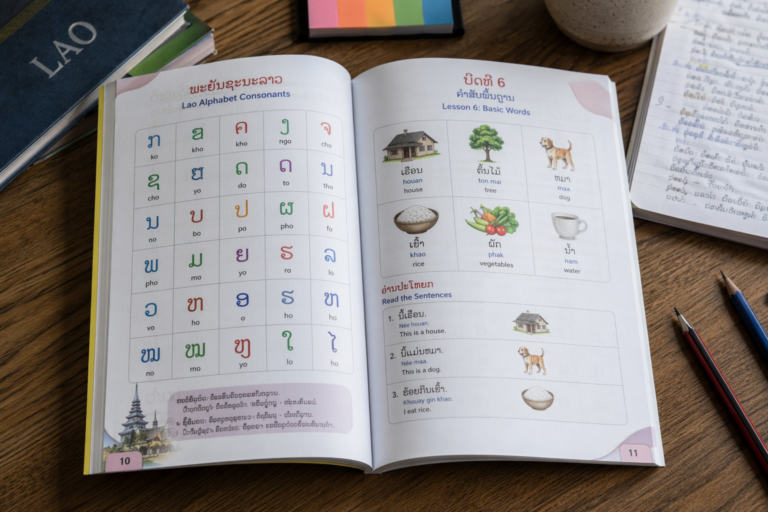
Consonants are the backbone of the lao alphabet. Every syllable starts with a type of consonant. Each one falls into a group, and this group helps set the tone when you say it out loud. So, learning consonants in lao is not just about sound. It also helps you know how the letters are used for pronunciation in the script.
The modern system has 27 main consonants. But, not every letter is used in the same way in each place. Some consonants can be at the end of a syllable, but their sound may change. There are also rules for consonant clusters, and in lao these are more limited than in English. The next bit will show you this in a clear way.
The 27 Consonants and Their Pronunciation
For beginners, it helps to group the 27 consonant letters by class rather than trying to memorise every sound at once. In the lao alphabet, pronunciation links to both the sound value and the type of consonant. Some letters also shift when they appear as final consonants in a syllable.
The official latin transliteration system can support early reading, but it should not replace learning the script itself. A simple overview of the three classes gives you a strong starting point before you move on to the full set of basic consonants and their individual forms.
|
Consonant Class |
Role in Pronunciation |
|---|---|
|
High |
Often supports high or rising tone patterns |
|
Mid |
Often supports mid or low-falling tone patterns |
|
Low |
Often supports low or falling tone patterns |
|
Initial position |
Consonant letters keep their main sound value |
|
Final position |
Some sounds change, such as /b/ sounding closer to /p/ |
Tips for Remembering Lao Consonants
If the consonants look strange, do not try to learn them all at once. It is better to link each shape with a sound, what class it is in, and some words. This helps you turn these separate symbols into things you can use.
You can use little memory tricks to help you remember faster. You do not need perfect memory on day one. The goal is to slowly get better at knowing them, so you can get good pronunciation when you see the letters later in words and short phrases.
-
Group consonants by class first, not in random order.
-
Put one letter, one sound, and one word on your flashcards.
-
Say each sound out loud. This helps your ear and mouth work together.
-
Look at similar consonants next to each other as a memory exercise.
-
Go over the vocabulary often, so each letter comes up in context.
If you stick with it, the shapes stop feeling so new. When these consonants feel familiar, reading basic syllables gets much easier.
Lao Vowels and Their Usage
Lao vowels are not used in the same way as English vowels. In the lao vowel system, vowels are marks that you put with a consonant. Each consonant in lao already has its own vowel sound. If there is another mark, the vowel sound will change. That is why you need to learn vowels and consonants together.
The length of the vowel can also change the meaning of a word. Lao has both long vowels and short vowels. Vowel marks may go above, below, before, or after the consonant. Once you know these patterns, it gets much easier to read lalo.
The 28 Vowels and How to Pronounce Them
The lao alphabet is commonly described as having 28 vowels, though these are not all separate full letters in the way English learners might expect. They are combinations of vowel marks attached to consonants, and each one changes the vowel sound of the syllable.
A practical way to begin is to sort them into short vowels and long vowels. The official latin transliteration system can help show sound patterns early on, but your real goal is to recognise how the marks sit around consonants and how length affects pronunciation.
|
Vowel Feature |
What to Notice |
|---|---|
|
Short vowels |
Briefer vowel sound; can change meaning |
|
Long vowels |
Extended vowel sound; distinct from short forms |
|
Above marks |
Written over the consonant |
|
Below marks |
Written under the consonant |
|
Before or after marks |
Written in front of or behind the consonant |
|
Combined placement |
Some vowel marks appear on more than one side |
Placement of Vowels in Words
One thing that often surprises people is that where you see the vowels in written Lao isn’t always the order you say them in. Vowel marks can be before, after, above, below or even all around the consonant that is in the middle of the syllable. When you read in this writing system, you need to notice patterns. It isn’t just about following the sounds from left to right.
Here’s another thing you need to know for the start of a word. If a vowel comes at the beginning of a syllable, it can’t be by itself. The writing system will make it join with a special mark called a glottal stop so the vowel still sits on a consonant base.
-
Every syllable has a consonant base holding it together.
-
Vowel marks can show up on different sides of the consonant.
-
Any vowel at the start of a word sticks to a special carrier.
-
You need to read vowel length closely. Vowel length can change meaning.
If you learn to spot the main consonant first in a Lao word, you will find the rest of the syllable is much simpler to work out.
Tone Marks and Tonal Features
In the lao language, the tone of a syllable is not just an extra thing. It changes what a word means, so to read well, you need to look at more than just consonants and vowels. That’s one reason why the lao writing system feels new to a lot of people in Australia.
Tone marks in lao help you see those pitch patterns. But these marks are not working on their own. The writing system also uses consonant class, syllable type, and the way vowels are set. When you know how the tone marks, consonants, vowels, and syllable types go together, the lao language and its tonal system make more sense.
Tone Markers and Correct Usage
The Lao writing system has four tone marks. These little signs sit above the first consonant of a syllable. They help you get the right pronunciation. But in Lao, tone marks do not work on their own. What they do depends on the class of the consonant and if the syllable is open or closed.
So, working out how to read a Lao syllable happens in steps. First, you need to check the consonant. Then, you spot the vowel sound. After that, you look for any tone mark. When you have all three, you can know the full spoken form. With practice, the rules get easier because they do not change much.
-
Tone marks sit above the first consonant of a syllable.
-
They change the tone already shown by consonant class.
-
The shape of the syllable affects how you read the mark.
-
To get it right, check the consonant, the vowel sound, and the tone together.
If you take your time to follow these steps, the tones in the Lao writing system will be less confusing and much easier to pick up.
How Tones Relate to the Lao Alphabet
In Lao, the tone of a syllable is a part of the alphabet itself. It’s not something added later. The tone for each word comes first from the class of its starting consonant. That is the reason why consonants in Lao script are put into clear groups.
Next, vowels and the shape of the syllable are also important. If a syllable ends with a vowel, it is treated one way. But if a syllable ends with a consonant like p, t, or k, it goes another way. When you see a tone mark on the first consonant, this can change things again.
So how do you get the tone of a syllable from the Lao alphabet? It’s all about how things work together. Consonants show the class, vowels sort out the type, and tone marks change the final sound. Once you know this system, Lao looks neat and makes sense, not just random.
Comparing Lao and Thai Scripts
The lao script and thai script are called a sister system because both of them come from the same roots in southeast asia. This is why they look a lot like each other when you see how the consonants, vowels, and tones work.
But, the two scripts are not the same. Lao is often more simple. It has fewer consonants and its way of spelling is easier. If you are learning, this can help you see why the lao script and thai script seem close, but also see the things that make lao different.
Key Differences and Similarities
Because the lao script and thai script come from a sister system, they look alike in some ways. They both set up writing in a similar way. Each one uses consonants to build a syllable, and then they add vowel signs and tone rules for pronunciation. If you know one script, some bits of the other will look easy.
The main thing that’s different is that the lao script keeps things simple. It has fewer consonants than the thai script. And later changes made the spelling rules for lao more simple, too. That means lao does not look as busy or packed on the page, but both scripts follow nearly the same idea.
-
Both scripts come from related sources.
-
Both have consonants as the start of a syllable.
-
Both need tone and vowel signs to say a word right.
-
The lao script has fewer consonants than thai script.
-
Lao spelling is often more simple than thai.
If you are learning, just remember this: what’s the same will help you spot patterns, but what’s not the same is still important when you read.
Practical Implications for Learners
If you start to learn the lao script after looking at the thai script, there can be some things that help. At the same time, it is easy to get mixed up. Some letters look almost the same, but they do not always work in the same way. Trying to guess from memory might mess up your pronunciation more than it helps.
It is a good idea to see Lao as its own thing right from the start. Only use the official latin transliteration system as a small help. Do not use it as the main way you read. This will help you keep your mind on letter shapes, the way tones work, and lao vocabulary.
-
Learn lao letter classes as their own thing.
-
Do not guess that thai sound values always match.
-
Use transliteration just for a start, then use it less and less.
-
Grow your vocabulary with short, clear lao syllables.
Thinking like this stops you from getting too mixed up. You will get better results, mostly if you want good pronunciation instead of just knowing which letter is which.
Common Challenges for Australian Learners
For people in Australia, the lao alphabet can seem tough. It is not like english at all. You do not just learn new shapes for letters. You also need to know about tone, types of consonants, and how vowels go around the consonant instead of standing alone.
Getting the right pronunciation is another hard part. People who speak english are not used to using tone to give meaning to words. The way you put space between words can also feel odd. There is good news though. You can use things like memory tricks, listening many times, and slow reading practice. These help you get better with the lao alphabet, vowels, and pronunciation.
Pronunciation Difficulties and Mnemonics
The main problem with pronunciation for many english speakers is the tone. In english, the way the pitch goes up or down might show if someone feels happy or upset, but it does not often change the main meaning of a word found in the dictionary. In the lao alphabet, the tone is actually part of the word. The tone is something you really need to hear well and say in the right way.
An extra hard thing is spotting letters under pressure. Some shapes can look new, and vowel signs might seem to move around the consonant. That is when having a good mnemonic system can help. It gives your brain something quick to hold on to before you get really good at it.
-
Use flashcards that have sound, the class, and one sample word with them.
-
Link each letter that is hard for you to a visual mnemonic that is simple.
-
Practise speaking out loud in short bursts. It will help with your pronunciation.
-
Keep comparing long and short vowel pairs at different times.
-
If some letters make you confused, check them every day instead of looking at them once a week.
If you repeat and go over it many times, the script will not feel as strange. It will look and feel more like a set pattern. That change is what makes you feel sure of yourself.
Handy Apps, Tools, and Printable Worksheets for Learning
Many new learners want to know about good apps and tools. The best ones are usually simple. They let you go over the shapes of the letters, their sounds and the syllables again and again. Most advice tells people to start with online charts and guides for the lao alphabet.
Printable worksheets are great too. They help because you slow down when you write by hand. This helps you see how each stroke should look, where the vowels go, and what patterns the letters have. If you also use flashcards, you will remember more. It is better than just reading passively.
-
Find beginner charts with consonants, vowels, and tone rules.
-
Use printable worksheets so you can work on writing and recognition.
-
Pick tools with clear lao fonts to make reading easier.
-
Use charts and flashcards together so you check what you know, not just what you see.
If you are looking for extras, you can find most things you need through online lao alphabet charts and practice sheets. They are the best way to get started with structured practise.
Everyday Usage of the Lao Alphabet in Laos
The Lao alphabet is a writing system you find everywhere in Laos. People do not just use it in school. You see it every day in public, and most people use it all the time. It is the main way people write things in their day-to-day life. Lao is the official language of Laos, so you spot it in many places.
You can see this alphabet on street signs, in newspapers, on your phone, in letters, and with anything from the government. That shows it is not just for school. When you want to read, send a message, or have to do official work, you need to know it. Using the Lao writing system is normal for most people living there. For anyone learning, this means the Lao alphabet and the official language of Laos are a big part of daily life.
Writing, Signage, and Communication
In Laos, you will see the lao alphabet everywhere people talk to each other in daily life. It is used because the writing system is part of the official language. People need it for public signs, local news, messages, and everyday work. Once you start learning, you soon see that the alphabet is not only used in school. It is part of what people do every day.
A good example is when you look at public signs. The letters on street and shop signs, or on bits of printed news, all show how the lao alphabet works out in the real world. If you are learning to read, you will find these examples helpful. The reason is that you see the same patterns and names again and again.
-
The lao alphabet appears on street and shop signage.
-
It is used in newspapers and other public writing.
-
People use it for letters, texts, and daily communication.
-
Offices and institutions rely on it for official language use.
When you get the basics down, you can see the lao script pretty much everywhere. Noticing it more will help you become faster and more confident with reading.
Role in Education and Culture
The lao alphabet is a key part of school. Kids use it to read and write in the official language from the start. All through school, they use these letters to pick up new words, grow their vocabulary, and get better at reading and writing. This builds their skill and trust in using the language every day.
The Lao script is also a big part of culture. It lets people read stories, old writing, and learn more about who they are. This set of letters does more than help people say words. It keeps memory, tradition, and a feeling of being part of a group alive.
In some places, the script is used for minority languages, too. This makes it even more important for culture. So, when people learn the lao alphabet, they get more than just lessons. They also get a strong link to education, culture, and the real language people use in Laos.
Order and Structure of Lao Letters
Learning the Lao alphabet can be much easier if you know both the order and how it is put together. It’s good to get the alphabet sequence right for things like charts, dictionaries, and more organised studying. But learning the order is just one part of what you need.
You also have to know how each letter works in a syllable. In the Lao language, everything is built around base consonants. Then you add vowel signs and, when you need to, there are tone marks as well. So, memorising the order can help you remember things. But to really read well, you need to see how all these parts come together to make real syllables.
Correct Alphabet Sequence
The correct order of letters in the lao alphabet is best learned from a proper chart rather than from guesswork. For beginners, the most useful approach is to study the alphabet sequence alongside consonant class and sound. That gives the order practical value instead of making it a memory list only.
The official latin transliteration system can help you follow pronunciation while you learn the order, but the chart itself should stay central. Since Lao vowels are marks around consonants, most learners begin by mastering consonant sequence first, then adding vowel patterns.
|
Study Focus |
Why It Matters |
|---|---|
|
Alphabet sequence |
Helps with organised recall and chart study |
|
Consonant class |
Supports tone reading |
|
Transliteration support |
Gives a rough pronunciation guide early on |
|
Vowel attachment |
Shows how syllables are built in practice |
|
Repeated review |
Turns sequence into usable reading knowledge |
A structured chart is the simplest answer if you want to know the right order clearly and efficiently.
Syllable Formation and Examples
In Lao, the syllable is the most important part to learn. You start with a consonant, add any vowels, and then check the tone used. This is why learning one letter at a time is just the start. Real reading is when you bring the parts together.
The next parts you should focus on are common patterns, not just single symbols. When you can find the base consonant and spot the vowel marks, it will be easier to put the pieces of the syllable together. You will not need to work out each sign on its own for long.
-
Begin by finding the main consonant in the syllable.
-
Check where the vowels are placed around that consonant.
-
Notice whether the syllable ends open or closed.
-
Add any tone detail after you find the main parts.
This simple order helps you tackle new words the same way each time. After some practice, you will spot whole syllables right away.
Conclusion
To sum up, learning the Lao alphabet helps you get to know the Lao culture and talk to people better. When you get used to its special parts, like consonants, vowels, and the tones, the language feels less hard. Keep in mind that doing it again and again makes you better. Using tools, apps, or little tricks can also make things easier. Go with the hard parts and enjoy learning because every bit gets you closer to doing well. If you want to know more or need some help just for you, you can reach out for a free trial talk. Good luck and have fun with your learning!
Frequently Asked Questions
Are there any effective ways for Australians to learn the Lao alphabet quickly?
Yes. The best way to learn fast is to use Lao alphabet charts, flashcards, easy apps, and write a bit each day. Use the official latin transliteration system only to help while you learn to read the Lao script. For Australians, it’s best to do small and steady sessions instead of trying to do everything in one go.
Where can I find printable Lao alphabet charts or worksheets?
You can find lao alphabet charts and worksheets online that help people learn the consonants, vowels, and tone rules. Try to look for simple charts that use clear lao fonts. The good resources give you space to practise recognition and also to write, so you can go over the forms again and again.
What are some memorable tricks or mnemonics to remember Lao letters?
A good way to learn the Lao alphabet is to tie each letter to a sound, a simple picture, and a word for your vocabulary. Flashcards are best if they show the letter’s group, the sound it makes, and an example all at once. One smart tip is not to study a letter on its own. Group the similar ones together and take time to compare them often. This helps more when you’re learning the Lao alphabet with flashcards and new vocabulary.