Key Highlights
-
The hawaiian language uses the hawaiian alphabet. The writing system is small, with only 13 letters in it.
-
You will get to know about the five hawaiian vowels and eight hawaiian consonants. These are used in a lot of words every day.
-
The glottal stop is shown by the ʻokina. It makes a real sound in speech and is an important consonant in the hawaiian language.
-
Long vowels are marked with something called diacritical marks, called kahakō. These marks change the sound and meaning of words.
-
Learners in Australia can start to read easy words fast. You can use audio, apps, and paper materials to help.
-
This guide also gives you the history, the right way to say words, how to spell them, and talks about the modern revival of the language.
Introduction
If you want an easy way to get into the Hawaiian language, start with the Hawaiian alphabet. The alphabet is small and clear, and it works much like how native speakers say their words. This makes it a good first step for learners in Australia who want to read, say, and spot Hawaiian words better. You do not have to know a lot of rules at the start. Once you know the letters and their sounds, the language will be much easier to get into.
Overview of the Hawaiian Alphabet for Australian Learners
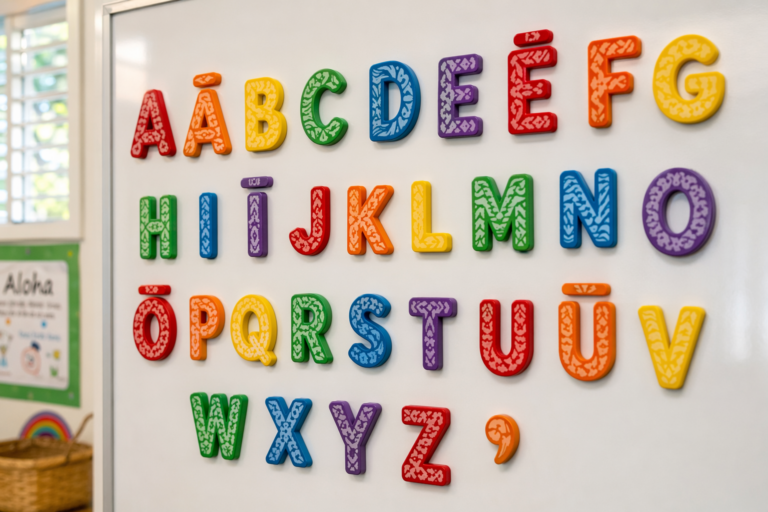
For anyone who wants to learn the hawaiian language, the hawaiian alphabet can be a good place to start. There are only 13 letters in the whole alphabet. The five hawaiian vowels are a, e, i, o, and u. It also has eight hawaiian consonants: h, k, l, m, n, p, w, and the ʻokina.
Each of the letters in the hawaiian alphabet has a sound that stays the same in most words. This can help you begin to read out loud sooner. The vowels are easy, and don’t change much. And the consonants sound much like those in english, so many people feel right at home with them. If you stop to see what makes it work, you can really get why this alphabet is so good for learners.
What Makes the Hawaiian Alphabet Unique
One thing that makes the hawaiian alphabet different is how small it is. This is one of the shortest alphabets used today, with only 13 letters. English has a lot more symbols, but the hawaiian language picks just what it needs. It does not try to copy the way English is spelled.
The hawaiian alphabet also has special characters that are important. The glottal stop, called the ʻokina, is used as a real sound and is a consonant, not just decoration. There is also the kahakō, which is used to show long vowels. This can change how words in the hawaiian language sound.
This system is also a way to show its rich heritage. Hawaiian started as an oral language, so the writing system was made to fit how people talked. That is why the hawaiian alphabet has fewer letters than English. Still, it uses its special characters to give words meaning and keep the sound clear.
Brief History and Origins of the Hawaiian Alphabet
Before people from Europe came, the hawaiian language was only spoken out loud. There was no written form yet. The way people talked helped shape the alphabet that came later. When writing came in, the goal was to show the real sounds everyone used every day.
In the 1820s, american missionaries worked together with locals who spoke hawaiian to make the alphabet with latin letters. Hiram Bingham played a big role at this early time, and the first printed book for learning came out in January 1822. The older alphabet had 21 letters, but it later got made simpler.
By 1826, the alphabet had been set into a form that showed how to say things more clearly. Many years later, in the 1980s, during revival work for the hawaiian language, people gave more care to correct spellings and putting in pronunciation marks. This shows why the modern alphabet is both easy to use and also means a lot to people and their culture.
Essential Elements of the Hawaiian Alphabet
The hawaiian alphabet has three main parts. These are the vowels, consonants, and special characters. The vowels are a, e, i, o, and u. The consonants you use are h, k, l, m, n, p, w. There is also the ʻokina. That one is a glottal stop you put in the alphabet.
There are some marks you need to look out for. These are called diacritical marks. The hawaiian alphabet mostly uses the kahakō, which is just a line over a vowel. It shows to hold the vowel longer. All these things change the way words sound and what they mean. The next bit talks more about these in an easy way for everyone to get.
The 13 Letters: Vowels and Consonants
The alphabet used in Hawaiian has 13 letters. It includes five hawaiian vowels and eight hawaiian consonants. This compact writing system makes early reading less overwhelming for beginners because each symbol has a fairly stable role in hawaiian pronunciation.
Here is a simple text table you can use for quick review:
|
Letter Type |
Letters |
Basic pronunciation |
|---|---|---|
|
Vowels |
A, E, I, O, U |
ah, eh, ee, oh, oo |
|
Consonants |
H, K, L, M, N, P, W, ʻ |
h, k, l, m, n, soft p, w or v, glottal stop |
A sounds like ah in father, E like eh in bed, I like ee in see, O like oh in go, and U like oo in moon. H, K, L, M, and N are familiar. P is softer than in English. W may sound like w or v, and ʻ marks a pause in the throat.
Special Marks – ʻOkina and Kahakō
The hawaiian language has some special marks, and these marks are important. There are two main diacritical marks used as sound markers. They are called the ʻokina and the kahakō. If you leave them out, you might say a word in the wrong way or make it mean something else.
The ʻokina is a glottal stop. You can think of it as the quick pause you hear in “uh-oh”. This mark is not an apostrophe. It works as a consonant. The kahakō is a line you see over a vowel, like ā or ī. It tells you to make the vowel sound longer. This is what people call long vowels.
-
ʻOkina: gives a clear break between sounds.
-
Kahakō: makes a vowel longer, such as ā, ē, ī, ō, or ū.
-
Both of these marks help you say words in the correct way and hold the right meaning.
You hear the change for words like paʻa and paa, or mana and māna. These diacritical marks might be small, but they really make the written form of the hawaiian language come alive and help with good pronunciation of the vowels and glottal stop.
Beginner’s Guide: How to Start Learning the Hawaiian Alphabet
If you are new to the Hawaiian alphabet, start with the letters and how each one sounds. The Hawaiian language has a simple written form. Because of this, most learners can read basic words fast if they practise a bit each day.
Try to use both your eyes and ears when you study. Look at charts or listen to recordings or beginner lessons. This helps you match the letters in the Hawaiian alphabet to what you hear in real speech. Once you get these basics, using the right apps or materials for the Hawaiian language can help you learn better and more easily.
What You Need to Get Started (Resources, Apps, Materials)
You do not need a big toolkit to start learning the hawaiian language. Just pick a few good resources. The best way is to hear the right sounds, see the best spelling, and practise a bit day by day. Do not try to learn it all at once.
Good options for beginners are digital tools and things you can hold. Audio is important now, because pronunciation is key in hawaiian language. This is true for both vowel length and the ʻokina. It helps to use printed materials too. You can go back and check spellings and markings any time.
-
Apps that play audio for letters and words
-
Resources with beginner charts or guides for pronunciation
-
Things you can print like flashcards, worksheets, or short word lists
-
Videos or music from native speakers so you can do some listening practice
If you can, pick materials that have diacritical marks. This keeps your learning close to the real written form from day one.
Step-by-Step Process to Master the Hawaiian Alphabet
Being great at the hawaiian alphabet comes from taking a few sure steps, not hurrying through it. Begin with the letters. After that, move on to the sounds, some of the common words, and then pick up the spelling rules. Doing things in this order makes the hawaiian alphabet feel clear rather than mixed up.
While you do this, always link the way words sound to how you write them. Hawaiian is good for people who listen closely, since the pronunciation and written form are very much tied together. The four steps below show you a simple way, from your very first lesson to where you feel more sure when reading.
Step 1: Familiarise Yourself with the Letters
Start by using the full Hawaiian alphabet as your set. There are 13 letters: A, E, I, O, U, H, K, L, M, N, P, W, and ʻokina. If you learn them in order first, you get to know the shape of the alphabet before you move on to bigger words.
Then, split the letters into two groups. The five Hawaiian vowels come first. After that, you get the Hawaiian consonants. It’s good to do this, because vowels are a big part of the sound in the language. Nearly every syllable in Hawaiian ends with a vowel.
Keep things simple for your early sessions. Say the alphabet list out loud. Copy the letters by hand. Test yourself to see if you remember them. If you do short daily review, it should work well because the set is small. Once the alphabet starts to feel familiar, practicing pronunciation will get easier and feel more natural every time.
Step 2: Learn Pronunciation with Audio Examples
After you know the letters in the alphabet, you should train your ear. It’s good to listen to native speakers or clear audio recordings to learn hawaiian pronunciation. The vowels will sound the same each time, and this helps give the hawaiian language a nice, flowing sound. When you listen, you will also pick up on the softer P and notice how the W can change.
To help with pronunciation, try to match each letter to its sound. A sounds like “ah”, E like “eh”, I is “ee”, O is “oh”, and U is “oo”. The letters H, K, L, M, and N are easy to say in hawaiian words. The W sometimes sounds a bit like v after i or e, but it is usually w after o or u.
-
Repeat short audio clips to practice each sound
-
Record yourself saying hawaiian words to check how you sound
-
Listen to songs or videos so you can hear the rhythm and stress in words
If you keep listening and practice, the alphabet will soon feel easy to use and not just something you have to remember.
Step 3: Practice Reading Common Hawaiian Words
Once the sounds get clearer, move on to some common hawaiian words. This is where many learners start to see real progress. Easy words like aloha, mahalo, kai, mauna, and manu show you how the alphabet is used in everyday reading.
Reading the words out loud is very helpful. Hawaiian is an oral language, so saying the words helps your mouth and ears get used to the sounds. You are not just seeing letters on a page, you are working on your pronunciation by reading the words aloud. That is why it is better to practise short, common hawaiian words instead of long lists, especially when you start out.
Give a go at some marked forms too, like Hawaiʻi, Waikīkī, kāne, and Hoʻolohe. These words teach you how spelling matches up with pronunciation. As you practise more, you will see that the alphabet uses only a few letters but common hawaiian words can still have a rich sound and a clear meaning. This is a great way for learners to understand hawaiian words and keep improving with the oral language.
Step 4: Understand Spelling Rules and Diacritical Marks
Right now, it helps to look at the rules that shape Hawaiian spelling. The alphabet has only a few letters, so every letter is important. Little things like how long you hold a vowel, or where you put a glottal stop, can change what a word means. For this reason, it’s a good idea to read closely.
How Hawaiian words look often matches how they sound. You have to say every vowel clearly. Each word must finish with a vowel. Diacritical marks help your pronunciation stay right. If you leave them off, you might know the word, but you could say it wrong. That is why learners should see these marks as part of how the written form works.
-
Read the ʻokina as a real part of the alphabet, not just an apostrophe
-
When a vowel has a kahakō, hold it longer than if it has no mark
-
Keep an eye out for words that look alike but have different markings
This way, the alphabet stays simple but does a good job. Having less letters does not make pronunciation or spelling sloppy. It just means marks and sounds are even more important.
Conclusion
To sum up, the Hawaiian alphabet is more than just letters. It’s a way to get to know the deep culture and history of Hawaii. When you learn the special parts and sounds in this alphabet, you get closer to understanding the beauty of the language. You might use apps to begin or look into rules for pronunciation and spelling. Every step you take brings you nearer to learning the Hawaiian alphabet. So, why not get started now? If you want more help, feel free to ask for a free trial or a chat to help you learn.
Frequently Asked Questions
Are there unique sounds in the Hawaiian alphabet not found in English?
Yes. The hawaiian alphabet has the glottal stop. It is written as the ʻokina. This is one of the main special characters in the hawaiian language. English speakers might know this sound from “uh-oh”. But in hawaiian, you use it often in the pronunciation and meaning of words.
Why are there only 13 letters in the Hawaiian alphabet?
The hawaiian alphabet has only 13 letters. The reason for this is that it was shaped to fit the real sounds you hear in the hawaiian language. Unlike english, the hawaiian alphabet does not use extra symbols. It sticks to five hawaiian vowels and eight hawaiian consonants. This makes the alphabet simple, clear, and good for using with the language.
How does the limited number of letters affect Hawaiian spelling and pronunciation?
The Hawaiian alphabet has fewer letters, so you need to be very careful with how you spell and say the words. Diacritical marks like the kahakō and the ʻokina matter a lot. They show how long a vowel is or where a pause in sound should be. In the Hawaiian language, these little things in the alphabet and pronunciation can change what a word means.
What are some easy tips for beginners to learn the Hawaiian alphabet quickly?
Begin with small steps and practise every day. Learners can use apps with audio, simple charts, or flashcards to learn. Recordings from native speakers help you improve your pronunciation. The Hawaiian alphabet does not have many letters, so if you go over the alphabet, the sounds, and marked vowels on a regular basis, you will start to read faster.