Key Highlights
-
The gothic alphabet is the way to write the gothic language, which is an extinct east germanic language.
-
People often talk about bishop wulfila when they talk about the gothic alphabet. He is known for working on the translation of the bible in the fourth century.
-
Some parts of the gospel of john are still around in old codex manuscripts, like the codex argenteus.
-
The gothic script is connected to the greek alphabet, and it also has a few links to latin and runes.
-
Blackletter is a type of calligraphy that came later, but it is not the same as the original gothic alphabet.
-
Learners in australia can study gothic letters, how they sound, and ways to practice them, step by step.
Introduction
If you have seen the gothic alphabet and thought about what it is, you are not the only one. Many people in Australia might find it strange at first. It does get easier to understand when you learn why it is used. The gothic alphabet was made for the gothic language. The style of these letters comes more from ancient greek, not from the lettering people use to simply decorate things today. This guide will give you an easy look at what it means, the story behind it, how it is put together, how to say the words, and ways you can use it for calligraphy.
The Meaning and Definition of the Gothic Alphabet
The gothic alphabet is the way the Goths wrote their language. In short, people made it to write the gothic language. The gothic language is now an extinct east germanic language. If you see this term in a dictionary, it means that old gothic script, not a type of modern font or dark lettering.
It is good to know the difference, especially if you want to learn about it. The gothic alphabet isn’t just about cool letters and style. It is a real alphabet. It links grammar, how words sound, and old manuscripts that we still have today. In the next sections, you’ll see how the gothic script is part of (and shapes) the story of language. You will also learn what it means today when people mention it in a dictionary.
Overview of Gothic Script in Language History
In the story of language, the gothic script is what people used to write Gothic. This was one of the early germanic languages. You can find the history of the gothic script in the time of the goths and the roman empire. This script is good for those who want to know how people wrote germanic languages before they turned into new, standard forms.
The reason why it still sticks in people’s minds is mostly the bible tradition. Some parts of the gospel of john and other bible texts were written down using gothic script. This points out that the script was not just for every day or spare notes, but for big religious work. Old codex books with this script are a big reason we know what we do about it now.
So, what is the gothic alphabet and where did people use it? The gothic alphabet was what people used to write down the gothic language. You mostly see it in christian texts connected to the goths who lived in the roman world. For those who want to learn, this alphabet shows the place where language, religion, and the culture of old manuscripts all come together.
Dictionary Definitions and Modern Interpretations
If you look up the gothic alphabet in a dictionary, you will see it means the alphabet used for the gothic language. That is the main meaning. In modern English, many people use “gothic” in other ways too. Some use it for blackletter styles, design fonts, or strong lettering.
For people learning, it helps to know the gothic alphabet is from history. It is not just about how something looks. It comes from a real language and is still seen in old manuscripts, grammar books, and when the letters are changed into the latin alphabet.
-
The dictionary meaning talks about the alphabet of the gothic language.
-
In modern English, “gothic” can get used in more ways than just this.
-
From a history view, it links to bible manuscripts and language study.
-
Some use it in design to mean any font that looks dark or from the old days, but that is not right.
So, the real meaning in dictionaries is this: the gothic alphabet is the true alphabet for the gothic language, not just any old style of decorative lettering or font.
The Origins and History of the Gothic Alphabet
The gothic alphabet started to take shape in the fourth century, during the time of the Roman Empire when people were turning to Christianity. There was a need for the Gothic language to have its own writing system then. This need came up because it was important for teaching and for the translation of the Bible. People wanted an alphabet that worked and was simple to use.
Many talks about the gothic alphabet bring up bishop wulfila, or Ulfilas. His name comes up often because he did the important translation of the Bible into gothic. To get a clear idea of this part of history, it is good to know how earlier Germanic writing looked and to understand what wulfila did to start a new literary path.
Early Germanic Scripts and the Gothic Connection
Before the gothic script grew to be important in written Christian texts, there was runes in early Germanic languages. The research brings up two ways Gothic writing shows up: the Ulfilan alphabet and the Elder Futhark runes. This alone shows there is a clear link with other Germanic languages and how they wrote things early on.
But that doesn’t mean they are all the same. You don’t find many gothic runic inscriptions, so it’s not the main way people kept the literary gothic language going, or what most learners now study. Instead, Ulfilas’s alphabet turned into the main script for the grammar of the gothic language, teaching, and texts.
So, what is the link between the gothic alphabet and other Germanic scripts? It has a big background in Germanic languages, same as the runes. But the gothic alphabet is not the same. It became a more formal alphabet for translation, grammar, and copying manuscripts. It stands out because of how much it was used for these things.
Influence of Bishop Ulfilas and the Gothic Bible
When people talk about where the gothic alphabet came from, the name Ulfilas comes up a lot. Most give him credit for the gothic alphabet. He made the script at a time when Christianity was starting to spread. The gothic alphabet let Ulfilas translate the bible into the language of the goths, and that was a big deal.
People still care about the gothic bible now, and that’s why the alphabet stays in the study of language. Old manuscripts like the codex argenteus give us parts of that tradition, including some bible lines most people know. There is also the codex ambrosianus and other codex manuscripts. These help us study gothic words and the forms of that east germanic language.
All up, the gothic alphabet was made to fill a real need. Ulfilas, the gothic bible’s translation, and saved codex manuscripts all helped the alphabet grow. Now, it’s one of the best sources we have for the gothic language, which is an extinct east germanic language.
Main Features and Structure of Gothic Letters
At its core, the gothic alphabet is a full writing system with its own letters, sounds, and even numbers. It is not just a bunch of random symbols. Each letter stands for parts of the gothic language, like consonants, vowel sounds, and some sound changes you find in learning material.
The structure has been influenced by the greek alphabet, with some features or looks that also link with latin and other ways of writing. If you are learning about gothic phonology, you need to know the values of these letters, not just how they look. The next bit will show what makes the gothic alphabet special, in both shape and the way it sounds.
Unique Characteristics Compared to Other Alphabets
One thing you notice quick about the gothic alphabet is that it was made just for one language. The letters and sounds did not just come from one other script. Learning tools show that it has its own order of letters, its own set of sounds, and a special way of using numbers. Grammar books often use the latin alphabet to keep things easy, but that is not the way gothic writing started.
If you look at the greek alphabet and the latin alphabet, gothic is different. It mixes parts of history with its own shaped letters and values. The gothic script is not like the old english ways either. That is because old english takes from other types of writing and later book habits.
-
The letters link to gothic phonology and show one sound value.
-
Some letters in the set have numerical values, just like the ancient greek systems.
-
A small number of signs do not have a match in the modern latin alphabet.
-
People use transliteration a lot now when they try to read gothic.
-
The alphabet has a fixed order that is kept in most learning guides.
So, when you talk about gothic writing, the main things are that it was made for its language. It has sound values fitted to that. It also blends forms from the past and has its own style. The gothic alphabet stands out for these reasons.
Gothic Letter Shapes, Strokes, and Style Elements
When you look at a gothic letter on the page, the shape is just as important as the way it sounds. Teaching guides show us that you can talk about the way the letter looks by breaking it down into strokes, angles, and marks that come up again and again. In calligraphy, people start by making simple forms with their hand, and with time, they move on to more tricky ones.
The material brings up some helpful style parts. There are some letters that use vertical strokes again and again. Some are made with joined slanting lines and ends that look a bit like lozenges. You also find tips about extra marks, like a little slash above the letter “i” to help you read it better. In language work, diacritics can show you how to say a letter, and punctuation could include something called an interpunct when you write down numbers.
If you know about font or design, keep this in mind: calligraphic parts belong with how you practise writing by hand, but the historic gothic alphabet is more about the way a language is built. Both are important, but they are not the same.
Complete Chart of the Gothic Alphabet
A complete chart lets you see the gothic alphabet as a whole system, not just as a set of odd signs. The chart keeps the original alphabetical order. It also shows you transliteration values into the latin alphabet. This makes it much easier for you to compare the gothic and latin letters, especially when you start to learn.
For people in Australia who use digital tools, the unicode standard is handy. It means gothic letters will show up the same on any screen. You do not need special or advanced software to get going. Just start by matching each gothic character with its modern latin partner. Then, you can work on how to say each one, use them in practice words, and do some writing drills.
Letter-by-Letter Breakdown with Modern Equivalents
Yes, you can learn the gothic alphabet through a simple letter-by-letter chart. The compiled material provides standard transliteration into the latin alphabet and basic sound guidance. For practice, focus first on recognition rather than memorising every sound change.
Here is a compact text table with common equivalents:
|
Gothic |
Latin alphabet transliteration |
|---|---|
|
? |
a |
|
? |
b |
|
? |
g |
|
? |
d |
|
? |
e |
|
? |
q |
|
? |
z |
|
? |
h |
|
? |
þ |
|
? |
i |
|
? |
k |
|
? |
l |
|
? |
m |
|
? |
n |
|
? |
j |
|
? |
u |
|
? |
p |
|
? |
r |
|
? |
s |
|
? |
t |
|
? |
w |
|
? |
f |
|
? |
x |
|
? |
ƕ |
|
? |
o |
After that, try matching letters to practice words from learning pages or grammar exercises. That step makes the alphabet feel usable rather than abstract.
Pronunciation Guide for Australian Learners
Pronunciation will get easier when you break it down into consonants, vowel patterns, and a few special mixes. The material has IPA tips for many letters. You do not need to be perfect at first. Try to make the same sound every time.
For people learning in Australia, it helps to do visual practice on its own, then do speaking practice. First, learn what each sign often shows. Look out for when a long vowel, a diphthong, or a sound change pops up between vowels or next to some consonants.
-
Start with the easy consonants like m, n, l, t, and k.
-
Learn the main vowel sounds first, before you go onto diphthongs like ai, au, ei, and iu.
-
Be aware of long vowel signs, mostly where the material points out length.
-
Use IPA as a guide to help you. Do not let it stop you from starting.
If you want to focus on calligraphy, write the letters out slowly and say the sound as you write. This helps you remember the shape and the sound together.
Writing in the Gothic Alphabet: Step-by-Step
If you want to get started with gothic writing, the best way is to follow a tutorial. This step-by-step guide for calligraphy helps you learn by showing easy letters first, then harder ones later. Doing it in this order lets you save time and feel good as you see your own progress. Each new style of letter builds from strokes you have already learned.
You don’t need lots of gear for gothic writing. Just grab a broad-nibbed pen, ink, good paper, and find a spot where you feel comfortable. Start there. Stay focused on how you sit, the angle of your pen, the space between your letters, and practising drills over and over. The next two parts give you a plan, made simple, for beginners.
Beginner’s Guide to Learning Gothic Script
A good way to learn gothic script is to start with the easy shapes before going in strict alphabetical order. The tutorial pages show you how. They begin with easy letters like i and l. Then, you move on to letters you can join like n and u. After this, you learn the ones that take a bit more time.
This way makes things easier because you keep using the same main pen strokes. As you get better, you tie your writing into the grammar of the gothic language and have short reading bits. Using practice words helps you find patterns instead of looking at every letter alone.
-
Hold the pen at about 45 degrees.
-
Start with the simple letters before the harder ones.
-
Make letter heights match the width of the nib.
-
Keep writing the same forms until you get even spaces.
-
Try practice words like li, ill, nun, and nice.
If you want to know how to learn gothic script for calligraphy, this is the way: start with easy shapes, do them often, and let each letter show you the next.
Calligraphy Tools and Materials for Australians
For people in Australia who are new to calligraphy, starting out is very easy. The tutorial that is put together says you should clear your desk, use good paper, pick a broad-nibbed pen, and grab some ink. Have tissues, water and bright light close by. If your desk is flat, putting a board on top and raising it a bit can help you find a better angle for writing.
Using good tools does more than just make your work neat. They help you keep your strokes wide, make the nib easy to control, and shape your letters so they are nice and clear. This is true if you are copying a formal alphabet or checking out ways the font changes when history and new style mix.
-
Broad-nibbed pen
-
Ink that suits what you need
-
Paper with soft lines
-
A space that is comfy for writing
-
A clear visual guide from your tutorial
If you want great photos or vector designs for your graphic work, go to tutorial pages, reference spots for calligraphy or digital type sites. Pick the ones that show clearly if they share an original alphabet or a style that comes from blackletter fonts.
Comparing Gothic Alphabet with Blackletter and Old English
This is something that often confuses people. The gothic alphabet is an old system made just for the gothic language. This was an extinct east germanic language. On the other hand, blackletter is a group of special writing styles. People used it later, mostly for making books. Old english is another different language, with its own style. These writing systems might look alike if you see old books, but they are not the same thing.
To make it clear when you learn, try to keep the type of language and the way it’s written apart. The gothic alphabet belonged to a lost east germanic language. The other styles were used in different places for things like books and special lettering, but not for the same language as gothic. By knowing this, you get what made each script of english, manuscript, or alphabet special in history.
Key Differences in Style and Usage
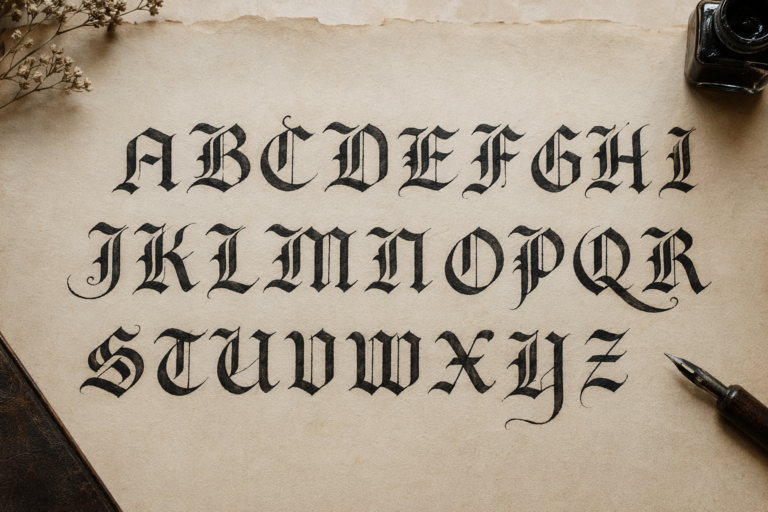
The easiest way to tell these apart is to ask what each one was made for. The gothic alphabet was used to write the Gothic language. Blackletter is a name for book writing styles that came later. One well-known blackletter style is textualis quadrata. People used this formal style to copy Latin books from 1200 to 1500.
The ways these are used are not the same. The gothic alphabet comes from an early Germanic language past and Bible translation work. Blackletter is more about medieval page layout, scribes, and how dense the words look. Old English scripts come from another tradition with its own history.
-
Gothic alphabet = script for the Gothic language
-
Blackletter = later calligraphy styles for books
-
Textualis quadrata = one type of blackletter
-
Old English = another language and manuscript way
-
Looking the same does not mean they are the same thing
The gothic alphabet is not the same as blackletter or Old English. Its true job was for language use, not just style or book writing.
Relationship to Early Germanic Writing Systems
To put the Gothic script among early Germanic writing, it helps to see it in layers. The first layer is with runes. People from early Germanic groups would use runes to make inscriptions. The second layer is more about books and reading. Here, Gothic shows up in a set of alphabet letters connected to the bible and people studying it.
The information also shows that people use the latin script often in grammars and teaching Gothic to new students. The latin script does not take the place of the old Gothic alphabet. But, it lets people find the language a bit easier. Learning with the latin script is something students still get help from today.
So, the Gothic script links with early Germanic ways of writing. This is through culture and a connection with runes, but also stands out as a script for books and study. The runes, the literary Gothic alphabet, and latin script all had their role. They were used by people in different ways over time.
Modern Uses and Applications of the Gothic Alphabet
Even though the gothic alphabet comes from a language that’s not used anymore, it still has a place today. People learn about the alphabet because they like languages or old manuscripts. It’s also used in calligraphy, design work, and when people want to make careful lettering. The gothic alphabet now has value as something to learn from and for art. People do not use it for daily work.
You can see its look turning up in tattoos, historic-style lettering, or in some digital designs that take ideas from older styles. The key thing to remember is to be right about the details. Most of the modern designs use fonts that look like blackletter, but they are not really the old gothic alphabet. In the next bit, you can find out how people use these designs now.
Artistic, Graphic Design & Tattoo Inspirations
In modern design, the gothic alphabet stands out because every letter has its own style and brings a touch of history. Many designers, tattoo artists, and people who love lettering use this look for things like headlines, single words, or to show off special initials. The hard part is knowing if you need the actual alphabet or if a blackletter-style font is enough.
If you want good references, the best thing is to choose sources where you can see each letter form without confusion. Good design begins when you compare the right shapes, not making things up as you go. That’s why a real historical chart, a clear photo of a manuscript page, or a well-done tutorial can give you better ideas than just any old font sample.
-
Look for charts that show all the letters with names or transliteration to help spot each one.
-
Try to find images from manuscript or codex pages so you get an authentic view of the letters.
-
Always check the historical letters before using any font for design.
-
If you want a tattoo, pick short words or just one letter—it will look clearer and more striking.
For graphic design work, it’s a good idea to get your gothic letters as high-quality vectors. The best way to do that is by using expert lettering references, or digital versions made to match the real historical forms of the alphabet.
Examples of Contemporary Gothic Calligraphy
Today, you will often see contemporary gothic calligraphy in all sorts of places. People use it in workshops, for handmade cards, when lettering posters, or for their own study projects. But, in many cases, artists are actually practising blackletter hands, such as textualis. They are not really using the original Gothic alphabet made for the gothic language. It’s good to remember this difference.
Still, there is a nice link between the two. A learner might get interested in the true alphabet and its history, and then try to write those letters neatly using calligraphy. Other people may copy forms from old manuscripts, set the transliteration next to modern English, or just make display art from single names or words.
So, are there uses for this script today? Yes, there are. People use it in projects for teaching, in artistic lettering, in graphic design ideas, and for careful calligraphy work. You will not see this writing used all the time in daily english, but it is still alive in study, craft, and art all over the world.
Conclusion
In summary, this text highlights the meaning derived from 2024-06—a representation of June rather than explore while insight, presenting embedded often found when
Frequently Asked Questions
Is the Gothic alphabet still used in Australia today?
The gothic alphabet is not something people use for daily writing in Australia now. You do not see gothic script play a part in how people talk or write in modern English. Most of the time, you might spot gothic lettering in calligraphy classes, when people look at old manuscripts, or when someone has a design project. People go back to this style for art use or to learn about history.
How can I access free printable Gothic alphabet sheets for practice?
You can find free gothic alphabet sheets on calligraphy tutorial pages, open learning sites, and study guides. These guides show each letter in a clear way. For good practice, pick sheets that show things like how to move your pen, the right space between letters, or transliteration. This will help your calligraphy look good and be easy to read, while also fitting in with the way people did it in the past.
What are the best ways to learn Gothic lettering for calligraphy?
The best way to learn gothic lettering is to follow a clear tutorial and use simple tools. Try to set aside a short amount of time each day to practise. Begin with easy letter groups the first time you start. Keep your nib angle steady as you go. Use practice words again and again until you see your spacing get better. Good gothic lettering will come from the right posture, control and being patient. Don’t rush to try fancy styles.