Key Highlights
-
The english alphabet has 26 letters. These letters make up the modern english alphabet.
-
Each letter of the alphabet has an uppercase form and a lowercase form.
-
There are five vowels in the alphabet. These are A, E, I, O, and U.
-
The other 21 letters are called consonants. Sometimes, W and Y do not act the same in words.
-
The english alphabet comes from the latin alphabet. The letters use the latin script.
-
When you learn the letters, the sounds, spelling, and order, you can read and write better in australia. It helps students in australia feel happy and sure when working with english.
Introduction
The english alphabet is the first thing you learn when you want to read, write, or do spelling in the english language. For students in Australia, it is a big step for clear communication. The alphabet we use now comes from the latin alphabet. It gives you the letters you need to make words, talk about ideas, and build sentences. When you know all the letter names, the sounds they make, and see how words are built, it is much easier to get new vocabulary and to learn english well.
Understanding the English Alphabet: Key Facts for Australian Students
The english alphabet we use now has 26 letters. It comes from the latin script. Each letter of the alphabet has two forms. You get the uppercase letters and the lowercase ones. This setup is the part of the modern english alphabet that gets used in schools, books, and most of the everyday writing.
But the story of the alphabet goes back to old english. At that time, there were 29 letters of the alphabet. They also used some different signs like thorn, eth, wynn, and ash. Back then, you would not see the letters J, U, or W used like the way they are in modern english. All of this shows how the english alphabet keeps changing with time.
What are the 26 Letters of the English Alphabet?
If you need to list all 26 letters of the english alphabet in order, here they are: A, B, C, D, E, F, G, H, I, J, K, L, M, N, O, P, Q, R, S, T, U, V, W, X, Y, Z. These letters of the alphabet make up the modern english alphabet, which comes from the roman alphabet.
Here is a simple text table showing the order clearly:
|
Number |
Letter |
|---|---|
|
1 |
A |
|
2 |
B |
|
3 |
C |
|
4 |
D |
|
5 |
E |
|
6 |
F |
|
7 |
G |
|
8 |
H |
|
9 |
I |
|
10 |
J |
|
11 |
K |
|
12 |
L |
|
13 |
M |
|
14 |
N |
|
15 |
O |
|
16 |
P |
|
17 |
Q |
|
18 |
R |
|
19 |
S |
|
20 |
T |
|
21 |
U |
|
22 |
V |
|
23 |
W |
|
24 |
X |
|
25 |
Y |
|
26 |
Z |
One interesting fact is that the ampersand was once treated as the 27th letter of the alphabet until fairly recently. Today, though, only these 26 separate letters of the alphabet are part of the standard system taught in English.
Uppercase vs. Lowercase Letters: What’s the Difference?
Every letter of the alphabet comes in two types: uppercase and lowercase. Uppercase letters are also called capital letters. Lowercase letters are the small ones you see most of the time in words. The sound and meaning are the same, but they look a bit different on the page.
For example, A and a show the same letter of the alphabet, just in two ways. This is true for B and b, or R and r as well. If you know both uppercase and lowercase letters, it will help you read books, write well, and spot each letter of the alphabet anywhere.
-
Uppercase letters are often used at the start of a sentence.
-
Lowercase letters come up in most everyday writing.
-
Both forms are part of the same letter of the alphabet.
-
Some pairs, like G and g, look more different, but they are still letters of the alphabet.
Vowels and Consonants Explained
When you write in English, every letter of the alphabet stands for a sound. The letters are split into vowels and consonants, and you need both for spelling, reading, and pronunciation. The english alphabet makes it easier for people to write what they want to say in daily life.
There are five vowels and 21 consonants in the basic alphabet. Vowel sounds can be long or short. Consonant sounds are often at the start or end of words. The next two parts will show you how vowels and consonants work in simple and handy ways.
All About the Five Vowels
The five vowels in English are A, E, I, O, and U. You see these letters in a lot of words. They often make the main vowel sounds in a syllable. When you say the letter of the alphabet, the name sounds are /eɪ/, /iː/, /aɪ/, /oʊ/, and /juː/. This helps you to get the pronunciation for each letter right.
Vowel sounds can be tricky. This is because they don’t always sound the same in every word. English, as a language, uses both short vowels and long vowel sounds. For example, a vowel can sound different in a short word, and then change in a longer word. This changes the pronunciation and how you spell it.
There is also the letter Y. Sometimes letter y is used as a vowel, and other times it is used as a consonant. Plus, English brings in diphthongs. These are when two sounds come together, like the sound you hear in “face”. This is why you need to practise vowel sounds, pronunciation, and spelling all the time.
Understanding Consonants in Everyday English
The english alphabet has 21 consonants. These letters are B, C, D, F, G, H, J, K, L, M, N, P, Q, R, S, T, V, X, Z, and you will often see W and Y as well. Consonants are used in many words to help make speech and writing easier to understand.
You will hear consonant sounds at the start, in the middle, and at the end of many words in the english language. Think about the sounds you hear in dog, fish, sing, or queen. Consonants be there to guide spelling and help people know how each word goes from one sound to the next.
Some sounds come when you join two letters of the alphabet together. These letter combinations make new consonant sounds in english. Some common patterns are ch, sh, th, wh, ng, ph, qu, and gh. These digraph groups are not new letters of the alphabet, but they are an important part of spelling, reading, and saying many english words.
Beginner’s Guide: How to Start Learning the English Alphabet
Starting with the english alphabet is a good way for beginners and other learners to get going. It helps you read simple words. You get to know how words sound and see the many spelling patterns in english. When you know the order and the sounds of the alphabet, the big words are not so hard to work out.
A lot of people make a few mistakes here. Some of them only look at the letter names and do not listen to the sounds or think about letter combinations. Others mix up similar letters or do not spend enough time to practise. The best way is to keep working on it every day. Try using songs, flashcards, and some easy examples. The next parts will show helpful resources and a step-by-step way to learn.
Essential Materials and Resources for Australian Learners
You do not have to buy pricey tools to learn the english alphabet. Most people get better when they use simple things that you can use again, as this helps memory and gives you confidence. The main thing is to use resources that let you see each letter of the alphabet, listen to the sound it makes, and hear example words too.
Good things to use are paper cards, some online videos, and listening to words. The alphabet song is really good for teaching the order, and it feels natural when you sing. You can also try using short word lists. That way, you link each letter to words you use in english every day.
-
Flashcards with one letter of the alphabet on each card
-
The alphabet song for order and recall
-
Videos that model clear pronunciation
-
Mini games on learning websites
-
Word examples such as apple, dog, or zebra
Step-by-Step Guide to Mastering the Alphabet
To get better at the english alphabet, start with small steps. First, learn the order of the letters. After that, move on to the names and then the sounds. Taking things this way helps keep the process clear. You won’t get too much at once. If you build your skill like this, the modern english alphabet will be easier to learn.
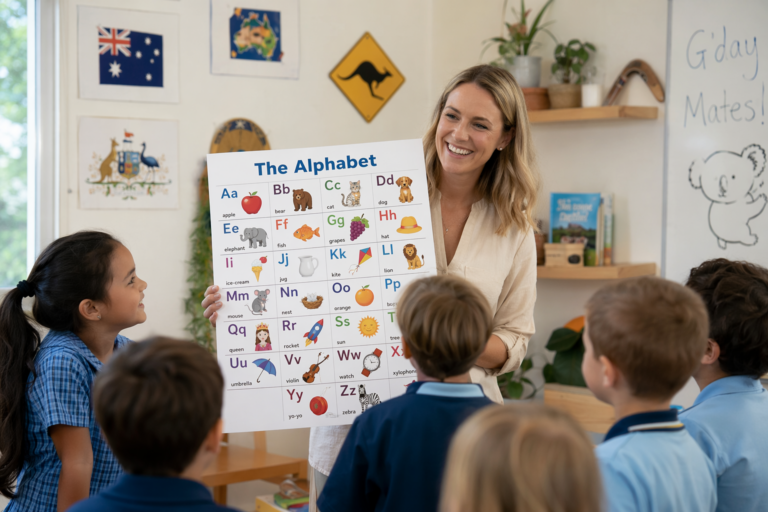
Next, link each letter of the alphabet with a simple word. For example, A is for apple, B is for bee, C is for cat, and keep going from there. This gives your brain the sound, the look, and what each letter means. People remember it better this way than just by learning the alphabet list.
Then, make sure you practise writing and saying the letters each day. Keep the sessions short, as that’s enough. Read all of them out loud and write them out as both uppercase and lowercase. Test yourself often. Going over the alphabet again and again is one of the best tips for getting good at knowing and remembering the modern english letters.
Step 1: Learning Alphabet Order and Letter Names
Start by learning the english alphabet in the order from A to Z. The order is important. You need it for the dictionary, spelling, and different tasks in class. Say the alphabet out loud many times so you don’t have to stop and think about what letter comes next.
Next, learn each letter of the alphabet by name. So, B is said as bee. H can be aitch or haitch. W is double-u. Here in Australia, Z is often said as zed. Knowing the english pronunciation of letter names will help you pick out letters when you hear them in school or every day.
If you want more help, check out some basic IPA next to each name. You don’t have to know all the IPA symbols from the start. Just use IPA for help with the tough letter names. This way, you make the english you hear and the english you speak better, at the same time.
Step 2: Practising Pronunciation and Sounds
When you know the letter names, try to practise the sounds for each letter of the alphabet. This is important because in English, the way we say things is not always the same as how we spell them. What you call a letter can be different from the sound you hear when it is in a word.
Use easy examples. The letter A is in apple, B in bee, C in cat, and D in dog. Listen close and say the sounds again. This will help you get each phoneme when people talk, not just when you see a letter on paper. As time goes by, your ear will pick up small changes.
It is also good to use digraph sounds like sh, ch, th, and ng. These show that in English, you sometimes need more than one letter of the alphabet to make one sound. If you work on both the letter names and the main sounds, reading in English will get a lot easier.
Fun Activities and Tips for Remembering the Alphabet
Learning the english alphabet works best when the practice is active. Many learners get the alphabet fast when they sing the alphabet song, do writing, or play quick games. Doing things is better than just saying the letters over and over. The alphabet song stays a favourite. It helps you remember the order, gives it rhythm, and builds recall at the same time.
Linking the letters to words, simple pictures, or some movement also helps you learn. This way, english practice stays new. You can go back to it often and not get bored. Below, you will find some easy ideas that work well for australian students at home or at school.
Games, Songs, and Practice Ideas for Australian Students
Fun practice really helps when you want to remember letter names, their order, and the sounds they make. Songs and games grab your focus, and they let you go over the english alphabet a lot of times without getting bored. It’s doing it over and over that makes the memory stick.
One smart idea is to use pangrams. The most well-known one is The quick brown fox jumps over the lazy dog. This sentence uses every letter there is, so it’s a good way to check you know the whole alphabet by reading a proper sentence.
-
Sing the alphabet song slowly the first time, then sing it faster
-
Use flashcards with quick games for matching letters
-
Write out The quick brown fox jumps over the lazy dog
-
Try some online mini games about letter order and the sounds
-
Say one letter out loud, then say a word that starts with it
Conclusion
To sum up, getting to know the English alphabet is a big part of learning for students in Australia. When you learn about the alphabet, you find out what makes uppercase and lowercase letters different. You also get to know about vowels and consonants, which are important when you read and write. Doing fun activities and using good resources can make it easy to enjoy and understand the English alphabet. Remember, it’s normal to take your time and try different ways to learn. Go back to any parts that you find hard. The more you practice, the better you get. This will help you speak and write with more confidence later on. If you want extra help or advice about the english alphabet or lowercase letters, you can ask for a free consultation.