Key Highlights
-
The dutch alphabet has the same 26 letters that english uses. This makes it easy for english speakers to start learning.
-
Dutch pronunciation takes steady practice. Some letters and vowels have a unique sound that you will need to get used to.
-
Many common dutch words use letter combinations like oe, ij, and ei. They might look the same as in english, but they do not sound like it.
-
Learners can get better at dutch by using audio, writing drills, and going over things again and again.
-
Simple tricks like mnemonics, songs, and handwritten practice let beginners build confidence fast.
-
Having a strong base in the alphabet helps with reading, spelling, and speaking dutch words.
Introduction
If you want to start learning the Dutch language, the Dutch alphabet is a good place to start. It looks the same to english speakers because the letters are just like the ones in english. But some of the sounds are a bit different and may surprise you. This makes Dutch easy to get into but gives you something new to learn, too. When you get to know the alphabet, you will find it helps you read simple words, notice sound patterns, and get more good at using Dutch every day.
Introduction to the Dutch Alphabet for Australian Learners
At first, the dutch alphabet looks a lot like the english alphabet. That is some good news for people in Australia who want to learn dutch. The 26 dutch letters come from the latin alphabet, and they sit in the same order that you already know. For beginners, this takes away one big problem. You can start to spot dutch words fast, even if you are not fully ready to speak them yet.
But, the tough bit is with dutch pronunciation. Even though the letters look the same as english, the sounds are not always the same. Some dutch letters, vowel pairs, and letter combinations make sounds that english speakers may not hear or use often. Dutch is known as a phonetic language, so how you say the words is very important. If you start training your ear early with the dutch language, you will get better much quicker as a learner.
Understanding the Basics: What Makes the Dutch Alphabet Unique
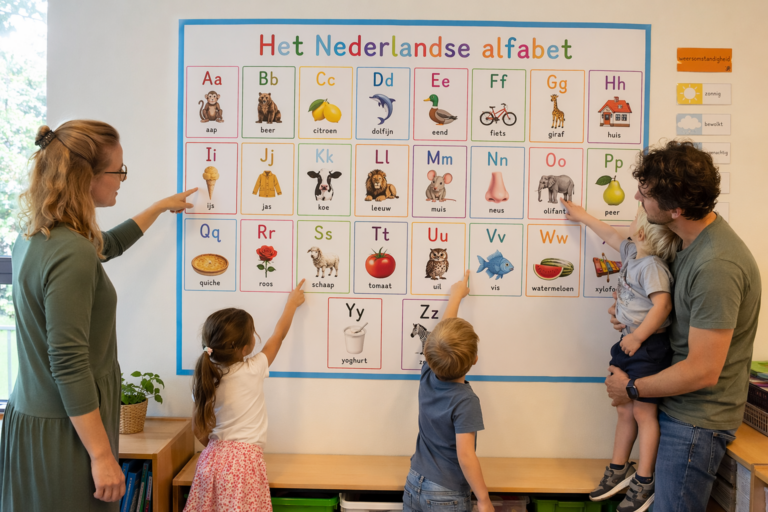
Here is the basic picture. The Dutch alphabet is based on the latin alphabet, and it has 26 Dutch letters. They are A, B, C, D, E, F, G, H, I, J, K, L, M, N, O, P, Q, R, S, T, U, V, W, X, Y, and Z. For learners, that familiar alphabet can make Dutch less hard at the start.
What gives Dutch its unique sound is not having extra letters, but how the letters act when people speak. Dutch pronunciation uses the same symbols as in English, but the actual sound can have different meanings. So a Dutch word might look easy when you see it, but saying it can still be tricky.
There are also well-known letter combinations in Dutch, like oe, ij, and ei. These letter combinations help make the sound of many Dutch words. So, you need to learn them as part of learning the Dutch alphabet, not just treat them as a side note.
Comparing Dutch and English Alphabets: Key Differences
The biggest surprise is that the dutch alphabet uses the same 26 letters as the english alphabet. But the sounds you hear are not always the same in both. So, the main differences are in pronunciation, not in learning a new alphabet. This is good news for beginners, but it can also make you think it is easier than it is.
In the past, there were missing letters in the dutch alphabet. The letters j, u, and w were not always there, but you will find all 26 in the modern dutch alphabet. If you are learning to speak today, it is more important to focus on how each letter sounds than on the history.
For most english speakers, two sounds can be tricky: the dutch g and the dutch w. The dutch g is made at the back of the throat and feels rough. The dutch w is not said like the english w either. Also, the vowels need extra care. Dutch uses both short and long signs for these, and it is good to get them right.
Essential Tools and Resources for Learning the Dutch Alphabet
Good progress often comes in the dutch language when you mix a few basic tools. Dutch lessons in different ways can help you see, hear, and say the alphabet many times. PDF sheets are handy because you can print them, carry them around, and look at them when you have some free time, even if you are not online.
You can also use an app, podcast-style dutch lessons, and word lists to build up your vocabulary while you get used to dutch letters. Using all of these keeps dutch in your mind. Now, let’s see which books, websites, and media can help make your dutch routine a bit easier.
Recommended Apps, Books, and Websites
You do not need a lot of tools. You just need a few good things that you use all the time. The material put together here is great for digital dutch lessons, printable practice sheets, and things you listen to with help. This works well for beginners because it covers the alphabet, practicing words, and working on sounds.
Pick resources that you can print, listen to again, and repeat. This helps with memory, especially when you are learning the order of the alphabet and how the words sound. Some learners get more out of study when they get feedback from a teacher, or what you get with language platforms linked to educational institutions. It is better than trying to do it all yourself.
-
A language app with a Dutch alphabet and short dutch lessons
-
Printable PDF sheets for handwriting practice and review
-
Websites with Dutch word tools and lists of common vocabulary
-
Podcast lessons you can listen to more than once for sound practice
-
Materials from educational institutions or lessons with a teacher’s help
Mnemonics work as well. Use songs, study groups for letters, and practice writing each day to help you remember things faster.
Audio and Video Resources for Pronunciation Practice
Yes, you can listen to audio examples, and this is one of the best ways to get better at dutch pronunciation. The information here talks about podcast lessons, video lessons, and phrase lists that feature native speakers. These tools help you see how single letters become full dutch words and build up your vocabulary.
Listening is important because dutch often seems easier than it sounds. If you only read, you might not notice the ways long vowels, hard consonants, or letters that look like english can sound very different in dutch. It also helps to play short audio clips more than once, instead of trying one long lesson.
-
Podcast lessons that are all about letters, words, and sentences
-
Video lessons where you watch how writing and pronunciation work together
-
Phrase lists with native speakers who say common dutch words
-
Audio drills inside an app so you can practise again and again
Try short sessions each day. Listen to the sound, say it out loud, then see how it is spelt.
Step-by-Step Guide to Mastering the Dutch Alphabet
Getting good at the alphabet in the dutch language is easier when you do it step by step. You do not have to pick up everything at once. Start with the order of the letters. After that, learn the usual sound that goes with each letter. Then, move on to words, listening, and how to spell.
This slow and steady way works well for the dutch alphabet. The letters look simple, but you have to watch out for how they sound. If you work on it one thing at a time, you will find it is not too hard to master. The next steps will turn the whole thing into small jobs you can do each day.
Step 1: Learning the Letters and Their Order
Start by learning the dutch alphabet in the standard order. Because Dutch uses latin letters, this part will feel familiar to most learners. Your goal is quick recognition, smooth recitation, and confident writing in upper and lower case. Do not rush ahead to full pronunciation before the order feels natural.
Here is a simple text table to organise the letters of the alphabet:
|
Group |
Dutch letters |
|---|---|
|
A-F |
A, B, C, D, E, F |
|
G-L |
G, H, I, J, K, L |
|
M-R |
M, N, O, P, Q, R |
|
S-X |
S, T, U, V, W, X |
|
Y-Z |
Y, Z |
Once that order sticks, write the sequence by hand each day. Say the letters softly as you write them. This connects sight, sound, and movement, which helps many beginners remember the dutch letters more quickly.
Step 2: Mastering Pronunciation of Each Letter
After you learn the order of letters, you need to work on how to say them. Dutch is known as a phonetic language, so the sound of each symbol is important. You do not need to speak perfectly on the first day. What you need is to listen steady and say things over and over. Try to clearly hear the name of each letter before you go to full sentences.
Some letters are easy, but some come with a unique sound that can surprise english speakers. The dutch g is famous for its rough sound that comes from the back of the throat. The dutch w is also not the same as the english w, so you should give it extra practice.
Use a simple way to practise. Listen to someone who speaks dutch, say the letter three times, then try it in a word. If the sound feels strange, take your time. Short practise drills, done many times, can give you a better dutch pronunciation than long lessons.
Step 3: Recognising Vowels, Consonants, and Special Characters
After you get used to the basic letters, sort them into vowels and consonants. This will help you see patterns in how to spell and say dutch words. Vowel length is important in dutch. It can change how a word sounds. The consonants can sound different to what you find in english as well.
In dutch, you just use the standard 26 alphabet letters. But, the language likes using special signs and letter combinations. For example, the trema shows you need to say both vowels on their own. The ij is a well-known digraph that has a big part in many dutch words.
You will also come across other letter combinations like ei and oe. Some learners check these against patterns with ai in english. This helps them hear the difference. While these letter combinations do not count as single alphabet letters, they are still a big part of dutch spelling and reading.
Step 4: Practising with Dutch Words and Examples
This is where you start to see how useful the alphabet can be. Instead of using the same letters again and again, now look at dutch words that help you see clear spelling patterns. The info here gives strong examples. The word boek shows how oe sounds. Boom gives you double oo. Muur has double uu, and veel shows double ee.
These dutch words teach you more than just vocabulary. They let you see how the dutch language often uses letter combinations and double vowels to make the sound of words. A good example is wijn. It points out the ij sound. Even land is helpful, as it shows how spelling can change in places like amsterdam and utrecht, with different word endings found in each place.
You do not have to learn every dutch word from A to Z at once. Start with some common dutch words and say them out loud. Read them, write them, and listen many times. This helps you get good at pronunciation and picks up new vocabulary too.
Navigating Dutch Vowels and Diphthongs
For many learners, it can be the vowels that really change things in the dutch language. The letters may look the same, but the sound can be different. This depends on vowel length, if a vowel is repeated, or if it sits with another letter. That is why you need to know more than just the alphabet to read Dutch the right way.
There are diphthongs too. You will see these two-letter sounds a lot in normal dutch words. They change how you listen to dutch and how you say it. When you see how vowels, the long patterns, and diphthongs work in the dutch language, you find that it gets much easier to read and hear new words.
Common Vowel Sounds and How to Pronounce Them
Dutch vowels need close focus because how long the vowel is can change how you say a word. If you use a short vowel or a long vowel, it makes the word sound and move in a different way. This is why it’s not enough for learners to just remember the letters. You have to listen to dutch words and hear how the vowels sound in them.
The material gives you a look at some long vowels in dutch spelling. You see this with the double oo in boom, the double uu in muur, and the double ee in veel. These dutch spelling rules help you know if a vowel is long. Once you pick up on this, it gets easier to read dutch words.
But there are also some tricky vowel combinations that can trip you up. These are sounds like oe, ij, or ei. english speakers might not guess the right sound just by looking. The best thing for learners is to listen to the words, say them out loud, and check how they sound. If you do this, you find that dutch vowels start to make more sense. The sounds fit better, and soon it comes more easily.
Important Diphthongs: ij, ei, au, ou, and More
Diphthongs are a big part of Dutch spelling and Dutch pronunciation. These are sounds made by joining two letters together. Dutch uses the same letters as English, but the way they mix letters makes a new sound. Many learners spot this in their first few Dutch lessons. Two letters together can form one main sound, not two single ones.
The information here points out ij and ei. Beginners often hear these as the same sound. This can confuse people at first, especially if you read fast. The important thing is not to try to remember every rule right away. It is more about seeing that these sounds do matter to those learning Dutch.
-
ij pops up in words like wijn and has its own strong sound
-
ei can sound like ij for many new learners
-
oe is another group, you will hear it in boek
-
au and ou are two more to keep an eye out for as you go along in your study
Try to spot these as whole sound groups. When you see them, pause for a second and say them pulled together. This can help a lot with your Dutch pronunciation as well as understanding Dutch spelling, especially for beginners.
Tips, Mnemonics, and Techniques for Memorising the Dutch Alphabet
Most people who are new to the dutch alphabet find they remember it faster when they use easy memory aids instead of just repeating things over and over. Tricks for memory can help because they turn hard letters into things you see, do, or hear, so they are easier to remember. This is important because learners have to think about spelling and also how to say each word.
The good thing is you do not need anything hard or tricky. You can try songs, writing things out, and setting small goals each week. These steps can help more than you think. In the next bit, you will see some simple memory aids that teachers and people learning by themselves often like to use for learning the dutch alphabet and getting better with pronunciation.
Fun Memory Aids Used by Dutch Learners and Teachers
The material here shares a few helpful tricks for people who are starting out. These tips are great in dutch lessons for beginners. They are simple to use, need little money, and you can do them at home again and again. For learners, it’s all about showing up each day. Doing a short routine daily will often give you better results than one big session once every week.
It helps if you mix sound, movement, and writing. This makes it easier to remember things. For those in a dutch lessons, the letters look like ones you know. The hard bit is learning what sound matches each symbol. Moving your body as you practise also makes it stick better for most people.
-
Learn an alphabet song or a short poem and say it out loud.
-
Focus on only a few letters at once before you try more.
-
Write each new letter by hand lots of times in your notebook.
-
Trace or draw letters that are big, and move your body while you say the letter.
You can also make a link in your mind between a new Dutch letter and a sound you know in your first language. If this picture in your mind is bright and strong, you will often remember it.
Conclusion
To sum up, getting to know the Dutch alphabet gives Australian learners lots of new chances. When you see how it’s different from the English alphabet, you can get better at the Dutch language faster. The tools and ways shown in this guide—like saying the letters out loud and using fun tricks to remember them—can make it easier and more fun to learn. The key is to keep practising and to use the language as much as you can. Don’t be afraid to dive in and try out the Dutch language. This will help you build your skills. Good luck, and enjoy your Dutch learning journey!
Frequently Asked Questions
Which letters are unique to the Dutch alphabet?
The Dutch alphabet is the same as the standard Latin alphabet. There are no extra letters. What makes Dutch have a unique sound is the way you say the words, along with special marks like the trema and the “ij” combination. These things help Dutch sound different, even though the alphabet is just like English.
How do Dutch children learn handwriting and the alphabet?
Dutch children usually learn the Dutch alphabet and handwriting in school. This happens with a clear routine. The kids practice writing by hand many times. They use printed worksheets in the classroom. Educational institutions follow standard spelling. There are also legal requirements. These connect to official spelling rules and the Spelling Act.
Are there regional pronunciation differences in the Netherlands?
Yes, you can find different pronunciation styles in the Netherlands. The information shows that spelling used to change from place to place, like in Amsterdam and Utrecht. This shows there is a lot of regional variety in the Dutch language. Learners today might still notice some accent differences. But the alphabet stays the same all over the country.
Can I find audio examples to practise Dutch alphabet sounds?
Yes, you can work on your Dutch pronunciation by using things like audio and video lessons, podcast clips, and drills from an app. These tools help you hear how native speakers say letters, words, and short lines. If you play these short sounds again and again, you can pick up the right Dutch pronunciation better than by just reading.