Key Highlights
-
The danish alphabet has 29 letters, and english speakers will see most of them and know what they are straight away.
-
There are three special letters at the end, Æ, Ø, and Å. These ones are big when it comes to danish pronunciation.
-
The system comes out of the latin alphabet, and this helps make the new language feel more easy to pick up.
-
You have to be careful with danish vowels because vowel length in danish words can change what you want to say.
-
The soft d, the danish r, and stød might get people on their language learning journey, even when you think you know the basics.
-
Regular practice with charts, apps, and simple words will help us build confidence fast.
Introduction
Starting with the danish language might be easier than you think. The danish language uses the same base as the english alphabet. But if you pick up a new language, there are always new things to find. Danish gives you three extra vowels. There are sound patterns that are different, and some of the letters act in a new way when you say them. If you learn the alphabet first, it can help a lot. This will make it easier for you to read, write, and hear danish. You will not need to guess as much and things will make more sense.
Overview of the Danish Alphabet for Australians
For Australians, the danish alphabet can be easy to get, especially if you know the english alphabet. It uses the same 26 main letters that english speakers use. So, when you see the page, it will not look strange at first.
What makes it different are the extra letters Æ, Ø, and Å. Native speakers use these as full vowels, not just as marks on letters. So, the alphabet is close to English, but it is not the same. Knowing about these extra letters early in your language learning journey can help you a lot. It will make things smoother, and you may see important spelling and sound patterns right from the start.
This can be good for you in language learning because you will get what native speakers say and read more clearly.
The Structure and Order of the Danish Alphabet
The danish language uses the latin alphabet. That is why the letters look so familiar to many people in Australia. Because of this, you get a good head start. When you start to see danish writing, you are not looking at a new set of shapes. You are working with the same building blocks as English, with just a few new ones added in.
In the way most people use it, the alphabet in danish starts at A and goes to Z. But at the end, there are three extra vowels. These are not just added on for fun. They are a real part of the alphabet, and people need to know them.
The order at the end is like this: X, Y, Z, Æ, Ø, Å. So, if you want to know where to find Æ, Ø, and Å, they sit at the very end of the alphabet. This place is important for putting things in order, like names or words. It is a good idea to learn this right from the start.
How Many Letters Does Danish Have?
The danish alphabet has 29 letters. There are the 26 that you see in English. But then, there are three more extra letters too. These are the additional vowels: Æ, Ø, and Å. These extra letters are pretty important for Danish spelling and the way people talk. You cannot just ignore them.
The whole set of letters is A, B, C, D, E, F, G, H, I, J, K, L, M, N, O, P, Q, R, S, T, U, V, W, X, Y, Z, Æ, Ø, Å. Some letters, like C, Q, W, X, and Z, show up mostly in words that come from other languages. But even so, they are still part of the main 29 letters.
When it comes to saying the letters, many of the consonants will seem about the same as in English. The vowels, though, can be a bit different. They can be long or short. Æ sounds a bit like the e in end, but more open. Ø is a special rounded sound and there is not a real match for it in English. Å can sound close to o in open, at least when it’s long. Later on, you will be able to read about these sounds in more detail.
Comparing the Danish and English Alphabets
At first, the Danish and English alphabet seem pretty much the same because both come from the Latin alphabet. That means it’s good for Australians, since you can see the shapes of the letters right away. It takes away one big roadblock when you start learning a new way to write.
But the big change is that Danish puts three extra vowels at the end: Æ, Ø, and Å. Danish also uses usual letters in ways that might not feel so usual, especially when we talk about danish vowels and danish pronunciation. A letter might look the same as you see it in English, but it can sound different when someone says it.
-
Danish has 29 letters and English has 26.
-
Æ, Ø, and Å are real letters and not just marks on top.
-
Some letters, like C, Q, W, X, and Z, mostly show up in words taken from other languages.
-
Vowel sounds in Danish can be a lot more up and down than most people think at first.
So the two alphabets are close, but it’s how danish pronunciation works that gives most people a challenge.
The 29 Danish Letters Explained
Knowing the full Danish alphabet is just the start. You really get ahead in your language learning when you can pick up the Danish letter sounds. Some letters in Danish work much the same as in English. But there are others that change, depending on the sounds around them.
This is important because a lot of native Danish words can hide the way they are said. It’s not always clear from just looking at the word. If you work on the letters that always sound the same, and learn which ones change, your language learning journey will feel a lot easier and less frustrating. The next parts here will show you not only the standard letters, but the three extra Danish ones too.
Standard Latin Letters in Danish
Most of the standard letters in the Danish language come from the latin alphabet. So the way they look is often easy to spot. But just because the letters look the same, it does not mean they will sound the same as in English. That is why people starting out with Danish can read the words, but not say them in the right way.
A few consonants in Danish sound quite like they do in English. K sounds like k in kick. P is often like p when it begins a word. If you hear a V at the start, it feels like v in very. J is usually a y sound, like you, and that can trip up people new to the danish language.
Some letters do not always have a set sound. D can turn soft, a bit like the th you hear. After a long vowel, G might not be clear. Sometimes you cannot hear it at all. If you say R, do not use the R from Australian English. So, while the danish letter sounds come from letters you know, you need to listen hard and learn them from the start.
The Three Unique Danish Letters – Æ, Ø, and Å
The Danish language has three special letters. These are Æ, Ø, and Å. These letters are not just marks added to other letters. Each one is its own letter with a spot in the Danish alphabet. They have their own names and sound different, too.
Æ is a front vowel. It does not sound exactly like any English vowel. It is a bit like the “e” in “end,” but you open your mouth a bit wider. Ø is also one of the special vowels. Many English speakers find this one hard. When you say a long Ø, it can sound like a rounded version of the vowel you hear in “hurt.” Å, when long, has a sound that is close to the “o” in “open.”
You see these unique characters in many words. They make a difference to the meaning. To get Danish pronunciation right, you need to learn them early. You will hear them a lot when people talk, and native speakers want you to use them as real letters, not just as shortcuts or swaps for other letters.
Where Æ, Ø, and Å Fit in the Alphabet
Many Australians think that Æ, Ø, and Å should be next to A or O. But in the Danish alphabet, these special letters go at the end, just after Z. This can open up a surprise for many first-time learners.
That order stays the same across the the dictionaries, class lists, and when you put things in ABC order. These extra vowels are not just old letters with a small change when you sort words. Each one stands alone, and people who use Danish all the time expect you to sort them this way.
-
Æ is found after Z.
-
Ø goes right after Æ.
-
Å shows up after Ø and is the last letter in the Danish alphabet.
If you take away just one rule, make it this end order. It helps you spell, find words, and work out why Danish names or places might be later in lists than you, or any English speaker, would think.
Pronunciation Basics for Australian Learners
For people in Australia, the first real challenge with danish pronunciation is not what danish words look like. It is how they sound. There are many new sounds in Danish, mostly in the vowels, and some letters can be soft or even not spoken at all.
A good first step can be to learn danish letter sounds by breaking them into groups. Begin with the basic vowel sounds. Then, see how long vowels and short vowels change when you say them. After that, watch how the D and R sound, and check out common letter pairs. Making small changes to how you listen can help a lot. These next parts show the places where many people will have trouble when starting.
Key Differences in Danish Pronunciation
Danish pronunciation can seem tricky because the letters do not always sound the way most Australians might think. The biggest changes happen with the vowels and some consonants. If you train your ear early on, many danish words are not so confusing.
One big thing to note is vowel length. Danish vowels can be long or short, and that really changes the way a word sounds. Another thing is the danish r. It is not like the English one, and it can change the vowel that comes before it. Some letters can also get weaker when they are in the middle or at the end of words.
-
Learn long and short vowels as separate sound habits.
-
Expect soft consonants, especially the letter d in lots of spots.
-
Listen for the danish r instead of saying an Australian r.
-
Do not think spelling tells you the full spoken form.
These changes are why it helps beginners to read and listen at the same time, not just try to remember the alphabet by itself.
Special Pronunciation Features Like Stød
One thing that makes the danish language different is something called stød. It’s a kind of glottal stop. You can hear it in some words, especially in parts of Denmark. It isn’t a letter, but it does change the way a word sounds. It also helps people tell words apart.
If you have ever said nuh-uh in English, you have already heard the idea of a glottal stop. In danish, stød pops up in words like lang, hund, and a few ways of saying maler. There’s no easy rule that tells you when it will show up.
If you’re just starting, don’t try to get it perfect the first time. You should listen for the click or pressure in the voice and try to copy it bit by bit. Stød is part of danish pronunciation, but it gets easier to hear once you get used to the way Danish sounds.
Common Pronunciation Pitfalls for Beginners
When you start to learn a new language in Australia, the most common mistakes are because people trust the spelling too much. Danish writing might look close to English, and this makes it easy to slip English ways onto every letter. That takes you off the real Danish letter sounds.
Vowel sounds give most people the biggest trouble. Each vowel can be said in more than one way, and words change with different letters next to them. Many also don’t hear the soft d or the silent g, or they say D and G too hard. Some keep putting in an English-sounding R, even though Danish r is its own sound.
-
Do not give every written letter a full sound.
-
Watch each vowel sound to see if it is short or long.
-
Try not to push out the soft d or speak the silent g.
-
Danish r has its own sound, so don’t just use the English one up.
If you slow down and say words in small groups, these common mistakes will pop up less and be easier to fix.
Spotlight on Unique Danish Letters
The most interesting part of the danish alphabet is the three unique characters: Æ, Ø, and Å. These are special vowels that are easy to see on the page. But they are even more important when you speak because each one sounds different.
For danish pronunciation, you should start practising these letters right away. None of them are exactly like what you have in English. That is why many Australians need a bit more time to get used to listening for them. When you do get the hang of these special vowels, everyday reading will seem much easier and not so scary.
How to Pronounce Æ, Ø, and Å
These three letters are best learned by using both your mouth and your ears. Danish pronunciation often means you have to move your lips and mouth in a new way, not like in English. If you just read about it, the sounds can stay unclear. So, always think about the mouth position for each vowel sound.
Æ sounds almost like the e in end, but you open your mouth wider. Ø does not really match any English sound. A long Ø is close to the sound in hurt, but with your lips rounder. Å usually sounds like o in open if it’s a long vowel and it can sound shorter in some cases. Unlike the soft d, these are pure vowel sounds and not shifts between consonants.
-
Open wider for Æ than in English.
-
For Ø, keep the sound forward and round your lips.
-
Make Å sit deeper, like it comes from back of the throat.
-
Practise full words, don’t just copy sounds on their own.
This last tip makes the danish pronunciation feel more natural when you talk for real. The key to getting each vowel sound right is practice and paying attention to how you move your mouth.
Common Words Using Danish Special Characters
You will not have to wait long to come across these letters in everyday words. Native speakers use the special characters in common words all the time. If you learn them through real examples, it will help you much more than just thinking of them as odd shapes.
For example, æ appears in æg, which means egg. Ø shows up in words like øl, meaning beer, and købe, which means to buy. Å is found in åben, meaning open, and få, which is to receive. Seeing these makes it easy to match the special characters with meaning, so you can remember their sounds.
-
æg
-
øl
-
åben
As soon as you start to spot these letters in words you know, you will see they do not look odd. This gives you more confidence to read and makes it easy to connect spelling and sound in a way that is really real, not just for study.
Distinctions Between Danish and Norwegian Special Letters
Danish and Norwegian are close neighbours, so learners often compare them. Based on the compiled material, both systems place Æ, Ø, and Å at the end, and Danish notes that Swedish and Norwegian differ more clearly in pronunciation, especially with features like pitch and the sound of R.
A useful point from Danish learning material is the old spelling form aa. In Danish, Å replaced aa in general writing, though aa still appears in some personal and geographical names. That change is linked to spelling reform, and it helps explain why some names keep older forms.
|
Feature |
Danish |
|---|---|
|
End letters |
Æ, Ø, Å |
|
Older form still seen |
aa in some names such as Aarhus and Aalborg |
|
Effect of spelling reform |
Å replaced aa in general use |
|
Pronunciation note versus Norwegian alphabet |
Danish R is described as different from Swedish and Norwegian, and Danish uses stød rather than phonetic pitch |
So, the biggest safe takeaway is this: the danish alphabet uses the same special end letters, but some sound features and old written forms differ.
Practical Danish Alphabet Learning for Aussies
If you want to see real progress in language learning, keep things practical. It helps to say the alphabet out loud, write it, and use it in short words, instead of trying to remember everything at once.
For Australians, the best way is this. Use short danish lessons, say the sounds out loud, and add practical exercises you can stick with. Regular practice is more helpful than having one long lesson each week. The next parts will go over charts, daily ideas, and apps or online tools that can help you keep improving.
Using Alphabet Charts and Pronunciation Guides
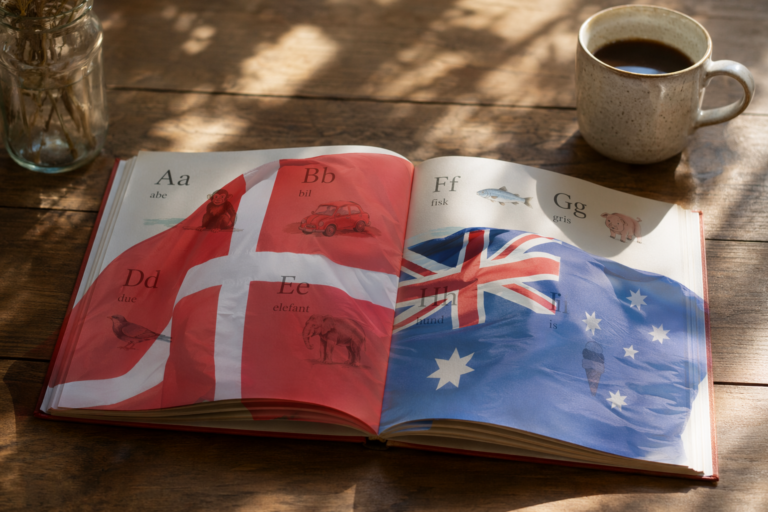
A danish alphabet chart is one of the best way to organise what you are learning. The full chart lets you see all the letters at once. It makes sure you notice extra letters as you learn, and not lose them like footnotes. When you are busy with language learning, there is something about having that chart on hand that really helps.
Pronunciation guides make things even better, especially if the spelling is easy but the sound is not. When you have a chart and some audio, you get to compare how the letter looks, how you say the name, and how it sounds in a real word. This is a good way to learn the tough vowels and letters like D, G, and R that can sound tricky.
-
Keep a full danish alphabet chart where you study every day.
-
Match each letter with one easy sample word.
-
Use pronunciation guides that have audio you can play back.
-
Review the final letters Æ, Ø, Å again and again until you know them without thinking.
This setup helps you hold the whole alphabet in your mind. It makes reading and language learning less confusing, especially with those extra letters.
Helpful Danish Alphabet Practice Techniques
You do not need big or tricky study plans to get better. The advice here is all about using easy exercises. Pick a few letters at a time. Write them by hand. Say them out loud. Try to pick them out from books, signs, and other things you read. Doing these things all the time helps you remember faster than trying to learn a lot at once.
Body-based learning is another good way. You can draw big letters, say them as you move around, or use music and rhythm to keep them in your head. It might sound like a game, but it helps a lot of complete beginners remember shapes and sounds of letters well.
-
Write each new group of letters every day in a notebook.
-
Use simple danish words to match letters to meaning.
-
Add minutes of daily reading practice with very short texts.
These regular practice routines are easy for most people to stick to. They help you see progress bit by bit without making your week feel too full.
Popular Language Apps and Online Resources
Yes, there are good tools that can help, and the material put together shows two simple types to try: app-based danish lessons and downloadable learning guides. Babbel lets you choose Danish and shows you a guide for the alphabet. DanishClass101 gives you help with the alphabet, charts, practice sheets, and some easy material for beginners.
When you start your language learning journey, you will get the most from these online tools if they let you read and listen too. eBooks or PDFs that you can download are good because you can print and use them away from your computer. You can also write notes right on the worksheets as you practice the letters and how they sound.
-
App-based danish lessons with audio playback
-
Printable eBooks or PDF practice sheets
-
Short danish texts and phrase lists for review
The main point is not the brand itself. What matters more is if the tool lets you hear, read, and say the alphabet again and again so you can remember it well.
Danish Alphabet in Everyday Use
The danish alphabet is not only something you hear about in the classroom. You see it in everyday words, place names, signs, and simple reading books. When you start to spot letter patterns, the system feels much more real.
That is why exposure is important. Danish children get to know these letters early, and adults can do the same by listening to danish music and reading short danish texts. The next parts talk about which letters you see the most, how you type the special ones, and how knowing the alphabet matters day-to-day.
Frequency and Occurrence of Each Letter
The compiled material does not give a full ranked frequency list for every letter, so it is best to stay practical. What it does show is that all 29 letters belong to the danish alphabet, but some appear in daily writing far more naturally than others. Native speakers regularly use the core vowels and consonants in common danish words.
It also notes that C, Q, W, X, and Z mainly appear in loanwords. That means learners should not panic about seeing them less often in ordinary Danish. By contrast, Æ, Ø, and Å are real working letters and show up in standard vocabulary.
|
Letter group |
General occurrence in Danish writing |
|---|---|
|
Core letters A–Z |
Common across everyday spelling |
|
C, Q, W, X, Z |
Mostly found in loanwords |
|
Æ, Ø, Å |
Regularly used as standard Danish vowels |
|
Diacritics such as acute accents |
Not very common |
So, different letters are not used equally, but the extra Danish vowels are far from rare.
Tips for Typing Danish Letters on an English Keyboard
Typing Danish with an English setup can feel a bit strange at first. The special characters are not shown on the keys. But the material you get gives you a handy backup. If you can’t use the Danish letters, you can write Danish using ae, oe, and aa.
This means you don’t have to pause your study if there are missing letters. You can still write things in a way that people can read while you learn. The same material says that aa is still found in some names. So, this way of writing is not new to everyone who reads Danish.
-
Use ae for Æ
-
Use oe for Ø
-
Use aa for Å
For practical exercises, these tips will help you on a standard keyboard. Later on, you can swap to a Danish keyboard on your computer or phone if you want to find the special characters faster.
Danish Alphabet in Schools and Society
In Denmark, the danish alphabet knowledge is just part of normal life. It is not something only experts know. Kids grow up knowing all the letters. This includes the special vowels like Æ, Ø, and Å. From day one, these are seen as usual. For people who are learning, this can help a lot. The aim is not to master something new or strange, but to get into their normal reading system.
You can see how this shows up everywhere for kids. It is in children’s books, classroom walls, and even in songs they use when kids start learning. There are simple examples, practice sheets, and even an alphabet song to help. These tools use a lot of repeating, which makes it easy for students to get the idea.
Even after kids leave school, they keep using this danish alphabet knowledge. They see the same letters in names, on packaging, and on food labels. When you know the special vowels and spot some sound patterns, you find that dealing with Danish out in the world gets much simpler. It is not hard or scary to read things in Danish every day.
Conclusion
To sum up, knowing the Danish alphabet is important if you want to learn the language and what it’s all about. Get to know the special letters like Æ, Ø, and Å and how to say them right. This will help you pick up Danish faster. It’s true that practice is the best way to get better. Use language apps, guides for how to say the words, and any other tools you find. Try to use Danish whenever you can, and don’t be shy about watching shows or listening to music in Danish. If you want to keep learning, check out our free resources. Hope you enjoy it!
Frequently Asked Questions
How can I type Æ, Ø, and Å on my computer or phone?
If you do not have a Danish keyboard, just use ae for Æ, oe for Ø, and aa for Å. These can be used in some situations and make it easier for language learning, practical exercises, and everyday words. Later on, you can add a Danish keyboard layout to get straight to the special characters.
Is the Danish alphabet difficult for English speakers to learn?
Not most of the time. For english speakers, the Danish alphabet is one of the easier parts when you start a new language. This is because most letters are the same as the usual Latin set. The main thing to get is the extra letters Æ, Ø, and Å. There are also different sounds that native speakers pick up easily.
Are there free online resources or eBooks for mastering the Danish alphabet?
Yes. The gathered info leads you to online places like alphabet guides, printable PDFs, and starter eBooks. These help with language learning by giving practical exercises, danish texts, charts, and audio reviews. They are good if you want stuff to print out and use for offline study. You can go back to it any time.