Key Highlights
-
The Cherokee syllabary is the writing system for the Cherokee language, and it’s sometimes called the Cherokee alphabet.
-
The symbols in the Cherokee syllabary do not work like the English alphabet. Each one shows a full part of a word, not just a single letter.
-
Sequoyah, who was also known as George Gist, came up with this way to write the Cherokee language in the late 1810s and finished it by 1821.
-
The Cherokee Nation started using it, and you can see it in the Cherokee Phoenix.
-
This writing system let Cherokee people read, write, find out new things, and keep the Cherokee language strong even now.
Introduction
If you ever see the Cherokee language and wonder how it’s written, you’re not alone. For many people in Australia, the Cherokee writing system may look new and different at first. But its story is easy to follow and stands out. Someone made this writing system for the Cherokee Nation, which is one of the best-known Native Americans groups, to have a way to write their own language. This was huge back then, and it’s still important now as people try to keep and grow the Cherokee language and identity.
Origins of the Cherokee Alphabet
The Cherokee alphabet was made by Sequoyah. He was a Cherokee man, and you might also know him as George Gist or Guess. He started this work on the cherokee syllabary back in 1809. He finished it by the year 1821.
His main goal was clear. Sequoyah saw that writing helped people chat with others far away, keep notes, and bring people together. The cherokee people could use this new writing for their own language. The cherokee syllabary gave the cherokee nation a way to stay strong and swap ideas at a time when there was a lot of pressure and change for them.
Sequoyah’s Inspiration and Innovation
Sequoyah, also known as George Gist, did not learn how to read or write in English. Even so, he understood how strong written words could be. He saw some Cherokee people talk about “talking leaves.” He knew that writing was made by people. It was not magic. That helped him start to build a way to write the Cherokee language.
At the start, his work was slow. He used some tests and tried different ways. He first tried making a picture for each word. That method was too hard. So he then switched to using sounds. He broke spoken Cherokee down into sound parts and made a mark for each one.
It took him about ten years to finish this idea. His final work was Cherokee writing that used syllables. The end result was called the Cherokee syllabary. This simple system helped write the Cherokee language on paper for the first time, which was big for all Cherokee people.
Purpose Behind Creating the Syllabary
The creation of the syllabary came from need. Sequoyah thought his people should have a written language in their own language. He didn’t want the words to be just spoken and forgotten. Writing would let the Cherokee Nation share news, look after records, and keep in touch even when people were far away.
This became even more important when white settlers and the government broke up the Cherokee communities, sending some east and some west. A written system could help their people stay together and know what was happening in these uncertain times.
-
It let the Cherokee Nation talk to each other across long distances.
-
It kept ideas, things that happened, and messages safe in a written language they could use later.
-
It gave cherokee people a strong way to use and take pride in their own language.
Structure of the Cherokee Syllabary
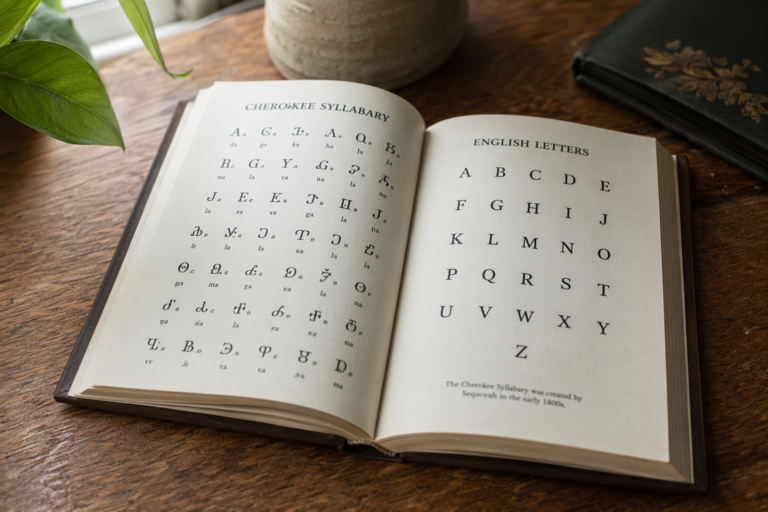
The Cherokee syllabary is not like the English alphabet. It does not use letters for each consonant and vowel on their own. Instead, this writing system has syllabary characters. These symbols usually stand for a consonant and a vowel together.
So, people match each symbol to a spoken sound in the Cherokee language. Sequoyah made this system with 86 symbols. That was enough for the sounds used in daily talk. Once you know how the Cherokee syllabary works, it helps to look at how it is different to the English alphabet. You can also see how the symbols of this writing system are set out and used.
Syllabary vs. Alphabet – What’s the Difference?
A lot of people call it the Cherokee alphabet, but that’s not really right. The Cherokee syllabary is not the same as the English alphabet. The two writing systems work in different ways. In the Cherokee syllabary, most of the symbols stand for whole syllables, not just single sounds or letters.
When people read with the English alphabet, they put letters together to make a word. But in the Cherokee writing system, one symbol can show a full part of a word as you would say it out loud. This shows how the Cherokee syllabary fits how people speak.
-
The english alphabet uses letters that show small bits of sound.
-
The cherokee syllabary uses symbols for whole syllables. This is often a consonant and vowel together.
-
Both are a writing system, but the english alphabet and cherokee syllabary put speech into writing in their own way.
Components and Arrangement of Cherokee Symbols
Cherokee symbols were made to show how the words in the language sound. Most of the syllabary characters stand for whole syllables, not single letters. This means people learn the sound units instead of having to remember lots of single consonants and vowels.
Sequoyah first put the symbols in an order that he liked. Each symbol has its own spoken sound. The phonetic values of these characters make it possible to turn spoken Cherokee into written words. People could learn this system fast once they saw how it works.
When reading or writing, it is important to match the shape of the symbol with the sound it makes. Once you know a character and its sound, you can go from spoken Cherokee to writing with much more confidence. The idea is simple—syllabary characters and phonetic values of these characters help people move between talking and writing in the language.
Learning to Read and Write in Cherokee
Learning Cherokee writing begins with a new way of thinking. You are not just trying to remember the pattern of separate letters in the English language. You are working with sound units that match how people say words in the Cherokee language.
This can actually make things easier, especially for beginners. When you get to hear the syllables clearly, you will see that the symbols are easier to learn. Stories from the past show that people picked up the system fast, so that can work well for you too. After that, it is good to work on saying the words right, knowing the sound patterns, and a few other good habits to help you improve.
Cherokee writing is different from the English language, but with time and these tips, you can make steady progress.
Pronunciation and Sound Patterns
Pronunciation is important in the Cherokee language because the Cherokee syllabary is tied to how people speak. When you read text written in Cherokee, you do not sound out every single letter like students of English writing do. You look at the whole syllable and say it as one sound.
This is why you need to pay close attention to vowel sounds. If you are learning, you have to listen to how the syllables are made and notice how a single phoneme fits in the bigger speech pattern. Even if you do not see the symbols as the same as English letters, you still need to understand the spoken words well.
Short vowels and long vowels will change the meaning of a word, so it helps to listen closely right from the start. The more you get used to hearing people speak Cherokee, the better you will get at reading and writing it in a natural way.
Essential Tips for Beginners
Starting with small steps is the best way to go. A Cherokee student can do well when they learn the sounds and symbols together. It’s better not to try to learn each on its own. Because Cherokee writing is close to how you say the words, you should listen to the language while you practise reading.
It’s good the be real with yourself. You are picking up a new system, not just a different form of English. So, it’s good to go slow and repeat what you learn. That will help more than trying to get through all the Cherokee writing symbols in one go.
-
Learn the syllable sounds first before you go for longer words.
-
Practise easy and common words like ᎣᏏᏲ, which means hello.
-
If you can, listen to native speakers and try to repeat after them.
-
Just go over a small group of symbols many times, rather than try all at once.
Visual Guide to the Cherokee Symbols
A full Cherokee alphabet chart shows you all the Cherokee symbols in the syllabary. The system uses syllables, not letters like the english alphabet. So the best kind of guide matches each symbol to how it sounds, instead of making it work like the english alphabet.
Below, you can see a simple table of text. The examples here come straight from the forms people say, and these appear in official material. You won’t see every one of the 86 characters, but this gives a clear look at how the writing system links the symbol, the sound, and the meaning for real use.
Cherokee Alphabet Chart and Phonetics
If you want to see how the Cherokee syllabary works, start with a few known examples. These entries show that Cherokee symbols map to spoken syllables, not to single English letters. That is the key difference behind the so-called Cherokee alphabet.
Here is a simple text table with examples and the phonetic values of these characters as presented in common learning material:
|
Cherokee symbols |
Sound guide |
Meaning |
|---|---|---|
|
ᎣᏏᏲ |
O si yo |
Hello |
|
ᏤᎾᏓᎪᎲᎢ |
Tse nu da go hv i |
Goodbye |
|
ᏣᎳᎩ |
Tsa la gi |
Cherokee |
|
ᏏᏉᏯ |
Si quo ya |
Sequoyah |
Even this small chart shows the pattern clearly. When learners connect each character group with its spoken syllables, reading becomes much more approachable. A full chart would extend that idea across the rest of the syllabary.
Numbers and Special Characters in the Syllabary
People often ask if numbers are a part of the Cherokee syllabary. From what you see here, the syllabary was made to show the spoken sounds of the Cherokee language. It uses syllabary characters for words and syllables, not for numbers.
So, when you want a separate set of numbers or special marks in Sequoyah’s main system, this is not what the main description talks about. The big idea is to write Cherokee speech in a clear and honest way.
-
The syllabary is focused on the sounds of the Cherokee language. It is not built for a list of numbers.
-
Its main symbols are for spoken syllables in the Cherokee language.
-
Special marks are not what the system is about here.
This is what stands out when you look at cherokee syllabary and syllabary characters.
The Cherokee Syllabary in Everyday Life
The Cherokee syllabary was not just for scholars. Early on, people in the Cherokee Nation used it every day. They used the Cherokee language in the syllabary to talk, share news, and print things. This helped keep people in the community close and in touch.
The value of the Cherokee syllabary is still strong. The Cherokee language is at risk because there are not many people who speak it well now. Even with this, the syllabary is important in trying to keep the language alive. People use it for printed records, teaching, and holding on to culture. That is why the Cherokee syllabary is still used today, and why it means so much to the Cherokee Nation and its people.
Modern Usage and Cultural Importance
Once the Cherokee Council approved the syllabary in 1826, people in the Cherokee Nation started to use it in many new ways. The Cherokee Phoenix printed it in a bilingual newspaper. This paper was read not just in the Cherokee Nation, but also in other parts of the United States and even in Europe.
While time went on, more books and papers were printed using the same press. They made hymn books, the Bible, and a novel all in Cherokee. Because of this, the writing system became a part of daily life. People saw it not just for learning at home, but out in public, too.
-
The Cherokee Phoenix made it easier for people to read and send messages.
-
Regular reading of Cherokee books and papers helped keep the language alive.
-
People keep teaching and learning today, which means the writing system still matters a lot for culture.
[cherokee nation]
[cherokee phoenix]
[writing system]
[united states]
Preserving Cherokee Language and Identity
Today, the Cherokee language is at risk. Less than 5 per cent of Cherokee people can speak Tsalagi well, as said in the material given. So, keeping things written down and teaching others has become very important for the Cherokee Nation.
Because Sequoyah made a way to write the language early on, there is a lot of proof of the native language. These old records help people bring back, keep safe, and teach the Cherokee language for later years. Because of this, the writing system still plays a key role.
Language is also about who people are. A writing system made for a group’s own words helps with memory, a sense of home, and carrying on the culture. Some names, like Cherokee Preservation Foundation, show they want to keep the language safe. Still, the main thing does not change: the writing system helps keep the Cherokee language and identity strong and alive.
Accessing and Typing the Cherokee Alphabet
If you want to go from reading to typing, the good thing is that the Cherokee writing system can show up on your devices. The guide talks about things like an online conversion tool and the Unicode Standard. This tells you that it is possible to use Cherokee on up-to-date tech.
But the information here does not give exact software, keyboards, or clear typing steps. So the main point is this: you can get digital access, and most learning tools grow from that base. After that, it is good to know what tools and official sources are out there to help you.
Online Tools and Cherokee Keyboards
For typing, the best place to start is to find tools that let you use the Cherokee script online. Here, you will see things like a Cherokee keyboard, an online conversion tool, free Cherokee fonts, and the Unicode block – these are the words you would use to search.
What can we say for sure about the topic? The script is well set up, written down, and most people know about it. You can find it being taught and used both in books and online. So, it is fair to say that it is possible to type in Cherokee these days.
-
Search for a Cherokee keyboard that can be used with the Unicode block.
-
Check an online conversion tool to make sure the characters look right and match what you need.
-
Use free Cherokee fonts, but only if they show syllabary characters clearly every time.
Reputable Learning Resources for Australians
If you are in Australia and need good learning help, the best way is to use official and educational places. The information here points you to government sites and history resources, which is a suitable method to get true basics about the Cherokee language before you look for more.
You do not have to trust random notes. You can start with groups who explain the history, symbols, and give examples in a clear way. This will help you not mix up the Cherokee syllabary and the English alphabet.
-
Look for official U.S. government pages that talk about the basics of Cherokee language.
-
Use old records or papers tied to the Cherokee Nation and the Cherokee Phoenix.
-
Check schools or places like the University of Oklahoma if they have content you need.
-
Try searching for Cherokee language classes or a Cherokee immersion school that works with known groups.
Conclusion
To sum up, learning the Cherokee syllabary is more than just picking up a new writing system. It lets you step into the deep history of the Cherokee people. When you get to know where it comes from, how it works, and how people use it today, you help keep the language and culture strong. This is important for many in their community. The cherokee syllabary is a great way to connect with your own roots or to add to your language skills. It also helps you see and feel the value in learning about others. If you want to know more, there’s good and trusted help and tools online that will give you what you need to start your journey.