

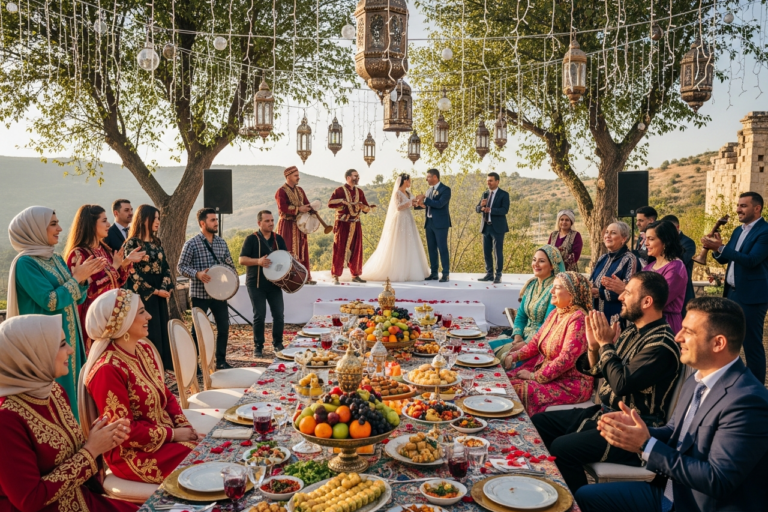
Key Highlights
-
A Turkish wedding has a few different stages. It all starts with both families agreeing and ends with a big party.
-
The bride’s family and the groom’s family are important at every part of a Turkish wedding. They take part in talking things over and giving gifts.
-
Before the wedding day, there is a henna night. This part is special. It shows the bride is going to begin a new life.
-
On the wedding day, you will see things like a red ribbon and people pinning gold coins. These are old and important customs.
-
The celebrations are full of energy and joy. People sing folk songs, dance, and there is always a big meal.
-
Giving gifts, mostly gold, matters a lot. This helps the new couple as they start out together.
Introduction
Have you ever thought about what happens at a traditional Turkish wedding? These events are full of life, history, and old customs. The whole community often comes together for them. So much love and support are shown during each step. When two people decide to get married, both families come together. They start a line of special steps that go way back. It often begins with a visit to the bride’s house. This journey goes on until the new couple starts their new life in a new home, and the house is ready for them to move in. This guide will show you every big part of a Turkish wedding tradition. You will see how two people go from meeting to starting their life together in a beautiful way.
The Origins and Significance of Turkish Wedding Traditions
Turkish wedding traditions are a mix of old customs, regional ways, and the culture found in the country. A traditional Turkish wedding is more than just about two people getting married. It is a big event that joins the groom’s family and the bride’s family.
These Turkish traditions focus on commitment, family values, and the support of the community. From the first meeting of both families to the last religious ceremony, each part of a Turkish wedding has its own meaning. All these steps help the couple feel supported as they start their new life together. Now, let’s look at the history of these Turkish wedding practices and see what family members do in all this.
Historical Influences on Marriage Practices in Turkey
Marriage in Turkish culture today comes from many years of history. It mixes old customs from the Ottoman period and many local traditions. In big cities like Istanbul, you may see more modern Turkish weddings, but most people still keep many old ways. This is true if you visit places like Trabzon in the Black Sea area or Central Anatolia. The events often follow a clear order that usually starts long before the wedding day arrives.
In the past, most Turkish weddings began when families set up a match for their children. Once both sides agreed, there would be an engagement. This step would often include a ring exchange. The joy would last for days. During this time, men and women would usually have their own parties.
Another big part of any Turkish wedding is the religious ceremony. An imam usually carries out this service. It often happens before the civil ceremony, which is the part where it becomes official in the eyes of the law. All these old steps built the base for today’s Turkish weddings. Now, you see both the legal and religious sides mixed with Turkish culture in every celebration.
The Importance of Family and Community Roles
In Turkish weddings, family and the community are at the heart of everything. The wedding is seen as the joining of two families, not just two people. From the start, sides of the family are a big part of planning, talking things over, and every part of the celebration. Close relatives, and elders especially, are always there as advisors and people who help settle any issues. They help make sure that things go well.
The bride’s father also has an important job. He gives his blessing for the marriage, and his okay is a big step in the wedding plans. Family takes part from the first time they visit the bride’s home. They help set up the couple’s new house and also help pay for some parts of the big day.
This group effort is a great example of how strong the community is in Turkish culture. The wedding is a time when people come together for the new couple. Everyone gives what they can—money, advice, love, and their wishes for a happy life together.
Turkish Engagement Customs: Celebrating the Söz and Nişan
Before the wedding day, there are two big parts of Turkish wedding customs. First, there is the “söz.” In this event, the groom’s family comes to the bride’s house and asks to marry her. This is when the well-known salty coffee is made. The bride puts salt in the groom’s cup as a joke to test him and see how he will act.
After the söz, the “nişan” comes next. This is a big engagement party. At that party, the couple puts on engagement rings. Both families come together to be happy for the couple during this event. These parts of the Turkish wedding make the lead-up to the big day special for the bride and groom.
The Söz: Formal Family Agreements and Symbolic Rituals
The “söz” means “promise” and is the first big step in the Turkish wedding process. At this time, the families come together at the bride’s home. The groom, with his older relatives, asks if he can marry the bride from her father. This is a special moment that is full of respect and old customs.
One fun tradition is when the bride-to-be makes and gives Turkish coffee to everyone there. She gives the groom a cup where she puts salt instead of sugar. If the groom drinks the salty coffee without showing he doesn’t like it, people think he has love and patience.
After the bride’s family agrees, the promise becomes real. There may also be a small ring exchange. Some key parts of the söz are:
-
The groom’s family asking for the bride’s hand in marriage the traditional way.
-
The bride serving Turkish coffee, and also a salty coffee for the groom.
-
The two families agreeing to the union and making the “promise” official.
These custom and fun traditions show how important Turkish coffee, the bride’s family, and both families are on this day. The salty coffee, ring exchange, and Turkish ways make it a unique moment for the groom and bride.
Nişan Ceremony: Gifting, Feasting, and Social Gatherings
After the söz, there is the “nişan,” which is a formal engagement party. This event can be a small celebration at home. Or, it can be a bigger party with many wedding guests at a rented venue. The nişan is the time the couple’s promise is shared with more people. It is a way for family and friends to get together and celebrate their new life as a couple.
A big part of the ceremony is the ring exchange. The engagement rings are tied together with a red ribbon. A family elder places the rings on the couple’s fingers. Then, the elder cuts the red ribbon. This shows that the couple is now officially engaged. There is a lot of joy after, with music and good food for everyone.
Gift-giving is an important part of the nişan. Guests and close family give gifts like gold jewelry and money. This helps the couple as they start their new life together. The main moments during nişan include:
-
The formal ring exchange with a red ribbon.
-
A feast with family and friends.
-
Many gifts, especially gold jewelry.
Pre-Wedding Rituals and Special Traditions
The days before a Turkish wedding are full of special and meaningful traditions. One of the best-known is the “kına gecesi”, or henna night. During this event, the bride and her female family members share a warm and heartfelt time together. It is often emotional. This tradition shows her move from her family home into a new life.
There is also the bridal hammam, or Turkish bath. This is a day for the bride to relax and spend time with her close friends and family. They all enjoy the moment together. Both the henna night and Turkish bath help to get the bride ready for her wedding day. These Turkish customs have a lot of meaning for everyone involved.
The Henna Night (Kına Gecesi) and Its Symbolism
The “kına gecesi,” known as henna night, is a big part of any Turkish wedding. This party is usually for women only. It happens at the bride’s house, and it is held one or two days before the wedding. The night is happy and sad at the same time. It celebrates the bride’s last night with her family. At the same time, it is about her new life in marriage.
The night starts with singing and dancing. Later, there are sad songs. These songs often make the bride cry, and this is meant to show her leaving her family. The bride sits in the middle and wears a red veil. This is there to show she has purity and to bring her good luck. Then, the henna is brought in on a tray with candles.
The bride gets henna put on her palms. A gold coin is usually placed in her hand for good luck and for her to have good things in life. Some of the other women also get henna put on their hands. There is a lot of meaning behind this henna night:
-
The henna is thought to keep away bad luck and bring good things.
-
The red veil stands for luck, love, and the fact that the bride has purity.
The Bridal Hammam: A Ritual of Beauty and Togetherness
The bridal hammam is a calm and happy tradition that takes place before the big day. In the past, this special event happened in a public Turkish bath. Now, since most modern homes have bathrooms, it is not as common to see it in cities. Still, many families love this idea and like to create their own spa-like hammam at home.
This get-together lets the bride, her mother, sisters, close relatives, and friends come together for a day of cleaning and joy. The trip to the hammam is a time for women to bond, share stories, and make the bride feel loved before she becomes a wife. It is a sweet way for everyone to feel close and get ready for the big day.
Long ago, the Turkish hammam was also a time for the groom’s mother to check the bride’s health and looks. But now, it is all about relaxing, having fun, and being happy. There is music, good food, and lots of laughs. The hammam makes great memories for the bride and her loved ones. This all happens away from her bride’s home, letting her feel special with people she cares about.
Wedding Attire and Meaningful Accessories
Turkish wedding attire has a lot of meaning in it. It mixes new styles with old ones. Many brides in Turkey now pick white dresses like Western brides. But some special things are still a big part of the turkish wedding tradition. One of the main things is the red belt. People also call it the “bekaret kuşağı.”
A male family member ties this red ribbon around the bride’s waist before she leaves her home. It stands for purity and is said to bring good luck in her new life. Besides the red belt, brides often wear gold coins and other jewelry given during the ceremony. All these special items make the bride’s look important in the turkish wedding.
Distinctive Features of Traditional Turkish Bridal Wear
Today, many Turkish brides wear white dresses on their wedding day, much like those seen in Western weddings. Still, a traditional Turkish wedding has some unique features that stand out. Customs in these weddings include different colors and items that carry a lot of meaning. In the past, long before the white dress became common, Turkish brides often chose bright and fancy gowns for their wedding day, each style showing the area they came from.
One of the most important parts of a traditional Turkish wedding is the red color. At the henna night, and sometimes during the wedding ceremony itself, you may see the bride wearing a red veil. This color means good luck and happiness. It also helps link what people do now with the customs from many years ago.
Another key part is the red belt called “bekaret kuşağı.” The family ties this soft ribbon around the bride’s waist during the wedding ceremony, right before she leaves her family home. The red belt is there to show her purity and has become a blessing from her family. This tradition means a lot in a traditional Turkish wedding, as the family hopes for their daughter to have a happy, good life after she gets married.
The Red Ribbon and Other Wedding Symbols
The red ribbon has a strong place in every Turkish wedding. You will see it many times during both the engagement and wedding day. At the engagement, the couple’s rings are tied with the red ribbon, and then someone cuts it. This marks the start of their life together.
On the wedding day, the red ribbon comes back but as the “bride’s belt.” Her dad or brother ties this belt around her waist. It stands for purity, and people believe it brings luck for a happy marriage. This part can feel very touching, as it is also when the bride leaves her family to start a new home.
The red ribbon is not the only thing you will notice. Gold coins are another big part of a Turkish wedding day. People pin them on the couple’s clothes to wish them wealth and good things ahead. All these things are there to send their best hopes and good luck to the couple.
-
The red ribbon at the engagement ceremony brings the couple’s rings together.
-
The red belt on the wedding day is for purity and luck.
-
Gold coins are given as a wish that the couple will have enough money in their life.
The Turkish Wedding Day: Ceremonies, Processions, and Superstitions
The Turkish wedding day is a busy time. There will be a lot of people, noise, and action. You will see lively groups, sad goodbyes, and unique beliefs that the families follow. One important part of the wedding day is the bride pickup. Here, the groom gets together with a group of cars. These cars are bright and make a lot of sound with honking as they all drive to the bride’s house.
As they travel, there are many playful stops and small traditions along the way. At the same time, there are also superstitions to bring good luck and keep away any bad things. These things make the turkish wedding feel even more special and fun for everyone. People will always remember this day.
Processions, Blessings, and the Bride’s Departure
A special part of the wedding day in Turkish tradition is the “gelin alma,” which means taking the bride from her home. The groom gets there with a group of family and friends. They are often with drummers and pipers. The wedding party makes the day feel very festive as they go to get the bride. Sometimes, the road is stopped by kids or young cousins. They ask the groom for a little money before letting him pass.
Before the bride goes, there is an emotional goodbye. Her father or brother puts a red ribbon around her waist and gives her a blessing. This is a touching moment. It shows that the bride is leaving her old home to start a new life with her husband.
After this, the whole wedding party moves in a fun convoy to the venue or the new house. People make some noise and feel very happy. Cars honk their horns and wave Turkish flags, so people will know there is a wedding. It is a way to show everyone that the two are joining their lives together.
Common Superstitions and Their Role in Weddings
Turkish weddings have many superstitions that make the wedding day special and lively. People believe these old traditions help the couple have a good, happy, and long marriage. These fun ideas are an important part of what happens on the wedding day.
One very well-known superstition for the wedding day is about the sole of her shoe. It is a fun tradition. At some weddings, the bride’s single friends write their names on the bottom of her shoe. People say that when the wedding is over, the person whose name fades the most will be the next one to start their new life and get married.
Other superstitions help bring good things to the wedding day and push away bad luck. When the bride goes into her new home, the couple might use barley or rice by sprinkling it over her. This is done for abundance and gives hope for a happy start. These fun traditions make everyone enjoy the day even more.
-
Writing names on the sole of her shoe to predict the next to marry.
-
The groom trying to step on the bride’s foot after the vows to have the “final say” in the marriage.
-
Spilling water behind the departing bride’s car for a smooth journey into her new life.
Music, Dance, and Festivities in Turkish Wedding Celebrations
Music and dance are at the heart of every Turkish wedding. You can feel the energy the moment the wedding ceremony starts. Drums and pipes play, and everyone hears the lively sounds fill the air. Traditional folk songs play a big part, and they bring people of all ages to the dance floor.
There is the “halay,” which is a line dance that almost everyone dances at a Turkish wedding. It brings guests together in a fun chain and everyone moves in time. Another dance people like to do is the upbeat “Roman” havası. During these happy dances, people often wave the Turkish flag. The whole thing shows how much people love to celebrate as a group at a Turkish wedding.
Popular Songs and Dances: From Halay to Roman
You can’t have a Turkish wedding without both music and dance. These two things are very important for making the day feel special and bringing people together. The music usually starts as soon as the bride pickup begins, with real davul (drum) and zurna (pipe) players joining in. You can hear their lively beats calling people in and letting everyone know that the wedding is happening.
One dance guests really look forward to at a Turkish wedding is the “halay.” It is the best-known dance. People hold each other’s arms or pinkies and move together. They make a circle or line while the beat gets faster. Doing the halay shows unity and sticks out as a favorite part of the party. People in different areas of Turkey also change the steps to fit their styles.
Another dance that brings lots of joy is the “roman” dance. This started with the Romani group in Turkey. Unlike the halay, roman dancing isn’t strict. People can add their own style and have fun with big moves. At times, the Turkish flag is waved in the air during these fun dances.
-
The Halay: A line dance that brings guests together as one.
-
Davul and Zurna: Drums and pipes add their sound to the celebration.
-
Roman: A lively and loose dance style that gets people on their feet.
How Music Unites Families and Guests
Music has a special place in Turkish weddings because it helps bring everyone together. On the wedding day, when the music starts, age and social status do not matter. Grandparents, kids, friends, and even new family members get up, join hands, and dance as one group. They all share in the happiness for the couple.
On this day, traditional folk songs play an important role for the wedding guests. These are loved by all, young and old. The songs tell stories about love and family. They help connect the two families and make everyone feel close. When people dance together in a circle for the halay, it brings everyone even nearer. They feel close, not just in body, but in heart too.
In the end, music and dance turn a simple gathering into a true celebration. On the wedding day, the music is a language every guest can understand. It takes down walls between people and helps everyone feel part of the special moment. The memories made here will last a lifetime.
Traditional Foods and Sweets Serves at Turkish Weddings
A Turkish wedding is much more than a simple event. It is a lively gathering for the senses. Food can really stand out here, and the great Turkish food is a big reason people love the celebration. The menu often brings together many well-loved dishes that show off the region’s food history. People will find savory meats, rice pilafs, and lots of mezes, which are some tasty appetizers. Overall, the wedding food is generous and so good.
A big favorite at many Turkish weddings is “keşkek.” This warm bowl of wheat and meat brings everyone together. It stands for unity and plenty. There’s also a wide group of sweet treats next to the rich dishes. Guests can try baklava and other amazing pastries. That way, the celebration has a sweet ending too.
Signature Dishes, Sweets, and the Role of Keşkek
The wedding feast is a highlight of any Turkish wedding, showcasing the richness of Turkish cuisine. While modern weddings might feature catered menus, traditional celebrations often include signature dishes that have been part of wedding feasts for generations.
One of the most important of these is “keşkek.” This ceremonial dish is made from wheat or barley and meat, slow-cooked for hours until it becomes a thick, creamy porridge. Preparing keşkek is a communal activity, with men and women working together, making it a symbol of shared effort and unity.
Besides keşkek, the wedding table is laden with other delights. Various kebabs, rice pilafs, and an assortment of mezes (appetizers) are common. For dessert, guests enjoy a wide range of sweets, with baklava being a perennial favorite.
|
Dish Category |
Examples of Dishes |
|---|---|
|
Main Dishes |
Keşkek, various kebabs (e.g., Adana, Urfa), meat stews |
|
Side Dishes |
Rice pilaf (pilav), bulgur pilaf, various mezes (e.g., hummus) |
|
Sweets |
Baklava, künefe, various fruit compotes |
The Meaning Behind Sharing Food at Wedding Feasts
Sharing a meal at a Turkish wedding is not just about eating. It means something much deeper. When everyone eats together, it shows the joining of two families. It helps build strong family ties. When the guests sit down with the bride and groom, they follow a tradition that helps bring everyone in the community closer. It is a way to support each other.
The food made for a Turkish wedding is special, too. Some dishes, like keşkek, need many people to help make them. This shows how important it is for the couple to work together and get help from others for a good marriage. The big amount of food on the table means that everyone is hoping the couple’s new life in their new home will be full of good things.
When people share these dishes, they are also giving good wishes to the newlyweds. Every meal served and every mouthful eaten is a way to hope for happiness, good health, and luck for the couple. Eating together at a Turkish wedding brings people together. It feeds their bodies and helps make the ties in the community stronger.
Gift-Giving, Gold, and Family Contributions
Gift-giving is a big part of Turkish weddings. It helps the newlyweds in their new life together and carries deep meaning. Instead of a registry, guests bring gold jewelry, gold coins, or cash. These gifts are important in the celebration. There is even a ceremony where people pin them onto the bride and groom.
Both sides of the family give a lot, too. They help pay for the wedding and help the couple set up a new home. These kind acts go a long way in making sure that the newlyweds start off strong with their money.
Jewelry, Gold Coins, and Symbolic Presents
In a Turkish wedding, giving gifts is easy to see and it matters a lot. The main gifts are gold coins and gold jewelry. You will often see the “takı” ceremony at the party. During this time, guests come up one by one and pin gold coins, bracelets, or cash on ribbons that the bride and groom wear.
This is not just about giving something to show love. It is also a real way for the group to help the couple with money for their future. The gold can help them buy big things later, like a new home or a car. The gift also shows who is wishing them well and standing by their side as they start a new life.
The amount and style of gold can be different. Close relatives might give bigger coins. Other guests might choose smaller ones. Thanks to this Turkish wedding tradition, the bride and groom both have some money saved when their new life as a married couple starts.
-
Gold coins (“altın”) are the most traditional wedding gift.
-
Gold jewelry, like bracelets (“bilezik”), are a common choice too, mainly from close relatives.
-
The “takı” ceremony is when guests come up in front of everyone to pin these gifts on the bride and groom.
Roles and Responsibilities for Each Family
In Turkish weddings, both sides of the family have some financial tasks to handle. This helps share the cost of the wedding and what is needed for a new home. It shows how both families take part in making this new life possible. Family help is a big part of the whole process.
The groom’s family will usually buy the new home. They also pay most of the big things for the wedding day. They often buy a nice set of gold jewelry for the bride. Their job is to help get the couple started in their new life.
The bride’s family often gets what is needed inside the new home. They buy the couches, beds, kitchen items, and everything for the rooms. Some time ago, this meant putting together a handmade dowry chest, but now it mostly means buying new things for the couple’s house.
Conclusion
To sum up, Turkish wedding traditions are full of life and color. They come from a long history and deep in turkish culture and the community. You will see many ceremonies, old habits, and special signs that show what the people believe and value. The Söz and Nişan times show real emotion and meaning. The celebrations after are full of music, dance, and good food. Each part helps families get closer and keeps their old ways alive. Knowing about these Turkish wedding customs will help you see more of Turkish culture. It also gets you ready if you ever go to a wedding in Turkey. If you want to learn more or need help with your own big day, feel free to ask for tips or ideas!
Frequently Asked Questions
What are the most important Turkish wedding traditions?
The key parts of a Turkish wedding tradition are special and full of meaning. To start, there is a family-led engagement process. Before the wedding day, there is the henna night, also called kına gecesi, which is a very emotional event. On this night, the bride takes part in a special moment where the red ribbon is tied around her waist to show purity. Then, during the wedding day, there is the takı ceremony. Here, guests pin gold coins and money on the couple as a part of the turkish wedding tradition. These steps help make every turkish wedding both unique and full of love.
How do Turkish weddings differ from Western weddings?
A turkish wedding is not just one day. It usually lasts for a few days and has a lot of different events. Family plays a big part in picking a partner and helping pay for things. At the wedding ceremony, you will hear folk songs and see dances like the halay. People like to give gold jewelry as a gift, so the couple can use it to set up their new home. This is a big part of turkish wedding traditions.
Are there any customs or symbols that surprise visitors?
Visitors may be surprised to see the bride give her partner salty coffee as a test. There is also the colorful and heartfelt kına gecesi. At this event, the bride puts on a red veil. The bride pickup convoy can be loud and gets a lot of attention. One more fun tradition is when people write names on the bride’s shoe to find out who might get married next.



