

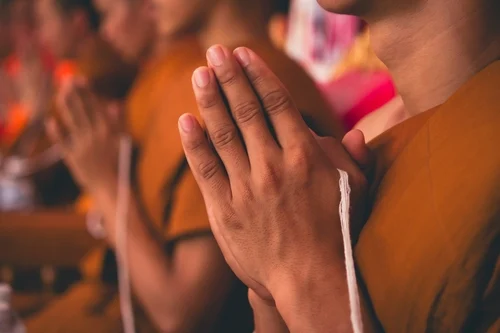
TL;DR: Nikini Poya is a sacred Sri Lankan Buddhist full-moon holiday that commemorates the first Buddhist council held after the Buddha’s death. Observed in August, it is marked by temple visits, meditation, the chanting of suttas, and the observance of Eight Precepts. In 2026, Nikini Poya falls on August 21.
Poya days are woven into the rhythm of Sri Lankan life. Every full moon, the island pauses. Temples fill with devotees dressed in white. The scent of incense drifts through courtyards. Buses run quieter, and alcohol sales are restricted by law.
Among Sri Lanka’s 12 annual Poya holidays, Nikini holds a place of special historical significance. It does not mark the birth or enlightenment of the Buddha—those are celebrated on other Poya days. Instead, Nikini commemorates something that happened after the Buddha’s passing: a moment when his followers came together to preserve his teachings for future generations.
For Sri Lankan Buddhists, that act of preservation is as sacred as the teachings themselves. This guide explains what Nikini Poya is, why it matters, when it falls in 2026, and how it is observed across the country.
What Is Nikini Poya?
Nikini Poya is a Sri Lankan Buddhist public holiday observed on the full-moon day of the month of Nikini, which corresponds to July or August in the Gregorian calendar. Like all Poya days in Sri Lanka, it is a national public holiday and carries deep religious significance for the island’s majority Theravāda Buddhist population.
The word “Nikini” refers to the traditional Sinhala lunar month during which the holiday falls. “Poya” (පෝය) is derived from the Pāli word uposatha, referring to the observance days held on full-moon nights in the Theravāda Buddhist tradition.

What Does Nikini Poya Commemorate?
Nikini Poya commemorates the First Buddhist Council (Paṭhama Saṅgāyana), which was convened approximately three months after the Parinirvāna (death) of Gautama Buddha, around 543 BCE.
According to Theravāda tradition, the council was organized by the monk Mahākassapa and held at Rājagaha (modern-day Rajgir, in present-day India) under the patronage of King Ajātasattu. Around 500 arahants—monks who had attained full enlightenment—gathered for the occasion. The council had one primary purpose: to recite, verify, and preserve the Buddha’s teachings before they could be lost or distorted.
At the council, two disciples played central roles:
- Ānanda, the Buddha’s personal attendant, recited the Dhamma (the discourses of the Buddha, now compiled in the Sutta Piṭaka).
- Upāli, renowned for his mastery of the monastic code, recited the Vinaya (the rules of discipline for monks and nuns, now compiled in the Vinaya Piṭaka).
The recitations were confirmed collectively by the assembled arahants, establishing what Theravāda Buddhists regard as the authoritative canon of the Buddha’s word. This council is considered the foundation of the Pāli Canon—the scriptural basis of Theravāda Buddhism practiced in Sri Lanka, Thailand, Myanmar, Cambodia, and Laos.
For Sri Lankan Buddhists, Nikini Poya is a reminder that the Dhamma they practice today survived because of that gathering. The holiday honors not just the Buddha, but the community of disciples who ensured his teachings endured.
When Is Nikini Poya in 2026?
In 2026, Nikini Poya falls on Friday, August 21, 2026.
As with all Poya days, the exact date shifts each year because it is tied to the lunar calendar rather than the fixed Gregorian calendar. In some years, Nikini Poya falls in late July; in others, it falls in August. Checking the Sri Lankan government’s official Poya calendar each year is the most reliable way to confirm the date.
Because Nikini Poya is a national public holiday in Sri Lanka, banks, government offices, schools, and many businesses will be closed on that day. Alcohol is not sold on Poya days under Sri Lankan law.

How Is Nikini Poya Observed in Sri Lanka?
Nikini Poya is observed with the same core practices as other major Poya days, centered on worship, reflection, and moral discipline.
Temple Visits and Worship
Temples across Sri Lanka see significantly higher attendance on Poya days. Devotees travel to Buddhist temples (viharas) and sacred sites to make offerings—flowers, incense, oil lamps, and fruit—at shrines and before statues of the Buddha. The lighting of oil lamps is especially prominent, symbolizing the light of wisdom dispelling ignorance.
Larger temples and pilgrimage sites, such as the Temple of the Tooth Relic (Sri Dalada Maligawa) in Kandy, attract thousands of devotees on Nikini Poya. Many families make the journey together, treating the day as both a religious obligation and a time for communal connection.
Observance of the Eight Precepts
On Poya days, devout laypeople often undertake the Eight Precepts (Aṭṭhasīla), a more rigorous set of moral guidelines than the standard Five Precepts followed in daily life. The Eight Precepts include:
- Refraining from taking life
- Refraining from stealing
- Refraining from sexual activity
- Refraining from false speech
- Refraining from intoxicants
- Refraining from eating after noon
- Refraining from entertainment and personal adornment
- Refraining from using high or luxurious beds
Observing these precepts for a full day is considered an act of spiritual discipline and merit-making (puñña). Some devotees spend the entire day at the temple, participating in communal activities throughout.
Meditation and Dhamma Study
Meditation retreats and Dhamma discussions are commonly organized at temples on Poya days. These sessions may include guided meditation, sutta recitation, and talks by senior monks. The connection to the First Buddhist Council gives Nikini Poya a particular resonance for study-oriented practice—it is a fitting day to engage directly with the texts that the council worked to preserve.
Dana: The Practice of Giving
Offering food and necessities to monks (dana) is a central act of merit-making on Poya days. Families prepare meals and bring them to temples for the resident monks. This practice reflects the mutual relationship between the lay community and the monastic Sangha that has sustained Theravāda Buddhism for over two millennia.

Why Nikini Poya Matters Beyond Sri Lanka
While Nikini Poya is primarily a Sri Lankan observance, the event it commemorates—the First Buddhist Council—is significant across all Theravāda Buddhist traditions. The preservation of the Pāli Canon at Rājagaha is the reason the Dhamma survived in its current form.
For Sri Lankans living abroad, Poya days are often observed through local Buddhist centers and diaspora communities. Meditation groups, Dhamma talks, and communal offerings keep the tradition alive far from the island. Nikini Poya, with its emphasis on the preservation of knowledge, resonates with communities who are themselves working to maintain culture and practice across generations and geographies.
A Day Worth Marking
Nikini Poya is not simply a day off. It is a day of remembrance—honoring the monks who gathered after the Buddha’s death and chose to ensure his words would not be forgotten. That choice, made over 2,500 years ago, shaped the spiritual lives of hundreds of millions of people across Asia and beyond.
On August 21, 2026, temples across Sri Lanka will light their lamps, devotees will observe their precepts, and communities will sit together in the quiet of a full-moon morning. The occasion is a reminder that the teachings endured because people cared enough to preserve them—and that caring for what matters is itself a form of practice.
Frequently Asked Questions About Nikini Poya
What is Nikini Poya?
Nikini Poya is a Sri Lankan Buddhist public holiday observed on the full moon of the Sinhala month of Nikini (July–August). It commemorates the First Buddhist Council, convened after the Buddha’s death to preserve his teachings.
When is Nikini Poya in 2026?
Nikini Poya falls on Friday, August 21, 2026.
What does Nikini Poya celebrate?
Nikini Poya commemorates the First Buddhist Council (Paṭhama Saṅgāyana), held at Rājagaha around 543 BCE, where the Buddha’s discourses and monastic rules were recited and compiled by 500 enlightened monks.
Is Nikini Poya a public holiday in Sri Lanka?
Yes. Nikini Poya is a national public holiday in Sri Lanka. Banks, schools, government offices, and many businesses are closed. The sale of alcohol is prohibited on this day.
How do Sri Lankan Buddhists observe Nikini Poya?
Common observances include visiting temples, making offerings, observing the Eight Precepts, practicing meditation, participating in Dhamma talks, and offering food to monks (dana).
What are the Eight Precepts observed on Poya days?
The Eight Precepts are a set of moral guidelines observed by devout lay Buddhists on Poya days. They include refraining from taking life, stealing, sexual activity, false speech, intoxicants, eating after noon, entertainment, and using luxurious beds.
Why is the First Buddhist Council important?
The First Buddhist Council was the gathering where the Buddha’s teachings were recited and verified by 500 arahants. It established the Pāli Canon, the foundational scripture of Theravāda Buddhism, and ensured the Dhamma was preserved after the Buddha’s passing.



