

Key Highlights
-
The Philippines is special in Asia because most of its total population is Christian.
-
The largest religious group is Roman Catholic, with over 78% of the people following this faith.
-
Islam is the next biggest religious group and is found mostly in the southern islands of Mindanao, Sulu, and Palawan.
-
Some people there still practice folk religions and hold on to their own indigenous beliefs.
-
The country’s religious life mixes native traditions and faiths that came from Spain and the United States.
-
Many different christian denominations and other faiths also add to the rich religious makeup of the nation.
Introduction
Welcome to a journey into the heart of Filipino spirituality. The Philippines is special. It is the only country in Asia where most of the people follow Christianity. This fact shapes a lot of the culture and the daily life in the country. The population of the Philippines is mostly Christian, which has made the spiritual part of this country both deep and interesting.
People here follow many belief systems. The Catholic faith is big, but there are also other smaller religions and some old practices from long ago. If you want to know the Filipino people, you have to learn about religion in the Philippines. It will help you understand what many of them do and why they do it.
Overview of Religion in the Philippines
The religious make up of the Philippines is made of many different parts. Most people in the country are Christians. But there is also a large Muslim group. Some people still follow old belief systems. Every religious group brings its own way of living and religious practices. These help shape life for people in the islands.
The demographics of the Philippines tell us about its history and culture. There have been many changes over time. We will talk about how each faith came to the country and grew. These faiths now play a big part in the country’s identity. Most people are Catholic now. In some places, Islam has a big effect on life. Now, let’s see what stands out about each religious group and how these belief systems came to be so important.
Defining the Religious Landscape
The Philippines is known for being mainly Christian. The biggest religious group is Roman Catholic. More than 86% of people are Roman Catholic in the country. This christian majority helps shape the culture and daily life in Southeast Asia.
Around 6% of people are part of different national christian groups. There is another 2% who belong to over 100 other Protestant denominations.
Islam is also a key part of life for many. You can find about 4% of the population practicing Islam, mostly in the southern places. The last 2% of Filipinos, mainly in high and faraway areas, keep to native religious beliefs and other non-Western ways.
So, while Roman Catholic’s the largest religious affiliation, there are people in the Philippines who practice many belief systems. Each group, no matter big or small, helps to build the country’s spiritual life and cultural story.
Historical Context and Evolution
The story of religion in the Philippines shows big changes over time. Before people from outside came, Filipinos had their own beliefs. They trusted many gods and spirits. In 1350, Islam started to move from Indonesia and spread north. By the 16th century, Islam was strong in the south. It looked like Islam could bring all the islands together.
Then, Spanish rule started when the Spanish arrived in 1565 with Miguel Lopez de Legaspi. Spain brought Christianity. Over more than three hundred years, Spanish rule worked to turn most of the islands Christian. This is why most people in the Philippines now follow Christianity. That change began in the 16th century.
After this, from the late 1800s to early 1900s, American missionaries came with the Americans. Many American missionaries were Protestant. They brought new christian denominations to the Philippines. Because of all of this history, religious syncretism grew in Southeast Asia. People mix old beliefs, Islam, and Christian ideas. This is how religion in the Philippines became what it is today.
Major Religions Practiced in the Philippines
Christianity is the main faith for most people in the Philippines. The Roman Catholic Church has the biggest group of followers, so the Catholic Church is the main religion for the country. Still, there are many christian denominations and the christian groups people belong to are not all alike.
There are other christian denominations with many followers, like the local group Iglesia ni Cristo. There are also many Protestant groups that add to the mix. Soon, we will talk more about how Roman Catholic ideas spread, the different christian groups in the population of the Philippines, and the big part that Islam plays too.
Catholicism and Its Prevalence
The Philippines has one of the biggest Roman Catholic groups in the world. The Catholic Church came to the country in the 16th century, brought by Spain. Because of this, it became the majority religion there. Spanish missionaries used large events, strong traditions, big churches, and a special church calendar to win people over. This plan worked very well.
Through many years of Spanish rule, Christianity started to be the main faith. The church was at the heart of every town. People went to mass, got baptized, and joined fiestas. These events set the pace for everyday life. Over time, Filipino Catholicism mixed old church rules and local customs.
Now, the Catholic Church still has a strong effect on the country. But it faces problems from groups such as Iglesia ni Cristo, or the Church of Christ. Even so, the faith of Filipino Catholics still helps to shape the way people in the country live and think.
Protestant and Other Christian Denominations
While most people in the Philippines are Catholic, there is also a wide group of christian denominations in the country. These groups have been growing over the years. Many of them started to become well known when people from the united states came in the American colonial time. Teachers and ministers helped build a public school system, and this let more churches and faiths get noticed.
One of the well known national churches is the philippine independent church, which some people call the aglipayan church. This church started when people in the Philippines fought against Spain. Today, it is linked with the episcopal church in the united states. Another big church is the iglesia ni Kristo, which began at the start of the 1900s.
Other christian denominations that people know about are the united church of christ in the philippines, the bible baptist church, the church of god, and the assemblies of god. All of these groups make up a big part of the way that Filipinos think about religion. They give people many choices besides the usual Catholic faith.
Islam and Its Regional Influence
Islam has been in the Philippines for a long time. It was there before Christianity came. Islam reached the islands around the year 1350. By the 16th century, it was strong in the southern Philippines, especially in Mindanao and Sulu. Most of the people in the Muslim population of the Philippines follow Sunni Islam.
The Muslim population of the Philippines is full of life and culture. In the past, the areas known as Muslim Mindanao had the most closely connected cultures before other powers came. Even though Spain and America tried to take control for many years, Islam stayed strong in the southern Philippines.
Now, Islam is still important in the history and society of the southern Philippines. It gives the Muslim Filipinos a strong sense of who they are. It shapes the law, politics, and daily life in that part of the country.
Indigenous Beliefs and Their Modern Presence
Before people from other countries brought new religions, the islands had strong beliefs and many folk religions. The early belief systems focused on many gods, spirits found in nature, and showing respect to ancestors. A lot of these ways of life have stayed, and they often mix with Christianity. This has helped form special Philippine folk religions.
Even now, these old beliefs still live on. Many indigenous peoples, mostly in faraway mountain places, still practice them. Let’s look at what makes these pre-colonial belief systems stand out and see how people today work to keep and bring them back.
Pre-Colonial Religious Practices
In pre-colonial times, different ethnic groups in the Philippines had belief systems that were close to nature and the spirit world. The indigenous beliefs included many gods. There was a main creator god named Bathala, along with many other spirits. These spirits lived in the forests, the mountains, and the streams.
Shamans and priests were important people in their towns. They spoke to both humans and spirits. They did rituals. They gave offerings to great or evil spirits. They also made charms to help protect their people. People also gave a lot of respect to their ancestors in these folk religions.
Even though many of these beliefs were changed or stopped during colonization, parts of these indigenous religions are still seen now. You can spot this religious syncretism when some groups mix old rituals with Catholic faith. Because of this, you get a special spiritual way that respects their pre-colonial history and traditions.
Revitalization Efforts for Indigenous Faiths
In the past few years, more people have worked hard to bring back indigenous religions in the Philippines. Many indigenous peoples, starting from northern Luzon and reaching down to the southern Filipino tribes, are now trying to keep and share their old belief systems. Their goal is to bring back their cultural identity and spiritual heritage. For years, these have not been given enough attention.
People taking part in these efforts work on several important things. They record stories that were told out loud through many years. They start old rituals again that were once stopped. They also teach younger people about folk religions and the rich world of indigenous Philippine folk religions. When they do this, they help everyone feel close to where they came from. They also make sure that these unique spiritual practices do not disappear as time goes by.
All these efforts show that there are many notable indigenous religions in the country. These are not just things from the past. They are still followed and are growing with the times. These belief systems are a strong part of the Philippines’ folk religions and spiritual traditions. They give indigenous peoples a deep feeling of being part of something special, and help connect their past to their present.
Demographics and Census Data on Religion
Knowing the demographics of the Philippines helps us see what the religious group layout looks like in the country. Census numbers give us good details about the size of each religious group in the total population. These statistics show how strong Catholicism is and point out other key faiths that are part of the country.
Looking at these details shows us the clear breakdown of religious affiliation in the country as a whole. We can use the latest national surveys to learn about current trends. Then we get to see where these religious groups are spread across the archipelago.
Latest Figures from National Surveys
According to the 2020 census, the religious landscape of the Philippines is overwhelmingly Christian. The data reveals that approximately 78.8% of the total population identifies as Roman Catholic, making it the largest religious group by a significant margin. This confirms the country’s status as a Catholic stronghold in Asia.
Other major religions also have a notable following. Islam is the second-largest faith, with 6.4% of the population of the Philippines identifying as Muslim. The Iglesia ni Cristo follows with 2.6%. The census also tracks smaller denominations, painting a detailed picture of religious affiliation. Here is a breakdown of the percentage of each religious group:
|
Religious Group |
Share of Population |
|---|---|
|
Roman Catholic |
78.8% |
|
Islam |
6.4% |
|
Iglesia ni Cristo |
2.6% |
|
Seventh Day Adventist |
0.8% |
|
Aglipay |
0.8% |
|
Iglesia Filipina Independiente |
0.6% |
|
Bible Baptist Church |
0.5% |
|
United Church of Christ in the Philippines |
0.4% |
|
Jehovah’s Witness |
0.4% |
|
Church of Christ |
0.4% |
|
Other religious affiliations |
8.2% |
Geographic Distribution of Religious Groups
The way each religious group is spread out in the Philippines is not the same everywhere in the country. The Christian majority, made up mostly of Catholics, can be seen in many places in Luzon and the Visayan islands. In most of these towns and cities, you will find a Catholic church in the center. This shows the strong Spanish influence that lasted for many years.
On the other hand, the Muslim population can mainly be found in the southern islands of Mindanao, Sulu, and Palawan. Many people call this part of the country Muslim Mindanao. People in this area have a different way of life and culture, which comes from their Islamic beliefs and traditions. The fact that there are more Muslims in the south creates a special relationship with the Christian majority living in other parts of the country.
Having religious groups and ethnic groups all in different areas can change the lives of people who live there. In many places, Christians and Muslims get along well. But sometimes, when one group stays mostly in one place, there can be issues over politics, land, or people’s right to govern for themselves. Still, it is important to remember that having many kinds of people, like those in Muslim Mindanao and in areas around a Catholic church, adds a lot to the mix of local cultures. It helps people learn from each other through different traditions and ways of life.
The Spread and Dominance of Christianity
The story of Christianity in the Philippines started with Spanish rule. This time brought big changes to the islands. The establishment of religion created a strong christian majority. The roman catholic church grew to be the most powerful group in the country and stayed that way for many years.
Spanish missionaries began this by spreading their beliefs. Over 300 years, their work under spanish rule made the catholic church strong in the Philippines. In the next parts, we will talk about how the early missionaries shared their faith. We will also look at how many kinds of christian groups have grown and still help build the nation today.
Early Missionaries and Spanish Colonial Legacy
Christianity became the main religion in the Philippines in the 16th century. This happened mostly because of Spanish missionaries who came to the islands. When Miguel Lopez de Legaspi came in 1565, Spain started to spread Christianity in a planned way. The missionaries did not always need to use force to get people to join.
The shows of the Catholic Church, like church clothes, big prayers, and special church services, got the interest of many people who lived in the countryside. The Spanish also moved people from different places into towns, near the church. The church gave them safety from slave raiders. It also became the main place for people to meet and to pray together.
During Spanish rule, the parish priest became the main religious leader in these towns. The Catholic Church was a big part of life and society. This is still true today and is why the Catholic Church stays important in the Philippines.
Growth and Diversification of Christian Movements
The Catholic Church has led for many years, but in the 20th century, there were big changes in Christian groups in the Philippines. During the fight against Spain, the Aglipayan Church, or Philippine Independent Church, started. It showed people wanted a faith that was tied to their country. At its highest point, this church made up almost one-third of all people in the country.
In more recent times, the way people belong to different churches has changed a lot. Small and often strict Christian groups are getting more people to join them. Groups like Iglesia ni Kristo, Jehovah’s Witnesses, and different evangelical groups, such as Members Church of God International, all keep growing.
This shows there is now a “war for souls.” Newer and local churches are taking on the catholic church’s strong hold. You can now see groups like the Church of Jesus Christ, the church of god, and other lively religious groups becoming more popular. Because of this, the way Filipinos believe and worship is now more mixed and changing, as more people try out new ways to show their faith.
Islam’s Historical and Cultural Role
Islam has been important in the history of the Philippines, mostly in the southern Philippines. The muslim population of the philippines came to the country many years before Christianity. It grew strong and built advanced groups and ways to live. Even after a long time and with many changes from outside, the muslim population of the philippines has kept their own ways and life.
This part will talk about how Islam started and grew in Mindanao and how it has touched the old and new ways of life for people in the southern philippines. Knowing more about the path that Islam followed lets us see the whole picture of religion and ways of life in the country.
Arrival and Foundation in Mindanao
Islam first came to the southern Philippines in the 14th century. It started to spread north from Indonesia and Malaysia. By the 16th century, when the Spanish got there, Islam was fixed as the main belief in Mindanao and the Sulu archipelago. There were also smaller Muslim outposts on islands like Cebu and Luzon.
The Muslim areas, such as Muslim Mindanao, had the most developed groups on the islands at that period. If Islam had more time, it could have brought the whole area under its lead. Having Islam early on gave the region a durable base that helped it fight off foreign control.
Knowing this history helps you see how important Islam is in Philippine society. With over 600 years in the southern Philippines, it built a strong group. This group kept its faith and ways of life alive, forming an identity different from the Christian majority.
Islamic Traditions and Social Impact
Islamic traditions shape life in the southern islands of Mindanao. For Muslim Filipinos, Islam is not just faith. It is a way of life. The religion guides social rules, law, family, and each day. These religious practices help people feel close to each other. They also build a strong sense of who they are.
The religion has a strong influence on art and music in this place. It can be seen in social events, too. Islamic festivals and holidays hold a central role in the culture. These events help keep the community’s values and history alive. Holding on to these traditions makes the community tough and helps them face challenges from outsiders.
In Philippine society, the role of Islam is very important, especially in the south. But it has also brought conflict. Muslim Filipinos want to protect their own way of life and freedom. Because of this, there have been many struggles with the national government. This shows how complex the relationship is between the Muslim group and the rest of the country.
Minority Religions and Their Contributions
Besides Christianity and Islam, the Philippines has many other small religion groups. These groups may be few, but they help make the belief systems in the country rich. Their presence brings more diversity. Some have roots in ancient Eastern faiths, while there are also one or two new faiths.
You can see religious syncretism in the Philippines in how these minority beliefs mix with daily life and mainstream culture. Now, let’s look at a few of these smaller but important religious communities. We talk about Buddhism, Hinduism, Judaism, and the Baháʼí Faith. These have their own place in the Philippines.
Buddhism, Hinduism, and Other Faiths
Buddhism and Hinduism have a small number of followers in the Philippines. Yet, they still have a cultural influence on the country, mainly because of the Chinese minority. Many Chinese Filipinos mix their religious beliefs. They add parts of Buddhism, Daoism, Confucianism, and even Catholic practices together. This mix gives Filipino religious beliefs a bit of East Asian style.
These belief systems are not the biggest religious group when you look at their numbers. Still, their ideas about life and ethics are part of some communities. There are temples and centers for these belief systems in big cities. These places are open for the ethnic Chinese and more Filipino people who join later.
When you see these belief systems, it tells you about the Philippines and its links to religion in other parts of Asia. Buddhism and Hinduism do not have a huge following. But their followers help make the country’s religious group culture more open and mixed.
Jewish and Baháʼí Communities
The Philippines has some small but strong Jewish and Baháʼí communities. There is a Jewish community that is not very big, but it has been in the country for many years. Most Jewish people in the Philippines live in Manila. This group is made up of people who move from other places, people who come for work, and families that now call the Philippines their home.
The Baháʼí Faith is one more minority religion in the Philippines. The message of unity and world peace in the Baháʼí Faith speaks to many Filipinos. The Baháʼí community keeps growing in a quiet way. Like other small groups, this Baháʼí community also adds to the country’s spiritual diversity.
Even though only a few people follow these religious beliefs, having these groups here shows that the country is open to many belief systems. Both of these communities help make the religious beliefs in the Philippines more rich and give more variety to belief systems across the islands.
Religion’s Influence on Filipino Culture and Society
Religion is a big part of life in Philippine society. It affects what people do every day. People do not keep religious practices just inside churches or places for worship. You can see religion in many family times, at community events, and when people talk about what matters in the country.
The advice of the religious leaders has a strong effect on what many people think. The things that people believe about faith also show up in their traditions and what the group accepts as normal. In the next parts, we will see how religion shapes family life. You will also learn how religion helps make the festivals and holidays in the country so lively.
Family Life, Values, and Traditions
Religion has a strong effect on Filipino life, especially when it comes to families. The family is the most important part of society for many people. Religious belief systems help people see why staying close to family, respecting elders, and helping others are important. Many Filipinos start and end their daily life with a prayer.
Religious practices show up in big life moments. This can be baptisms, weddings, or funerals. These times are important, and they bring families together. They help people remember what beliefs they all share. The values of caring for others, being prayerful, and being open to everyone come from the main religions. Now, these values are a big part of being Filipino.
You can see this mix of faith and tradition almost everywhere. It shapes the way people act and talk. It also guides their moral standards and how they see the world. From a short prayer before a meal to a small altar in the house, faith is always there in the Filipino way of life.
Popular Religious Festivals and Holidays
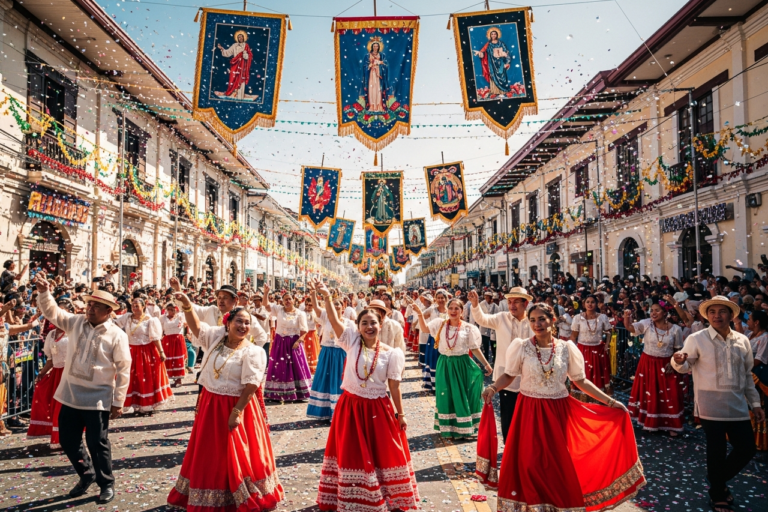
The Philippines is known for its bright and lively religious festivals. These celebrations mix Catholic religious practices with folk religions. The country’s belief systems can be seen in these events, and they bring together a lot of people, both locals and visitors. One of the biggest religious events is Holy Week, which many people know as Semana Santa.
During Holy Week, people all over the country take part in different rituals. These include calm processions and powerful shows about the Passion of Christ. Beside this, there are many other special religious festivals during the year. Each one honors a different patron saint or an important religious icon.
Some of the most well-known festivals are:
-
Sinulog Festival: This big event happens in Cebu City for the Santo Niño (the child Jesus). People fill the streets with dancing and colorful parades.
-
Ati-Atihan Festival: In Kalibo, Aklan, this festival also celebrates the Santo Niño. It is famous for group dances and the people who cover themselves in soot.
-
Pahiyas Festival: In Lucban, Quezon, people give thanks to San Isidro Labrador, the patron saint of farmers. Homes are decked out with bright produce and other decorations.
These festivals show the Philippines’ strong belief in both religious practices and folk religions.
Conclusion
The many religions in the Philippines show the country’s long and different history. Catholicism is the biggest faith, but there are also people who follow Islam and those with indigenous beliefs. Each one helps shape the way people in the Philippines think and live every day. When you look at these religions, you see how faith is a big part of life here. It also shows how important it is for people to accept and get along with those who do not share the same beliefs. When you learn more about religion in the Philippines, you find that every tradition adds something special to the country’s story. If you want to know more or have questions, just ask!
Frequently Asked Questions
How do Filipino Americans maintain their religious practices in the United States?
Filipino Americans in the United States keep their religious practices by making close church groups. They still celebrate Holy Week and fiestas, but they change some things to fit where they live now. The free exercise of religion helps them build churches and groups so they can keep their spiritual and cultural traditions going.
Are there notable indigenous religions still practiced today?
Yes, there are still some indigenous religions followed by a small part of the population of the Philippines. These folk religions and indigenous beliefs live on. Southern Filipino tribes keep these ways going. They do old rituals and share their spiritual traditions with their children. This is how the spirit of these beliefs stays strong in the population of the Philippines.
How has religious diversity shaped communities in the Philippines?
Religious diversity makes society in the Philippines more complex. There are many belief systems, and people mostly live together without many problems. But, when a religious group becomes very big in one area, this can sometimes cause tension. The philippine government says there must be a separation of church and state. Still, religion is a strong force in daily life and shapes what many people do.



