

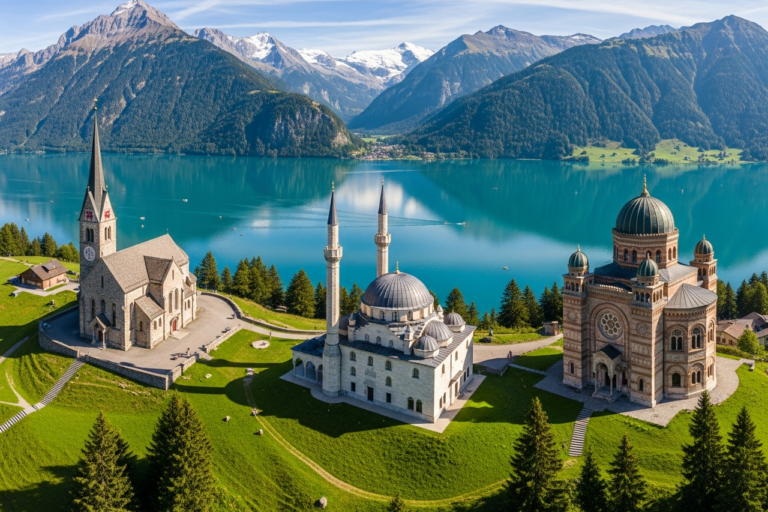
Key Highlights
-
Switzerland has many religions, but Christianity has been the main faith in the past.
-
Roman Catholicism is still the largest religious group, but there is less Christian religious affiliation among the swiss population now.
-
Many people say they have no religious affiliation. This group has grown a lot over the last fifty years. Now, they are a big part of the population.
-
When people move to Switzerland, they bring other religions. Now, religious communities like Islam and Orthodox Christianity are bigger.
-
Different areas have their own ways, with some cantons being more Catholic or Protestant than others.
-
Each canton decides how church and state work together. The church tax system is set by the canton.
Introduction
Let’s take a closer look at Switzerland’s religious landscape. Many people know Switzerland for the beautiful Alps and good chocolate. But the country also has a long and changing story when it comes to faith. There is religious diversity all over, but not the same everywhere. Each Swiss canton can have their own way when it comes to belief and practice. As the total population goes up or down, religious communities in each area also change. This gives us a picture of faith, old ways, and new ways without religion, all coming together in today’s Switzerland.
Religious Landscape and Demographics in Switzerland
Switzerland’s religious communities have changed a lot over the years. The Federal Statistical Office has data that shows a big shift in religious affiliation in the total population. While Roman Catholicism and Protestantism are still common, there is a lot more religious diversity now. More people are being part of other faiths, and many have no religion at all.
This change is also happening in other parts of Western Europe. The main religions in Switzerland today are Roman Catholicism, Protestantism, and there is a larger group of people practicing Islam and other faiths. There are also many people who say they have no religion. These changes show how religious communities in Switzerland keep changing. Next, we will see how these changes have happened over time. We will look at the regional differences and at some of the factors about the people who live there.
Trends in Religious Affiliation Over Time
The trend in religious affiliation in Switzerland shows a significant move away from traditional churches. According to the Swiss Federal Statistical Office, the group with no religious affiliation has grown more than any other in the last 50 years. In 1970, nearly the entire population identified as Christian. By 2021, those without a religion made up almost a third of the population.
This decline has affected both major Christian denominations. While immigration from Catholic countries has helped Roman Catholicism remain the largest religious group in absolute numbers, both it and Protestantism have seen their share of the population shrink, especially since the 2000s. Census data clearly illustrates this ongoing secularization.
Here is a glimpse of how religious affiliation has shifted, based on available data:
|
Year |
No Religion |
Roman Catholic |
Protestant |
|---|---|---|---|
|
1970 |
1.1% |
~50% |
~50% |
|
1990 |
7.4% |
Declining |
Declining |
|
2021 |
~33% |
~33% |
Declining |
Regional Differences in Religious Practice
Religious practice in Switzerland is not the same everywhere. Over time, there has been a split between catholic cantons and protestant cantons. For example, the Alpine cantons of Uri, Schwyz, Nidwalden, and Obwalden are strongly roman catholic. People in these places are more traditional and have conservative values.
Cities that grew from industry, like Geneva, became protestant cantons and are strong in that faith. These old splits still play a role in local life and politics. Still, as more people move around and the country becomes less religious, the lines are not as clear. Most of the time, the relationship between church and state is decided by each canton.
But there are some cantons, such as Geneva and Neuchâtel, that practice separation of church and state. In these places, religious communities get their money from private donations, not from a church tax. This changes how religion works there and how churches get support compared to the rest of Switzerland.
Religion by Age, Gender, and Education
Demographics help us see how religious affiliation is changing in Switzerland. Census data shows that the non-religious part of the Swiss population is often younger, more educated, and living in cities. You will also find that there are a bit more men than women in this group.
The group is not all the same. Some of them are atheists or agnostics. Some people do believe in a higher power but do not take part in any organized religion. For many, not being part of a religion is not about turning away from all beliefs. It is more about moving away from formal religious activities. Swiss people often step away for personal reasons or because they were not raised with strong religious socialization.
The trend means that many Swiss people are less connected to religion in the old way. As the swiss population moves away from church and religious grounds, especially for the young and educated, the number of people with no religious affiliation keeps going up. This shows a strong shift from organized religion in Switzerland.
Christianity in Switzerland
Christianity has been in Switzerland for a long time. It helped shape the people and the culture there. The two biggest Christian groups in the country have been the Roman Catholic Church and the Protestant Church. Over time, fewer people have joined these christian groups. Even so, the roman catholic church and the protestant church are still the biggest groups based on faith in the country.
Many people from other places have come to Switzerland. They brought new christian denominations, like Orthodox Christianity. This made the country’s christian groups more mixed. The next parts talk about how roman catholicism and protestantism started. They also talk about where they are now. We will look at if Switzerland is still called a Christian country.
Roman Catholicism—History and Presence
Roman Catholicism has been a big part of Swiss life for a long time. It is often linked to tradition and the idea of keeping old ways. Some areas are well known for being “Catholic cantons.” Places like Uri and Schwyz are some of these. They were also in the first Swiss group that came together in 1291.
In ten Catholic cantons, the regular government helps pick bishops. This is not usual in other places. The practice started in 1828, after an agreement with the Pope. There was a time when Protestants made up most of the people in Switzerland. But then, many people came here from Catholic countries in the middle of the 1900s. Because of this, the roman catholic church grew and became the biggest group again.
Now, the roman catholic church still has many members in Switzerland. But the church faces new problems. Fewer people go to church, and the world there is becoming less focused on faith. Most cantons still have a church tax. This money is important for the catholic church in Switzerland. Still, more people are now leaving the church so they do not have to pay the church tax.
Protestantism—Legacy and Influence
Switzerland had a big part in the Protestant Reformation during the 16th century. Ulrich Zwingli in Zurich and Jean Calvin in Geneva were two main leaders of this movement. The new religion was accepted in the richer rural areas and cities that were starting to grow into places of industry. Geneva became a strong center for Protestant faith.
Protestant ideas like logical thinking and working hard helped build the base for Switzerland’s success today. The people in charge of the 1848 constitution were strong Protestants. They built the federal state, made one national currency, and got rid of trade rules inside the country. This change set up a modern and industrial economy. You can still see this history in Switzerland’s culture.
Today, big protestant churches have lost many members. Smaller evangelical and free churches still keep their groups. Protestantism may not have as many active followers now, but it still shapes Switzerland’s history and how people see themselves, mostly in the protestant cantons.
Are Swiss People Still Considered Christian?
Swiss people are often seen as Christian, but things are changing. The roman catholic church is still the biggest religious group in Switzerland. Many swiss people feel a connection to christian communities or the catholic church, even if they do not go often. Churches still play a part in big life moments for many.
Still, the way people connect to religion is shifting. Studies show that fewer swiss people care about religion. In 2000, only 16% said religion was very important to them. Seeing people at church has also dropped a lot. Many swiss people are leaving their church, mostly because they do not want to pay the church tax. This shows that ties to the church are becoming weaker.
Switzerland has deep roots with christian communities, mostly due to the roman catholic church. Many still call themselves christian. But when you look at day-to-day life, religion is not as strong as before. Now, most swiss people are less religious and lean more toward being secular or having their own ideas about faith.
Other Religions in Switzerland
Switzerland is a place where you will find many different religious communities. It is not just about Christianity. Many people have moved here in recent years. This has helped more religious groups grow and become a part of the country. Now, there are Muslim communities and jewish communities in Switzerland. People who follow Buddhism and Hinduism are also living here.
Because of this, the religious diversity in Switzerland is getting richer. The country has changed into a place with many different faiths. There are now large Muslim groups, and jewish communities have stayed strong over the years. Each of these groups has its own story and has helped make the country even better. You can see the history and culture of all of these religious communities when you look closer.
Muslim Communities—Growth and Role
Islam is now the third-biggest religion in Switzerland. This change happened over the past few years. The number of Swiss Muslims went up a lot. Most of them came from the Middle East, with some being refugees and asylum seekers. In 2000, the census counted over 300,000 Muslims, which is more than twice as many as in 1990.
These religious communities are part of Swiss life in many ways. Swiss Muslims take part in the country’s economic life. They have set up their own places of worship and cultural centers. Sometimes, it can be hard to find prayer rooms, but the community keeps growing and showing its presence.
More Swiss people are becoming Muslims too. The number went from 7,700 to 36,500 in the ten years before the 2000 census. This shows the Muslim community is growing not just from immigrants, but also becoming a steady part of the country.
Jewish Communities—History and Impact
The Jewish communities in Switzerland have been around for a long time. Their numbers do not really change much, with about 17,900 people counted in the 2000 census. Even though there are not a lot of them, they have added a lot to life in Switzerland.
The history of Jewish households in Switzerland has good times and hard times. There were big challenges during World War II, for example. This group of people has stayed strong. They keep their way of life and their places to meet. They also talk about human rights and why it is important that everyone can choose their faith.
Now, Jewish communities fit in well with people in Switzerland. They do not get bigger as fast as some other religious groups, but they are still very active. Their old traditions and strong spirit are a big part of life in Switzerland. Many times, they speak out on religious grounds to stand up for their history and beliefs.
Buddhism, Hinduism, and Other Faiths
The religious diversity of Switzerland is growing, with Buddhism, Hinduism, and other faiths helping make that happen. There are about 21,000 Buddhists in the country. They follow different ways of thinking. In 2003, the Wat Srinagarindravararam temple opened in canton Solothurn. It follows the Theravada school and was an important moment for Buddhists there.
The number of Orthodox Christians has gone up because people moved in from central and eastern Europe. Now, there are over 130,000 Orthodox Christians. This gives the Christian groups in Switzerland more depth, building on what the catholic church and Protestant traditions already have.
Other christian groups are in Switzerland as well. The christian catholic church and the apostolic church add to the mix. They may have fewer people, but with these and others like Hinduism, we can see Switzerland moving to a more open and rich mix of beliefs. This shows just how much the country is changing and how its religious diversity is growing.
Religion’s Place in Public Life and Education
Religion in Switzerland is not simple. The country tries to keep the old ways and mix them with new, modern ideas. The Swiss Constitution says people can choose their religion. Each canton handles how the local church and the state work together. So, there are different rules across Switzerland about religious education in public schools and the money for religious activities.
Many people in Switzerland are less religious now than before. Even so, religion is still part of public events and holidays. In the sections below, you will see how people mark religious holidays. You will also read about what the younger generation thinks of religion, and how it is part of their education and lives.
Keywords used: freedom of religion, public schools, swiss constitution, religious education, religious activities
Religious Holidays and Public Celebrations
Religious holidays are still a big part of public life in Switzerland, even as more people move away from religion. Many of these holidays come from Christian traditions and are seen as official public holidays. Each canton has its own calendar and can celebrate different holidays, depending on the history and religion of that region.
Church tax gives money to official churches. This money helps keep up the buildings and supports these holiday events. But, there are fewer people who go to church now, so many wonder if these traditions will change in the future. The federal state does not set rules for religion, so each canton takes care of its own religious calendar and gives support to their churches.
Key public holidays with religious roots include:
-
Christmas
-
Easter
-
Ascension Day
These days play a strong role in the country’s year. They are times when people come together with family or go to events in their towns. For many, these holidays are about more than just religion.
Youth Perspectives on Religion
For many young people in Switzerland, religion is not tied to a group or an institution. It is something personal and about what they believe or feel themselves. The trend of secularization is strong, especially with the youth. They are more likely than older people to have no religious affiliation. Many of them grow up without strong ties to a religion.
Religious education in schools is different in each canton. Usually, the goal is to teach about different world religions instead of teaching one faith as the only right one. This follows the idea of religious freedom. It helps to stop religious discrimination. Most young people accept other beliefs, but they do not want to follow just one doctrine.
Some young people do not say they belong to a religion, but they still believe in a higher power. Others find meaning in exploring spirituality outside of the church. For these youth, religion is something private. Its role is set by what matters most to each person, not by what the community says.
Conclusion
Switzerland has a mix of religions that comes from its own history and culture. The country has strong roots in Christianity. Roman Catholicism and Protestantism are the main groups. There are also Muslim and Jewish communities that are growing in number. Each religion plays a part in making Swiss life rich and lively.
As time goes on, it is good to understand how these religions work together. Religion affects many parts of public life and education in Switzerland. By learning about the way religions are in Switzerland, we help build a society that welcomes and values all people. If you have questions or want to know more, you can look into this topic further.
Frequently Asked Questions
Why are churches in Switzerland seeing fewer visitors?
Swiss churches now have fewer visitors. This is because many Swiss people are not as involved in religious activities as they were before. The drop in religious affiliation is clear. People are moving away from church events and religious groups. The church tax is also a reason why some leave. It makes some Swiss people decide to officially leave the church. This lowers the number of people who are members and who go to religious activities in Swiss churches.
What is Switzerland’s policy on religious freedom?
Switzerland gives people the right to practice their religion freely. This is written in the Swiss Constitution. It protects what people believe as well as the rights of religious groups. The Swiss government makes sure this happens. The way the church and the government work together or stay apart is decided by each canton. They do this while keeping human rights in mind.
Keywords: religious freedom, separation of church, swiss constitution, swiss government, human rights
How important is religion for young people in Switzerland?
Many young people in Switzerland do not find traditional religion important. A lot of them have no religious affiliation at all. Even though religious education is taught in school, how they feel about faith is more about the individual. Some of them say they believe in a higher power, but they do not follow an organized religion.



