

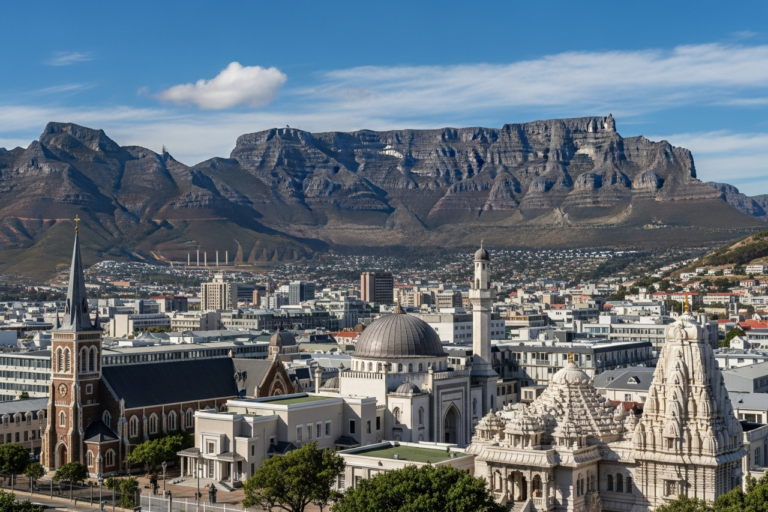
Key Highlights
-
Christianity is the main religious affiliation in South Africa. Over 85% of people in this country say they are Christian.
-
South Africa has a lot of religious diversity. The country blends Christianity, indigenous beliefs, and other minority faiths.
-
Now, many South Africans move from mainline Christian churches to Pentecostal and African Independent Churches.
-
The law in South Africa, which is set by the constitution, protects freedom of religion for all people.
-
Traditional African religious practices still play a big role in the spiritual and cultural lives of many South Africans.
-
Minority religions like Islam, Hinduism, and Judaism have strong histories. These are a big part of what makes the nation whole.
Introduction
Let’s take a look at the world of religion in South Africa. This country is full of many different faiths. The old ways of belief are still in use, and you can also find global religions here. Many people mix local and world faiths in their lives. When you learn about the religious beliefs in South Africa, you get to know a lot about the country’s culture, past, and how its people live together. Most of the people here are Christian. But there are also groups that follow other, smaller, or older faiths. The mix of spiritual life in South Africa is broad, just like its people.
Historical Overview of Religion in South Africa
The religious history of South Africa shows how much things have changed over time. For many years, south africa had many different indigenous religious practices. These ways of life were tied to the land, the people, and their daily lives.
When european settlers came, they brought a big change. They brought Christianity with them. This often led them to try to stop or look down on traditional beliefs. This made people choose between old ways and new beliefs. The blend of these religions and the way people held on to their own practices, helped shape the country’s faith today. The push and pull between what was native, and what was brought in, can still be seen in how south africa lives with both these traditions and religions now.
Pre-colonial Religious Traditions
Before people from other countries came, most of South Africa followed their own spiritual ways. These practices, which people often call African religion or African Traditional Religion, were not the same for everyone. Different groups in the country had their own beliefs and customs in how they did things. These ways of living shaped all of society. They guided how people made rules and what they did every day.
In the middle of these traditions was deep respect for ancestors. People thought of the ancestors as a bridge between the living and the higher powers. African religion also put a strong link between people and the world around them. Many thought that there were spirit forces in the land and all animals. With these indigenous religious practices, people had the way to see the world and see where they fit in it.
Now, lots of people in South Africa are Christian, but these indigenous beliefs have not gone away. They have not vanished, but have learned to live side by side with Christian ways or even combined with them. This blend shows just how important traditional beliefs and spirituality still are in south africa and how they shape who people are.
Colonial Influence and Missionary Activity
When European settlers came to South Africa, they started a lot of missionary work. Many christian groups like the Dutch Reformed Church, Anglicans, and Methodists set up strong roots. They wanted to convert the local people. This push for Christianity was closely tied to the colonial project.
Missionaries often looked at local cultures and religious ways as lower than their own. Because of this, many native traditions were pushed aside or stopped. During this time, big church groups like the Roman Catholic Church grew. These churches became important for both social and political life. The work of christian groups changed the religious shape of south africa in a big way.
Now, this history is complicated. Colonial churches are losing members today, but what they did in the past still matters. Their work helped make Christianity the dominant religion in south africa. This is still true, even though the way people follow Christianity is now more mixed and shaped by African cultures.
Post-apartheid Shifts in Religious Identity
The end of apartheid in 1994 started a new time for freedom of expression in South Africa. This big change made a real difference to the religious identity of south africans. People were no longer told what to believe by the state. They could choose and show their beliefs in ways that had not been allowed before. After this change, many began to think differently about their faith.
A lot of south africans started to leave the oldest, European-run churches from the colonial and apartheid years. The new government, led by the African National Congress, put religious freedom in the constitution. This made sure everyone was free to believe as they wanted, and people did not need to worry about what the state would do to them.
With this new freedom of expression, the way people believed changed a lot. More and more people started joining african independent churches and Pentecostal groups. These churches often connect with the lives and histories of many south africans. Many say they feel these groups give a more real and local way to be Christian after apartheid. The move toward african independent churches and new forms of worship shows that people want a faith that feels honest and less tied to the old ways of the past.
Demographics and Distribution of Religions
When you look at the religious groups in South Africa, you see a country where many people are part of a religion. Recent census numbers show more than 85% of the total population in South Africa say they are Christian. This means Christianity is the biggest belief system in the country by far.
But, the numbers do not show the whole story. People in South Africa follow many different Christian churches. There are also quite a few people who follow African Traditional Religion. You will find groups of Hindus, Muslims, Jews, and others as well. Now, let’s talk about the data, where these groups live, and some trends in the south africa population that make up this mix of beliefs.
Census Data on Religion
For those seeking reliable statistics, Statistics South Africa (Stats SA) is the primary source for official census data on religious affiliation. Their surveys provide a detailed breakdown of how the total population identifies spiritually. The 2022 census confirmed that South Africa remains a deeply religious country, with only 2.9% of people claiming no religious views.
The data shows that Christian adherence has grown, now accounting for 85.3% of the population. This broad category, however, contains immense diversity. The largest single group within Christianity comprises the African Independent Churches (AICs), like the Zion Christian Church, which are growing rapidly. In contrast, mainline Protestant and Catholic churches have seen a steady decline in membership.
Here is a simplified breakdown of religious affiliation based on available data:
|
Religious Group |
Approximate Percentage of Population |
|---|---|
|
Christians |
85.3% |
|
Traditional African Religion |
~7.5% (often practiced alongside other faiths) |
|
No Religion/Agnostic |
~5.6% |
|
Hindus |
~2.4% |
|
Muslims |
~1.7% |
|
Other (Baha’i, Jewish, Buddhist etc.) |
<1% |
Regional Variations in Religious Practices
Religious practices in South Africa are not the same everywhere. Regions have different ways to worship. For example, some places in the country are home to certain groups of faith, like African Independent Churches or the Muslim community. This is because of how people moved, settled, and spread their beliefs over the years. These changes help us see the real spiritual life in South Africa.
In north KwaZulu-Natal and Mpumalanga, the African Independent Churches are the main churches for more than half the people living there. The Western Cape, and Cape Town, has a strong and active Muslim community. Most of these Muslims come from Cape Malays. On the other hand, most of South Africa’s Hindu people live in KwaZulu-Natal. This started when Indian workers were brought to the country many years ago.
The differences in religion across the regions show how rich South Africa’s past is. For instance, the Northern Cape has its own religious groups that are not the same as those in big cities like Johannesburg. With religious freedom in the law, South Africa lets all these groups grow in their neighborhoods. They grow and take part in the wider life of the country and add to its diversity.
Age and Gender Trends in Religious Affiliation
Looking at religious affiliation in South Africa by age and gender shows some clear patterns. Surveys and census data say that women in South Africa are more likely than men to say they are religious. They also go to religious services more often. This trend is seen in many different religious groups in the country.
When we look at age, the mostly young population in South Africa is going through a lot of spiritual searching. Many young people are part of a religion, but more of them are choosing new and lively styles of faith. Churches like Pentecostal and charismatic ones are popular. These churches connect well with young South Africans. They talk about everyday challenges like finding a job, and they give hope for personal growth and success.
Gender and age trends make a real difference in daily life. They help shape family life, social groups, and even views on politics. As some churches get more young members, social values and involvement in the community can change. This shows that shifts in religious affiliation and belief keep changing the face of South African society from the ground up.
Christianity in South Africa
Christianity is the dominant religion in South Africa. Most people in the country say they are Christian. You can find many types of Christian churches here. Some churches are big and old, while others are small and run by local people. This faith is a big part of life for millions in South Africa.
Christian beliefs can be seen in the country’s social life, culture, and even in politics. If you want to know more about life in South Africa today, it helps to see the different ways people practice Christianity. The main Christian groups are Protestantism, Catholicism, Pentecostalism, and the Zion Christian Church, which started in South Africa.
Protestantism and Its Impact
Protestantism has been in South Africa for a long time. It came with the first European settlers. Mainline Protestant groups like the Dutch Reformed Church, Methodist, Anglican, and Congregational churches played a big role in shaping the social and political scene of the country for many years. During apartheid, some of these churches went along with the government, but others stood up for justice and freedom.
The religious scene in South Africa has changed a lot over the last few decades. Fewer south africans belong to these mainline churches now. Many people are leaving these old churches because they see them as linked to a colonial past, and think they do not meet today’s spiritual needs.
This drop in numbers is a key part of the bigger changes happening in south african christianity. As people look for worship that fits better with their culture and feels more alive, the power of traditional Protestantism is fading. This has made room for other types of christian groups to grow fast, and now these are changing south africa’s spiritual life in a big way.
Catholicism: History and Presence
Catholicism has been in South Africa for many years. The Roman Catholic Church started its work in the country when people from Europe came to settle there. At first, the church served European settlers, including White Catholics. Later, it started to help more people in the country. Over time, the church set up schools, hospitals, and other places that help many communities.
Unlike some other main churches, Catholicism has kept its group of members steady. The Roman Catholic Church is well organized, and its old ways help give people a sense of security. You will find Catholic parishes all over South Africa. They are in big cities like Cape Town and also in small, faraway towns.
Today, in South African society, the Catholic Church still has a big part to play. The church often stands up for human rights and speaks out about poverty and how people are treated. While it may not grow as fast as some Pentecostal groups, its history and the base it has built keep it strong. The influence of the church remains important in the country.
Pentecostal and Charismatic Churches
The rise of Pentecostal and charismatic churches is now a big trend in South Africa. Groups such as the Apostolic Faith Mission, along with many other independent charismatic churches, have seen fast and big growth over the past few years. These types of movements are known for lively and bold worship. They focus on personal spiritual experiences and say that healing and miracles can happen.
Many things can explain why these churches are growing. The message that these churches give is about hope and feeling strong as a person. This message speaks to people facing tough times, like poverty and no work. The services at these churches are energetic and catch the eye, so many young people like to go to them instead of old, traditional services that might not feel exciting. Some churches teach a “prosperity gospel.” This is the idea that faith will bring wealth and a better life.
These new church groups have a big effect. They change how people in south africa practice their faith. They also affect how people think about social and political issues. Unusual groups, like the Church of Scientology, are in the country too. Still, it is the Pentecostal and charismatic churches, like the Apostolic Faith Mission, that are making the biggest changes to people’s faith today.
Zion Christian Church
The Zion Christian Church (ZCC) is the biggest of the African Independent Churches (AICs) in South Africa. It is a very strong part of the religious life there. The ZCC has millions of people who follow it. Every year, they travel to Moria in Limpopo province. This gathering is one of the largest Christian events in the world. The ZCC gives people an African way to be Christian.
The ZCC and other AICs bring together Christian beliefs, indigenous religious practices, and local culture. This makes them a good choice for many people. People can be Christian without leaving behind their African background. Services often include African languages, music, and dance. This creates a special feeling for everyone who goes.
The fast growth of the Zion Christian Church shows how much religion in South Africa is changing. People now look for faith that feels close to their way of life, instead of only following ideas from outside places. The success of the ZCC points to a strong need for Christianity that also has room for African spirituality and old customs.
African Traditional Religion
African Traditional Religion is the local spiritual way in South Africa. It is not just one faith. There are many beliefs and customs that people have shared for many years. Even though not many people say they follow these indigenous religions in government counts, they have a big and deep effect on the culture of the country.
A lot of South Africans, even if they call themselves Christian or Muslim, still use ideas from traditional African religion in their daily lives. This belief system is a big part of who they are, how they see family, and how they work with others in their community. The following explains some main ideas of this belief system, its impact on culture, and how it still shows up in life today.
Core Beliefs and Practices
The core of african religion is that the spiritual and physical worlds are closely connected. The beliefs are not written in sacred books. Instead, people pass them down by speaking to each other and through group rituals. These traditional beliefs help people understand life, death, their place in the community, and their place in the world.
A big part of these spiritual practices is showing respect to ancestors. Ancestors are seen as still being a part of the family, and they talk to spirits. Traditional healers, known as sangomas, have a big role. They guide people spiritually, help tell what will happen, and know a lot about healing. They connect the community to its roots through ceremonies, stories, and everyday rituals.
Key parts of these traditional beliefs are:
-
Belief in a Supreme Being: This is often a creator god who does not get involved much, but there are other spirits or gods who take care of people.
-
Veneration of Ancestors: People believe those who have died still help or affect those who are alive.
-
The Importance of Community: One’s well-being and sense of self are tied to family and the wider group.
-
Harmony with Nature: There is great respect for the land, water, and all living things, which are seen as being connected to spiritual power.
These african religion practices and indigenous beliefs bring communities together and guide their way of life every day.
Influence on South African Culture
The influence of African Religion can be seen in many parts of life in South Africa. It touches how families live, how local groups come together, and how people celebrate. You can find its ideas even in the lives of people who say they follow other faiths. This old spiritual path helps form the deep ways people think and act. It means a lot to millions.
There are traditional leaders and religious leaders who still play a big role in many places in South African society. People look to them for advice about many things, like health or problems in the community. They have the wisdom that comes from their ancestors. Their role shows that these beliefs still matter today, even as the country grows and changes.
Also, some big ideas from African religion, like “Ubuntu,” help shape how the country acts today. Ubuntu is about knowing we are all connected and should help one another. These strong values are part of what helped build the new South Africa. It shows how local ways of believing still help shape the country’s mind and heart. These beliefs are a strong part of what makes South African society what it is.
Contemporary Expression of African Spirituality
In today’s South Africa, more people are turning back to African spirituality. This change is not just about looking to the past. It is about making African Traditional Religion fit for life now. Many young south africans feel a need to reconnect with their indigenous beliefs. They see this as a way to get closer to who they are and where they come from. Many use this to push back against ways of thinking and living that came from outside Africa.
You can see the rise of these indigenous beliefs in many parts of life in South Africa. They show up in the way people dress, the music they like, and in new approaches to health and well-being. More south africans feel good about embracing the old ways, even if these were once looked down upon by others. Now, people often go to traditional healers, join in ceremonies for their ancestors, and put lessons from African spirituality into their daily lives. They sometimes mix these with their other religious habits too.
The way people express their beliefs now shows that things are not as they once were. It is not about picking ‘modern’ or ‘traditional.’ Now, south africans often mix old and new ideas together as they look for meaning. The fresh interest in African Traditional Religion is a show of pride. It is about the roots, history, and the search for something to guide life in the years after apartheid.
Minority Religions in South Africa
Christianity is the main faith in South Africa, but there is also a mix of other religions. These smaller groups help make south african society richer and more interesting. The muslim community, people who follow Hinduism, Judaism, the Baháʼí Faith, and Buddhism are all important in the country.
Each group has built places to pray, schools, and spaces for their culture. They play a big role in daily life and are protected because South Africa values religious freedom. Now, let’s look at how these minority religions have grown and what life is like for them today.
Islam: Growth and Community Life
Islam has been in South Africa for many years. It came a long time ago, before a lot of other religious groups arrived. The first group of Muslims started at the Cape with people who were slaves, came as political exiles, or worked as merchants from Southeast Asia, especially from Indonesia. Because of this, the Muslim community in the Western Cape has a special culture all its own. Later on, in the 1800s, another group of Muslims came from India as workers and traders.
Now, the Muslim community in South Africa is full of life and is well-organized. You will see mosques in a lot of towns and cities. There is a strong sense of community, and people focus on family, education, and helping each other. The group includes people with Asian roots and more people from other backgrounds who have joined over time.
Even though the Muslim community in South Africa is not as large as groups in the Middle East or other religious groups in South Africa, it is active and plays an important role in the country. There are councils and organizations that work for the Muslim community. They help the group have a say in discussions about social and moral issues in South Africa.
Hinduism: History and Festivals
Hinduism is mostly followed in South Africa by Indian South Africans. Their families were brought to the area of Natal in the 1800s to work on sugar cane farms. They came as workers who were signed on to work for a set time. Even though they had to deal with a lot of hard times and unfair treatment, they still kept their religion and culture strong. They built a Hindu community that stayed strong over the years.
Now, this group is an important part of religion in South Africa, especially in KwaZulu-Natal. You can see many bright and colorful temples around, known as mandirs. Their cultural life also stays active, and you can really see this when Hindu festivals are held. Diwali, which is known as the festival of lights, and Kavadi are enjoyed with great excitement. These celebrations are so well-loved that people across South Africa know about them.
For many Indian South Africans, being Hindu is a big part of who they are. It helps them feel close to their history and gives shape to life in the community. Hindu traditions, from pretty temples and big festivals to their ideas about life, add something special to life for south africans and help make the country rich in different cultures.
Judaism: Heritage and Institutions
The Jewish community in South Africa may be small, but it has been here for a long time. Most of the Jewish people came from Lithuania around the end of the 1800s and early 1900s. They left their homes to get away from persecution. These people settled quickly and took part in many parts of South Africa. They helped shape business, politics, and culture.
Community surveys show that most Jewish people live in Johannesburg and Cape Town. This group has good organization. There are synagogues, schools, and welfare groups in the cities. These places help Jewish families pass down their beliefs, culture, and ways of life.
Even though there are not many of them, the Jewish community has always taken part in life in South Africa. During apartheid, some Jewish people spoke out and fought against it. Today, this community is still very active and brings a lot to south african society. They help make the country more open and mixed while dealing with new changes in South Africa.
Baháʼí Faith and Buddhism
The Baháʼí Faith and Buddhism are both smaller religions in South Africa. Each one has its own special place. The Baháʼí Faith, known for talking about the spiritual unity of all people, came to the country in the mid-1900s. People from different racial and cultural groups have joined this faith over time. They work to help bring together people from many backgrounds and help with talks between those from different religions.
Buddhism has a different story in South Africa. It started because of Chinese immigrants who came in many waves during the last hundred years. Lately, more south africans are getting interested in Buddhist groups like Tibetan and Zen Buddhism. Many south africans like its focus on mindfulness, peace, and how it can help them.
Even though not many south africans follow either the Baháʼí Faith or Buddhism, these religions still help make South Africa more diverse. You can find centers and community groups for both faiths, mostly in bigger cities. They bring new ideas and add to the way people talk about belief and life in the country.
Legal Framework and Freedom of Religion
South Africa is known for having strong laws that support freedom of religion. This commitment is an important part of the country’s changes after apartheid. The right for people to choose their religion is seen as a basic part of human rights in south africa. Their constitution says that every person can have and show their beliefs. People can do this without being afraid of being treated badly or harmed.
Because of this legal support, there is a good chance for the different groups of people to practice many kinds of faiths. The government does not pick sides. It does not help or block any faith. Now, we will talk about the rules and protections written in the constitution, the laws set up to help support all types of faiths, and also some of the legal disputes about religion that still happen in south africa.
Constitutional Protections
The Constitution of South Africa was adopted in 1996. It gives strong protection for freedom of religion. In Section 15 of the Bill of Rights, it says, “Everyone has the right to freedom of conscience, religion, thought, belief and opinion.” This is at the heart of south africa’s religious freedom. It means people can have their own religious beliefs, show them in worship, and put them into practice.
The constitutional court is important for how these rights work in real life. The court has looked at many cases about religious freedom. It often needs to think about other rights too, like equality and dignity. The constitution does not let anyone use a person’s religious affiliation as a reason for unfair treatment. This is true both for public life and in private life.
These rights do not only protect political rights. The constitution also gives a way to respect religious and cultural groups. These groups can follow their own faith, keep their own traditions, and have their own communities. Because of this, south africa is a place where many faiths can live together in a fair way.
Laws Promoting Religious Diversity
In South Africa, there are many laws and state bodies that help support religious diversity beyond the constitution. One important group is the Commission for the Promotion and Protection of the Rights of Cultural, Religious and Linguistic Communities (CRL Rights Commission). This commission works to create respect and unity among people from different backgrounds. It can look into problems and give advice to the government about religious rights.
The South African Law Reform Commission also checks laws to make sure they match ideas about equality and religious freedom in the constitution. This work includes looking at issues like recognizing religious marriages. The Department of Home Affairs is one of the state bodies involved in this. These groups want to build a legal system where all traditions are included.
By working together, groups like these commissions and the National Assembly go beyond just saying it is okay to have different religions. They try to encourage and support all different religious groups. The laws are there not just to protect, but to celebrate South Africa’s many faiths. This helps make sure every religious group has a voice and is safe in society.
Challenges and Ongoing Legal Debates
Even though there are strong laws to protect it, there are still problems and debates about religion in South Africa. People still face religious discrimination at times, even if the government does not support it. One of the biggest ongoing debates is about how religious freedom fits with other basic rights, like equality for all people and making sure no one faces unfair treatment. This is especially true when the topic is about gender and sexual orientation.
A big part of public talk and legal debate is about family law. Right now, there is a slow process to give religious marriages, from the Islamic faith in particular, legal status. For a long time, these marriages did not count under the civil laws of South Africa. That is why there have been many public hearings and a lot of work with both civil society groups and religious communities. They are trying to come up with a plan that respects religious traditions and the rights protected by the constitution at the same time.
These debates show that the issue of religious diversity is not easy for a country. Some big topics that come up a lot are how to handle religious leaders so that they do not harm people, and what part religion should play in public schools. Lawmakers, the courts, and people in the country keep talking about these points. Dealing with these issues is something South Africa’s democracy will need to keep working on as time goes by.
Religion’s Role in Society and Social Change
Religion is not only something private for South Africans. It has a big and clear role in the country. It also helps shape civil society. Many people see religious leaders as a big voice for what is right and wrong. They can shape what people in the country think about many things.
From the fight against apartheid to talks today about fairness and what is right, faith groups stand out for the people. These groups often help shape where the country is going. Now, let’s look at how religion and politics join together. We also need to see how faith groups that talk with each other can help all of South Africa come together.
Religion and Politics
The link between religion and politics in south africa is both strong and complicated. When people in south africa fought against apartheid, christian groups and religious leaders from many faiths led the push for justice. Many people who fought this fight, including some who later became political prisoners, found their strength and reasons to keep going in their faith. The South African Council of Churches, for example, spoke out loud against the old racist government.
After apartheid ended, the connection between politics and faith was still important. Political leaders often go to big church events, mostly when it is time to vote, hoping to get public support from big religious leaders. The african national congress and other parties know that religious groups can help them get people to support their plans.
But, this mix of faith and politics does come with some challenges. Some religious leaders talk about social justice and ask hard questions to the politicians. Others take strong sides and pick their favorite political team. This shows that christian groups and their leaders can shape what people think. The way religion and politics work together is still important for where south africa will go next.
Interfaith Dialogue and National Unity
South Africa is a country with many different religions and cultures. Because the people are so diverse, talking between faiths is needed to bring the country together and help everyone get along. Many groups and programs let leaders and members from different religions meet. Here, they can get to know each other better and work together towards things everyone wants. These meetings are important to handle any arguments that may come up and to keep people respectful of each other.
People meet in different ways. Some are in big groups across the country, and some happen in small towns and neighborhoods. They talk about many things, including problems like poverty, crime, and health. By doing this, people from any religion can see that they care about the same things and want what’s good for everyone. These days, a lot of this talking happens on social media. This helps reach more people and spread messages about getting along and being kind to those with other religious beliefs.
One big place where this talking is very important is in public schools. People want rules that treat every religion fairly and help kids learn about right and wrong. When everyone talks together, South Africa can set up rules that work for all and keep the country together. This way, there is more respect among all groups, and it helps make the country strong and united even with so many ways to believe.
Conclusion
To sum it up, religion has many roles in South Africa. It shapes both how people see themselves and how they fit in with others. The country has many faiths, from Christianity and African Traditional Religions to lineups with fewer followers. This mix shows how the people of South Africa come together and talk with each other. If we look at the country’s history and what is happening now, we can better see what adds to South African society. When you think about this rich mix, know that every religion brings something of its own. It helps build the culture and still pushes for change in society. If you want to learn more about south africa or see deeper parts of south african society, feel free to ask for more details.
Frequently Asked Questions
How does religious diversity impact daily life in South Africa?
Different religious beliefs shape daily life in South Africa in many ways. People celebrate many festivals and have public holidays from these different groups. The community members often connect with each other due to this mix. It also affects the way people think about family and what they value. Even the way leaders talk and share ideas is shaped by these beliefs. In public schools, the rules are made so everyone can feel that their religion is valued and respected.
What are the major religious festivals celebrated?
South Africa is a place that values many different faiths. The country makes sure that big Christian holidays like Christmas and Easter are public holidays for everyone. In South Africa, people also celebrate other important days. These include Diwali from the Hindu community and Eid from the Muslim community. All of this shows how south africa has many cultures and people who respect each other.
Where can I access reliable data and statistics about religion in South Africa?
If you want good data on religion in south africa, the main official source is statistics south africa. They collect this information for the country and use census data. Big international sources like the world religion database, pew research center, and reports from the department of state also have helpful facts and ideas.



