

Key Highlights
-
Singapore is known for its religious diversity, with Buddhism, Christianity, Islam, Taoism, and Hinduism being the top religions in the country.
-
Buddhism is the biggest religion and is followed by about one-third of the resident population.
-
The country’s constitution lets people have freedom of religion. It means they can say, practice, and share their faith.
-
The government works hard to keep religious harmony. There is a law called the Maintenance of Religious Harmony Act, and they run interfaith ideas and events to help.
-
About 19% of people are non-religious. This group is getting bigger in Singapore.
-
People celebrate the religious festivals from all key faiths with much joy. It shows the nation’s multicultural way of life.
Introduction
Welcome to Singapore. The country is known for its amazing religious diversity. It is a place where many major religious groups live together in peace. When you walk on the streets, you will see mosques, churches, and temples right next to each other. This shows how well the people live in harmony, even though there are many kinds of religious groups here. In this article, you will see more about the different religious practices found in Singapore. We will talk about the faiths that most people follow, some smaller groups, and how all of them make Singapore special in Southeast Asia.
Religious Demography in Singapore
Singapore’s population is made up of people from different backgrounds. There are many faiths and beliefs, which gives the country a lot of religious diversity. There is no official state religion in Singapore. People there are free to follow any religion they choose. This right is very important in the nation’s society.
Because of this, major religious groups from all over the world live in Singapore. You will see that this mix of beliefs is clear in daily life. People from different religious groups talk, work, and share their culture with each other.
The way these groups interact shapes the social and cultural life of Singapore. So, it is a place where more than one tradition can grow, and people can live together with respect for other religions and religious affiliation.
Overview of Religious Groups
The religious groups in Singapore are many, and there is a lot of difference in what people believe. The main religions that people follow are Buddhism, Christianity, Islam, Taoism, and Hinduism. These major religious groups often go hand-in-hand with the different ethnic groups found in the city’s resident population. For example, most people in the ethnic Chinese population follow Buddhism or Taoism. Almost all ethnic Malays are Muslim. Most ethnic Indians follow Hinduism.
This mix leads to a blend of different religious traditions. Every group brings something special, like their customs and festivals, and this adds to the lively culture of Singapore. You can see how mixed it is when you look around at all the places of worship, including large monasteries, old temples, and new churches.
Christianity is also followed by a lot of people, and you find many of these among the ethnic Chinese. The mix of religious groups found in the country’s resident population makes Singapore a place where many beliefs can be practiced and respected. People here get to know the ways and views of others, making the nation even more open and full of life.
Population Distribution by Religion
The population distribution by religion in Singapore highlights its exceptional religious diversity. According to recent census data, Buddhism is the largest religion, with about 33% of the resident population identifying as Buddhist. This is largely due to the significant ethnic Chinese population, many of whom follow Buddhist or Taoist traditions.
Christianity is the second-largest religion, followed by about 18% of the population. Islam accounts for nearly 15%, while Hinduism is practiced by around 5% of residents. A notable and growing segment is the “No Religion” group, which makes up about 19% of the population. This varied distribution contributes to Singapore’s high religious diversity index score, making it one of the most religiously pluralistic nations in the world.
Here is a breakdown of the religious composition:
|
Religious Community |
Population Percentage |
|---|---|
|
Buddhism |
33% |
|
Christianity |
18% |
|
Islam |
14.9% |
|
Taoism |
10% |
|
Hinduism |
5% |
|
Not Religious |
19% |
|
Other Religions |
0.6% |
Trends in Religious Affiliation
Singapore shows a changing picture when it comes to religious affiliation. Many people still hold on to their traditional faiths, but there have been some clear changes over the years. One big change is the rise of Christianity. This faith has seen more people join and is now one of the religions that is growing the fastest in the country.
There is also a bigger group of religiously unaffiliated people in Singapore today. This group includes people who are atheists, agnostics, or anyone who does not link themselves to one set religion. It is a big part of the population now. This matches what is happening in many other places in the world too, with more people—especially younger and more educated folks—moving away from strict religions.
On the other hand, some older religions like Taoism have fewer followers today. As people pick different faiths, religious diversity in Singapore keeps changing. The country keeps finding new ways to show its spiritual life.
Historical Roots of Religion in Singapore
The strong religious diversity in Singapore today goes back many years. This did not start recently. Long before Singapore became busy and well-known all over the world, people from many places came to live, trade, and work here. These groups brought with them different ways of life and many beliefs. Over time, the mix of cultures, trade connections, and outside rule all helped shape the range of religions that we see now.
If we look at where these beliefs came from, we can see how all the different religious groups learned to be together in one small area. There were people with local beliefs first. Then, other faiths came in with the immigrants and those who set up colonies. Each step added something new to Singapore’s shared story. That history is what gives the country its deep religious diversity today. In this story, we will look at how each time period gave something special to Singapore’s religious identity.
Pre-Colonial Influences
Before the British came, the religious scene in Singapore was made by the local, indigenous people and trade with other places nearby. The Orang Laut, who are sea people, lived on the island first. They had animistic beliefs. This means they thought nature and the world around them had spirits. Singapore was also linked to the larger Malay world. Long ago, that whole area was touched by Hindu-Buddhist empires, like Srivijaya and Majapahit, before Islam reached them.
The island used to go by the name Temasek and was a busy trading port. Merchants and people from many ethnic groups stopped there. These people brought their own religious traditions to the island when they came. Early Chinese traders brought ways like Taoism and Buddhism. People from India and the Middle East brought in Hinduism and Islam. Because of this, there was already a mix of religious beliefs in Singapore’s early times.
This time before the British set up a background for today’s multicultural society. There were followers of other religions on the island as well, living side by side with the local ways. The island had many types of religious contact way before modern development. This old and rich mix helped make a place where people got used to living with diversity.
Colonial Era and Religion
The British came to Singapore in 1819, and this changed the way people practiced religion there. During the colonial time, many new people from China, India, and the Malay archipelago moved to Singapore. Because of this, the number of people in the city went up fast, and there was more religious diversity. The British government let everyone trade freely. People came from many places, bringing their beliefs and building new places of worship. Many of these buildings are now famous and part of history.
At that time, Christian missionaries came, too. They introduced Christianity to the local people. These missionaries opened schools and gave help to those in need. This made it easier for Christianity to grow. The colonial public authority stayed mostly neutral about religion. The government allowed every religious organization to take care of their own needs, as long as no one disturbed public order.
Religious leaders for each group helped their own people. They made temples, mosques, and churches. During these years, the major religious groups started to become strong and well known. The public authority did not get involved much. This let these groups grow in their own way. In the end, it helped make Singapore a multicultural place with much religious diversity. Now, there are many different places of worship, and everyone’s background gets respect.
Post-Independence Developments
After Singapore became independent in 1965, the government made it very important to keep religious harmony. The leaders saw that the country’s religious diversity could help the nation stay strong, but they also knew it might cause problems. To make sure there was peace and good public order, they put rules in place. These rules were to help every religious group show respect and get along with each other.
The government chose to be secular, but it supported talks between people from different religions. They encouraged groups like the Inter-Religious Organisation (IRO) to help make goodwill. The government also created laws like the Maintenance of Religious Harmony Act. This law is there to stop religious leaders from starting trouble between different groups or to stop them from mixing religion with politics in a way that could break up society.
Over time, this way of doing things has worked well. The religious landscape in Singapore has changed. There are now more people who follow Christianity and more people with no religious affiliation. But the main goal to have religious harmony has not changed. Because of this, Singapore still shows the world it can be a place where people from all backgrounds can live together in peace.
Major Religions Practiced in Singapore
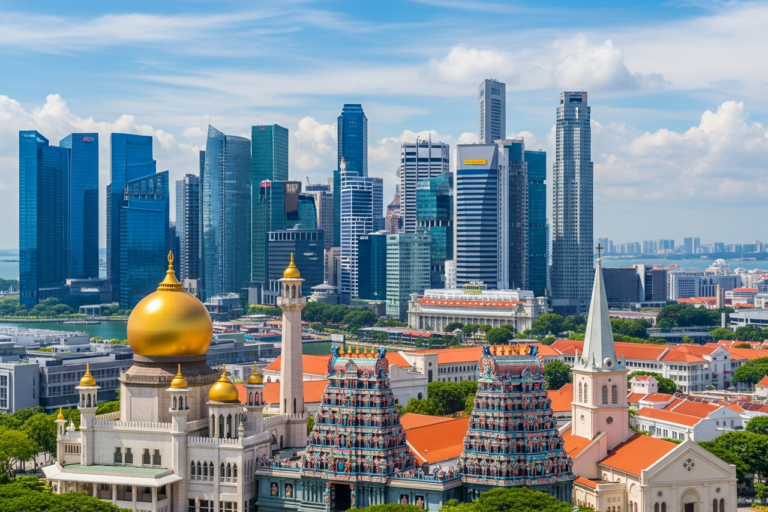
Singapore has many major religious groups. Each group adds to the country’s rich and lively cultural life. When you look at the skyline, you can see this religious diversity. There are domes of mosques, spires of churches, and temple roofs. All these buildings show how different faiths live together in Singapore. This is an important part of how people live here.
In the next part, we will talk about the major religious groups found in Singapore. You will get to know the main religious traditions of Buddhism, Islam, and Christianity. You will also see how these faiths shape the community and life in Singapore.
Buddhism
Buddhism is the largest religion in Singapore. About one out of three people in Singapore say they are Buddhists. Most Buddhists in Singapore are ethnic Chinese. They mostly follow Mahayana Buddhism. But you will see something different in this city. All three main Buddhist traditions are here: Mahayana, Theravada, and Vajrayana. You can find temples and centers for each.
Buddhists in Singapore have many religious practices. They chant and meditate. They make offerings at places of worship. They also celebrate festivals like Vesak Day, which is about the birth, enlightenment, and death of the Buddha. Many temples do more than just offer religious instruction. They are places for the community to meet and for people to do charity work.
Buddhist centers such as Kong Meng San Phor Kark See Monastery and the Buddha Tooth Relic Temple are very important. They are not only places of worship. They are also major cultural spots in the city. These centers help many people with their spiritual life. They are taken care of by groups that look after the needs of the Buddhist community in Singapore.
Islam
Islam is one of the main religions in Singapore. Around 15% of the people in the country are Muslim. Most of them are Malay, but there are also Muslims from other ethnic groups, like Indians and Arabs. Almost all of the Muslims in the country are Sunni Muslims. They follow the Shafi’i way of thinking.
The Islamic Religious Council of Singapore, called MUIS, is an important board. It looks after things for the Muslim community. It takes care of mosques and gives religious instruction through madrasahs. MUIS also checks on things like halal food certification. At the same time, it helps make sure that all religious activities fit well into Singapore’s life. It keeps everything running smoothly for people of all different ethnic groups and looks out for public order.
People in Singapore who are Muslims practice their faith every day. They join in prayers, fast during the month of Ramadan, and celebrate special days like Hari Raya Puasa and Hari Raya Haji. The mosque is more than a place to pray, though. It is a place where people come together to learn, teach, and meet with others from the community.
Christianity
Christianity is one of the main religions in Singapore. About 18% of the people in the country follow this faith. The Christian community comes from many backgrounds and has different groups. The largest of these are Catholics and Protestants. Many Chinese Christians live in Singapore, but people of other backgrounds also believe in this faith.
There are churches located all over the island. They offer many religious activities, like weekly services and Bible study groups. These churches hold community outreach programs too. Many of them also give religious education and help with social services. They do a lot of good work for people in Singapore. The oldest church is the Armenian Church. It serves as a special symbol for the long history of Christianity in Singapore.
Christianity in Singapore keeps growing. This is because churches and many groups share their message using sermons, community service, and written materials. This group makes the country even more rich with cultures and beliefs.
Other Significant Religious Communities
Besides the main faiths, Singapore also has other important religious groups. These smaller communities help make the country more diverse. They have been in the nation for a long time. Their presence and their religious practices play a big part in Singapore’s mix of cultures. They bring their own ways and add something special to the spiritual life in the country.
We will look at some of these faiths like Taoism, Hinduism, and Sikhism. Each group has its own places for prayer, its own traditions, and its own festivals. These things help make Singapore a rich and open place for all people.
Taoism
Taoism is one of the main religions in Singapore. It has deep roots in the traditions of the ethnic Chinese community. About 10% of people in Singapore say they are Taoist. This old Chinese way of thinking and living was started by Lao Tzu, a famous thinker. Taoism teaches people to live in harmony with the Tao, or the “Way.” It is also about respecting ancestors and worshiping a group of gods.
In Singapore, many Taoist practices mix with the ethnic Chinese folk religion and Buddhism. So, it can be hard to tell where one religion stops and another begins. The act of worship in Taoism includes saying prayers, giving food and incense as offerings, and burning joss paper at temples or on home altars. People do this to get blessings, protection, or advice from their gods and ancestors.
Taoist temples, like the Thian Hock Keng Temple, are the heart of religious and everyday life. They hold well-known festivals such as the Hungry Ghost Festival and the Nine Emperor Gods Festival. These events are full of lively rituals, shows on the street, and big community meals. They bring lots of joy and keep the traditions alive in Singapore each year.
Hinduism
Hinduism is mostly followed by people from the Indian community in Singapore. They make up about 5% of the whole population. Most of them have roots in South India, especially Tamil Nadu. But, you will also find people who are from other parts of India and even Sri Lanka. The Hindu community is active, lively, and has a long story here.
At the center of this group, you find the many beautiful Hindu temples. There are about 30 Hindu temples in Singapore. The oldest one is the Sri Mariamman Temple, which is in Chinatown. It was built in 1827. Hindu temples are not only for prayer. They also act as places where people meet, learn, and hold different cultural events.
The main Hindu festivals, such as Deepavali and Thaipusam, are celebrated with great joy. Deepavali is known as the festival of lights. Thaipusam is about thanks and penance. These important days are public holidays. People from other religions join in the celebrations too, showing that Singapore is welcoming to everyone. Many tourists come here during these times because these events are so special.
Sikhism
Sikhism is one of the smaller religions in Singapore, but the Sikh community here is strong and gets a lot of respect. There are about 12,000 to 15,000 Sikhs in the country. Most of them have roots in the Punjabi part of India. The first Sikhs came to Singapore in the late 1800s. Many of them worked in the colonial police force back then.
The main places of worship for Sikhs are called Gurdwaras. You will find a few Gurdwaras all over Singapore. They are very important as both spiritual and community centers. Anyone can visit these places of worship, no matter what faith they follow. A special thing about the Gurdwara is the langar. This is a free kitchen where you will get vegetarian food. It is open to all and shows the Sikh value of serving others.
The Sikh community in Singapore enjoys many festivals such as Vesakhi, which is both the Sikh New Year and a harvest festival, and celebrates the birthdays of their Gurus. During these festivals, there are prayers, singing, and big processions. The Sikh people help add to the rich mix of cultures and religions in Singapore.
Minority and Smaller Religious Groups
Singapore does a lot to keep religious diversity strong. The country works hard to protect and respect all religious groups, even the smaller ones. These faiths may not have as many people as others, but they still have a big role in the country’s mix of beliefs. They help shape Singapore’s rich and interesting mix of faiths, which is a big part of what makes the country special.
In the next few parts, we will talk about some of these smaller but valued faiths: Jainism, the Bahá’í Faith, and Judaism. Each group in this list brings its own history, ways, and part to life in Singapore. All of this helps show that the country has a friendly and open spirit when it comes to religious groups and religious diversity.
Jainism
Jainism is one of the smallest minority religions in Singapore. There are only about 1,500 people in this community. Most Jains in the country come from India, and many of them can trace their families back to Gujarat. Though their numbers are small, Jain people in Singapore are very active. They keep up religious traditions and live by ideas like non-violence (ahimsa), non-absolutism (anekantavada), and non-possessiveness (aparigraha).
The main place where the Jain community gets together is the Singapore Jain Religious Society. It has a temple, which they call a derasar. This place is used for prayers, for talks about religion, and for events in the community. The followers stick to a strict vegetarian diet and take part in fasting, usually during the holy time of Paryushan.
Jainism brings something unique to Singapore’s religious traditions with these deep ideas. The community lives peacefully with followers of other religions and with religiously unaffiliated people. This shows how people in Singapore value harmony and respect between everyone.
Bahá’í Faith
The Bahá’í Faith is one of the religious groups in Singapore. It has about 2,000 members who are very dedicated. This religion started in the 1800s. Bahá’ís believe in the value of every religion and the unity of all people. The first members came to Singapore in the early 1950s. The community has been growing since then.
The Bahá’í community works together under the Spiritual Assembly of the Bahá’ís of Singapore. This is the main religious organization that helps run the group. It takes care of activities and speaks for all members. Bahá’ís do not have any priests or persons to lead services. Instead, they choose councils to lead their communities at both local and bigger national levels.
Their religious practices include prayers every day. There is also a time of fasting that lasts 19 days. They get together for “Feasts” every 19 days. These feasts are for prayers, talks, and meeting each other. The community also joins other groups for interfaith events and education. They want to help all people feel united and make life better for everyone. Because of this, they play a strong part in helping Singapore’s many religious groups live in peace.
Judaism
The Jewish community in Singapore is small, but it has a history that goes back to the 1800s. Many of the first people who came to Singapore were from Iraq. They became known for their work as merchants and for helping others. Now, there are about 2,500 people in the community. Some are from families that settled a long time ago. Others are people from other countries who live in Singapore for work.
The main places of worship for the community are the Maghain Aboth Synagogue and the Chesed-El Synagogue. Both are not only important for prayer but are also well-known buildings. People come here for religious services, cultural events, and to learn about their faith. The community keeps to Jewish religious traditions. They meet on the Sabbath, follow kosher food rules, and observe holidays such as Rosh Hashanah and Yom Kippur.
This is one of the oldest religious communities in Singapore. The Jewish community has played a part in building the country. Today, they are still active and take part in many things in society. Their story shows how Singapore is open to many different faiths and cultures.
Modern Religious Movements
Singapore is known for religious diversity. Along with many long-standing faiths, there are also modern religious groups here. These groups often have ties to places outside Singapore. They have found the city-state open and friendly. The groups offer new spiritual paths to people. Many in Singapore who want different ways to believe and join new types of groups have become a part of these movements.
These newer religious groups add more variety to the country’s spiritual life. Next, I will talk about some of these groups, like Soka Gakkai, Hare Krishna, and Transcendental Meditation. This will help us see what they do and how they fit into the mix that is Singapore’s religious diversity.
Soka Gakkai
The Singapore Soka Gakkai is a group made up of regular people who follow Buddhism. It has become one of the most well-known religious groups in Singapore. This group is a part of Soka Gakkai International, which is a worldwide movement based on the teachings of Nichiren Daishonin, a monk from Japan. The main ideas they share are about peace, culture, and learning, all based on Buddhist ways.
The center of their religious practices is chanting the words “Nam-myoho-renge-kyo.” They also read parts of the Lotus Sutra. Most members get together with others in their area for talks and study groups. These small meetings help everyone feel close and trust each other, which has made this group grow and be strong over time.
Soka Gakkai follows Buddhist beliefs, but it is seen as one of the more modern religious groups in the country. It is known for focusing on making yourself better, working for peace, and getting involved in the community. Because of this, people from many different backgrounds have joined, and it now plays a big part in the religious life in Singapore.
Hare Krishna
The Hare Krishna movement, also called the International Society for Krishna Consciousness (ISKCON), is one of the new religious groups that has a presence in Singapore. It got its start in the West during the 1960s. ISKCON is rooted in Vaishnavism, which is a part of Hinduism focused on worshipping Krishna.
Their main place in Singapore is the Sri Krishna Mandir in Geylang. There, people take part in different religious activities. These include singing and chanting the Hare Krishna mantra together (this is called kirtan), listening to talks about the Bhagavad Gita, and showing respect to the deities. The temple also gives out free vegetarian meals, called prasadam, to everyone who comes in. This is a big part of how they show service.
The Hare Krishna movement may be small compared to other religious groups, but it brings more variety to how people practice Hinduism in Singapore. Its lively and loyal way of worship, along with its simple take on living a spiritual life, helps it bring in followers from many walks of life.
Transcendental Meditation
Transcendental Meditation (TM) is a kind of silent mantra meditation. It became well known in the middle of the 20th century as one of the new religious movements. Even though many see it as just a way to feel better or manage stress, TM comes from Hindu spiritual teachings. In Singapore, people use TM to help with stress, grow as a person, and find inner peace.
The religious practices in TM are both simple and follow a set order. Anyone who wants to practice TM learns a special mantra. This happens during a ceremony. They then meditate for 20 minutes, two times each day. This method is made to be easy. It helps the mind relax and go into a peaceful state that some call “transcendental consciousness.”
TM is not a religion in the usual way people might think. Still, it does show how more people want some kind of spirituality that does not need to follow any formal organized faith. In Singapore, TM is part of the country’s religious pluralism. There, many different ways to look for spiritual growth—both through religion and not—are open to everyone.
The Non-Religious Community in Singapore
A big part of the religious diversity in Singapore is the group of religiously unaffiliated people. This group is almost one out of every five people in the country. It has atheists, agnostics, and people who do not follow any faith at all. These people add something new to the rich mix of society.
More people are now choosing a non-religious identity or turning to secularism in Singapore. This is a trend that is getting stronger. In the next parts, we will talk about different sides of this group, why many are unaffiliated, and how this change affects all of us.
Secularism and Atheism
Secularism and atheism are getting more common in Singapore, especially among people who are not tied to any religion. Singapore is a secular country. This means the government does not support any single religion. In Singapore, people talk about secularism as a way of thinking, not just a choice of faith. This group has both atheists, who do not believe in gods, and agnostics, who say no one can know if gods exist or not.
Having no religious affiliation for many people does not mean they lack morals or kindness. Some of them follow humanism, which puts focus on reason, values, and the importance of people making choices. Many do not take part in religious practices like prayer or worship. But they often care about things like compassion and doing things for others in the community, just like their friends or family who follow a religion.
The rise of atheism and secularism is one reason why Singapore stands out for its religious diversity. Being one of the most diverse countries in this way means the country is home to many faiths and also gives people the freedom to have no faith at all.
Reasons for Non-Affiliation
More people in Singapore now choose not to have any religious affiliation. Some make this choice after thinking about it or because they follow a scientific way of looking at the world. They might not find explanations from religion convincing. They choose to depend on facts and proof instead.
There are also people who are not religious for other reasons. Some grow up in families that do not practice a faith. Others slowly stop following the religion they were born into and do not join a new one. Many live busy lives and do not have the time or energy to take part in religious activities. Social media and the internet let people see lots of new ideas. Because of this, people can question the religion they got from their families.
Some key reasons include:
-
Some people like scientific or human-centered ways of thinking more than religious beliefs.
-
Some do not agree with what organized religions teach or the way they view social issues.
-
Some grow up in homes without religion or slowly lose faith as time goes by.
Impact on Society
The growing number of people who are not part of any religion is having a big effect on Singapore’s society and culture. Their presence helps keep the country and its public life fair for everyone. It makes sure that the laws and rules in the country are not made from just one group’s beliefs.
As more people are not tied to a religion, they add their views to the talks that shape the country. This creates room for different voices and brings people together with shared values, like common sense, human rights, and being a good citizen. It can help bring different religious groups closer. People in Singapore may then feel like one, not just separated by what they believe.
Over time, including those who have no religion makes religious diversity stronger in Singapore. It helps people see values, ways to live, and the idea of community in a new way, not just by faith. The mix between the religious and the non-religious helps shape a society where more people matter. It makes Singapore more open, united, and supports public health as well as the well-being of all.
Religious Diversity and Social Cohesion
Singapore shows how a place with a lot of religious diversity can have strong social unity. The government and the people work hard to make a society where different religions live together in peace. This way of keeping religious harmony does not just happen by itself. It needs to be cared for and built up over time.
This part will talk about the ways Singapore keeps this balance. We will see how interfaith groups, government rules, and community programs all help bring Singapore’s many religious groups together.
Interfaith Organizations and Initiatives
Yes, Singapore has a strong system of groups and projects that work to keep religious harmony. The oldest and most well-known group is the Inter-Religious Organisation (IRO), which started in 1949. It brings leaders from ten different religions together so they can understand each other better and work as one.
These religious groups play a big part in connecting different people in the country. They set up talks, workshops, and open events where the public can get to know what others believe or do. This brings people of different religions closer, helps get rid of wrong ideas, and builds trust.
Some important interfaith programs are:
-
The Inter-Religious Organisation (IRO): Builds understanding and holds common events.
-
Inter-Racial and Religious Confidence Circles (IRCCs): Local networks that help when there are issues about races and religions in the area.
-
A-Pledge to Promote Religious Harmony: A promise made in public, where people or groups agree to treat everyone with respect.
-
Harmony of Faiths Exhibition: Teaches people about the good things all different religions have in common.
Singapore’s focus on religious harmony is strong, and people from different religions work to keep peace in the country.
Promoting Harmony Through Policy
Singapore is very open to people from different religious groups, and the government works hard to keep this attitude strong. The state often steps in to help keep religious harmony, which helps keep public order and makes society stable. One key law is the Maintenance of Religious Harmony Act (MRHA). This law lets the government stop people or groups who try to cause hate or problems between different faiths.
There is also the Presidential Council for Minority Rights. This group checks all new laws to be sure they do not treat any racial or religious community unfairly. This rule in the constitution helps to protect religious diversity in Singapore, making sure no group is left out because of their faith.
The government takes a secular approach but still supports religion. It does not pick favorites. Instead, it tries to make a place where everyone can keep their faith, as long as they do not hurt the rights of others or threaten the peace. This careful way of handling things helps Singapore be successful as a country with many different religions.
Community Engagement Activities
Community engagement is key to how religious diversity helps shape Singapore’s society and culture. Many places of worship open their doors to everyone. They invite people in to see and learn about different religions. Mosques, temples, and churches often have “open house” events. At these events, they give guided tours and show people their religious practices.
These efforts help people understand other religions better. They bring people together and create a shared sense of community. Religious groups also team up on charity work and social projects. They work together to help the wider community. This kind of teamwork helps people form strong friendships. It also brings respect between followers of different religions.
Also, schools have citizenship education. They teach students about religious diversity and religious harmony. Students learn about different religions found in Singapore. They learn why tolerance and respect are important. Community engagement like this helps values like mutual respect be passed down. It helps make religious diversity a strength for everyone.
Government Role and Religious Freedom
The government of Singapore has an important and careful job in looking after the country’s different religious groups. While the constitution gives all people religious freedom, the state also feels that it must keep peace between all these groups. The government tries to find a balance. It gives people room to show their religion but will step in if needed to keep public order.
Public authority works with a set of laws and rules to look after religious groups. These rules protect religious freedom and communities but also make it clear what people can and cannot do. The next parts will talk about what legal protection religion has, the kind of help the state gives, and what rules there are to keep harmony.
Legal Framework Protecting Religion
The government of Singapore does a lot to help with religious freedom. There is a strong legal system for this, and it is written into the Constitution. Article 15 of the Constitution says every person can have, follow, and share their religion. This basic right is at the heart of religious life in the country.
The Constitution also keeps religious groups safe. It gives them the right to take care of their own affairs. They can set up and keep going any group, building, or cause for religious or charity reasons. They can also own things like land or buildings. Article 12 makes sure no one is treated unfairly because of their religion. All people will be treated equally by the law.
This set of rules lets all religious groups grow and be active. Reports from groups such as the Department of State mention that there are some limits, but the main goal for the Singapore government is to keep religious freedom while also making sure there is public order and people can get along. This helps create a safe and calm place for all faiths to live together.
State Support for Religious Groups
The Singaporean government supports religious freedom not only with laws but also with state help. The help is given in a fair way to all major religious groups. This shows that the state is not tied to one religion but is friendly toward all. For example, the government gives money to build and take care of religious buildings. These places are seen as part of the country’s history.
The state also helps with religious instruction and education for the different groups. The Islamic Religious Council (MUIS) is an example. It is a board backed by the state. It looks after Muslim needs like mosques and madrasahs. The government also meets with other groups to see what they want or need.
Public schools have a role in offering religious education. Students learn about different faiths in Singapore. The lesson is not there to try and convert anyone, but to help students show respect for all groups. This is called an accommodationist approach. It means the state helps religious groups to grow as long as the groups give something good back to society.
Restrictions and Maintenance of Religious Harmony Act
While the government gives space for religious freedom, it puts some rules in place to keep peace among different religious groups. The most important law for this is the Maintenance of Religious Harmony Act (MRHA). This law lets the Minister for Home Affairs give a restraining order to anyone who creates conflict between religious groups or uses religion to push political ideas.
A restraining order can stop someone from talking to religious gatherings, printing out religious bulletins, or leading a religious organization. When these orders are made, the Presidential Council for Religious Harmony checks them before they take effect. This system helps step in early and keep problems from growing between religious groups.
Some religious groups, such as the Jehovah’s Witnesses and the Unification Church, are not accepted by the government. So, what they can do is limited. The government says these steps are needed to keep public order and protect social unity. This shows the government’s way: it wants to offer religious freedom, but also set clear boundaries so religion does not break up the community.
Religion in Everyday Life
In Singapore, religion is a big part of daily life. It goes way beyond places of worship. The food people eat, the festivals they join in, and many other things are shaped by religious practices. This brings a special feel to Singaporean culture.
You can see the influence of religion all around. It helps make the country lively and supports public health with strong community groups. Let’s look at how religious festivals and daily habits are part of life for people in Singapore.
Religious Festivals and Their Significance
Religious festivals are a big part of daily life in Singapore. They bring people together all year with fun and exciting events that everyone enjoys. The main festivals from the biggest religions are public holidays here. This means everyone can join in or watch the celebrations if they want. These events really show the religious diversity found in the country.
During these times, places of worship are full and busy. The act of worship becomes even more special, as it feels joyful and shared by all who take part. Streets light up with decorations, there are special foods, and families come together. These festivals are about more than faith. They are big cultural events that help make the community stronger, and they add to the deep national identity in Singapore.
Some of the most important festivals are:
-
Chinese New Year: The Chinese community marks this time with family dinners and old customs.
-
Hari Raya Puasa: This festival happens when Ramadan ends. Muslims celebrate with food and saying sorry or forgiving each other.
-
Deepavali: The Hindu festival of lights, which stands for good winning over bad.
-
Vesak Day: This day honors Buddha’s birth, his reaching full wisdom, and his death.
-
Christmas: Christians celebrate this, but many other people enjoy its joyful feeling too.
Influence on Daily Practices
Religious diversity has a big impact on daily life and the way people live in Singapore. For many, faith shapes their daily habits, like morning prayers or what they choose to eat. It is common to see lots of halal food for Muslims, vegetarian meals for Buddhists and Hindus, and kosher food for the Jewish community.
The effect of religious diversity is also seen in the way people relate to each other and how they act. The things people believe, such as being caring, telling the truth, and helping others, often come from religious teachings. These values can help public health and social well-being because religious groups usually support their members when they need help the most.
The act of worship is easy to see in Singapore. You can spot a Muslim person doing daily prayers, a Buddhist chanting, or a Christian going to church. This steady and open practice of faith, along with respect for different beliefs, is what makes Singapore a good and peaceful place to live.
Conclusion
To sum up, knowing about religion in Singapore helps us see the country’s rich mix of cultures. The different religious practices shape daily life and help people feel close to each other. These beliefs have deep roots and still change with time. Religion is a big part of what makes Singapore stand out. Accepting this mix through friendly programs and rules brings everyone together. It helps people respect each other. When you look at the many sides of faith in Singapore, keep in mind that each group brings something special to society. If you want to know more or have any questions, you can ask for more info.
Frequently Asked Questions
Which is the largest religion in Singapore?
Buddhism is the biggest religion in Singapore. About 33% of the resident population there say they are Buddhist. Buddhism is one of the major religious groups in the country. A lot of its followers come from the ethnic Chinese population. The ethnic Chinese are a big part of Singapore, and they make up most of the people who follow Buddhism. This connection helps add to the religious diversity in Singapore.
How has Singapore’s religious landscape evolved?
Singapore’s religious landscape has changed a lot over time. This is because of migration and new ways of living. More people now call themselves Christian, or say they do not follow any religion at all. Because of this, there is more religious diversity in the country. You can see clear numbers about this change in census data and in many written materials about religious affiliation.
Are there interfaith activities in Singapore promoting harmony?
Yes, Singapore works hard to keep religious harmony. The country has many events where people from different faiths can meet and talk. Groups like the Inter-Religious Organisation (IRO) help make these meetings happen. These steps help keep Singapore’s rich religious diversity strong. Both the government and local religious groups give their full support to these plans.



