

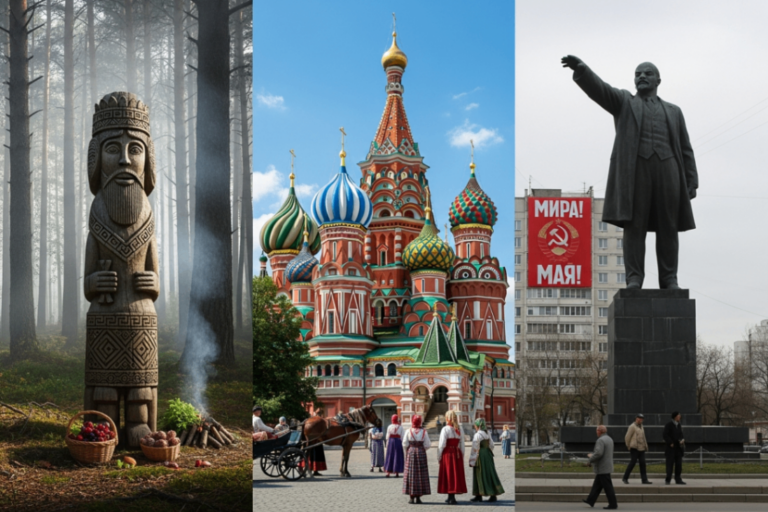
Key Highlights
-
Orthodox Christianity is the main faith in Russia. Many people now follow the Russian Orthodox church, and more have joined since the Soviet Union ended.
-
Russian history had a big effect on how people in the country practice religion. It started with Christianization, then came a time when religion was not allowed during the Soviet Union, and now religion is coming back since the Soviet Union is over.
-
Even though a lot of people say they are religious, not many often go to church.
-
There are other religious groups in Russia too, like people who follow Islam, Protestantism, Judaism, and Buddhism. These groups are spread out across the country.
-
The Russian Constitution gives religious freedom, but not all religious groups get the same treatment. Some get more attention from the government than others.
Introduction
Religion in Russia is a big part of people’s lives, and it is deeply tied to the country’s past and who they are as a nation. For many years, Orthodox Christianity and the Russian Orthodox Church have played a big role in russian culture. They have shaped the way people live and even how they make art and keep traditions. The russian orthodox church is very important. But, there are also many other faiths in the country. If you want to understand more about Russia, you need to know about this mix of religions. It helps to show why russia and its people are so unique and interesting.
The Landscape of Religion in Russia Today
The religious scene in modern Russia has changed a lot since the end of the Soviet era. The Russian Orthodox Church is now the biggest religious group in the country. Most people say they are Orthodox Christians.
But it is not just about the Russian Orthodox Church. There are many other religious groups and religious minorities in the country. Islam, Protestantism, Catholicism, Judaism, and Buddhism all have set up their own communities. This shows that Russia is home to people from different backgrounds and cultures. Below, you will see more about the major faiths, where they are found in the country, and what is happening with their followers now.
Major Religions and Their Followers
Russia is a multi-confessional state where several major religions are practiced. The most widespread faith is Orthodox Christianity, with the Russian Orthodox Church being the largest religious body. A significant portion of the population identifies with this tradition, a number that has grown substantially since the 1990s.
Islam is the second-largest religion, with a strong presence in specific regions and among certain ethnic groups. Other notable faiths include various Protestant churches, Roman Catholicism, Judaism, and Buddhism, each with its own history and community of followers within the country.
|
Religion |
Estimated Share of Population |
Key Notes |
|---|---|---|
|
Orthodox Christianity |
72% (as of 2008) |
Experienced a massive revival post-Soviet era, from 31% in 1991. The dominant faith. |
|
Islam |
~5% (ISSP 2008 survey) |
Second-largest religion, with some estimates being higher. Strong in the North Caucasus. |
|
Protestantism |
<1% |
Includes various denominations like Baptists, Pentecostals, and Lutherans. |
|
Roman Catholicism |
<1% |
A smaller minority, with a history tied to certain ethnic groups like Poles and Germans. |
|
Judaism |
<1% |
Historically significant, with a population that has seen shifts due to emigration. |
|
Buddhism |
<1% |
Traditionally practiced in regions like Buryatia, Kalmykia, and Tuva. |
Diversity of Belief Systems Across Regions
Russia is a huge country. Because of this, there are many different religious beliefs in different areas. Orthodox Christianity is the main faith in most European parts of Russia. Other religions can be found in certain places. These religious beliefs shape the religious life of people living there.
The mix of religions from one area to the next is a big part of what makes up Russia’s spiritual identity. For example, some republics have many people who do not follow Orthodox Christianity. Instead, they belong to other religions. This gives the country a rich and varied mix of faiths.
Key regional religious beliefs include:
-
Islam: Most common in the North Caucasus, like Chechnya and Dagestan, and also in Tatarstan and Bashkortostan.
-
Buddhism: The biggest religion in Kalmykia, Buryatia, and Tuva. These places are found in the southern and eastern parts of Siberia.
-
Shamanism and Indigenous Beliefs: You can still see these religious practices in parts of Siberia and the Far East. In some places, they exist side-by-side with other faiths.
The Relationship Between Religion and Ethnic Groups
In Russia, the link between a person’s ethnicity and the religion they follow is often very strong. For many people, religion is not just what they believe, but also an important part of their culture and who they are. This is very true for ethnic Russians. Most of them are connected with the Russian Orthodox Church.
Other groups in Russia also tie their faith to who they are. For example, Turkic and Caucasian people like the Tatars, Bashkirs, and Chechens are mostly Muslim. This close tie between faith and background has built up over many years, with people and cultures growing together.
So, when someone connects with a certain religion in Russia, it often also shows their deeper link to a group, whether that’s Russian Orthodox, another Orthodox church, or part of the slavic people. The Russian language helps bring everyone together in the country, but faith makes group identities even stronger.
Current Trends and Shifts in Religious Affiliation
One of the biggest changes in modern Russia came after the collapse of the Soviet Union. People started getting back to religion after years of the government forcing atheism. From 1991 to 2008, the number of adults saying they were Orthodox Christian jumped from 31% to 72%.
This new wave of belief didn’t stop right after the soviet era ended. Data shows that religious ties kept getting stronger even in the 2000s. So, it’s not just that people were free to say what they believed during the Soviet Union—they really started to change over time. The group with no religious tie dropped from 61% in 1991 to 18% by 2008.
Orthodox Christianity got the biggest boost, but other religious movements and smaller groups also grew, especially in the 1990s. The collapse of the soviet union opened the way for new spiritual ideas to become common in Russia.
Historical Roots of Religion in Russia
The story of religion in Russia has been long and full of big changes in its past. For more than one thousand years, people in Russia have followed different religious traditions. At first, there was Slavic paganism. Later, the Orthodox Church became a strong force in the country. The Christianization of Kievan Rus’ was an event that shaped the Russian Empire and set things in motion for many years ahead.
Over time, there were moments when the state supported religion. This happened during the Russian Empire. There were also times of strong pressure and harm, which took place when the Soviet Union was in control. To really know why religion matters in Russia now, it is important to know about these roots in history. The next parts will look closer at these key times and how they still matter now.
Pre-Christian Traditions and Ancient Beliefs
Before Orthodox Christianity came, the area that is now called modern Russia had many old beliefs. The early Slavic people lived all over Eastern Europe. They followed a form of paganism. People believed in gods and spirits tied to things like nature, farming, and the circle of life.
These beliefs were part of everyday life. People had different rituals and festivals for the seasons and big events. Gods like Perun, the god of thunder, and Veles, the god of the underworld and cattle, were main figures for the Slavic people.
In the other parts of this wide land, especially in Siberia and the Far East, shamanism was, and still is, important. These traditions focus on communicating with the spirit world. They are some of the oldest kinds of religion in the area.
Christianization and Its Long-Term Effects
The choice to take up Orthodox Christianity in 988 AD, led by Prince Vladimir of Kiev, was a big step for the Slavic people and the growing Russian state. This change, often called the Christianization of Kievan Rus’, shaped the area’s culture, politics, and beliefs for good. The Eastern Slavs grew closer to the Byzantine Empire because of this. It also set them apart from people in Western Europe.
This switch shaped how people saw the world for many years. The Russian Orthodox Church became an important part of life in Russia. It played a huge role in art, buildings, books, and the law. This strong tie to orthodox christianity became part of what it means to be Russian.
Even when the Russian state saw big changes—like the Mongol invasion or the soviet era—the link between the russian orthodox church and the people did not go away. After 1991, many returned to their roots, showing that the bond between the people and the orthodox church was still strong.
Impact of the Russian Empire on Faith Communities
In the time of the Russian Empire, the Orthodox Church had a strong and special place. It was the main church for the country, and the Tsar supported it. Because the church and the government were so close, the orthodox church was a big part of life. The church touched everything, like the military and schools.
But the empire had many groups in it. As the empire grew, it took over large areas, including central asia, that had different people living there. This brought many religious minorities under Russian rule. Some were Muslims from central asia and the Caucasus, some were Catholics and Protestants from the west, and some were Jews living in the Pale of Settlement.
The russian empire did not treat all these groups the same way. Some groups got to live quietly, but some faced tough laws and were not treated well. This made a difficult system for religion, with the orthodox church at the top. It affected how people of different faiths got along for many years.
Soviet-Era Policies and Their Legacy
The 1917 Bolshevik Revolution was the start of a difficult time for religion in Russia. The russian state used its communist idea that was against belief to try to wipe out faith. Freedom of religion was taken away, and religious institutions were treated very harshly.
Lots of churches, mosques, and synagogues were shut down. Many were ruined or turned into things like warehouses and museums. Priests, imams, and rabbis were often arrested. Some were sent to gulags or killed. If you said you had faith in public, you could lose your job, not get into college, or face heavy trouble from the russian state.
The soviet era left a mark that is still strong. The government never managed to get rid of faith fully, but religious institutions suffered, and belief was pushed out of sight. Now, religious groups in Russia are coming back, but they do so with the memory of this hard history. This history still shapes how they deal with the government and each other.
Post-Soviet Religious Revival and Changes
The collapse of the Soviet Union in 1991 brought a big change in Russia. People were finally free to look for their spiritual past and say what they believe. After years of forced atheism, many wanted to go back to faith. This time brought a big rise in religion, which changed Russian society in important ways.
The Russian Orthodox Church was one of the main winners in this period. It did well as people returned to the faith. The Orthodox Church started building many new churches again and became a strong part of russian society. It also took back its role in saving russian culture and the country’s identity. Right after the fall of the Soviet Union, the number of people who said they were part of the Russian Orthodox Church grew fast.
This return to faith was not just about orthodox church groups. Other religious groups in Russia also got stronger and started to grow. They rebuilt and formed new communities. Still, this change made things more complex. These faith groups had to find their way around new state rules and also figure out their place beside the strong Russian Orthodox Church.
Demographics and Distribution of Religious Groups
When you look at the demographics of religion in Russia, you can see a complex picture. Many people in the total population say they have a faith, with Orthodox Christianity being the biggest group. But, not many go to church on a regular basis. There are a lot of self-identified religious adherents, but it is clear that attending church is much less common.
These groups do not live evenly across the country. There are big changes based on the area, and these are tied to things like ethnicity, history, and culture. In the next parts, you will see more about where these people live, the way their ages differ, and how life in the city or the country changes the religious picture in Russia.
Geographic Patterns of Faith in Russia
Religion is not spread out evenly in Russia. You can see clear patterns in different parts of the country. Most people in the European side of Russia, like in Moscow and Saint Petersburg, follow the Russian Orthodox Church. This area is also where the Russian state began, and it is the center for the Russian Orthodox Church.
But, if you go to other parts of Russia, you will see something different. The North Caucasus is mostly Muslim. Places like Dagestan and Chechnya are strong Muslim regions. The Volga area, which includes Tatarstan and Bashkortostan, also has a big Muslim group that has been there for a long time.
If you move even more east, there are some places in southern Siberia where Buddhism is the main faith. You will find this in Buryatia, Kalmykia, and Tuva. The reason for these different religions in these areas is Russia’s past. As the country grew, it brought in many groups of people, and many people kept their own faiths and ways.
These patterns show how Russian Orthodox believers are more common in the west, while the North Caucasus and the Volga are homes for many Muslims. Buddhism is strong in certain parts of southern Siberia. This mix comes from the history and the people that make up Russia.
Regional Variations in Religious Identification
Religious identification in Russia is very different from one part of the country to another. This is often tied to ethnic and old borders from history. In the central and northwestern areas, Russian Orthodoxy is strongest. For many people in these regions, being Russian can mean being part of Russian Orthodoxy.
But, as you go to other parts of the country, this religious picture changes a lot. In the south, especially in the North Caucasus, most local people say they are Muslim. Here, Islam is not only a religion. It is also a big part of daily life and local culture for people in that area.
The way people pick their religion often comes from their ethnicity and which part of the country they call home. So, you will see many kinds of different religious areas across Russia. Each of these zones has its own story when it comes to faith, culture, and people’s lives.
Age and Generation-Based Religious Differences
When you look at religion in different age groups of Russian citizens, you see that some things stand out. Since the end of the Soviet Union, more people in all age groups say they belong to a religion. But older Russians are more likely to believe in their faith and say they are part of the Orthodox Church. For example, in 2008, about 82% of Russians age 70 and older said they were Orthodox, while just 62% of people between 16 and 29 did so.
This shows there is a big gap between age groups. People who spent more time during the Soviet era may have held on to the Orthodox Church more. Or, they might have come back to it as they got older. Older people are also more likely to call themselves religious, and to say they believe in God.
But when it comes to how often people go to church or take part in other religious practices, there is not much difference based on age. Going to church stays low for all age groups. Also, more young Russians now say they belong to smaller religions such as Islam. This may lead to changes in what faith looks like among Russian citizens in years to come.
Urban vs Rural Religious Observance
There are clear changes in how people follow religion in Russia’s big cities compared to smaller towns or villages. You can see many people connect with religion in both the city and the countryside, but how they show it and how often they do can be quite different. In the past, small towns were where you would find people holding on to the old ways of faith, and the church was the main place for everyone to come together.
Since the end of the Soviet era, things have gotten more mixed up. A lot of people in small towns still feel a strong tie to Orthodoxy, but this does not always mean they go to church more than those who live in big cities. Some reports show that not many people go to religious services very often in any part of Russia, whether in the city or out in the country.
People who live in Russia’s big cities, like Moscow, might have more chances to be part of different religious institutions, or join groups with other types of faiths. Still, even among most people who say they are Orthodox, their faith is usually more about where they came from and sticking with their culture, not about going to church every week.
Notable Minority Religions and Populations
Besides the main Orthodox Church, Russia also has many other religious groups. These religious minorities each have a long history in the area. Even though these communities are a small part of the total population, they add a lot to the country’s rich mix of beliefs.
Islam is the biggest religion after the Orthodox Church. There are millions of people in Russia who follow Islam, and many of them live in certain parts of the country. After Islam, some other well-known groups are Protestants, Catholics, Jewish people, and Buddhists. These groups have also had their own paths of keeping, losing, and getting back their faith in Russia.
Some main religious minorities are:
-
Judaism: Jewish people have lived in Russia for a very long time. The history here is not simple. Now, Jewish life in Russia is coming back, and there are active community centers and synagogues in bigger cities.
-
Buddhism: Many people in Kalmykia, Tuva, and Buryatia follow Buddhism, which is one of Russia’s important faiths.
-
Catholicism and Protestantism: These parts of the Christian faith are smaller. They are often linked to groups like Poles and Germans who live in the country.
The Structure and Role of Russian Orthodox Christianity
Russian Orthodox Christianity is the main religion in Russia. It has the most followers and shapes a lot of the country’s culture. The Russian Orthodox Church is the biggest and strongest religious group in Russia. It connects deeply with the national story and who people are.
The church doesn’t just affect people at church on Sundays. It also guides social habits, shapes old and new holidays, and touches politics. To really know modern Russia, you have to look at where orthodox christianity came from, how the church works, and how much it matters in Russian life. In the next parts, we will talk about what russian orthodox christianity believes, how the orthodox church is organized, and the ways the russian orthodox church changes the culture.
Foundations, Beliefs, and Traditions
Orthodox Christianity in Russia is part of Eastern Orthodox Christianity. This faith goes back to the early years of Christianity. At its center are the teachings of Jesus Christ, the Holy Trinity, and following the holy writings and traditions. People believe they can find salvation by getting closer to God or becoming more like Him.
The faith has many special rituals and uses icons in worship. These sacred pictures show Jesus Christ, the Virgin Mary, and the saints. People use these images at home and in church when they pray. They see them as a way to feel closer to God. There are also many well-known religious sites for those who want to visit and take part in a journey of faith.
Key traditions and practices include:
-
Liturgy: The main worship service is called the Divine Liturgy. It is known for the way people chant, use incense, and keep the service beautiful.
-
Sacraments: There are seven sacraments in orthodox christianity, such as baptism, chrismation, and taking part in the Eucharist.
-
Religious Holidays: Major religious holidays are Orthodox Christmas, celebrated on January 7th, and Pascha, known as Easter. These events are the most important in the religious calendar and people across Russia take part in celebrating them.
Orthodox christianity has many traditions. People visit religious sites and take part in prayers and rituals that go back many years. The focus is on living by the teachings of Jesus Christ, taking part in
Organizational Hierarchy and Leadership
The Russian Orthodox Church has a clear system with levels in place. At the top is the Patriarch of Moscow and All Rus’. He is the spiritual leader for many Orthodox Christians in and outside of Russia. The main body that runs the church is called the Moscow Patriarchate.
The Russian Orthodox Church is made of areas called dioceses or eparchies. A bishop or metropolitan leads each one. These dioceses then break down into parishes. The priest leads the parish, which is the local group of people. This setup creates a path of leadership from the top to each person in the church.
Religious leaders in the Orthodox Church, especially the Patriarch, also have a big part in public life in Russia. They often talk about right and wrong and speak with government leaders. This system gives the Russian Orthodox Church a strong team that can voice its thoughts on the country’s issues.
Social and Cultural Influence of Orthodoxy
The Orthodox Church has had a big impact on Russian culture. For more than a thousand years, the church has shaped the country’s art, thinking, and values. The link is strong, and to many people in Russia, being Russian is tied to the Orthodox faith—even if they do not follow it closely.
You can see this effect in many places in Russian culture. Big writers like Dostoevsky and Tolstoy talk about ideas like suffering, hope, and faith, all coming from the orthodox church. Music by people like Rachmaninoff and Tchaikovsky also uses church songs and themes.
Today, the Orthodox Church still plays a key part in religious life. It helps people through charity, speaks about family and morals, and gives people a sense of togetherness. It helps keep a link to the past, even as the country changes. The church remains a strong part of Russian culture.
Role in Festivals and Public Life
The Russian Orthodox Church is easy to notice in public life in Russia. People see the church at many events, especially during religious holidays. The biggest church feasts have now become a big part of Russian culture. Many in russian society take part in these, even if they do not believe in God.
The most important of these is Pascha, or Easter. This is when many have services all over the country. People come to get their food blessed and to be with family. Orthodox Christmas, on January 7th, is also special. On this day, you find religious services but also fun traditions that many in Russia enjoy.
The russian orthodox church does more than only hold holidays:
-
Public Ceremonies: Priests take part in state occasions. They bless things like military hardware or are there to start new public buildings.
-
Moral Guidance: The leaders of the orthodox church talk about things that matter to the country. They often share views about social and political questions to help people know what is good.
-
Cultural Preservation: The church helps keep Russian values. Many see it as keeping the heart of old Russia safe with its culture and teaching.
The russian orthodox, russian orthodox church, and its holidays are a big part of russian society and shape how people work and live together.
Church Attendance and Participation Rates
One of the most surprising things about religion in modern Russia is the difference between how many people say they are part of the Russian Orthodox Church and how often they take part in church activities. More than 70% of people say they are with the Russian Orthodox Church, but not many of them actually go to church.
Studies keep showing that only a small number of the people who say they are Orthodox Christians go to church services often. For example, in the late 2000s, less than 10% of Russians said they went to religious services at least once a month. So, it seems that for many, being part of the Orthodox Church is more about their culture and being Russian than about what they do in their religious life.
People often call this “belonging without believing” or “believing without belonging.” Many in modern Russia feel close to the Russian Orthodox Church as part of who they are and may celebrate big holidays like Easter. But, they do not feel a need to go to church often or follow every teaching from the Orthodox Church.
Christianity Beyond Orthodoxy in Russia
The Orthodox Church is the main Christian group in Russia. But it is not the only type of Christianity found there. Russia is also home to other Christian groups, even if their stories are a bit complex. These groups help make religion in the country more varied.
Some of these are the Catholic Church, many Protestant churches, and the Old Believers, who have an important history. The next parts will talk more about the background and how these groups are part of life in Russia today. This will help you see another side of Christianity in Russia.
Catholicism: History and Modern Presence
The Catholic Church in Russia is one of the smaller religious minorities in the country. Its roots go back many years. It was often tied to groups in the Russian Empire who were not Russian. These people were mostly Poles or Germans who moved to different parts of the country. Because of this, many people in Russia saw the Catholic church as a “foreign” faith.
In the soviet era, things got very hard for the Catholic Church and for all religious organizations. Priests were taken by the government. Churches were shut down. The Catholic church almost lost its place in Russian life.
But after the soviet era, things started to change. The Catholic church has been able to grow again. Restoring its structure, it is working to bring people back. The number of people is still small, less than 1% of all in Russia. But there are active parishes and dioceses now. The people who go to these churches still hold on to their special Christian traditions, even though most people around them follow the Orthodox church.
Protestant Denominations and Growth
Russia is also home to many types of Protestant churches. These include Baptists, Pentecostals, Lutherans, and Adventists. Some like the Lutherans have been in the country for a long time. Their history is tied to German people who moved to Russia many years ago.
The collapse of the soviet union in the 1990s brought big changes for religious groups. There was new religious freedom for everyone. Many protestant churches started to grow fast. Domestic revival and overseas missionary activity became common. Evangelical groups began to work all over the country. They set up new congregations and tried to reach more people.
But this growth has not been without some problems. Some protestant churches have been viewed with suspicion both by the state and by the orthodox church. They sometimes get called “sects” or are seen as foreign agents. Still, even with these challenges, protestant churches are a small but full of life part of Russia’s religious groups.
Old Believers and Other Christian Minorities
The Orthodox Old Believers are a special group in Russian Christianity with a long past. They broke away from the main Russian Orthodox Church in the middle of the 1600s. They did not accept changes to church rules from Patriarch Nikon. Because they would not change, the government and the church gave them a hard time for many years.
Still, the Old Believer groups made it through. They kept their old ways and habits, even when they had to live far from towns in Russia or move to other countries. People know them for being very strict in their faith. They also have strong ties among their people. After the Soviet era, they could follow their faith much more freely.
There are also other small Christian groups in Russia besides the Old Believers. Each one has its own story and customs. All of them add something to the wide mix of religions in Russia.
-
Spiritual Christians: These include Doukhobors and Molokans. They do not have priests or church leaders.
-
Armenian Apostolic Church: This group is for the Armenian people living in Russia.
-
Georgian Orthodox Church: This church is for Russians from Georgia.
Islam in Russia: Presence and Influence
Islam is the second biggest religion in Russia. It has been in the country for a very long time—just as long as Christianity, and in some places, even longer. Many Russian citizens, including people in the North Caucasus and the Volga area, follow this faith.
Islam has always been a key part of life in Russia. It helps shape the way people think about their country, especially because Russia has many different ethnic groups and religions. In this part, you will learn about how Islam spread in Russia over time. You will also read about where most Muslims live, how Islam is practiced, and the place it has in Russian life today.
Historical Spread and Establishment of Islam
The history of Islam in the area that is now Russia goes back a long way. It was around before the Russian state in Moscow started. Islam first came to the Caucasus in the 7th century. That was soon after the religion began. Derbent, a city in Dagestan, has one of the oldest mosques in the world.
Later, another big change happened when the Golden Horde became powerful. The Golden Horde was a Mongol state that ruled the Russian lands for many years. In the 14th century, the leaders of the Horde changed to Islam. This made Islam strong in the Volga region and in parts of Siberia.
As the Russian Empire grew and moved south and east, it included more Muslim lands and people. The long history of peace, trade, and sometimes trouble between the Russian state and its Muslim groups has shaped Russian history a lot. This relationship is also tied to connections with Central Asia.
Key Muslim Regions and Republics
Islam in Russia is not spread all over the country in the same way. You will find that Islam is mainly found in some main places and in some republics. Many people call these areas Russia’s “Muslim regions.” These places have been important for the religion for a long time. They are known for rich Islamic culture and learning.
The most well-known Muslim area is the North Caucasus. This is a mountain area in the south of Russia. Republics like Chechnya, Dagestan, and Ingushetia are here. People in these places are almost all Muslim. In these areas, Islam is at the heart of the people’s identity, culture, and the way they live every day.
There are also other Muslim regions that stand out:
-
Tatarstan and Bashkortostan: These are in the Volga region and are home for the Tatars and Bashkirs. These are two big Muslim ethnic groups in Russia. Kazan, a city in Tatarstan, is a top spot for Russian Islamic history and culture.
-
Parts of Siberia: Some communities of Siberian Tatars live here. They have followed Islam for a long time.
-
Major Cities: There are many Muslims now in big cities like Moscow and Saint Petersburg. Most come from Central Asia and the Caucasus and work there.
You will find that in Russia, the Muslim faith is stronger in the north caucasus and parts of siberia. In cities like saint p
Mosque Networks and Islamic Education
The revival of Islam in Russia after the soviet era has led to more places for worship. Across the country, and mainly in areas with many Muslims, there is a big push to build and fix mosques. Many new mosques have been built. Old mosques have also been given back to their communities and fixed up.
With more mosques, Islamic schools and universities have also grown. The network of madrasas and universities trains new imams and Islamic scholars. These religious institutions teach everything—from basic lessons on the Quran to more advanced studies in Islamic theology.
The renewal of these religious institutions matters a lot for keeping and sharing Islamic knowledge and customs in Russia. It helps people connect again with their history, which was not allowed during the soviet era. It also helps them build an Islam that fits Russia’s own story and needs.
Societal Role and Islamic Celebrations
Islam is a big part of the social and cultural life for many people in Muslim communities across Russia. In places where most people are Muslim, the mosque is at the center of everything. People meet there to pray, learn, and help each other. It is not just for prayer, but also for social time, teaching, and giving to charity.
Religious holidays are very important for millions of people in Russian society. These times are big events, and in some areas, they are official public holidays. These holidays help people come together and feel their religious ties even more.
Here are some of the most important religious holidays and their meaning:
-
Eid al-Fitr: People celebrate this at the end of the Ramadan fast. There are prayers, big meals, and family visits. In the big cities, public prayers get very crowded as many people show up.
-
Eid al-Adha: This “Festival of Sacrifice” remembers how the prophet Ibrahim (also called Abraham) was ready to sacrifice his son. On this day, people focus on prayer, giving to those in need, and sharing food with family and others.
-
Friday Prayers: These weekly prayers are key for everyone. It is a central duty and a good time for everyone in the community to meet.
Judaism: History and Contemporary Life in Russia
The story of Jewish people in Russia goes back many years. It is full of hard times, but there have also been moments when their culture was at its best. In the Russian Empire, Jewish people had to live in a place called the Pale of Settlement. In the soviet era, they had to deal with harmful laws and actions that were often against them.
But now, life for Jewish people in Russia is getting better. Groups like the Federation of Jewish Communities of Russia are helping a lot. Many synagogues and centers for culture are opening again. Young people are starting to learn about their history and where they come from. The next parts will talk about this history and show how life for Jewish people in Russia is stronger and more active today.
Origins of Jewish Communities
Jewish people have lived in what is now called modern Russia for more than a thousand years. Many made their homes in the area known as the Caucasus. Most of the Jewish people who became part of the Russian Empire did so in the late 1700s, when the partitions of Poland happened. This added a large group of Yiddish-speaking people to Russia.
The rulers of the Russian Empire made most of these Jewish people live in a special area called the “Pale of Settlement.” They were not free to move or work as they wanted, and there were many rules against them. Even with these hard times, the Jewish people made a bright and busy culture in the towns and cities there.
In the late 1800s and early 1900s, there was a lot of violence against Jewish people. These attacks, called pogroms, and many unfair rules made many Jewish people leave. Still, when the 1917 Revolution took place, Russia had one of the biggest Jewish communities in the world. Their lives and stories are a strong part of Russian history. The Grand Choral Synagogue in St. Petersburg, which opened in 1893, is there today and shows this time before the revolution.
Grand Choral Synagogue in St. Petersburg
Synagogues and Jewish Cultural Centers
The comeback of Jewish life in Russia after the Soviet era is clear to see. It shows in the way many people have built and fixed up synagogues and Jewish centers. During the Soviet years, old synagogues like the Moscow Choral Synagogue were left unused or used for other things. But now, the people have gotten these places back and worked hard to make them look good again.
The Federation of Jewish Communities of Russia (FJCR) has had a big part in this new start. This group has helped bring back Jewish community life across the country. The FJCR has started many new synagogues, schools, and centers, even in towns where few Jewish people live.
These centers are important for everyone in the group. They are more than holy places, as they give people many other things like kosher food, holiday parties, classes for all people, and help for those who need it. These centers help Jewish people feel close to each other again and bring back their spirit.
Current Jewish Population and Activities
Estimating how many Jewish people live in Russia today is hard. It changes based on if you count people who follow the religion, those with Jewish ancestors, or only the ones who say they are Jewish. The number is much smaller now than it was one hundred years ago. This is because of the Holocaust, Soviet actions, and lots of people leaving for other countries. Still, a strong group is there. They are busy building up Jewish life again.
Right now, Jewish religious life is lively and getting better. Religious organizations have brought back many Jewish services and events. These were not allowed for a long time. The comeback is helped by many rabbis. Many were trained in Russia after the Soviet times.
Current things happening include:
-
Religious Services: People meet for regular prayer. These happen in synagogues in many cities in Russia.
-
Holiday Celebrations: Jewish holidays like Hanukkah and Passover are celebrated out in public. These big events bring the community together.
-
Education: There are Jewish day schools, kindergartens, and after-school programs. They help kids learn Jewish lessons and keep traditions for the future.
Buddhism and Other Eastern Faiths
Buddhism is one of Russia’s four main religions that the government accepts. The other three are Orthodox Christianity, Islam, and Judaism. Buddhism has been in Russia for many years, and some parts of the country have people who follow this faith. This makes Russia different from other places in Europe, since it has people born there who practice Buddhism.
Beside Buddhism, some Eastern faiths like Hinduism, Taoism, and Sikhism are starting to show up in modern Russia. They usually get here through new religious movements. This section will talk about the Buddhist republics in Russia. It will also look at other religious minorities from Eastern religions.
Buddhist Republics and Centers
Buddhism in Russia is found mostly in three republics. In these areas, it is the main religion for the local people. These places are the center of Buddhist life in Russia. Since the end of the soviet era, their faith has come back in a big way.
People here follow Tibetan Buddhism, called Vajrayana. In the soviet era, Buddhist temples were taken down. Many lamas were targeted and harmed. After that, there has been a renewal. Monasteries are being rebuilt. Many new monks and nuns are now being trained.
The main Buddhist republics are:
-
Buryatia: It is in Eastern Siberia close to Lake Baikal. This is a big place for Buddhism in Russia. The Ivolginsky Datsan here is where Russia’s top Buddhist leader lives.
-
Kalmykia: This republic is north of the Caucasus. It is the only place in Europe with most people following Buddhism. Its main city, Elista, has the biggest Buddhist temple in Europe.
-
Tuva: This is in southern Siberia near the border with Mongolia. Here, Buddhism mixes closely with local shaman ideas.
Practices, Rituals, and Festivals
The practice of Buddhism in Russia’s Buddhist republics is full of energy and color. People follow many rituals and celebrate different festivals as a big part of religious life. These ways come from the Tibetan Vajrayana school, and trained lamas lead them.
The rituals use chanting of mantras. People turn prayer wheels and hold beads in their hands. Offerings are made during these times. Most of this happens at monasteries. These monasteries are called datsans. The datsan is the heart of religious life. Here, there are big ceremonies, and people can go for teachings. Visitors can also get blessings and advice from the monks.
Some important festivals and practices in the religious life are:
-
Sagaalgan (White Month): People celebrate Buddhist New Year. It is the most important festival. This is a time to be with family, have a fresh start, and take part in rituals for a good year ahead.
-
Tantra Rituals: Trained monks do special rituals. These help clean away bad things or solve problems for people.
-
Astrology and Medicine: Monasteries also use old ways of Buddhist astrology and medicine. These are needed parts of the religious life.
Presence of Hinduism, Taoism, and Sikhism
Buddhism has been in Russia for a long time. But the other faiths from the East, like Hinduism, Taoism, and Sikhism, only came to the country more recently. These religions showed up mostly after the Soviet Union ended. They stay as small groups and are found mostly in big cities.
Hinduism in Russia is best known for the International Society for Krishna Consciousness (ISKCON), or the Hare Krishna movement. This group started to get followers when the Soviet Union was still around. It has kept growing over time. Still, it has faced some legal problems and pushback from more common religious groups in Russia.
These groups may be small, but they add a lot to the country’s religious groups and the mix of beliefs in Russia.
-
Hinduism: Most followers are with ISKCON or are Indian people living in Russia.
-
Taoism: Very few follow it, and many are drawn to it through an interest in Chinese martial arts or ways of thinking.
-
Sikhism: A tiny community made up mostly of people who came from India.
Indigenous and Ethnic Religions
Besides the big world religions, Russia has the indigenous and ethnic faiths that many people say are very interesting. These are old beliefs like shamanism, Tengrism, and the different types of modern paganism. These ways of thinking help people link to spiritual traditions that came before both Christian and Islamic beliefs.
Most of these faiths are connected to one ethnic group or often to a special area of land. You can see this a lot in Siberia and the Russian Far East. After the Soviet era, people began to show more interest in these old faiths. Many will look for ways to find their roots and past in them.
Shamanism and Pagan Revival Movements
Shamanism is one of the oldest types of religion in Russia. It started long ago, especially in places like Siberia and the Far East. Shamanism is not just one religion. It is a group of beliefs and ways of life. People who follow Shamanism believe that a shaman can talk to spirits to help heal or bring things back into balance.
After the Soviet Union fell, many local groups such as the Tuvans, Yakuts, and Buryats began to follow shamanic ways again. This happened because people wanted to take back their culture. For a long time, these ways were not allowed. Now, shamans are important to their people again.
There is also a rise in the Slavic Native Faith. This is a new movement where many ethnic Russians try to bring back the old pagan beliefs of the ancient Slavic people. It is not just one way of thinking. Many groups and people remember and use their country’s different pagan stories and beliefs about the Slavic people.
Tengrism and Other Traditional Beliefs
Tengrism is an old native religion that is coming back in some areas of Russia. It used to be the main belief system for many Turkic and Mongolic people in central asia and Siberia before Islam and Buddhism came. People in this faith worship Tengri, who is known as the sky god.
Right now, many groups are working to bring Tengrism back. This is happening a lot with Turkic people in places like Sakha (Yakutia) and Altai. For people who follow Tengrism, starting this faith again helps them stand out with their own culture and beliefs that come from long before big world religions.
Bringing back Tengrism is just one part of a bigger move to revive native religions all over Russia. These old beliefs are closely tied to nature, family roots, and each ethnic group. They show how people want to keep their own culture strong and clear even as the world changes and most people follow bigger faiths.
Interactions with Mainstream Faiths
The way Russian indigenous and ethnic religions connect with big faiths like Russian Orthodox Christianity and Islam can be different and sometimes hard to define. In some places, you can find a mix of beliefs, where shamanism or old pagan ideas blend with traditions from a larger faith.
For example, in some parts of Siberia, it is normal for someone to go to an Orthodox church service and also visit a shaman. People see this as a way to use what is helpful from both traditions. They do not see the two as being in a fight with each other. Instead, they think you can have both to make life better.
But sometimes, there is trouble between these groups. Some who are strong in the Russian Orthodox Church worry about shamanism and the pagan faiths coming back. They think it might hurt Christian values. Big, long-standing faiths often call new religious movements “sects” and are not open to them. All these things show us that religious minorities in Russia, like those who follow small or old faiths, still need to find how they fit in with bigger religions like the Russian Orthodox Church.
New Religious Movements and Spirituality
The religious life in Russia after the end of the Soviet Union is not just about the return of old faiths. The end of communism left a space where many new religious movements and other types of beliefs could grow. These groups try to give new answers to life’s big questions.
These movements can be about special ideas or may come from small spiritual groups. They add to what it means to have a spiritual life in Russia now. They also show how many people are looking for meaning outside of regular religious institutions. The next parts will talk about how these groups are growing and how people in the country feel about them.
Growth of Alternative and Modern Spiritual Groups
The 1990s saw a big rise in interest for new religions and modern spiritual movements in Russia. After Soviet censorship stopped, a lot of new ideas and spiritual teachers came in. Some were from other countries, and some were from Russia. Many people in Russia felt let down by both communism and the old ways of religion. That made them look for something new.
These spiritual movements are very different from each other. Some of them are based on Eastern thinking. Some follow secret and hidden teachings, while others share New Age beliefs. Some groups are new and made by Russian leaders. Many of these groups focus on your own experience, growing as a person, and being healthy.
Examples of these groups include:
-
Anastasianism: This is a movement that loves nature. It’s based on a set of books called “The Ringing Cedars of Russia.”
-
Roerichism (Agni Yoga): This is a set of spiritual beliefs that follow what the Russian artists and mystics Nicholas and Helena Roerich taught.
-
Various esoteric and New Age groups: These groups use things like meditation, other kinds of medicine, and astrology.
Localization and Russian Spiritual Identity
One interesting thing about new spiritual movements in Russia is the way they are shaped to fit the Russian way of life. Even if these movements begin with foreign ideas, they also take in parts of Russian culture, history, and philosophy. This mix helps create something new and special in modern Russia.
With this, people start to build a spiritual identity that is clearly modern and Russian. Many do not follow the teachings of the Orthodox Church. Instead, they choose a path that is more personal and takes ideas from different places. Some people mix parts from different traditions. Others look to a local teacher they can follow.
This idea of looking for something new in spiritual life shows how people in modern Russia are also searching for who they are. When the old ways from the Soviet era ended, people wanted to understand where they fit in the world now. This helps keep religious life in Russia lively and full of change.
Reception by Society and Authorities
The way Russian society and the authorities react to new religious movements is mixed and often unfriendly. From the start, these groups have faced doubt from the russian orthodox church. The church often calls them “destructive sects” or “cults.”
This thinking shapes how people and the russian government see these religious groups. The government and local authorities have passed laws that make it hard for non-traditional groups to get registered and run their activities. These rules say they fight extremism, but they have been used to stop many minority faiths, like Jehovah’s Witnesses, smaller Protestant groups, and other unusual religious movements.
Because of this, many new religious movements in modern russia live in a tough legal and social spot. They deal with unfair views in russian society, mean coverage in the media, and lots of pushback from authorities. It is hard for them to survive or grow in this complicated religious world.
Religion and Russian Society
Religion is very important in Russian society. It is more than just what people believe or do on certain days of the week. It is a strong part of the way people see themselves and their country. It also brings people together and is key to much of Russian culture.
You can see faith in many parts of life. This includes the way families live, how kids learn, and even in Russian art. Religion helps shape all these things. In the next parts, you will see how religion affects family and community life, the arts and books people write, and how kids are taught in school.
Religion and its practices touch almost everything in russian society and russian culture.
Religion’s Role in Family and Community Life
In many parts of Russia, religion is a big part of family and community life. For families who follow their faith closely, religion helps guide their decisions, and it shapes how they raise their children. Events like baptism, weddings, and funerals are special moments. These bring the family together and show the importance of religion in their lives.
The local parish or religious community is also a key social network. It gives people a place to belong and helps them support each other, especially in small towns and in the country. This makes religious institutions important not just for spiritual matters, but for everyday life as well.
Still, the way people practice religion can be different from family to family. Some are deeply faithful. Others see religion as more of a tradition than something they do all the time. They might celebrate big holidays like Easter but not go to weekly services. This shows that many say they are part of a religion, but not as many take part in it often.
Influence on Art, Literature, and Music
Religion, especially Orthodox Christianity, shapes Russian culture in big ways. Faith has been at the heart of Russia’s art, writing, and music for a long time. This strong link makes Russian culture feel deep and special.
Russian writers, like Fyodor Dostoevsky and Leo Tolstoy, looked at questions about belief, sin, and saving oneself. They wrote stories that people around the world know. Their books use a lot of religious words and talk about important ideas that are part of Russian culture. The Russian language has many sayings that come from Orthodox Christian texts.
You can see this strong bond in other arts, too:
-
Art: Icon painting is a special form of art that is all about religion. Artists like Andrei Rublev became legends in this field.
-
Music: Russian classical music is full of religious and spiritual feelings. It includes church chants in pieces by Tchaikovsky and Rachmaninoff and sacred songs by Bortniansky.
-
Architecture: The onion-shaped domes on Russian churches are well-known across the country. They stand for Russian faith and are a big part of the landscape.
orthodox christianity, russian language, russian culture
Religion and Education
The part that religion plays in schools has been talked about for years in Russia since the Soviet Union ended. For a long time, students had to learn atheism in every class. Now, adding religious topics back into schools has been hard and has caused debate.
The Russian state created a required school class called “Foundations of Religious Cultures and Secular Ethics.” The goal is to teach students about the main religions in Russia and what secular ethics mean. Parents get to pick which part their child will study. The options are Russian Orthodox, Islam, Judaism, Buddhism, or ethics without a religion.
Still, how this religious education is taught is debated. Some say it lets the Russian Orthodox Church have a special spot in schools. This can mix religion and regular teaching. Those in religious organizations, especially the Orthodox Church, ask for more say in schools. People who want schools to stay separate from churches do not agree. They point to the rule in the Russian state that says church and state should be split.
Government Policy and Religious Freedom
The government rules on religion in Russia are not easy to understand. There can be problems with how they work together. The constitution says everyone should have religious freedom. But, the law gives “traditional” religions a special place. There are rules that get used to limit what some other religious groups can do.
Because of this, some religious groups get a lot of help from the state, while others have to deal with hard legal steps and paperwork. The topic of religious freedom is often something human rights groups worry about. In the next parts, we will look at what the law says about religion and the biggest problems faced by religious groups in Russia.
Constitutional Guarantees and Legal Framework
The Russian Constitution, which was set in place in 1993, says that Russia is to be a secular state. It also says that people in Russia have the freedom of conscience and freedom of religion. Article 28 is very clear. It gives every person in the country the right to follow any religion or choose no religion at all. People can believe what they want, share what they believe, and practice any other form of belief.
This rule in the Constitution is the base for all religious freedom in Russia. But things get more complicated with other laws, especially the one from 1997 called “On Freedom of Conscience and Religious Associations.” This law makes things different for some religious organizations.
Orthodox Christianity, Islam, Judaism, and Buddhism are seen as Russia’s traditional religions under this law. Because of this, they get special treatment and are treated with a high level of respect. On the other hand, “non-traditional” and new religious groups must deal with many rules if they want to register. These hurdles make it hard for them to own things, write or share their religious ideas, or do day-to-day activities like other groups.
These rules affect the way religious groups work in the country and play a big part in how people see religious freedom, the secular state, and the freedom of conscience for all.
Registration and Organization of Religious Groups
The process to register as a religious organization in Russia can be hard, especially if you are with a minority faith. There is a 1997 law called “On Freedom of Conscience and Religious Associations.” This law splits things into two main paths: “religious groups” and “religious organizations.”
“Religious groups” do not get registered as legal bodies. This means they have only a few rights. They cannot own property, open bank accounts, or invite foreign clergy to come to the country. For a group to get full legal rights as a “religious organization,” it must show that it has been in the country for 15 years or more. Or, it can join a bigger, central religious group. This 15-year rule makes it hard for many new or minority faiths to get official legal rights.
Some of the hardest rules from the law have become softer over time because of court cases. However, the process to register still has many steps and can be used in different ways by local authorities. This makes it feel unsure for many religious groups. It also gives local authorities a way to limit the activities of groups they do not like.
Restrictions and Issues Affecting Religious Freedom
Many things make religious freedom a challenge in Russia. The russian government puts rules on religious practices. It often gives more support to the russian orthodox church. This helps the orthodox church have more power over other religious groups. Because of this, people in smaller faiths, like old believers and protestant churches, may see more trouble and red tape.
Local authorities can also choose when and how to enforce laws. This can limit what smaller religious organizations can do. Even with all these problems, many religious groups work hard to keep their beliefs and ways of worship. This shows the strong faith of russian citizens, who find ways to stick with their religion, even when it is hard.
Recent Legal Cases Involving Religion
There have been many important legal cases in recent years that show the issues around religious freedom in modern Russia. There has been a lot of attention on actions against groups like Jehovah’s Witnesses. These groups say that local authorities treat them unfairly. The Russian Orthodox Church has also been part of many arguments about its power over religious practices. This often affects smaller religious groups and people from minorities. These cases show that there is still a struggle for freedom of conscience in Russia. People there often have to deal with traditions mixing with new laws, and this creates questions about how to balance religious life and what the state wants.
Interfaith Relations and Cooperation
Interfaith relations in Russia show how different people work together. The Russian Orthodox Church often talks and works with other religious minorities. This helps build a better understanding between Orthodox Christians, Jewish people, and Muslims, especially in the North Caucasus. Events like interfaith conferences let these different religions come together. They talk about their goals and how they can work to solve problems in Russian society. These meetings help everyone see what values they share. They make it easier for people to help each other when facing problems. There are still some challenges, like differences between regions, but the Russian Orthodox Church and others keep trying to build a friendly space for all religious minorities. This spirit of working together shows how Russian society is rich and full of many cultures. The goal is to help all people live together peacefully.
National and Regional Interfaith Councils
National and regional interfaith councils help start talks between different religious groups in Russia. These councils usually bring together people from large groups like Orthodox Christianity, Judaism, and Islam. They work with each other to build understanding and trust. They also hold interfaith forums and plan community events together. The goal is to solve problems and help with religious freedom.
When the councils ask for open talks, they help break down walls between different cultures. This helps the whole country become more peaceful. What these councils do is good not just for one group, but for all the people in Russia. Their work starts something good that goes out to other places, too.
Events Promoting Religious Understanding
Many events happen all over Russia that help people have better understanding of each other’s religion and live in harmony. These events include talks, workshops, and community meetings. They help religious groups like the Russian Orthodox Church, Jewish communities, and the Federation of Jewish Communities of Russia come together and work as one. When people celebrate religious holidays like Christmas and Eid, it brings everyone together, helps people learn about the way others believe and live, and lets them share their traditions.
These actions make Russian society stronger. They also help people respect each other more and let everyone feel included. People get the chance to talk, ask questions, and see how the many religions in Russia come together to shape daily life.
Challenges and Successes in Interfaith Dialogue
There are many challenges to interfaith dialogue in Russia. These include long-standing tensions and different religious practices in the country. But, there is also some progress. This happens when people work together to build understanding. The religious organizations now arrange events that bring different groups together. This helps people in the community talk and close the gaps between them.
Good things often start from local efforts. Here, different religious groups carry out charity work as a team. This shows that people can share values, no matter their faith. These groups often include Orthodox Christians, Jewish people, and Muslims. Their work together is a good sign. It points toward a better and more peaceful way of living. This helps create a place where there is more respect and acceptance of others, even with the many different religious groups and religious practices in Russia.
Conclusion
To sum up, faith in Russia is made up of many beliefs and ways to practice them. The Russian Orthodox Church is an important part of this. While it can be hard for religious groups to talk and get along with each other, they still work together and try to understand one another. This is helped by history and Russian culture, which have shaped how religious life looks today. People in Russia care about having freedom of conscience and choose what they believe. As all these traditions meet in modern Russian culture, they help people see more of what makes the nation unique. It’s important for everyone to welcome these differences so the country can have a better future.
Frequently Asked Questions
How religious are Russians today?
Today, there are many different kinds of religion in Russia. People there believe in different things. Some follow old faiths like Orthodoxy. Others do not follow any religion, and some practice less common religions. Still, for many people in Russia, being religious is a big part of who they are.
Are there restrictions on religion in Russia?
Yes, Russia has many rules that control religious practices. These rules can be very hard for groups that are not part of the usual or main faiths. The laws made to stop extremism can also make it hard for people to have open religious activities. The government watches over many groups. This can make it tough for them to register or share their beliefs in public. Because of this, many religious communities find it tough to work freely in the country.
Where can I find reliable statistics on religion in Russia?
You can find reliable numbers about religion in Russia in government reports, studies from schools, and trusted groups like the Pew Research Center. Local universities also do surveys that show changes and trends for religion in the country.



