

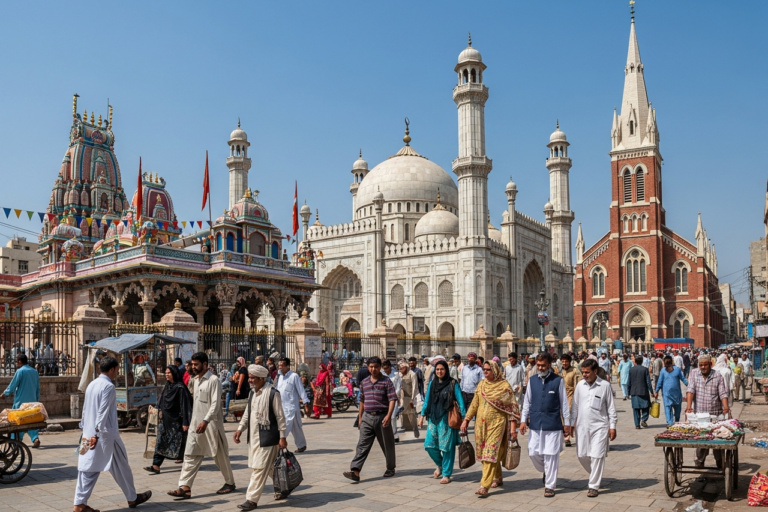
Key Highlights
Here’s a quick look at the main points about religion in Pakistan:
-
Islam is the state religion of Pakistan. Most Muslims in the country are Sunni.
-
Pakistan is called an Islamic republic, and its laws must follow Islamic rulings.
-
The country has many religious minorities. Some of them are Hindus, Christians, Sikhs, and Ahmadis.
-
The constitution gives people freedom of religion, but there are some laws that affect this.
-
Religious beliefs and practices are a big part of daily life and culture for people in Pakistan.
Introduction
Let’s take a closer look at religion in Pakistan. This country is an Islamic Republic, and faith is a big part of its identity. Most of the total population here are Muslim. But, there are also some other religious groups in the country. When you understand the religious landscape, you get to know more about the culture, laws, and social life in Pakistan. In this article, you will get a clear idea of the different faiths people practice in Pakistan.
Understanding the Religious Landscape of Pakistan
To really understand Pakistan, you need to look at the different religious groups it has. Islam is the state religion. Most of the total population is Muslim. But there are other major religious groups too. These groups add to the country’s mix of identities. Their religious beliefs also shape how they live and what they do.
This part will look at the main religious groups in Pakistan. It will show the percentage each group makes up using census data. It will also talk about how these numbers have changed as time has gone on.
Overview of Major Religions in Pakistan
Pakistan is an Islamic Republic. The majority of Muslims in the country follow the Sunni branch. There is also a large Shi’a minority. This makes Pakistan the place with the second-largest Shi’a group in the world. The legal system is shaped by Islamic laws, to match the beliefs of most people.
Beside Islam, there are Pakistani Hindus and Pakistani Christians. Hinduism is one of the biggest minority religions and it has been around in the region for a long time. The Pakistani Christian community has both Roman Catholics and Protestants. This group also has a long history and is an important part of the country.
Some other religions are smaller but still add to the mix. They include Ahmadis, Sikhs, Parsis (Zoroastrians), and Baháʼís. Each group has its own beliefs and ways, and together, they help make up Pakistan’s religious life.
Percentage Breakdown of Religious Affiliations
Official census data gives us a clearer picture of the percentage breakdown of religious groups within Pakistan’s total population. According to the 2017 Census, the overwhelming majority of the population identifies as Muslim. This data helps in understanding the scale of the major religious groups and their representation within the country.
The largest minority groups are Hindus and Christians. While their numbers are small compared to the Muslim population, they represent millions of people. Other faiths like Sikhism, Zoroastrianism, and the Baháʼí Faith comprise an even smaller fraction of the population.
Here’s a simplified breakdown based on the 2017 census data:
|
Religious Group |
Percentage of Population |
|---|---|
|
Muslims |
96.5% |
|
Other Religions |
3.5% |
(Note: “Other Religions” includes Hindus, Christians, Ahmadis, Sikhs, and other smaller communities.)
Demographic Trends and Changes Over Time
Looking at census data, you see how the religious makeup of Pakistan has changed over time. The numbers show growth and shifts in the population. Islam has always been the main religion, but the size and place of minority groups have changed.
In recent years, people talk a lot about how many of each group live in Pakistan. Unofficial guesses may not match the official census data, mostly when it comes to minority groups. Things like migration and conversion can shape these numbers.
Religion in Pakistan is not only about the numbers. It is also about how it shapes the country, the law, and daily life. As time goes on, the way the state works with each religious group has changed. This affects the way rules are made and how people show their faith in public.
The Dominant Role of Islam in Pakistan
Islam is the state religion of Pakistan, and this has a big effect on people’s lives. The country is known as an Islamic Republic. This means that Islamic law and its principles play a major part in government and law. All the rules need to follow Islamic injunctions.
In this part, you will find out more about the main kinds of Islam in Pakistan. You will see how the faith shapes national laws and how people are ruled. There is also a look at how Islamic festivals and customs are part of daily life for most people in Pakistan. These parts help to show what it means for Islam to be the state religion of Pakistan.
Sunni and Shia Branches – Key Beliefs and Practices
Most Pakistani Muslims are Sunni Muslims. They mainly follow the Hanafi school of thought. This school uses reason when looking at religious rules. It is seen as more open to new changes but still respects old ways. The main beliefs and practices of Sunni Muslims shape how many people live in Pakistan.
Shia Muslims are also found in Pakistan. They are about 10 to 15 percent of the whole population. Pakistan has the second-largest group of Shia Muslims in the world. The Shia community comes from many smaller groups like Imāmiyya (Twelver) and Isma’ili. They may be fewer in number, but their traditions and beliefs are important. You can see their practices across all parts of the country.
Sufism is another big part of muslim life in Pakistan. It is not a separate group. It works inside both Sunni Muslims and Shia Muslims. Sufism helps people feel closer to God mostly through worship. Many people love these spiritual ways. Songs, poems, and books in Pakistan are also shaped by Sufi traditions.
Influence of Islam on National Laws and Government
The Constitution of Pakistan makes the country an Islamic Republic. It builds Islamic law into the nation’s legal system. Every law made by the National Assembly must follow the injunctions of Islam. Most cases use Hanafi jurisprudence, which matches the views of the Sunni majority.
The Supreme Court and the Federal Shariat Court help interpret laws using Islamic principles. The Federal Shariat Court can check if any law goes against the injunctions of Islam.
In 2021, new laws showed the religious variety within Islam in the country. These rules let the divorce and inheritance cases for Shia Muslims follow the Shia school of thought. This change respects the different legal traditions for people in the Muslim community.
Keywords: islamic republic, supreme court, national assembly, islamic law, federal shariat court, shia muslims, constitution of pakistan, injunctions of islam
Islamic Festivals, Rituals, and Everyday Life
Islam is a big part of daily life in Pakistan. It is there not just in formal religious services but in how people live every day. The five daily prayers help make the day’s rhythm. Islamic values touch how people greet one another, how they act with family, and even how they act with others in the area. These values are seen in what people eat, say, and do.
Major Islamic festivals are special days everywhere in the country. People get very excited about these holidays. Many take part in prayers, meet family, and help others by giving money or food. These days show both the strong faith and the culture of the people.
Some Islamic festivals and important religious services are:
-
Eid al-Fitr: This is at the end of the month of Ramadan.
-
Eid al-Adha: This shows respect for Prophet Ibrahim and what he was willing to do for his faith.
-
Ramadan: This month is about fasting, praying, and thinking deeply. It is special for Muslims all over the world.
-
Milad-un-Nabi: This festival is for the birthday of Prophet Muhammad.
Significant Religious Minorities in Pakistan
Pakistan has mostly Muslim people. But there are also some important religious minorities. These religious groups include Hindus, Christians, and Sikhs. They have lived in the country for many years. They also help make the nation’s culture rich and different. But they often run into problems because they are not in the majority.
The constitution of Pakistan says there should be freedom of religion. But in real life, it can be hard for people to fully use their minority rights. In this part, we will talk about the main religious minorities. We will look at their communities, their cultures, and what life is really like for them in Pakistan today.
Hinduism: Communities, Culture, and Practices
Pakistani Hindus are the biggest religious minority in the country. Most of them live in the Sindh province. They are a big part of local life there, and their roots in the area go back many years. The story of their presence shows how the region has had people from many backgrounds for a long time.
Pakistani Hindus are a unique religious community. They keep close to their old ways and customs. A lot of their social life happens around temples and at gatherings. They celebrate special days like Diwali and Holi together. These holidays bring a lot of joy and excitement to the places where they live.
They have been in the Sindh province for a long time, but they still deal with some social and legal problems. Still, they have stayed together and keep their culture alive. Pakistani Hindus play a strong part in making Pakistan’s religious community and social life more rich and bright. They help keep traditions and add to the country’s many different ways of life.
Christianity in Pakistan: History and Presence
Pakistani Christians are the second-biggest group of people in the country who do not follow the main religion. This group has a long story in the region that goes back to before Pakistan was made. They are found all over the country. Many of them live in big cities, but you will also find some in villages.
There are different groups within the Christian community. The two main groups are the Roman Catholics and the Protestants. They have set up many places of worship. These places, along with schools and hospitals, are open to people from all religions. These places of worship and other buildings have helped Pakistani society in many ways.
Pakistani Christians face problems like being left out and violence. Even with these issues, they stay strong. They keep their faith and traditions. They take part in much of the country’s life and they help make Pakistan what it is.
Sikhism, Baháʼí, Zoroastrianism, and Other Faiths
Besides Hindus and Christians, Pakistan has many other religious minority groups. Each group brings its own special heritage to the country. The Sikh community, for example, shares a long history and spiritual bonds with this land. Some of the holiest places in Sikhism are in Pakistan, so people travel from all over the world to visit these sites for religious worship.
Zoroastrianism is also found here and is practiced by the Parsi community. This faith is one of the oldest in the region, but there are not many followers left now. In the same way, the Baháʼí community is a small but known faith group. All these minority groups try hard to keep their own customs and take care of their religious worship sites.
There are even smaller groups, too. Some of these, like the Kalash who live in the northern areas, follow an old belief system. There are also small numbers of Buddhists and Jains. All together, these different people make up a rich mix of religious life in Pakistan.
Regional Diversity in Religious Practice
People in Pakistan do not share one way to practice or show their religion. There is a lot of difference from one area to another. The people and their religions are not the same in every province or territory. Some places have more people from one faith. Some have a mix of different religious groups. You can see this not just in big cities but also out in the tribal areas.
If you go to the northern areas, you will find there are groups with special local beliefs. In the southern part, in Sindh, there is a lot of the Hindu community. This part will look at how religion is not the same in every province. It will also talk about which religious groups you see in which region.
Provincial Variations: Punjab, Sindh, Khyber Pakhtunkhwa, and Balochistan
Each province in Pakistan has its own style when it comes to religion. Punjab is the biggest province for people and most are Sunni Muslims. It also has the largest number of Christians in the country. The big cities in Punjab are places where both Islamic learning and Christian communities grow.
Sindh stands out because it has a wide mix of religions. The vast majority of Hindus in Pakistan live here. Sindh also has a strong Sufi scene, where Islamic beliefs mix with local customs. This makes Sindh known for its blended culture.
Khyber Pakhtunkhwa and Balochistan don’t have as much variety in religion. Most people in these provinces are Sunni Muslims. But in Balochistan, there are Shia Hazaras, especially in Quetta. There are also smaller groups of religious minorities, like Sikhs and Hindus, in these areas.
Religious Communities in Azad Jammu & Kashmir and Gilgit-Baltistan
Azad Jammu & Kashmir and Gilgit-Baltistan are special regions in Pakistan when it comes to religion. Most people in Azad Jammu & Kashmir are Sunni Muslim. Their daily life and ways are strongly connected to the local Kashmiri culture and the Islamic ways found in the area.
Gilgit-Baltistan sits in the northern areas and stands out for its religious mix in Islam. There are many Shia Muslims here, including both Isma’ilis and Twelvers, along with Sunnis. Having these different groups of Muslims live in the same region has become a big part of what makes Gilgit-Baltistan unique.
People of all these different groups have lived together for hundreds of years. They help build a special culture and style of life here. The way different groups of Islam are found in these regions shows how much variety there is in the faith in Pakistan. It also adds to the country being known for its rich religious diversity.
Religion in Education and Society
Religion is very important in the Pakistani education system and in the life of the people. In public schools, religious instruction is needed by every student. Muslim students have to take Islamic Studies as one of their main subjects. The state wants to teach these values from a young age.
This way of teaching religion helps make social rules and shapes the way the youth see the world around them. In the next parts, you will read about how religion is part of the school curriculum, how madrasas play their part, and how faith can change the lives of young people and the whole community.
Religion in the School Curriculum
In Pakistan, religion is a fixed and needed part of the school plan in public schools. All Muslim students must take Islamic Studies, called Islamiat, from the early grades until the end of school. This makes sure that most students have some knowledge of their religion.
The course for Islamic Studies talks about the main parts of the religion. It covers the Quran, stories from the Prophet Muhammad’s life, and also some history and moral rules in Islam. If a student is from another religion, they are supposed to get a different subject. This is usually Ethics, or sometimes a class about more than one religion. How often these classes are really available, or how good they are, is not always the same everywhere.
Key things about religious education in public schools are:
-
All Muslim students must do Islamic Studies.
-
The lessons are about the Quran, saying of the Prophet, and the history of Islam.
-
Non-Muslim students get choices like Ethics as other subjects.
-
Religious beliefs and ideas be part of other classes also.
These steps are taken to include islamic studies in the school life of every Muslim student in public schools.
Role of Madrasas and Faith-Based Schooling
Alongside the public school system, madrasas, or Islamic seminaries, have a big part in giving faith-based schooling in Pakistan. These schools are a main source of religious instruction for many. They offer in-depth teaching that goes way past what public schools give.
Madrasas mainly teach the Quran, islamic law, and other subjects about faith. Many families go for madrasas, especially in rural or low-income places. These schools give free education, boarding, and lodging. So, they are easy for people to use for their children’s schooling.
In recent years, the government has started trying to register and regulate madrasas. Officials want these schools to teach normal subjects like science and math, along with their religious instruction. The idea is to give students a wider education but still keep the tradition of Islamic learning.
Impact of Religion on Youth and Community Dynamics
Religion plays a big role in the lives of young people in Pakistan. It helps form their values, who they are, and how they talk to others. For a lot of the youth, their faith is a strong part of their daily life. It guides what they choose to do in their education, at work, and in their relationships. They also have active participation in religious events and take part in different activities with the community.
This strong religious identity has an effect on social life. In many places, mosques and community centers are at the center of much the social life. People often get together at these places, and religious leaders be important in the lives of the youth. But, this power can also lead to social pressure. Young people may feel they need to act in a certain way to fit in with what is expected from their religious beliefs and culture. This can sometimes make it hard for them to show who they really are.
There is also change in how young people connect with their faith. Some stick to the old ways and hold on to traditional and religious events. Others use phones, computers, and global ideas to change how they take part in their religious beliefs. This meeting of the old way and the new way is changing community life in Pakistan and it will keep shaping the future for the youth.
Rights, Protections, and Challenges for Religious Groups
Pakistan’s constitution gives people certain rights and protection. This includes people in minority religious groups. The law says there is freedom of religion. It lets you believe in and practice your faith the way you want. But there is often a big difference between what the law says and what happens in daily life.
Religious minorities face many problems. These problems can come from other people, the government, or in courts. This section looks at the constitution’s rules for minority rights. It also talks about issues like blasphemy laws that affect religious groups and religious minorities in Pakistan.
Constitutional Guarantees and Legal Framework
The Constitution of Pakistan gives some basic rights to all people in the country. This goes for everyone, no matter what their religion is. It says people can say, follow, and share their faith. These rules are there to help keep many types of religions safe in Pakistan.
But, these rights are not always simple. They often work together with laws that say the “glory of Islam” must be protected. The High Court and Supreme Court have the job to figure out how these laws should work when there is confusion. The government deals with different religious groups using both the law and the Constitution of Pakistan. They pick leaders and help solve problems that matter for those groups.
Some big rights the Constitution gives to religious groups are:
-
People have the right to say, follow, and share their religion.
-
There are clear rules to help protect the fair rights and needs of people in minority groups.
-
The country helps keep the property and places of worship safe for religious groups.
-
Religious groups are free to run their own religious institutions.
These choices and rules are all there to protect all religious groups and their places of worship. The role of the High Court and Supreme Court is important to make sure all this is done the right way.
Issues Faced by Religious Minorities
Religious minorities in Pakistan face many problems that can put their safety and well-being at risk. One big problem is how the country uses strict blasphemy laws. These laws do not target minorities directly, but critics say they are often used against them. This stops people from enjoying freedom of speech and stops them from expressing their religion.
Along with legal problems, these groups face social pressure, harassment, and discrimination. They may get less chance to find work or go to school. Their personal security can be at risk. If someone says they broke blasphemy laws, there can be mob violence. This puts the lives of them and their families in danger. It also hurts their human rights.
Ahmadi Muslims deal with even more trouble. The law does not allow them to say they are Muslims or practice as Muslims. This makes their religious identity a crime. As a result, they face harsh violence and social pressure. They are one of the most vulnerable communities in Pakistan.
Conclusion
In the end, learning about religion in Pakistan shows that Islam is the main faith. But there are also many different religious groups. Knowing this helps you see how these beliefs shape daily life, culture, and society in the country. The big festivals and the issues faced by minority groups are all parts of what makes Pakistan stand out. When you look into these points, you can get more respect for religious tolerance and for people living side by side. If you want to know more about daily life or the way minority groups live in Pakistan, you can ask for a talk or for help.
Frequently Asked Questions
What are some important religious sites to visit in Pakistan?
Pakistan has many important places of worship. In Lahore, there is the Badshahi Mosque. This mosque is special for Muslims. Another big mosque for Muslims is the Shah Faisal Mosque in Islamabad. For Sikhs, Kartarpur Sahib is a main place to visit. The northern areas have shrines and temples. These are important for people from the area and visitors from other countries.
How does religious diversity shape daily life across Pakistan?
Religious diversity changes how people live every day. It brings different festivals, foods, and ways of being with others. When people with different religious beliefs live together, it creates a special mix in the community. The mix makes things interesting, but there can be problems too. Public policy needs to work hard so people get along, and everyone has equal rights.
How does the government interact with different religious groups?
The government talks with religious groups by following the Constitution of Pakistan. This law gives some rights to minorities. The Ministry of Religious Affairs looks after matters about different religions. There are also special seats for minorities in lawmaking groups. This is done to make sure they have a voice in public policy and their rights are not left out.



