

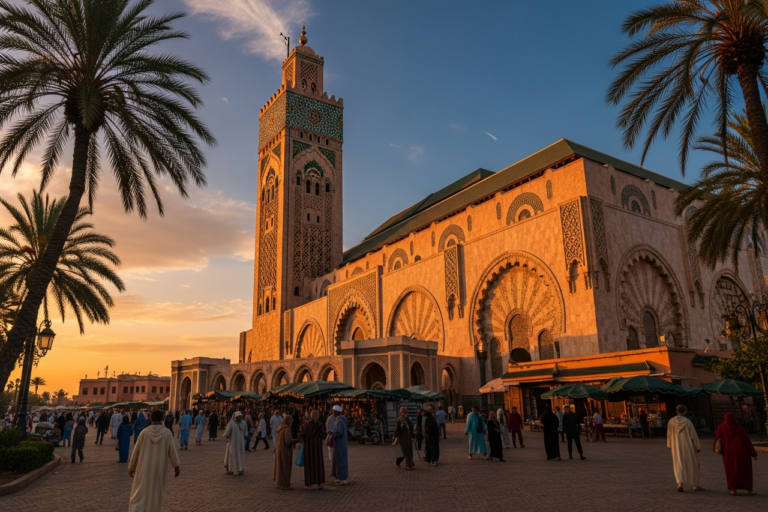
Key Highlights
Here’s a quick look at what we will talk about with religion in Morocco:
-
Islam is the state religion, and most people there follow Sunni Islam.
-
The King of Morocco has the title “Commander of the Faithful.” This gives him a lot of power with religious matters.
-
Even though Islam is the main religion, there are some small religious minorities in Morocco. There is a long history with the Jewish community and some Christian groups too.
-
The constitution says people have freedom of belief. Still, legal provisions do put a few limits on people who are not Muslim or who leave Islam.
-
Religious beliefs are a big part of daily life. They affect laws, what people do, and how many people think about things.
-
Sunni Islam, which is the religion of the state, gets support and money from the government.
Introduction
Welcome to a look at the heart of Moroccan spirituality. The religion of the state in Morocco is Islam, and it shapes much of life there. The state religion can be seen in the way people build their homes, how they act every day, and in their traditions. But, the religious beliefs found in Morocco are not simple or straightforward. There is more than just one faith here. People in Morocco have old customs and beliefs, and these live side by side with Islam. In this article, we will see different ways faith is part of life. We will talk about both the state religion and the experiences of its smaller groups.
Overview of Religion in Morocco
The main religion of the state in Morocco is Islam. This shapes most of life and the culture in the country. More than 99% of their total population is Muslim. So, to really know Morocco and its people, you have to know about Islam.
But the country does not have only one faith. There are other religious groups in Morocco. Their numbers are small, but different religious beliefs have been in this place for many years. These groups may be tiny, but they help make Morocco the country it is today. Now, let’s take a look at the history of these groups and see which ones are in Morocco now.
Historical Background of Moroccan Religions
Morocco is known as a sovereign Muslim state. This comes from many years of history. Islam became the main religion in the country long before the country’s independence. The religion shapes the laws, the way people are governed, and how the community works every day. For a long time, Islamic principles and the way people in Morocco live go hand in hand.
The jewish community has also been a big part of Morocco’s story. This group is much smaller now but used to be much larger in the past. They have made their mark on the culture and the history of the nation. Jewish people came to live in the region before many other religious groups, and their story stays part of Morocco to this day.
The christian faith can be found too, mostly from people who moved to live in urban areas. Over the years, different religious groups have come and gone. Still, the one thing that never changed is that Islam remains at the center of life in the country. Even now, this fact plays a big role in shaping Morocco.
Main Religious Groups Present Today
Most people in Morocco, over 99%, are Sunni Muslims. This means Sunni Islam is the main faith in the country. It has a big effect on law and the way people live each day. There are some other Muslim groups in Morocco. One of these is a small group of Shia Muslims, with about 3,000 people.
Besides Islam, a few other religious groups live in Morocco. The jewish community is still a key part of Morocco’s story. This group is now much smaller, with between 4,000 and 6,000 people. There are also christian citizens and people from other places who live in Morocco, plus a small group that follows the Baha’i faith.
Here is a look at the main religious groups:
-
Sunni Muslims: This group makes up more than 99% of Moroccans. It is by far the largest community and has the most influence.
-
Shia Muslims: This is a small group with about 3,000 members.
-
Jews: This jewish community is made up of about 4,000 to 6,000 people who live mostly in Casablanca.
-
Christians: There are about 5,000 christian citizens and expatriates, though some people say there could be as many as 25,000 in Morocco.
Islam in Moroccan Society
In Morocco, Islam is not just a personal belief. It is also the religion of the state. Most people in Morocco follow Sunni Islam and are a part of the Maliki school of jurisprudence. This school shapes many rules and customs in Morocco.
The state religion can be seen in the way people live every day. You hear the call to prayer in the streets, and Islamic holidays are a big part of life. The daily routine of many is connected to Islamic traditions. Now, let’s look at how common Sunni Islam is and how the state religion shapes what people do in Morocco.
Sunni Islam and Its Prevalence
Nearly all Muslims in Morocco are Sunni Muslims. Following Sunni traditions is a key part of the country’s identity. People in Morocco follow the Maliki school of jurisprudence. This is one of the main ideas in Sunni Islam.
The Maliki school of jurisprudence helps guide the religious leaders. It shapes the country’s Maliki Sunni interpretation of Sharia. This also affects some of the legal system, especially family law. The King is known as the “Commander of the Faithful.” He is in charge of the nation’s religious life and makes sure that the Maliki Sunni customs stay strong.
When people across the nation follow the same practice, it helps everyone feel they are together. It gives people one way to see what is good, how to act, and how to live with each other. The maliki school of jurisprudence is very common in Morocco, so people look to their main religious leaders and follow the same religious rules everywhere.
Religious Influence in Daily Life
Islam has a big effect on how people live in Morocco. For most Muslim families, faith helps guide their choices at home and in their community. Almost 99% of people in Morocco say religion is important to them, and more than 83% say they pray many times every week.
That influence is seen in public life and how things are run. The state can give customs exemptions for religious materials and actions that fit with the official religion. Keeping public order is linked to caring about religious feelings, especially at key Islamic holidays and events. In urban areas, you will still hear the call to prayer and see people focus on Ramadan, even with modern ways of life.
Here are some ways religion shapes daily life:
-
Festivals like Ramadan and Eid al-Adha are national days off.
-
Rules for marriage, divorce, and inheritance in family law come from Islamic ideas.
-
Many people plan their day around the five daily prayers.
-
Giving to charity and helping in the community are seen as important religious duties.
Role of the King as Commander of the Faithful
In Morocco, the king is known as “Amir Al Mouminine,” which means Commander of the Faithful. This title gives him a top place as the religious leader in this sovereign Muslim state. He has the right to manage religious matters, and he uses a royal decree, called a Dahir, to make key decisions.
The king is the main person who protects Islam in Morocco. He leads the Superior Council of Ulema (a group of religious scholars). Only the king can say yes to religious edicts, which are called fatwas. This section will talk about the king’s religious power and how it shapes the country’s politics and how people live.
Religious Leadership and Authority
The king has a special and clear role when it comes to religion in Morocco. He is called the Commander of the Faithful. The king can use a royal decree to exercise his religious powers, and this has the force of law in the country’s spiritual matters. He also leads the Superior Council of Ulema, which is the top group of religious leaders. The council studies and gives advice on any questions the king wants answers to.
This council is the only group that can give out fatwas. They base these answers on the country’s Maliki Sunni interpretation of Sharia. But, they can do this only if the king says yes first. This setup makes sure that religious talk and thinking in the country match what the state wants, which is a moderate and open-minded Islam. The king has the final say on all religious matters.
The king is in charge of Islamic affairs, but there are also other community leaders. For example, there are rabbinical authorities for the Jewish community who handle matters for their people. Even so, the king is the most important religious leader for most people in Morocco. This fact puts him at the center of Moroccan society.
Impact on Political and Social Structures
The king’s religious authority shapes both politics and daily life in Morocco. The law says that no political parties can be built on a religious base. They also cannot work against Islam, because Islam is the religion of the state. These legal provisions are there to keep public order and stop religious extremism from getting into the political space.
This setup affects political rights and how people can speak in government. For example, if members of parliament say things that question the Muslim religion, they can face charges. This shows how the state religion is safe within the political system. It keeps Islam’s role at the top.
For everyone living there, the king brings people together by leading with one main view of Islam. Laws about family, public behavior, and morals are also shaped by how the king sees the religion of the state. The king’s leadership helps bring balance between old religious ways and the push to modernize the country.
Religious Minorities in Morocco
Morocco is mostly a Muslim country, but there are also some religious minorities who have lived there for many years. These groups include Christian citizens and a well-known Jewish community. The law in Morocco gives all people freedom to have their own beliefs. Still, life for these groups, both in daily life and under the law, can be complicated.
What these groups go through, like how they follow their faith and keep their cultural heritage, helps us understand more about how Morocco deals with religious diversity. Next, you will see more information about the Jewish community and the Christian citizens living in Morocco. It will talk about their lives, the cultural heritage they want to keep, and any problems they face. It will also include some of the challenges for Christian converts and other religious minorities.
Christianity and Churches
The Christian community in Morocco is primarily composed of expatriates. Estimates of practicing members range from 5,000 to 25,000, most of whom reside in major urban centers like Casablanca and Rabat. These communities, including Roman Catholic and Protestant denominations, are generally free to hold religious services in established churches.
However, there are restrictions. The government prohibits proselytizing to Muslims, and the penal code makes it illegal to “shake the faith” of a Muslim. While foreign-led Christian organizations are permitted to conduct charitable activities, they must not engage in proselytism. The construction of new churches is allowed, but it requires official permission, which can be a lengthy process.
The Christian faith in Morocco is practiced within these legal boundaries. Here is a brief overview of the Christian denominations:
|
Denomination |
Approximate Population |
Primary Location |
|---|---|---|
|
Catholics |
0.07% of the population |
Urban areas |
|
Protestants |
0.01% of the population |
Urban areas |
|
Orthodox |
<0.01% of the population |
Urban areas |
Jewish Communities and Heritage
Morocco’s Jewish community is small, but it has a long history. This history is a big part of the country’s cultural heritage. Right now, there are about 4,000 to 6,000 people in the jewish community. Most of them live in Casablanca. Many of the people are older because younger people in the jewish community have left the country over the years.
Community leaders in the jewish community help take care of many things. They look after synagogues, jewish community centers, and Jewish cemeteries. The government sees this group and its leaders as important. Jewish Moroccans have special rabbinical courts for personal issues, like marriage and inheritance. The government helps protect Jewish holy places too.
The jewish community still has a place in how people live together in Morocco.
-
They take care of their own charitable activities and have new cultural events.
-
Jewish community leaders talk and work with people from the government.
-
People in the community hold on to their history and the stories from the past.
-
The king of Morocco has always talked about how Jewish history is part of what makes the country what it is.
Legal Framework for Religious Practice
Morocco has a set of legal rules that control how people practice religion. The constitution says that Islam is the state religion. It also says people have the right to practice their own beliefs. But, these rights are not total. Other legal provisions help set limits on these rights.
The penal code has rules about how religion can be practiced, especially for non-Muslims or for anyone who questions the idea of Islam as the state religion. The country uses public order as one reason for these laws. Because of this, someone could face a court trial for some kinds of religious actions. The next parts will talk more about the constitutional rules and the restrictions that are in place.
Constitutional Provisions on Religion
The 2011 Moroccan constitution sets the main rules for religion in Morocco. Article 3 says, “Islam is the religion of the State, which guarantees to all the free exercise of beliefs.” This means that Islam is the state religion, but at the same time, everyone is promised religious freedom.
Still, these rules are seen with Islam’s strong place in mind. For example, constitutional amendments are not allowed to change the parts about the Muslim religion. This makes sure Islam stays at the center of the country’s laws and state religion. The king is known as the “Commander of the Faithful.” It is his job to make sure people respect Islam.
Groups like the U.S. Department of State look at how Morocco puts these rules into action. The constitution gives a base for religious freedom. But other laws and state policies show what people can and cannot do, to make sure Islam always stays the religion of the state.
Restrictions and Tolerance for Different Faiths
Morocco says people should have religious freedom in its constitution. But the penal code puts many limits on certain religious actions. One big rule is that no one can try to convince a Muslim to change his faith or make him question it. The law uses this to charge people, including Christian converts, if they talk about their beliefs with Muslims.
This makes it hard for religious minorities to show their faith in the open. Court officials are allowed to use these rules to keep public order. Being accused of hurting Islam can be very serious for someone. Because of this, many Moroccan Christians keep their faith quiet and private.
The state lets known foreign religious groups pray in private. But citizens in Morocco who stop being Muslim may not be treated the same. This shows there is a line between believing quietly, which is allowed, and saying your faith out loud, which might show you go against the state’s religious identity.
Status of Religious Freedom
The topic of religious freedom in Morocco is often talked about by groups like Amnesty International. The government says people can worship freely. But, its laws and rules make things more complex. Morocco follows the International Covenant on Civil and Political Rights. However, some of its own laws still limit this freedom.
The government tries to keep things stable and put Islam first. This can shape both what the state does and how people in general feel about different beliefs. The next part will look at what the government does regarding worship, as well as how people see different religions in the country.
Government Policies on Worship and Expression
The Moroccan government takes an active role in managing religious life. It gives money and building grants to mosques. The state also supports the spread of Islamic religious material with its moderate Maliki way of thinking. It manages the content of sermons to make sure they match the official religious line and help keep public order.
But, the government limits how non-Muslims can show their beliefs. The U.S. Department of State points out that proselytizing is against the law. Any material seen as trying to convert a Muslim is banned. This rule covers online platforms like social media, and some people have faced problems for sharing different religious ideas.
This two-sided policy makes state religion look favored. For example, foreign Christian groups can pray in certain churches, but they need to keep things quiet. The government’s rules are made mainly to defend Islam’s main place in society. This means other faiths cannot show their beliefs in public the same way.
Public Attitudes Toward Diversity of Belief
Most people in Morocco think that religion is very important. The country’s focus on Islam shapes these views. Surveys show that most Moroccans feel people with strong religious beliefs are good for society. But many also do not trust people from other religions. More than 76% said they felt this way.
This kind of distrust can make life hard for those who do not share the same beliefs. This is especially true for Moroccans who have left Islam or now think differently. People like blogger Fatima Karim, who got a lot of strong responses after posting things seen as against Islam, show this problem. People who share views that go against religious norms online or outside of more open urban areas may face real trouble.
The way the public feels is deep and can be summed up in a few points:
-
The people believe religion is key for society.
-
There is a lot of distrust towards people of other faiths.
-
People mostly accept foreign minorities if they worship in private.
-
There is strong social pressure on Moroccans who leave or question Islam. People think this hurts public order.
The topic of religious beliefs in Morocco is shaped by, and also shapes, the country’s views, daily life, and even ideas about public order and the way people live in both small towns and urban areas.
Religion in Moroccan Culture and Traditions
Religion is deeply a part of Moroccan life and its cultural heritage. You can see this in art, the way houses look, the language people use every day, and their customs. It is not just about going to a mosque or visiting a holy place. It helps to give the people of Morocco a strong sense of who they are together, and adds to their shared feeling of faith.
Islam shows up the most during big religious holidays. People across Morocco celebrate these days with their own special traditions. Faith also pushes many to take part in charitable activities and help others. In this country, religion can be seen in the parties and gatherings, but also in art, the way people speak, and in the way they act around each other.
Religious Festivals and Celebrations
Religious festivals are some of the biggest events in the Moroccan year. People in urban areas and in the countryside take part with great excitement. Ramadan, the holy month, changes daily life in the country. During this month, people fast, have special foods, spend more time with family, and focus on prayer. It is also a time to think about others and do more charitable activities. At the end of Ramadan, people celebrate Eid al-Fitr, which is a happy occasion.
Eid al-Adha is another major festival. It is called the “Feast of the Sacrifice.” This festival is about remembering how Ibrahim was ready to sacrifice his son for God. Families who are able, will sacrifice a sheep. They share the meat with their family, their friends, and with people who need it. These acts bring the community together and show the value of helping others.
These festivals slow down life in many urban areas and out in the villages. They show how faith can unite people.
-
Ramadan: A month to fast, pray, and come together as a community.
-
Eid al-Fitr: This festival comes at the end of Ramadan and is filled with big meals and seeing family.
-
Eid al-Adha: This festival is about giving and sharing, with a focus on charity.
-
Mawlid al-Nabi: This festival is the birthday of the Prophet Muhammad.
Spirituality in Arts, Language, and Customs
Spirituality is an important part of Moroccan arts, language, and traditions. It be at the heart of its cultural heritage. Many mosques, palaces, and old homes in Morocco show Islamic geometric patterns and beautiful calligraphy. These designs are tied to faith and belief. They do not show pictures of people or animals, following rules from Islamic arts.
People in Morocco use the Arabic language in a special way. Many everyday words and phrases are full of religious meaning. People say “Inshallah” (God willing) and “Alhamdulillah” (Praise be to God) often, no matter who they are. This shows that spirituality is mixed into even the simplest talks. Because of these habits, you see the importance of religion in both public and private life.
Moroccan daily life shows religious values too. Treating guests with kindness, showing respect to older people, and standing together as a group are all very important, and these are also taught in Islam. People in Morocco follow these ways as normal, and you can see it in things like how food is shared or what happens at births and weddings. Spirituality is a real part of the everyday experiences that build their cultural heritage.
Conclusion
To sum up, religion in Morocco mixes the country’s history, culture, and the way people live together. Islam is the main faith, and it shapes a lot of how people think and act every day. The King is known as the Commander of the Faithful. This shows how close the link is between the country’s leaders and people’s beliefs. Religious minorities are present in Morocco too, which brings more variety to the culture. When we learn about these different sides of religion and religious practices, we get a better view of Moroccan life. This also helps us see other world religions in a more open way. When we know more, we can respect the ideas and beliefs that guide many people. If you want to find out more about how religion and culture tie in together, you can look further!
Frequently Asked Questions
How has religion in Morocco changed in recent years?
In recent years, Islam is still the main religion of the state. But, there is now more talk about religious freedom. This talk is coming from human rights groups and electronic media outlets. There is no statistical data that shows if people’s beliefs are changing. But, online platforms let people share different views about religion and even not having a belief at all. This has started to challenge the old traditions in the country.
What role does religion play in public life and identity?
Religion is at the heart of life in Morocco. It shapes who people are and how they live together. Islam is the religion of the state. This plays a big part in the country’s laws, the way people think, and how political parties are set up.
The government checks the content of sermons to keep public order. The king also has a religious role, which helps make a national identity that is based on a calm and open kind of Islam.



