

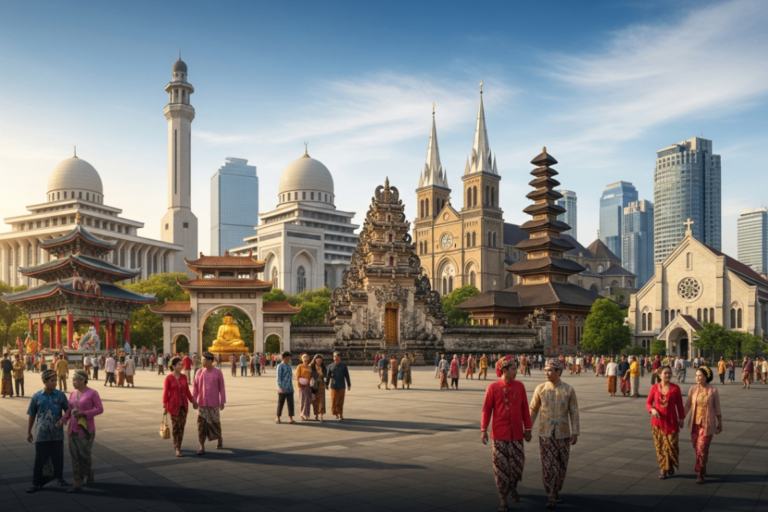
Key Highlights
-
Indonesia says there are six religions it officially recognizes. These are Islam, Protestantism, Catholicism, Hinduism, Buddhism, and Confucianism.
-
The country has more Muslims than any other place in the world. Over 87% of the people in Indonesia are Muslim, and most are part of Sunni Muslim groups.
-
Religious diversity is important to the country. Still, religious minorities sometimes have problems.
-
The Indonesian government uses the idea of “Pancasila” to bring people together. This idea supports unity and belief in one God, and it aims to help everyone get along.
-
The constitution supports religious freedom. But blasphemy laws and trouble building houses of worship continue to be issues.
Introduction
Welcome to a look at the heart of Indonesia and its spiritual life. The country sits in Southeast Asia and is made up of many islands. It is full of different faiths and ways to believe. Indonesia has the world’s biggest Muslim population, but the whole story about religion here is much bigger and interesting. The nation now recognizes six religions. This creates a special mix of religious diversity. To get what makes Indonesia so rich, you should know about the balance between freedom of religion in the law and what is really happening in daily life. This helps you see why Indonesia has a strong and special culture.
Overview of Religion in Indonesia
Religion plays a big part in the lives of people in Indonesia. You can see the influence of religion every day and in many parts of their culture. The main religions here are Islam, Protestantism, Catholicism, Hinduism, Buddhism, and Confucianism. The Indonesian government only gives official recognition to these six faiths. The government is involved in many things that have to do with religion.
This official recognition helps to give structure to religious life. But it also brings many problems for religious minorities and groups whose beliefs are not on the list. People who follow other religions or old local beliefs have a harder time in the country. Even though Indonesia’s motto is “Unity in Diversity,” many religious groups still face a tough situation. They try to keep their own ways while also dealing with rules and policies from the Indonesian government.
Ancient Beginnings and Traditional Beliefs
A long time ago, before big world religions arrived, the islands now called Indonesia had a mix of traditional beliefs. People followed old spiritual customs that we now call animism and dynamism. These beliefs said there are spirits in the world around us. They thought spirits lived in things like mountains, trees, rivers, and animals. Worship of ancestors was also a big part of life. Communities would honor the people who came before them with rituals and special events.
These indigenous religious groups were at the center of spiritual life in Southeast Asia. Their traditional beliefs were part of everyday life for many ethnic groups. These beliefs played a big role in things like farming, family traditions, and how people worked together. This helped prepare these societies to be open to new ideas. So, there was a kind of religious pluralism that took place in this area.
Even now, people still hold on to many parts of these old beliefs. In many places, they have mixed them with bigger religions that came in later times. This is why you find some unique faiths in different areas of Indonesia. It shows just how strong the roots of indigenous spirituality are in this part of the world.
The Arrival of Major Religions
The way religion spread in Indonesia changed when Indian traders came in the early centuries CE. They brought Hinduism and Buddhism with them. These two beliefs started to be the main ideas in the strong kingdoms in Java and Sumatra. Big temple sites like Borobudur and Prambanan show just how much these religions shaped early life in Indonesia.
Later, starting in the 13th century, Muslim traders from the Middle East and India arrived and introduced Islam. The new faith spread across the islands in a mostly calm way. Many people mixed Islamic teachings with local ways and their old beliefs. Over time, many rulers and sultanates chose to follow islamic law and made it a key part of how they ran things. This is why Islam became the religion that most people in many parts of the country followed.
Christianity came after these changes. It started mainly in the 16th century with the coming of European colonial powers. Portuguese traders shared Catholic ideas, while the Dutch brought Protestant ideas. These two new religious groups gathered followers from many different ethnic groups in Indonesia, making the country’s spiritual scene even more mixed and rich.
Influence of Religion on Early Cultures
Religion played a big part in the way early Indonesian cultures grew. It shaped the art, buildings, writing, and how people acted in daily life. Hindu-Buddhist kingdoms gave the world famous stories like the Ramayana and the Mahabharata. These tales were changed to fit in with local ways. People still use them in storytelling, wayang puppets, and dance shows that many love now.
When Islam came, it brought new styles, like in calligraphy and mosque buildings. These often got mixed with old local designs. People learned to value community and respect for each other. These religious values became important in the way people acted every day. This also made it easier for people with different beliefs to live together in peace and share religious harmony in one place.
Over time, the meeting of old and new beliefs shaped the unique cultural face of Indonesia. One religion did not push away another for good. Instead, new religions were taken in, changed a bit, and mixed with what was already there. This is how practice and thinking became a mix of ideas. As a result, different religious communities learned ways to get along. Most people still see this open way of living with religious diversity as a special part of being Indonesian, even if it faces some tests today.
Main Religions Practiced in Indonesia
When you look at religion in Indonesia, you see a mix of beliefs, but the system is set by law. The Indonesian government, through the Ministry of Religious Affairs, has six official religions. These are Islam, Protestantism, Catholicism, Hinduism, Buddhism, and Confucianism.
This setup helps to explain how religious life works in the country. Most of Indonesia’s population is Muslim, but the state wants there to be room for more than one religion. Still, the rules can make it hard for faiths that are not one of these six to get legal protection. This can limit religious freedom for some people. Now, let’s take a look at each of the main official religions.
Islam: The Largest Faith
Islam is the main religion in Indonesia. More than 87% of the people there say they are Muslim. Because of this, Indonesia has the biggest Muslim population in the world. Most people follow Sunni Islam. There are also smaller groups of Shia and Ahmadiyya inside the country. You will see how important the faith is everywhere, from the sound of prayer calls in every city to holidays like Eid al-Fitr.
All over the islands, you can find many houses of worship. Some are grand national mosques in big cities. Others are small prayer houses in villages. These places are the heart of Muslim groups and their religious communities. People use them for prayers, learning, and social times together. You can also see how Islam shapes what people wear, how they follow rules, and how they talk to each other every day.
For many people in Indonesia, Islam helps bring everyone together. At the same time, there is still a lot of diversity. Two large Muslim groups, Nahdlatul Ulama and Muhammadiyah, were both founded in Indonesia. They speak up for moderate views of the faith and are very important for education and helping people in their daily lives.
Christianity: Protestantism and Catholicism
Christianity is the second-biggest religion in Indonesia. It includes many Protestants and Catholics. Christians make up about 10% of the people, so they are an important group in some parts of Indonesia. There are more Protestants than Roman Catholics, but both have deep roots in Indonesia. This goes back to when Indonesia was a colony.
There are many strong Christian communities across the country. They are very easy to see in the eastern parts of Indonesia. People will find more Christians in North Sulawesi, West Papua, and East Nusa Tenggara. In these areas, Christians make up most of the people. Christian churches are a big part of these local communities. The churches are not just houses of worship. They also act as places where people get education, healthcare, and help with social activities.
Even though the country says there is religious freedom, Christian communities sometimes have a hard time. It can be tough to build new churches. They need to get many forms and permits. In places where most of the people are Muslim, some people push back against new church buildings. Still, Christians in Indonesia stay active and are a key part of the country’s religious life.
Hinduism and Its Unique Presence
Hinduism has been in Indonesia for a long time, but now, only about 1.7% of the people follow it. It is one of the six recognized religions in the country. Most people think of Hinduism in Indonesia when they think of Bali. The religion stands out the most on this island, and from there, a special kind called Balinese Hinduism grew.
Balinese Hinduism mixes old Hindu ideas with local beliefs and ancestor worship. You can see it everywhere in Bali. People give daily offerings in front of homes and shops. There are big temple ceremonies and many colorful festivals. Balinese Hinduism is an important way for the country to show its religious diversity.
There are also Hindu groups outside Bali, though they are smaller. For example, the Tenggerese people in East Java keep the faith alive in their way. Hinduism may have fewer followers in Indonesia now, but its strong history and living traditions, especially in Bali, mean a lot to the country’s culture and soul.
Buddhism and Its Roots
Buddhism has been in Indonesia for a long time, just like Hinduism. Long ago, it was the main religion in powerful empires such as Srivijaya. Now, Buddhists are one of the religious minorities in the country. They are less than 1% of the people in Indonesia. Most Buddhists in the country are from the Chinese ethnic group, but there are also some who come from other ethnic groups.
Even though there are not many Buddhists, Buddhism is one of the six recognized religions in Indonesia. There are impressive old places of worship like the Borobudur temple in central Java. This temple is a strong sign of the religion’s history in the area. Many people from around the world go to central Java to visit these places of worship and see their beauty.
Today, most Buddhist religious communities live in cities. They go to temples and monasteries to practice their faith. They join in special festivals, such as Vesak. This festival is to remember the birth, enlightenment, and death of Buddha. These religious communities help show how Indonesia has so many different cultures and groups living together.
Confucianism and Cultural Influence
Confucianism in Indonesia is closely linked to the country’s ethnic Chinese people. It is not just a religion. It is also a way of thinking and a set of rules that has a lot to do with the family, honoring elders, and keeping peace among people. For many years, it was not clear if the government saw it as one of the recognized religions. This was especially true during the New Order, when the government did not let much Chinese culture be practiced in public.
After the Reformation period, things started to change. The government gave Confucianism official recognition. It became one of the six recognized religions. This was a big step forward for religious freedom and giving better rights to all religious groups in Indonesia. It meant that people could say they were Confucian on their paperwork, and they could practice their beliefs more freely.
Now, you can find many Confucian temples, called klenteng, in cities that have many ethnic Chinese residents. These temples are places for worship and gatherings for holidays like Chinese New Year. The fight for and achievement of official recognition for Confucianism shows how Indonesia has moved toward more religious pluralism.
Indigenous Religions and Local Practices
Beside the six official religions, Indonesia has hundreds of indigenous religious groups. Each group holds its own traditional beliefs and ways. These belief systems are called “aliran kepercayaan.” They are a big part of the archipelago’s past and different ethnic people practice them on the islands.
For many years, the people in these faiths were not officially named in documents. They often had to choose one of the six recognized religions. Now, the government statistics are starting to count these groups more. Still, they have a long road to reach full recognition and safety. This shows that religious pluralism in Indonesia is still changing.
Kejawèn: Javanese Spirituality
Kejawèn is a spiritual way that comes from the Javanese people. It is not a formal religion, but a mix of beliefs. Kejawèn uses parts of animism, Hinduism, Buddhism, and Islam. The main idea is to find inner peace and spiritual light. It also teaches people to live in harmony with the world.
People who follow Kejawèn often do things like meditate, fast, and visit places that are special and holy. They do this to feel close to a higher power and their family who came before them. By doing these things, they want to be better people on the inside. Many Javanese say they are Muslim, but at the same time, they may keep these Kejawèn ways in their daily life. This shows how some people can blend different religious values in an easy way.
The religious values of Kejawèn are about being open toward others, having control of one’s self, and searching for true meaning. Kejawèn is a way of being spiritual that has shaped how the Javanese think and live. It has been part of art, books, and ideas in Javanese life for a very long time. People in these religious communities still keep Kejawèn traditions, even though modern life can make it hard.
Sunda Wiwitan and West Java Traditions
Sunda Wiwitan is the traditional faith of the Sundanese people who live in West Java. The people who follow this faith have a deep respect for nature and believe in a supreme being called Sang Hyang Kersa. They also honor their ancestors, thinking that their spirits look out for them.
The teachings of Sunda Wiwitan are handed down by word of mouth, in poems, and in sacred writings. Followers have special places, like mountains or forests, where they hold their rituals and ceremonies. These ways are a big part of who they are and keep them close to their family roots and land.
This group is one of the indigenous religious groups in Indonesia. They have faced problems in getting official recognition as a religious group. For many years, they have had to say they belong to one of the six recognized religions on their paperwork. Their constant work to keep their faith alive shows what many local religious groups in Indonesia go through.
Bali’s Religious Blend
The island of Bali gives a good example of religious diversity in Indonesia. Most people on the island follow Balinese Hinduism. But this is not the same Hinduism as the one from India. Instead, it mixes Hindu ideas with old local beliefs and some Buddhist ideas. You can see this blend in many parts of life on the island.
People call this mix “Agama Tirta,” which means the Religion of Holy Water. It focuses on balance and religious harmony. Every day, people leave small offerings called “canang sari.” They give these offerings to both gods and demons to keep the world in peace. This way of being is a big part of their culture.
Because of this, Bali is full of different spiritual ideas coming together. The temples are not only for people who follow Hinduism. Many temples show pieces of the island’s old and new beliefs. This peaceful mix of faiths makes Bali stand out. It shows how people there know how to work with others, welcome new things, and keep their religious harmony strong.
Sumatra’s Local Faiths
Sumatra is a big and diverse island. There are many local faiths in Sumatra, and they exist alongside larger religions like Islam and Christianity. These traditional beliefs are usually tied to certain ethnic groups in north Sumatra and other areas. People connect these faiths to their family history and traditions from their land.
For example, the Batak people of north Sumatra have their own beliefs. These include ancestor worship and a way of seeing the world that is pretty detailed. Some people there still practice these customs, or mix them with Christianity as part of their life.
Other ethnic groups on the island have their own spiritual ways, too. Many of these local faiths use rituals that focus on farming, births, deaths, and healing. Shamans or older people in the community who know a lot lead these traditions. These faiths were here before people here followed recognized religions.
Most people on Sumatra say they follow Islam or Christianity. Still, these traditional beliefs are strong and stay in their lives. These ideas shape how people act and what is important to them. This shows that many communities in Indonesia keep their ancestors’ spirituality while also following the more known religions.
Demographics of Religion in Indonesia
Knowing about the religious groups in Indonesia helps you see the bigger picture of the country. Most people in Indonesia are Muslim, based on government statistics. But, there are also many religious minorities. These groups are a big part of many areas, which means there is a lot of religious diversity in the country.
The Ministry of Religious Affairs keeps records on which religion people say they have. This information can be found on the national identity cards that everyone carries. Each person can choose their own religion from six approved faiths. Let’s take a look at the numbers and learn how these communities are spread out all over Indonesia.
Religious Composition and Census Data
Based on recent government statistics and data from sources like the US Department of State, Indonesia’s population of over 263 million people is religiously diverse, though one faith is predominant. The official data provides a clear snapshot of the religious composition of the nation.
Islam is the religion of the vast majority, but other faiths have millions of followers. Here is a breakdown of the religious composition based on available data:
|
Religion |
Percentage of Population |
|---|---|
|
Islam |
87.2% |
|
Protestantism |
7.0% |
|
Catholicism |
2.9% |
|
Hinduism |
1.7% |
|
Buddhism |
0.7% |
|
Confucianism & Other |
0.5% |
These figures show that while Indonesia has the world’s largest Muslim population, it is also home to over 25 million Christians and millions of followers of other recognized religions. This demographic reality underscores the country’s motto, “Unity in Diversity,” and highlights the importance of managing interfaith relations.
Muslim Population Statistics
About 87.2% of people in Indonesia say they are Muslim. Indonesia has the largest Muslim population in the world. This is almost 13% of all Muslims worldwide. The Ministry of Religious Affairs is in charge of things related to the faith, which is followed by more than 229 million people in the country.
Most Muslims in Indonesia are Sunni. But there is a lot of variety among Muslim groups. The two biggest groups are Nahdlatul Ulama and Muhammadiyah. Both follow different Islamic traditions. However, they are both known for being moderate and for starting in Indonesia. These groups have a big role in schools, social services, and politics.
Islam is the majority religion in Indonesia. Still, the law promises religious freedom for everyone. Because of this, it is common to see people from Muslim groups mix with people of other beliefs every day. Since Muslims are such a large group, their ways and culture shape much of what Indonesia is known for.
Christian Population Distribution
Christians are the largest religious minority in Indonesia. They make up about 10% of the people in the country. Most of them are Protestants, at around 7%. Roman Catholics are about 3%. There are now over 25 million Christians in Indonesia. This is a large group when you look at the whole country.
The number of Christians is not the same everywhere in Indonesia. Some places have more Christians than others. In east nusa tenggara, west papua, southwest papua, north sulawesi, and parts of north sumatra, Christians are actually the majority. In those places, christian churches are easy to find, and they are a big part of life there.
You can also find Christian groups living in places where most people are Muslim, especially in big cities. The government statistics show this spread. You can see how the different provinces and islands, like north sumatra and west papua, have their own religious mix because of their long history, changes, and culture over the years.
Minority Religions and Regional Percentages
Besides Islam and Christianity, there are a few other recognized religions in Indonesia. These smaller groups are important religious minorities in the country. About 1.7% of the people in Indonesia are Hindus. Buddhists make up 0.7%, and Confucians and other groups are around 0.5%. These numbers seem small, but since Indonesia has a large population, this means millions of people belong to these faiths.
These religious minorities are not spread out evenly in every place. They are usually in certain areas. Most Hindus in Indonesia live in Bali. In Bali, more than 80% of people follow Hinduism. Buddhists are usually found in cities with many ethnic Chinese people. Examples include Jakarta, Medan, and the Riau Islands.
Government statistics show how these groups are spread out in different areas. For example, in Bali, Hinduism is the main religion. In a place like West Kalimantan, you see a mix of religions. There, you can find Muslims, Christians, and Buddhists all living together. This shows that if you only look at national numbers, you might not understand what is really happening in each place when it comes to religious life.
Religion by Region
The religious diversity in Indonesia changes a lot from one island to the next. Most people in the country follow Islam, but when you look closer at each area, you see it is much more than that. For example, in West Sumatra and Central Java, there are a lot of Muslims. But in some other places, most people are Christian or Hindu.
This mix in each region comes from many years of history, people moving from place to place, and how the culture has grown. To really see how much religious diversity there is in Indonesia, it helps to learn about local people and traditions. This also lets us know what makes each region special. Now, let’s look at some of these main places.
Java’s Religious Landscape
Java is the most crowded island in the world, and it’s known as the heart of Indonesian Islam. Places like Central Java, East Java, and West Java have a lot of Muslims. Religion is a big part of life there. You see many mosques all around, and Islamic ways shape how people act each day.
But, religion is not all the same on the island. Java is also famous for the Kejawèn belief system. This is a mix of Islamic ideas, old Hindu-Buddhist beliefs, and old spirit traditions. Many people in Java do say they are Muslim, but they also follow old rituals and customs from these mix of beliefs.
There are also Christian and other religious communities you can find mostly in big cities. These groups often live beside the Muslim majority. This adds more variety to the way people live on the island. When you see ancient temples, like Prambanan and Borobudur in Central Java, you remember that Java has a rich and mixed past with many different beliefs.
Bali’s Unique Hindu Majority
Bali is different from other places in Indonesia. Most people in the country are Muslim, but more than 80% of people in Bali follow Balinese Hinduism. This makes it one of the few places where this faith is still strong. Many people call Bali the “Island of the Gods” because of this.
When you look around Bali, you see a lot of places of worship, called “pura.” These can be small family shrines at homes or large temples built by the sea on high rocks. The religious life on the island is very active and not just inside these temples. You can find daily offerings, bright parades, and many ceremonies all the time in the streets, so there is always a feeling of people giving thanks and praying.
Having a Hindu majority helps make Bali known for religious harmony. Even though most follow Balinese Hinduism, there are also Muslims, Christians, and Buddhists living there. People from different faiths often join or watch the festivals in a kind and respectful way. This shows us how a group that is a minority in the country can grow and shape the life and culture of their region.
Sumatra’s Diversity
Sumatra is a huge island with a lot of different religious groups living there. Many places on the island, like Aceh and West Sumatra, are known for how they follow Islam in a strict way. Aceh is special in Indonesia because it uses sharia law for Muslims, showing how important Islam is in that part of Sumatra.
But if you look at the Batak highlands in north Sumatra, you will see things are not the same. Most people there are Christian. This comes from people doing missionary work in the 1800s. In the Batak highlands, churches are everywhere, just like how you see many mosques in other parts of Sumatra. The Riau islands are also known for having many Buddhists, many of them are ethnic Chinese people.
All these different groups show the strong religious diversity on Sumatra. The ethnic groups in Sumatra often follow different beliefs, so there is a wide mix of religious communities across the island. Sometimes this diversity can bring problems, but it also shows how complex and rich the connection between religion and background is in Indonesia.
Sulawesi’s Faith Communities
Sulawesi is an island in Indonesia where you can see a big split between Islam and Christianity. The south part of the island, which has south sulawesi, is mostly Muslim. The Bugis and Makassar ethnic groups are the main people there, and they follow Islam. There is a long history of Islamic kingdoms and ways of life in this area.
When you go up north, things start to change. The people in north sulawesi and parts of central sulawesi are mostly Christian. For example, the Minahasa people in north sulawesi are almost all Protestant. This has made the area have a strong Christian culture, with the church being a big part of life for people there.
This split between the north and south is sometimes a reason for tension, especially in places like central sulawesi because there are more mixed groups living together. Even so, it shows how the different parts of Indonesia have made their own special religious ways. People who follow each faith, Muslim or Christian, are a key part of what makes Sulawesi unique and rich in culture.
Kalimantan and Lesser-Known Beliefs
Kalimantan is the part of Borneo that belongs to Indonesia. This place shows a new side to the country’s religious pluralism. People in the big cities and along the coast are mostly Muslim. In the middle of the island, you will find many Dayak ethnic groups. These groups have, for a long time, followed traditional beliefs sometimes called animism. Now, in areas like West Kalimantan, many Dayaks have changed to Christianity.
Indigenous religious groups in Kalimantan have spiritual ways that come from nature, spirits of ancestors, and ideas about how the universe works. Even though many have now picked one of Indonesia’s official religions, old traditional beliefs are still important in how people act and in their way of seeing the world. This means their faith can be a mix of old and new, making their religious groups special in this area.
Kalimantan has a religious landscape made up of Islam, Christianity, and the ongoing presence of these traditional beliefs held by indigenous religious groups. In places far from large cities, these local ways are still strong. This gives Indonesia more religious diversity and lets us see faiths that may not be among just the six recognized religions.
History of Religion in Indonesia
The story of religion in Indonesia is always changing. Many different ideas have come, grown, and changed life in the islands for a long time. People first believed in local spirits and gods. Later, big world religions came to the area. Every new faith left a strong mark on the islands. It changed how people live, think, and lead in this Southeast Asian country.
This long history is the reason why Indonesia has so many different religions now. To really know Indonesia’s religious story, the way new faiths came in is important. They arrived and spread because of trade, kings, colonial rulers, and later, after independence. These ideas mixed during the 16th century, and this continued through to the time after the New Order. This helps us see why Indonesia’s people have such a rich and deep religious life.
Prehistoric Spirituality
The first kind of spirituality in the Indonesian archipelago was animism and dynamism. At this time, many ethnic groups thought that spirits were in both living things and objects that have no life. People believed that things like mountains, trees, rocks, and rivers each had their own spiritual force. The way people connected with their environment was shaped by these beliefs.
Worshipping ancestors was also a big part of these traditional beliefs. There was a thought that spirits of the dead still looked after the living and could help or guide them. To ask for their blessings and protection, communities held special rituals and ceremonies for their ancestors. These practices built the spiritual base for many cultures among the islands.
When new religions came, these ancient practices did not fully go away. They mixed with the new faiths and became what we see today as unique syncretic faiths. You can still find the influence of this old spirituality in the traditional customs and ways people see the world in many Indonesian communities.
Hinduism and Buddhism in Early Kingdoms
The religious life in Indonesia started to shift a lot when Hinduism and Buddhism came to the country. Indian traders and scholars brought these two faiths to the group of islands around the 4th century CE. The local rulers liked them, and soon there were strong Hindu-Buddhist kingdoms.
Some of the main powers in this era were Srivijaya in Sumatra, which became known for Buddhist studies, and Majapahit in Java, a Hindu-Buddhist empire. They controlled much of the area for many years. Big temples like Borobudur, for Buddhism, and Prambanan, for Hinduism, were built at this time. Today, these buildings still stand and show how much these beliefs shaped Indonesian art, buildings, and life.
Now, most people in Indonesia do not follow Hinduism or Buddhism. Still, these are seen as recognized religions there. No one can deny the mark these faiths left. They built the start of Indonesia’s mix of different faiths and gave the country a rich culture that still matters now.
The Spread of Islam through Trade
Islam started to spread in Southeast Asia, including the Indonesian islands, around the 13th century. Muslim traders from Gujarat, Persia, and the Arabian Peninsula brought the new faith with them. The spread of Islam in this area was mostly peaceful. The traders set up life in port cities, did trade, and often married local people.
Little by little, local rulers and their people became interested in this new faith. As more kingdoms joined, Islamic law and ideas about government started to take the place of Hindu-Buddhist systems from before. By the 16th century, Islam was the main religion in places like Java and Sumatra. Strong Islamic sultanates also formed in different parts of the region.
Islam’s growth added to the religious diversity found in Indonesia. It did not push out older beliefs right away. Many times, new Islamic practices mixed with local traditions. Because of this, the way Islam is lived in Indonesia is unique and looks different from how people follow it in other parts of the Muslim world.
Colonial Era and Christian Growth
The arrival of European powers in the 16th century was a big moment in Indonesia’s religious history. The Portuguese traders came first. They brought Roman Catholic missionaries who started to spread their faith to the local people. This happened mostly in the eastern part of the archipelago, like Flores and Timor.
Later, the Dutch set up their colonial rule in Indonesia. They introduced Protestantism. The missionary work grew a lot during the colonial years. These efforts were strongest in places where Islam had not spread much, such as the Batak highlands of Sumatra, parts of Sulawesi, and the islands of Maluku. Because of this, large Christian communities grew in these regions.
The changes from the colonial time are a main reason that Christianity is found in certain parts of Indonesia today. The Christian churches built then became big centers for teaching and care. This made them very important in the local communities. That period helped make Christianity a major minority religion in Indonesia.
Modern Changes after Independence
After Indonesia became independent in 1945, the country needed to create one strong identity from its many cultures. The first leaders set up Pancasila as the philosophy for the nation. Its first principle is “Belief in the One and Only God.” This idea was a middle ground. It gave Indonesia a religious base, but it did not make it an Islamic nation. It officially supported monotheism and allowed many beliefs.
The Indonesian government set up the Ministry of Religious Affairs. This ministry was made to handle issues about religion. At first, the government recognized only Islam, Protestantism, and Catholicism. Later, Hinduism and Buddhism were included. After some time, Confucianism was added, too. With these decisions, the ministry became very important for religious freedom and how people talk about it.
After Indonesia’s independence, and especially after the New Order ended in 1998, there have been many talks about religion in everyday life. Questions about religious freedom, rights for minorities, and the power of conservative religious groups became big parts of the political and social life in the country today.
Religion, Society, and Daily Life
In Indonesia, religion is not just about what you believe. It affects almost everything people do. It shapes the way you dress, what you eat, and how you talk to your neighbors. Religious values are always there in everyday life. Family and community are connected through many religious rituals and traditions.
This strong presence of religion helps to build close religious communities. It also gives people a feeling that they are part of one group. Sometimes it causes tension, but faith often brings values that help keep society together and support religious harmony. You see this in festivals, schools, and how people act with each other.
Religious Festivals and Public Holidays
Religious festivals are a big and important part of life in Indonesia. They show the country’s mix of official religions. The government respects this by making the main holy days from all six official religions into national holidays. This way, religious communities all over Indonesia can enjoy the most special events in their faith.
These festivals bring a lot of joy. People pray together, eat together, and meet with their families. Places of worship see many people come in and out. Families and religious groups share meals and old habits. Many times, people from other religions join the fun. That helps everyone to have more religious harmony in their lives.
Some of the best-known religious festivals that are public holidays are:
-
Eid al-Fitr (Idul Fitri): Marks the end of Ramadan for Muslims.
-
Christmas: Remembers the birth of Jesus for Christians.
-
Nyepi: The Balinese Hindu “Day of Silence,” a special New Year event.
-
Vesak (Waisak): Honors the birth, enlightenment, and passing of Buddha.
Religion’s Role in Education
Religion has to be a part of the school experience in Indonesia. From the first year of school to the last, every student takes classes in religious education. These classes focus on the student’s own religion, which their family tells the school. The religion must be one of the six recognized religions in the country.
The ministry of religious affairs works together with the education ministry to watch over this policy. They make sure the lessons for each faith follow a set standard. The classes try to teach good morals and how to do the right thing, based on that faith. Muslim students, for example, get this lesson in regular schools or in schools called madrasas.
The main aim of teaching religion this way is to help kids grow up with strong morals. But there are problems as well. The biggest issue is for students who follow indigenous beliefs or faiths that are not among the recognized religions. These students may need to pick a class in one of the six faiths on the official list.
Family and Community Traditions
In Indonesia, the way people live in families and groups comes from religious traditions. Big life moments like births, weddings, and funerals are almost always marked by religious ceremonies. Each family follows the customs of their own faith. These things are not just for the family. They bring the whole community together. This helps people create strong social ties.
Religious values like respect for elders, helping each other (gotong royong), and being friendly are important in daily life. Parents teach these values to their kids when they are young. This helps them know the right thing to do in their community. Faith acts like a moral guide. It shapes how people treat each other and what they feel they should do for others.
Because of the mix between religion and community life, people feel like they belong and get social support. Even though each group has its own faith, the focus on good values brings much religious harmony. People from different groups come together to celebrate or help each other during hard times.
Social Etiquette Guided by Faith
Social rules in Indonesia come from strong religious values. Most people in this country follow Islam. Because of this, it is important to show modesty, care, and polite behavior every day. When people greet each other, you might notice some religious feeling in it. There is also great respect for elders—people really try to show it in their words and actions.
You will often see rules based on faith when people meet. People use their right hand to give or get things because they feel the left hand is dirty. In most religious communities, touching between men and women who are not married is rare. It is expected that you dress modestly, especially when you go to places of worship.
These steps are not just about saying or doing the right thing. They show who you are inside and what you believe. To have a good time with people in Indonesia, it is good to know their religious values and be careful around their local rules. This helps you treat others well and fit in with their religious communities.
Legal Framework of Religious Freedom
Indonesia gives people the right to choose their religion based on its constitution. The law says anyone should have the freedom to worship. But, the country only officially recognizes six religions. This makes the rules around religious freedom hard to follow and sometimes not clear.
The government wants to protect human rights and let people have their own religious freedom. Still, there are rules that can take away these rights. If you want to really understand religious freedom in Indonesia, you have to know how the constitution, government policies, and blasphemy laws work together. The way these laws and rules connect changes what rights people get. Here, let’s look into how human rights, religious freedom, official recognition, and blasphemy laws all play a part.
Constitutional Guarantees
The main legal support for religious freedom in Indonesia comes from its constitution. Article 29 of the Indonesian Constitution clearly says that “the State guarantees all persons the freedom of worship, each according to his/her own religion or belief.” This article is at the heart of the nation’s promise to religious pluralism.
This promise is an important part of the country’s founding ideas. It is meant to protect human rights by making sure everyone can pick and follow their own religion without being forced. It also follows the national motto, “Bhinneka Tunggal Ika” (Unity in Diversity), by recognizing that many faiths live together in the same nation.
But when it comes to real life, the use of this rule can be hard because of other laws and rules. The state only sees six official religions as legal, so people in other beliefs might not get the same rights or help. This creates a gap between what the indonesian constitution says about religious freedom and what people see happening in everyday life.
Official Recognition of Religions
One important part of Indonesia’s religious legal setup is the ministry of religious affairs giving official recognition to certain religions. The government, through the ministry of religious affairs, has recognized six religions: Islam, Protestantism, Catholicism, Hinduism, Buddhism, and Confucianism. This system changes the way that people live with religion in the country.
If someone belongs to one of these recognized religions, they get help and support from the state. This includes money for the places of worship and setting up religious education in schools. People in these religious groups can also list their religion on their national ID cards (KTP), which they need in order to get help from the government, like when they go to register a marriage.
If religious groups or beliefs are not part of the six recognized religions, it is very hard for them to get the same official recognition. After a 2017 court decision, people who follow religions or beliefs that are indigenous are able to put their faith on their ID cards. However, a lot of smaller religious groups still do not get the full rights or protections that recognized religions have. They operate in a grey area when it comes to the law.
Government Policies Affecting Faiths
The Indonesian government has made rules that affect religious communities. One key rule is the 2006 Joint Ministerial Decree on Houses of Worship. This decree was made to help set clear steps for building places of worship. But many people have said this rule makes it harder for religious minorities to build their places of worship.
People who want to build must get a list of names from others in the area and ask for help from different government departments, like the Ministry of Religious Affairs. In areas where most people are Muslim, these rules have often kept Christian churches from being built. When people in the area do not agree, it can stop the process for a permit.
Other rules put in place by the government, like the blasphemy law, have strong effects on how people practice their religion. These rules are said to be there to stop fights about religion. But many see them as ways to go after religious minorities and those who think differently. This means people may not feel free to show their religious beliefs and practices.
Regulation of Religious Organizations
The Indonesian government is active in watching over religious groups and what they do. The main way they control this is by asking all religious groups to register. If they register, these groups get some rights, like owning property and getting money to help them run.
One big rule that the government watches is about building houses of worship. The Joint Ministerial Decree from 2006 has clear rules on this. It says you need a real reason in the community for a new place of worship. You also need the local people and leaders to say yes before you build.
This rule has caused a lot of problems. Many religious groups that are not in the majority say the government makes the rules too hard to follow. Sometimes, they face strong pushback from people around them. Because of this, building churches or other temples can take many years, or the plans can be stopped. This has become a big problem for religious freedom in the country.
Challenges and Issues Related to Religious Freedom
Religious freedom in Indonesia is promised by the constitution, but there are still big problems. The blasphemy laws in the country are used against religious minorities. People with different opinions can be targeted too. This often ends with court cases and sometimes even jail time. Because of this, many people live with fear and stay quiet about what they believe.
There is also a lot of unfair treatment of religious minorities. People might notice this when they are left out of groups or have a hard time getting permits for their places of worship. At the same time, hard-line groups that do not accept others have become stronger and act out with violence or threats. This has made it harder for Indonesia to show it truly stands by its ideas of including everyone.
Restrictions and Controversies
One of the biggest rules in Indonesia that limits religious freedom is its blasphemy law. Articles 156 and 156(a) of the penal code say it is a crime if someone is seen as being hostile, mean, or rude toward any of the six recognized religions. The government says these laws should help keep religious harmony, but they have faced a lot of criticism.
People say that the blasphemy laws are hard to understand and not fair. They say the laws are often used more on religious minorities, some academics, and even activists. A well-known case is when the former Christian governor of Jakarta was sent to jail for blasphemy. This case led many people around the world to speak out and brought up questions about social justice and freedom of expression in the country.
On top of the blasphemy laws, there are other rules made by the government that also make things harder. There are many rules for building houses of worship, and these rules have started fights where minority religious groups had their permits taken away or saw work stop because local groups did not like them. This has hurt their right to practice their religion with others.
Interfaith Harmony Efforts
In Indonesia, the country has seen a rise in religious tensions. Because of this, many groups are working to help bring about religious harmony. The work is mostly led by moderate religious leaders, organizations from the community, and the government. They want to close gaps between people of different faiths and help them understand each other better.
A big part of this work is interfaith dialogue. People from different religions meet in these events. They talk about their problems, clear up wrong ideas, and try to get to know each other. By talking about what they have in common, they work to build trust. This helps people worry less about other groups and opens the door to more kindness and a spirit of working together.
Some actions to promote religious harmony are:
-
Programs by big, moderate Islamic groups like Nahdlatul Ulama and Muhammadiyah try to fight against extreme ideas.
-
Cross-cultural religious literacy programs, for example, by the Leimena Institute, give religious teachers a chance to learn about other religions. The hope is that they will pass on more open thinking and fight against unfairness and hate.
-
Local community projects where people of different faiths join in and help with social work together.
Minority Rights and Discrimination
Religious minorities in Indonesia often face a hard time because of who they are. These groups include Christians, Ahmadiyya Muslims, Shia Muslims, and people with traditional beliefs. Many of them have to deal with both social and legal problems. It can be hard for them to practice their faith or be a full part of the community.
One big problem is building places of worship. The rules are very strict, and local people may not want them there. This makes it much harder for these groups to have a space for their faith. The Ahmadiyya and Shia communities often face being left out, being yelled at, and sometimes even attacks from hard-line Sunni groups at their mosques.
This shows there are very real human rights problems. Even though Pancasila, the core national belief, talks about bringing people together, many people from these groups still face bias and barriers every day. Advocacy groups say the government should do more to protect these religious minorities, make sure their human rights are safe, and let them use their places of worship.
Recent Events Impacting Religious Freedom
In the last few years, events in Indonesia have shown ongoing problems with religious freedom. Groups like the United States Department of State talk about this in the International Religious Freedom Report every year. They give many examples. Some are about people being charged with breaking blasphemy laws. Others are about how some groups are treated unfairly.
One case happened in North Sumatra. A Christian woman went to jail on blasphemy charges. She was sent to prison because she complained about how loud a mosque’s loudspeaker was. This story got worldwide attention, even in the New York Times.
In another event, a local government canceled a church’s building permit. This happened after some radical groups protested. This was done even though the central government had said yes to the church.
These cases show how law, politics, and what people feel all mix together. In Indonesia, there has been a rise in hardline Islamist groups. These groups use people’s strong feelings about religion for their own political goals. This has made there be more unrest about religious issues and has changed the feeling about international religious freedom in the country.
Christian Communities in Indonesia
Christian communities are the biggest group of religious minorities in Indonesia. They add a lot to the country’s religious diversity. There are both Protestants and Roman Catholics in these groups. You will find them all over the country. Some places even have a Christian majority.
But even though they have been part of Indonesia for a long time, things are not always easy for them. Christian churches do well in many places. In some regions, though, people have trouble building places of worship and sometimes face social discrimination. Now, let’s talk more about Protestant and Catholic parishes.
Protestant Churches
Protestantism is the biggest Christian group in Indonesia. About 7% of the people there are Protestant. The Dutch and German missionaries brought the faith to Indonesia during the colonial years. Over time, it has grown and now there are many different types of Protestant churches.
You will find many Protestant churches in the Batak highlands of North Sumatra, North Sulawesi, West Papua, and in some parts of Kalimantan and Central Sulawesi. In these places, the church is usually very important to community life. It does not just help with faith, but also with things like schooling, health care, and social help.
The Indonesian government counts Protestantism as one of the six recognized religions. That gives the faith a strong legal standing. But like other small faiths, Protestant groups can run into problems, especially when trying to build new Christian churches in areas where there are more Muslims than Christians. Still, Protestantism is active and strong in Indonesia.
Catholic Parishes
The Roman Catholic Church is followed by about 3% of people in Indonesia. This makes it the second biggest Christian group in the country. Its roots in the islands go back to the 16th century when Portuguese missionaries came here. Roman Catholic is one of the six official religions that the government recognizes.
Most Catholic churches and people you will see are in the eastern islands. Flores, which is in East Nusa Tenggara, is especially known because most people there are very devoted Catholics. There are also many Catholic people living in West Kalimantan, Papua, and in big cities around Indonesia. The Church is important in giving help in schools and hospitals. It does a lot in teaching and health care through its many places in these fields.
The Catholic community is strong and organized in Indonesian society. In general, the group gets along well with the Muslim majority. This relationship is often better than what some other smaller groups have with the Muslim majority. But sometimes, Catholics do face problems. One problem can be with getting permission to build new churches for their group. This shows that even official religions like Roman Catholic can face a few challenges in Indonesia.
Distribution and Influence
The Christian groups in Indonesia mostly live in just a few areas. The government statistics show that the Christians are religious minorities if you look at the whole country, but in some places they are the largest group. For example, most people in East Nusa Tenggara are Catholic. In North Sulawesi, West Papua, and Southwest Papua, most people are Protestant.
Because Christians are the majority in these provinces, they have a lot of say in how people live. The church and Christianity shape the local laws, social rules, and the way people spend their time and work together. But in areas where Muslims are the majority, Christians are often small groups. Sometimes they live in remote places and do not have as much power or connection with the larger group.
Christianity in Indonesia is more than just how many people follow it. The Christian schools and universities run by the church are some of the best in the country. They allow kids from any religion to study. There are also many Christian groups that help take care of people and help with health and community needs. This makes Christians an important and respected part of life in Indonesia for all people.
Recent Trends in Indonesian Religious Demographics
Recent trends show that Indonesia’s religious demographics are changing. Government statistics say that Islam is still the largest religion, but there are changes. These come because of things like more people moving to cities, people moving within the country, and new social attitudes. The youth are a big part of this change.
These new changes are seen in the makeup of religious communities across the country. They also show in how people express their own religion. This shift is part of bigger social changes that Indonesia is going through. Watching this will help us understand the future of religious diversity in Indonesia. Let’s now look at some of these trends.
Urbanization and Changing Beliefs
The fast growth of cities in Indonesia is changing the way people live with their religion. Many people are moving to cities from different places. They come for work or to study, and they bring their beliefs, too. Because of this, the cities are now seeing more religious diversity than in the past.
When people move to a city, old community links may not be as strong as they were at home. This change can make some people look at their faith in new ways. Some will get closer to religious communities to help find who they are and to get support in city life. Others may not follow their old faith as much, or they might keep their beliefs more private.
As more people from different backgrounds live closer together in cities, they meet others with different views. Sometimes, this can cause problems between groups. But it also gives a chance for people to talk with and learn from each other. In the end, urbanization means there is more religious diversity, and it also helps change how people in Indonesia show and live out their faith.
Youth and Modern Spirituality
Indonesia’s youth live in a world where old religious values and new global trends come together. Many young people in the country still hold on to the faith of their family. They are also getting new ideas from the internet and social media. This has made more people interested in modern forms of spirituality.
Some young Indonesians are looking for faith that feels more personal and not tied to big church groups or other big groups. They may like spiritual groups that talk more about being aware, feeling good, and going straight to the divine. Sometimes this happens outside the formal structures of Indonesia’s six recognized religions. This shows a world trend where people want their own form of spirituality.
But there is another trend too. Some young people in Indonesia are moving toward more religious conservatism. This often comes from people they follow online and from groups on social media. These two trends—with some moving to modern spirituality and some to stronger religious values—show that young Indonesians use religion in many ways. They are helping shape how religious life will look in the future.
Notable Shifts in Populations
The overall share of major religions in Indonesia has mostly stayed the same. Still, there are some clear changes if you look closer. One big change is that more people who follow old local faiths are now being counted. After a court decision in 2017, more people started putting their native beliefs on official papers, and this may make the future government statistics look different.
People moving inside the country is another reason for changes. The transmigration plan moved many people from crowded Java to other islands. This has changed the religious diversity in some places and, sometimes, when a new main group arrives, it can cause tension with the people already there who have a different main faith.
Also, studies say that the number of Christians in some areas is going up, though not very fast. People who move from one recognized religion to another also make small changes, even if there are not so many of them. Over time, these things help shape the country’s religious diversity as people choose how they want to be seen or move to new places.
Religious Minorities and Their Recognition
The Indonesian government has rules to officially recognize six religions. This policy has a big effect on religious minorities in the country. If a religious group is one of these six, they can get legal status. They also get support from the state. But for religious groups outside these six, things are harder.
The main way the government controls religious life is through this system of official recognition. There have been some new laws that give more respect to native, or indigenous, beliefs. Still, many smaller religious groups do not have all their rights. They have problems with paperwork and face trouble in society. Let’s look at how some of these smaller religious groups live today.
Jewish and Sikh Communities
Indonesia is home to very few Jewish and Sikh people, but both communities have long histories in the country. The Jewish group is very small. There are maybe just a few hundred people, and most of them have family links to Dutch and Iraqi traders. There is only one synagogue that is still open for their worship. It is not easy for them to follow Judaism here. The government does not give them official recognition.
The Sikh community is also small. Most Sikhs live in big cities like Medan and Jakarta. Many Sikhs here have roots in Punjab, India. Sikhs in Indonesia go to their own places of worship, called gurdwaras, and keep their religious and cultural ways alive.
Judaism and Sikhism are not counted as two of the six recognized religions in Indonesia. So, people in these groups cannot put their religion on their ID cards. They also may run into trouble with things like marriage registration. These religious groups have to figure out how to get by in a system that does not make things easy for them. This shows there are limits to how far the country’s religious recognition goes for some.
Bahá’í and Jain Presence
The Bahá’í and Jain communities help make religious diversity in Indonesia even stronger. They are not a big part of the people, but the fact that they are there shows how important freedom of religion is for the country. This idea is also part of the Indonesian constitution. The Bahá’í faith talks about unity and peace. It helps people from different groups come together and have good interfaith dialogue. Jainism teaches non-violence and care for all living things. These ideas fit well with the values of the people in Indonesia. Both groups add something new to the religious harmony in Indonesia. They help make the country’s beliefs and social life more lively and rich with religious pluralism.
Challenges for Small Religions
Small religious minorities in Indonesia deal with many problems. Most of these problems come from not having official recognition. If they are not one of the six official religions, these groups are stuck in a legal gray area. Because of this, they struggle to handle simple things like registering marriages and births in their own religion.
One big issue is the national identity card (KTP). People must pick their religion from the six official religions or list themselves as following an indigenous belief. Those in unrecognized religious groups often have to choose from these options or leave the section blank. This can cause trouble for them, like facing discrimination when they try to use public services.
Small religious groups also face risks because of the country’s blasphemy laws. The laws protect the six official religions. Anything seen as “different,” or that seems to insult these religions, can be targeted. For many religious minorities, this leads to a stressful and uncertain life.
Religion’s Influence on Culture and the Arts
Religion shapes a lot of art and life in Indonesia. It is at the heart of the country’s culture and arts. You can see its touch everywhere. From the grand look of temples and mosques to beautiful stories found in books and dance, faith is always there. It is a strong thread that keeps their art and life tied together.
Religious values help guide what kinds of art get made and what they mean. They often help people learn what is right or good. They also bring people together and make them feel close. You can see this deep link in almost all their arts. It shows how belief and being creative can go hand in hand.
Art and Architecture Rooted in Faith
The most striking signs of how religion has shaped art and buildings in Indonesia are seen in its places of worship. The large Buddhist temple of Borobudur has thousands of panels that show stories and ideas from Buddhism. The tall Hindu towers at Prambanan are also well-known around the world as great works made during the classical years.
Later on, as Islam spread, there were new ways of making buildings. Mosques all around the islands show many styles. Some older Javanese mosques have roofs with many levels, which look like the time before Islam came. Others have big domes that are used in newer buildings. These mosques are not just for prayer. People in the religious communities also use them for other things. They are important symbols for those who believe.
The ways religion shapes things does not end with buildings. Islamic writing that is nice to look at, Balinese carvings with stories from Hindu faith, and pictures from the Christian faith show that belief in something greater has helped artists create. This long tradition in art and buildings lets us see how Indonesia has a rich and mixed spiritual past.
Literature and Storytelling Traditions
Religion has had a big impact on literature and stories in Indonesia. The Ramayana and Mahabharata, which are Hindu epics from a long time ago, were changed into local stories. These stories have been a part of Indonesian culture for many years. People do not just read the stories. They also watch them happen in things like traditional theater, shadow puppet plays (wayang kulit), and dance shows. These ways of telling stories pass on important morals and religious values to people of all ages.
When Islam came to Indonesia, the country saw new kinds of writing. Islamic writers created poems and stories about God’s teachings and deep spiritual thoughts. Stories about the prophets also became well liked. These writings helped spread Islamic ideas and religious values to the many islands of Indonesia.
Even now, modern writers in Indonesia often use religious themes. Many authors talk about faith, old customs, and today’s problems. They write about how traditions and religious values work with life’s new challenges. This steady focus on religion shows how important stories still are for sharing and learning about religious values and ideas in Indonesia.
Music and Dance Celebrating Religion
Music and dance in Indonesia are closely tied to religious celebration and ritual. In Bali, the gamelan orchestra plays at almost every Hindu temple event. Its bright, repetitive sounds are thought to be a true offering to the gods. Balinese dances show scenes from Hindu stories. These dances are acts of worship but also fun to watch.
There are also Islamic traditions that bring their own music. The “qasidah” is a kind of sung poem that honors Allah and the Prophet Muhammad. You will find it all over Indonesia. In Aceh, men do the Saman dance together. They sing and clap at the same time. This dance is often part of Islamic festivals and shares messages of faith and togetherness.
Christian groups add their touch with religious music too. They have choir hymns in local languages and lively gospel songs. No matter the religion, music and dance help people feel their religious values. These art forms bring communities together to celebrate beliefs and show what they stand for.
Cuisine and Rituals
Indonesia’s rich religious diversity can be seen in the food and rituals of the people. Each of the official religions has its own way to cook and eat, especially during special times. When the fasting month of Ramadan comes, people get together for special food after the sun goes down. Families and friends use this time to share meals. In Bali, Hindu offerings include food too, and during Chinese New Year, families enjoy big feasts. These traditions show how well people of many ethnic groups and religious communities get along. All these foods and customs do more than feed the body. They help bring people close and help them understand each other, making their bonds and unity strong.
Conclusion
Religion in Indonesia is a mix of many beliefs and ways of life. This shows how many different kinds of people live there. The Indonesian government gives official recognition to different religions. These include Islam, Christianity, Hinduism, and Buddhism. It works to support freedom of religion and tries hard to keep peace between faiths.
There are many ethnic groups across the country. Each group brings its own ways and beliefs about life, adding to the religious diversity in Indonesia. Some issues still come up, such as blasphemy laws and times when people do not always get along. Still, people keep talking with each other across faiths. This ongoing interfaith dialogue helps people better understand one another and keeps them together.
In the end, the strong and bright spirit of Indonesia shows in the way people accept their differences. This helps all to find a shared identity as a country. Their focus on freedom of religion, religious harmony, and support from the Indonesian government is what makes their life together work.
Frequently Asked Questions
What are the official religions recognized by the Indonesian government?
The Indonesian government has six official religions. These are Islam, Protestant Christianity, Catholicism, Hinduism, Buddhism, and Confucianism. Each one is an important part of life in the country. They help shape how people live, their customs, and how they get along with each other. If you know about these official religions, you will better understand Indonesia’s great culture and history.
How does Indonesia protect religious freedom?
Indonesia protects religious freedom with its constitution. This recognizes many faiths in the country. The government has laws to help people be tolerant of each other. There is also a national interfaith dialogue. This makes people respect different religions. But, there are some problems. Minority rights still face challenges. Local governments sometimes act in different ways.
What are the major challenges for minority religions in Indonesia?
Minority religions in Indonesia often have a hard time. People in these groups can face unfair treatment and may not always be able to use places of worship freely. There can also be rules that make it hard for them to follow their faith. Social problems and pressure from leaders can make things worse for these groups. This can stop them from coming together as a community and from showing their culture.



