

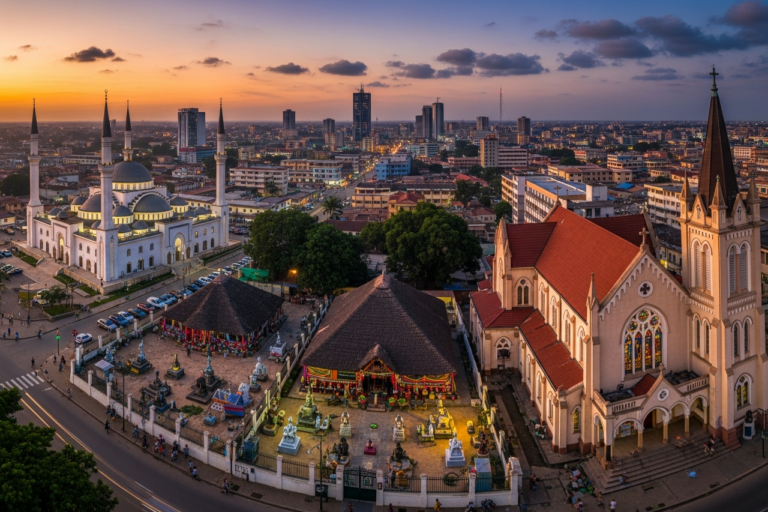
Key Highlights
-
Ghana is a country known for high religious tolerance, and Christianity is the most common faith there.
-
The main religions in Ghana are Christianity, Islam, and the old African beliefs.
-
Christianity has many christian denominations. These include Pentecostal/Charismatic groups, Protestant groups, and catholic communities.
-
Religious identity matters a lot to people, and many stress living peacefully side by side with those from other faiths.
-
The government helps to protect religious freedom. Religious leaders often work together on problems that affect them all.
-
People from different faiths often show mutual respect and build a strong feel of community with one another.
Introduction
Welcome to Ghana. This big country is in West Africa, and faith is a big part of the way people live every day. People here show us that many religious beliefs can all live together in peace. You can see this in the lively Sunday church meetings and the calls to pray when the mosques get busy. For the people, religion is something they share with others and also keep for themselves. There are many different religious groups in Ghana. Each group has its own ways and adds something special to the life of the country. In this overview, you will get to see what the religious scene in Ghana looks like, from who is there to how they show their faith.
Religious Demography and Population Trends in Ghana
Looking at Ghana’s religious makeup means seeing what the numbers tell us. The 2021 government census says the country has a total population of about 33.8 million people. Out of all these people, most say they are Christian. This means Christianity is the biggest group, but there are also other religious groups in the country.
You will find different religious groups in many parts of Ghana. Christians live all over the country, but the majority of Muslims are in the northern regions and in big city areas like the urban centers of Accra, Kumasi, and Sekondi-Takoradi. These places shape Ghana’s religious identity even more. Now, let’s see what the major faiths are and look at their numbers.
Overview of Major Religions Practiced
Ghana’s religious life is built on three main parts: Christianity, Islam, and traditional beliefs. Christianity is the biggest in the country. There are various Christian denominations you will find here, like Pentecostal/Charismatic, Protestant, and Catholic churches. These groups have a strong place in the everyday lives of many people. Most religions followed in Ghana today are a mix of worldwide beliefs and the special ways of local people.
The Muslim population in Ghana is also a big part of who we are. Groups like Sunni, Ahmadiyya, and Shia are most known. All these communities live near one another and practice their faith with a lot of peace. This shows the famous religious tolerance people talk about in Ghana.
Many Ghanaians, no matter if they are Christian or Muslim, still keep some traditional beliefs in their daily life. People often mix old ways with their main faith. This gives Ghana a special blend in its spiritual life that you may not see anywhere else.
Percentage Breakdown by Faith
The 2021 government census provides a clear picture of how Ghana’s population is divided by faith. Christian groups make up the vast majority, comprising over two-thirds of the nation.
The census data reveals that the Muslim population accounts for a significant minority, making Islam the second-largest religion in the country. A smaller but culturally important segment of the population adheres to traditional beliefs, while some Ghanaians belong to other faiths or profess no religion at all.
Here is a simple breakdown based on the 2021 census data:
|
Religious Group |
Percentage of Population |
|---|---|
|
Christian |
71% |
|
Muslim |
20% |
|
Traditional Beliefs |
3% |
|
Other/None |
6% |
Christianity in Ghana
Christianity has a big role in daily life in Ghana. It shapes many things from how people spend their days to the way national holidays are held. Ghana has many christian denominations. These include the Catholic Church, Protestant groups like the Society of Friends, and lots of charismatic churches.
Religious leaders are seen with respect by many people. Groups such as the Christian Council of Ghana matter a lot in public life. Christian holidays like Christmas and Easter are special times for the whole country. Next, we will take a look at how Christianity came to Ghana over the years. We will also see its big effect on life for people in the country today.
Historical Roots and Spread of Christianity
The rise of Christianity in Ghana is closely tied to its colonial past and the work of early christian leaders. European missionaries were the first to bring the religion. Over time, more people in Ghana got interested in it. Local groups made it their own and started strong christian communities.
Many types of christian denominations began to grow. This was not just the older church groups. African independent churches also became popular, such as the apostles church and church universal. These churches often mixed christian beliefs with local ways of life. This made it easier for Ghanaians to understand and connect with their faith.
Local leaders played a big part in spreading Christianity. Their work was important for growing christian communities all over the country. Today, there is a lively and mixed christian landscape in Ghana. Faith has become a key part of the daily lives of many people.
Influence on Contemporary Ghanaian Culture
The impact of Christianity in Ghanaian culture is big. You can see it everywhere. This faith is now a main part of the country’s identity. It shapes how people act, how schools work, and even how people talk in public. Many folks look to religious leaders for advice and support on questions about right and wrong.
Groups like the Christian Council of Ghana play a big part in public talks. They help with social work and educational activities. Churches are more than just places to pray. The church is a spot to meet others, learn new things, and get help or support.
Christianity is deep in Ghana’s life in many ways:
-
The nation celebrates christian holidays.
-
Schools always include religious and moral lessons.
-
People often start public events with a christian prayer.
-
Religious leaders have a big role in guiding the morals of public life.
Islam in Ghana
Islam has been in Ghana for a long time. The country has many Muslim people who help make it a place with many faiths. The majority of Muslims in Ghana are Sunni. They follow the customs of Muhammad. But there are also groups like Ahmadiyya and Shia.
At first, Islam came from traders who traveled from the Middle East and North Africa. Now, it is part of everyday life in Ghana. There are active Muslim communities in both big cities and rural areas, especially up in the north. Here is a closer look at these main communities and how the muslim population has changed over time.
Key Muslim Communities and Their Practices
Ghana has a lively and mixed Muslim population. You can find Muslim communities all over the country. Most live in the north, but there are also many Muslims in the big cities. The urban centers of Accra and Kumasi have large groups, too.
People in these communities follow Islamic ways and rules. In the Dagbon region, Islam is closely linked to the major chieftaincies. This means that the religious leaders sometimes are the same as the traditional chiefs. Here, religious identity and leadership often mix, bringing the two together in one group.
It does not matter if they are in busy cities or in smaller rural areas. Muslims in Ghana keep up their faith and daily routines. Mosques are important in both places. They use them for prayer, learning, and meeting each other. This strong community feeling helps their beliefs stay strong and pass from one group to the next.
Growth and Demographic Shifts
The religious scene in Ghana keeps changing as time goes on, and census data helps us see how things shift. While Christianity is still the main religion, the Muslim population continues to have a strong and steady presence, mainly in the northern areas of the country.
Has the religious landscape in Ghana changed in recent years? Yes, it has. Things change because of moves in the population and how birth rates are not the same among the different religious groups. For example, when people come into Ghana from countries next to it, they can change what the religious mix looks like, especially along border parts.
Key points about these changes are:
-
Muslim communities still live mainly in the northern areas and in some urban places.
-
Problems can get worse between farmers and herders, and this can make tensions go up among different groups in rural areas.
-
Disagreements among Muslim people, usually because of doctrinal differences, happen more often in the northern areas.
Traditional African Religions
Many years ago, before the arrival of Christianity and Islam, the people in Ghana followed traditional African religions. These religious beliefs were important to daily life in the community. People saw the world as full of spirits. They believed these spirits lived in nature and called this way of thinking animistic religious beliefs.
Now, only a small number of people say they only follow these old religions. But aspects of indigenous beliefs are still a big part of life for many Ghanaians. Most people mix their traditional ways with being Christian or Muslim. Traditional religions still play an important part in society. They help people know who they are and bring communities together through customs and social events.
Role in Daily Life and Community Identity
Traditional beliefs are still very important in the daily lives of many people in Ghana. This is true even for those who call themselves Christian or Muslim. This belief system helps people understand the world, know what is right or wrong, and see where they fit in the community.
Traditional beliefs are a big part of who people are and their history. The people often learn about these beliefs through speaking, sharing stories from one person to another, and using their local languages. This helps keep their culture strong and gives everyone a feeling that they belong. For most, the traditional beliefs are mixed with who they are. These are not apart from someone’s identity, but part of it.
People have much respect for those who came before them. Community events and group rites matter a lot to them. Many also believe in the spirits that are in nature. All of these things shape how people act with each other and what they think is important in life. Because of this, traditional religion is not something from the past, but it is active and part of Ghana’s life today.
Rituals, Festivals, and Social Customs
The energy of traditional beliefs shows most during rituals, festivals, and social customs. These times are full of color, people, and spirit. They bring people together to show respect for their past and ask for goodwill from spiritual forces.
Are there big religious festivals in Ghana? Yes, there are. A lot of people celebrate yearly festivals that link back to their traditional beliefs. Many festivals happen to mark good harvests, remember old events, or show respect for ancestors and spirits. Traditional religious leaders, like priests and priestesses, guide the rituals.
These festivals are a big part of life in Ghana and every year, you will find:
-
Special rituals to wish for good times and safety.
-
Shared meals, dancing, and music with many people.
-
Pouring drinks to show thanks to ancestors and spirits.
-
Parades and wearing special clothes to show where people come from.
Legal Framework and Religious Freedom
Ghana’s constitution has rules that strongly support religious freedom. It does not let anyone treat people unfairly because of their religion. It also makes sure people have their own religious rights, so they can follow and practice any religion they want. In Ghana, there are usually no limits on how people practice their religion.
A religious group can choose to sign up with the government if it wants to become a legal group, but there is no rule that forces them to do so. If a group does get formal government recognition, it can get things like tax breaks for work that does not make money. The way things work in Ghana helps people be free in their religion. It also supports a healthy mix of different faiths in the country. Let’s look at how these protections work and what people in the country think about them.
Constitutional Protections and Governmental Policies
Religious freedom in Ghana is protected mainly by the country’s constitution. It gives every person the right to follow their faith. Ghana has also signed the International Covenant on Civil and Political Rights. This shows the country’s promise to keep these freedoms safe on a world level.
The government is neutral and shows respect in matters of religion. At events, government officials often use both Christian and Islamic prayers. The Ministry of Education puts religious and moral education in public schools. This teaching covers ideas from both main faiths. A High Court decision in 2021 said that students have rights to show their religious views. One example is that Rastafarian students can keep their dreadlocks.
Still, people keep talking about the government’s role with religion. There was a plan to build a national cathedral which made people talk about keeping church and state apart. Some are asking to regulate certain pastors, but established religious bodies do not agree with these calls.
International Covenant on Civil and Political Rights
Societal Respect and Interfaith Relations
What really stands out in Ghana is not just the laws but the way people respect each other’s beliefs. There is a strong culture of religious tolerance. People in Ghana know the importance of peaceful religious coexistence.
So, how do people from different faiths get along in Ghana? Faith leaders from both Christian and Muslim groups often talk and work together. They come together to discuss issues that matter to both groups. Faith leaders also do good things together in public, like going to each other’s events or giving money to important projects. These actions show the importance of mutual understanding.
This team spirit shows up in different ways:
-
There are friendly talks between different religious leaders.
-
Faith leaders join together in national groups like the National Peace Council.
-
Leaders often speak in public about the need for living together in peace.
-
Community workshops help people get along and support good relations between all beliefs.
Conclusion
To sum up, religion is a big part of life in Ghana. It helps shape the way the people see themselves and their culture. There are many beliefs here, including Christianity, Islam, and different African religions. This mix of faiths shows both the country’s many sides and how it stands together. The law in Ghana gives people religious freedom. This helps everyone live beside each other in peace, even if they do not follow the same beliefs. When we learn how these beliefs work together, we see how rich Ghana’s culture is. We also see how talking to each other across faiths can help bring peace and teamwork. If you want to know more about the active religious festivals or how these different groups get along, reach out and explore Ghana’s amazing religious story!
Frequently Asked Questions
Are there major religious festivals celebrated in Ghana?
Yes, Ghana has many big religious festivals. People in the country celebrate national christian holidays such as Christmas and Easter. There are also muslim events like Eid al-Fitr and Eid al-Adha, and these are public holidays too. In addition to these, there are many different traditional festivals during the year. Each group has their own way of doing things and these events are often led by local religious leaders.
Has the religious landscape changed in recent years?
Yes, the way people practice religion is slowly changing. Census data shows that Christianity is still the main religion. At the same time, more people move in from other countries, and birth rates are not the same everywhere. Because of these things, the numbers are changing. You can see this in some rural areas and in the urban centers of Accra, where the local communities are made up of different religious groups over time.
How do different religions interact peacefully in Ghana?
People in Ghana are known for getting along well with each other, and a big reason for this is the strong religious tolerance in the country. Religious leaders from many faiths will talk openly and work together, often joining in groups such as the National Peace Council. These religious leaders also visit one another’s events and team up with ecumenical bodies to help build peace and respect between all people.



