

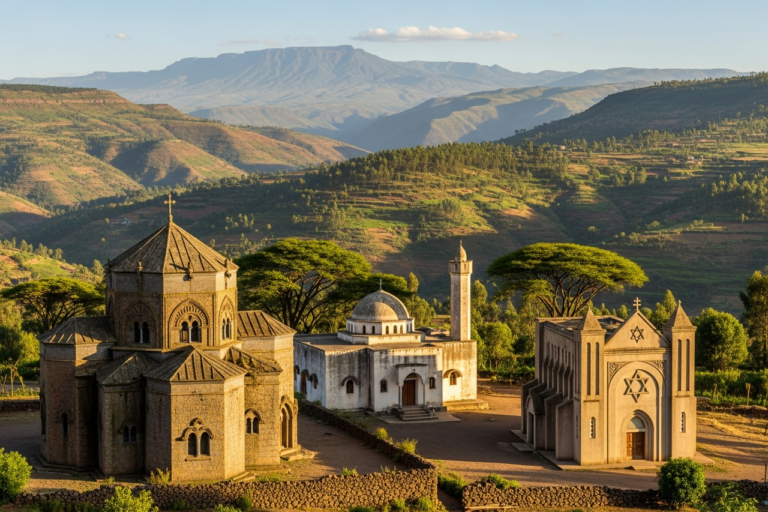
Key Highlights
-
Ethiopia is a very religious place. Ethiopian Orthodox Christianity is the biggest faith there, and Islam is next.
-
The Ethiopian Orthodox Church is among the oldest Christian churches in the world. Its history goes back to the fourth century.
-
Islam has been in Ethiopia for a very long time. It started in the country with the first migration during the time of Prophet Mohammed.
-
Ethiopia was home to many Ethiopian Jews, called Beta Israel. Most of them have now moved to Israel.
-
Even though Christianity and Islam are strong, people in rural areas still practice traditional religions.
-
The country’s rules say Ethiopia is a secular country, but religion is a big part of life. It matters a lot in how people see themselves and how the society works.
Introduction
Welcome to Ethiopia. The people here live with faith every day. Ethiopia has some of the oldest religious communities in the world. This country has a rich and lively spiritual life. The Ethiopian Orthodox Church has old traditions that go way back. Islam has deep roots here. The story of the Ethiopian Jews is special, too. Religion is part of the Ethiopian identity.
This article will help you see the different beliefs. You will learn about historical changes. You will find out how religion shapes life in Ethiopia.
Overview of Religion in Ethiopia
Religion is easy to see and be part of life all over Ethiopia. The country is mostly Christian. Orthodox Christians are about 43% of the total population. There is also a big Muslim community. Muslims make up about 33% of the Ethiopian population.
These two big religious groups live side by side with the Protestant Christian group, which now has nearly 20% of the people. The country does not have an official state religion now. Still, the orthodox church has left a strong mark from history. These religious communities have made the country’s culture, traditions, and way people act what they are. Next, we will look at how these faiths began and what they mean for Ethiopia.
Historical Roots of Ethiopian Religions
The religious story of Ethiopia has very old roots. Christianity started in Ethiopia in the fourth century, right in the Kingdom of Aksum. Church writers tell how a Christian traveler named Frumentius was captured there. Later, he helped spread the faith and then became the first Bishop of Aksum.
The king of Aksum, King Ezana, made a big choice and became a Christian. This was a key moment. It changed things for the nation’s future and set a new path for faith in this place. The turn to Christianity meant people moved away from the indigenous African religions that had been part of life for many years.
Before Christian and other major faiths arrived, people in Ethiopia followed many traditional beliefs. Some, like the Rastafari, think of former Emperor Haile Selassie as more than a man, seeing him as a human incarnation of God. All these stories and beliefs come together. They make up the rich religious scene that you find in Ethiopia now.
Significance of Religion in Ethiopian Identity
For many Ethiopians, the way they see their religion is tied to who they are as people and as a nation. This link is very strong in Orthodox Christianity. For many years, the Ethiopian Orthodox Church worked so closely with the state that it became the state religion up until 1974. It had a big effect on the laws, culture, and what it meant to be Ethiopian.
Leaders like Haile Selassie made this bond even stronger. Many thought of him as the one protecting the faith. Because of this long past, Ethiopian Orthodox Christians stand out as some of the most deeply faithful people in the world. For example, most of them—almost 98 out of 100—say that religion is a big part of their lives.
This strong faith shows in how often people go to the orthodox church and how often they pray every day. The orthodox church is more than a place where people worship. It is the heart of the community. The church keeps old traditions alive and gives people a strong sense of who they are that has lasted, no matter how much the world around them changes.
Geography and Regional Distribution of Religions
The religious groups in Ethiopia change a lot depending on the part of the country you look at. Most of the people who follow the Ethiopian Orthodox faith live in the northern highlands. This group is strongest in the Tigray and Amhara areas. The Muslim population is mainly found in the east and southeast. Many people in the Somali and Afar regions are Muslim.
A national census gives clear numbers about these groups all over the Ethiopian population. Most Ethiopian Jews do not live in Ethiopia now, but their main home used to be in the northern part of Gondar. Where these groups live shows old ways of moving, changing faiths, and settling in new places. The next parts will talk more about the people in each area and how where they live helps shape how they follow their religion.
Religious Demographics by Region
The distribution of religious groups across Ethiopia’s regions reveals a diverse and sometimes overlapping mosaic of faiths. In certain regions, one group forms the clear majority of the population, while others are more mixed. For example, the Amhara and Tigray regions are overwhelmingly Orthodox Christian.
The Oromia region, the country’s largest, has a mixed population of Muslims, Orthodox Christians, and a growing number of Protestants. The capital city, Addis Ababa, is also a melting pot, with large representations of different faiths coexisting. Meanwhile, regions like Somali and Afar are predominantly Muslim. This regional breakdown is crucial for understanding local cultures and social dynamics.
Here is a simplified look at the religious distribution in some key regions:
|
Region |
Predominant Religion(s) |
|---|---|
|
Tigray |
Ethiopian Orthodox |
|
Amhara |
Ethiopian Orthodox |
|
Oromia |
Mixed (Islam, Orthodox, Protestant) |
|
Somali |
Islam |
|
Addis Ababa |
Mixed (Orthodox majority, significant Muslim & Protestant minorities) |
Influence of Geography on Religious Practices
Geography has played a big role in the way people practice religion in Ethiopia. The rough highlands in northwestern Ethiopia have been the main area for orthodox christianity. Cities like Axum and Lalibela sit in these mountains and are the religious centre of ethiopian orthodox christians. Here, orthodox christian traditions stay strong, often because these places are so isolated.
On the other hand, the lowland regions in the east and southeast got ideas from the Arabian Peninsula. This helped Islam grow and become a main faith in these spots. These areas are still important places for muslims.
In western ethiopia and in other rural areas, local traditional beliefs have stuck around. These rural areas did not see as much push from the central state to follow orthodox christianity.
Because of this mix of geography and history, religion is practiced in Ethiopia in ways that are different from much of Africa. Ethiopia was not shaped as much by foreign missionaries. It has old and native forms of orthodox christianity and islam, so it stands out on the continent.
Christianity in Ethiopia
Christianity in Ethiopia goes back almost 1,700 years. This makes it one of the oldest Christian countries in the world. Most people belong to the Ethiopian Orthodox Tewahedo Church. Orthodox Christians in Ethiopia keep old customs and are very faithful.
Over the last years, the Christian faith in Ethiopia has become more varied. Protestant churches have grown fast, especially Pentecostal and Evangelical groups. This growth has brought change to the country’s way of worship and sometimes causes problems with the Orthodox Church. The next parts will look at the special history of orthodox christians, ethiopian orthodox churches, and the effect of new protestant churches in Ethiopia.
Ethiopian Orthodox Tewahedo Church
The Ethiopian Orthodox Tewahedo Church is the largest group in Ethiopia. It is at the center of Christianity in the country. The church is a part of Oriental Orthodoxy. It has ties with churches in Egypt, Armenia, Syria, Eritrea, and India. This branch is not the same as Roman Catholic or Eastern Orthodox.
One of the most important places for orthodox christians is the Church of Our Lady Mary of Zion in Axum. Many people in Ethiopia say this church keeps the Ark of the Covenant. They believe Menelik I, who was King Solomon and Queen of Sheba’s son, brought it from Jerusalem.
The ethiopian orthodox church is tied to the country’s history and its people. It has old traditions that borrow some parts from Judaism. This connection and its long history help ethiopian orthodox followers be among the most loyal and devoted. Many people say orthodox christians in Ethiopia are some of the most faithful in the world.
History of Christianity’s Arrival and Growth
The story of Christianity in Ethiopia starts in the fourth century when the Kingdom of Aksum was strong. A Syrian Christian named Frumentius brought the faith to the area. He was captured during a trip and after that, he became important at the royal court. Frumentius helped share the beliefs of Christianity with the person who would soon be king.
When King Ezana became king, he chose to follow this faith. He then made Christianity the main religion in his kingdom. The pious Christian king’s choice changed Ethiopian history in a big way. This set the whole nation on a religious path that made its identity for thousands of years.
With the king’s trust and push, Christianity spread through the highlands. Monasteries and churches opened, and they became places for learning and culture. The church in Ethiopia made its own special service, art, and ways of worship. Because they had little contact with other parts of the Christian world, the church in Ethiopia created a style of faith that was one of a kind and stayed with the people for a long time.
Christians’ Role in Ethiopian Society
Christians have had a big and lasting role in shaping the society of Ethiopia. For many years, the Ethiopian Orthodox Church was deeply connected with the king, the state, and its people. Its religious leaders were very important in politics and social life. The orthodox church also guided education, the law, and culture.
Today, the Ethiopian Orthodox Church is still strong. It is a key moral and social group. But the rise of Protestant Christianity in the country has brought new voices. It has also changed how things work between the churches. Protestant Christianity and Roman Catholics, even though there are not as many of them, also do a lot for society. They help with education, health, and building up the community. Each group has its own way of doing things. Sometimes, these Christian groups work together, but other times they compete.
You can see the work of Christians in these ways:
-
Religious leaders from the orthodox church, protestant christianity, and roman catholics often talk about big issues in the country. They help people come together and work for peace when there are problems.
-
Churches are big providers of help like schools and health care, especially in rural areas.
-
The country celebrates religious holidays in a public way. Orthodox events, in particular, are some of the biggest national days in Ethiopia.
Islam in Ethiopia
Islam has been in Ethiopia since the start of the religion. A group of Muslims left Mecca because of trouble and found safety in Ethiopia. This event is called the First Migration, or Hijra. It happened when Prophet Mohammed was alive. This made a strong and lasting bond between Ethiopia and Islam.
Today, Ethiopia has the third-biggest Muslim population in sub-Saharan Africa. Most of the people are Sunni Muslim. Islam plays a big role in the life of the people, especially in the east and southeast parts of the country. The next parts will talk about how Islam spread and the group of Muslims’ traditions.
Historical Spread of Islam
The story of Islam coming to Ethiopia is special because it is about finding safety and living together in peace. Around 615 AD, the Prophet Muhammad told some of his followers to go to the Christian Kingdom of Aksum. He wanted them to get away from trouble and be safe. The king of Aksum was fair. He let the foremost companions of Muhammad live there. He let them believe in their faith.
This event built respect between the Muslims and the Ethiopian Orthodox Christians in power. Islam started off in places near the sea and slowly spread to other places inside the land. Trade and a group of preachers helped share the faith more as time went on. In the east and south, powerful Muslim sultanates rose many years later.
Even though there were fights sometimes between the Christian kingdom and the Muslim states, the Muslim population grew to be a big part of Ethiopia. The country is known for having all kinds of people. This long road makes a very special type of Islam in Ethiopia. This type has lived side by side with its neighbors for more than a thousand years.
Muslim Communities and Traditions
Muslim communities in Ethiopia are made up of different groups, and each one has its own way of doing things. Many blend their traditions with the local culture. Most Muslim people live in the eastern, southeastern, and western parts, and in many rural areas. Most are Sunni, but Sufism can also be found here. There are many Sufi orders and shrines, and they are important in the spiritual life.
Over the past few years, Islamic reform movements have grown stronger. These movements help build the religious identity of Muslims and make their presence more clear in public. There are more mosques being built, and Islamic dress codes are followed more closely, especially by women.
Some main parts of Muslim life in Ethiopia are:
-
Public celebrations of big holidays like Eid al-Fitr and Eid al-Adha, and these days be national holidays.
-
Mosques and religious groups give support and help to the community.
-
Muslim people interact with other religious groups, which was peaceful in the past, but now there are more problems, and this causes tension in some places.
These changes affect rural areas and religious groups across Ethiopia.
Judaism and Other Abrahamic Faiths
Besides Christianity and Islam, Ethiopia has long been home to a special group known as the Beta Israel. Many people call them Ethiopian Jews. There is a lot we do not know about how this jewish community began. Some stories say they come from the lost tribe of Israel. For many years, they lived in the north of Ethiopia and kept their own faith and ways of life.
Most people from Beta Israel have now moved to Israel. Still, they are a big part of Ethiopia’s history with religion. There are also some small groups from other Abrahamic faiths, like the Baháʼí Faith, that be in the country today. The next parts will talk more about these people and their stories.
The Beta Israel Jewish Community
The Beta Israel means “House of Israel.” This group is a small ancient group of Jews. They lived in Ethiopia for many years. Their history is long. It is also very detailed. The Beta Israel practiced Judaism in their own way, which came before the Talmud. They kept customs that were not like the customs of other Jewish community groups around the world. Most of them lived in the Amhara and Tigray regions. They often stayed in their own villages.
The Ethiopian Jewish community went through hard times. There were times when people tried to make them change their religion. In the 1900s, their link with the wider world Jewry started again. The israeli government then said they were Jews. This helped them move to Israel.
Two big rescue plans, called Operation Moses and Operation Solomon, happened in the 1980s and 1990s. These airlifts took tens of thousands from the Beta Israel to Israel. Now, only a very small community is left in Ethiopia. The story of the Ethiopian jewish community shows faith and strength.
Baháʼí Faith and Other Minority Religions
Ethiopia has many different religious communities. Most people in the country follow Orthodox, Muslim, or Protestant faiths. But there are smaller groups who practice other beliefs. For example, the Baháʼí Faith started in Ethiopia in the 1930s. It has a small group of followers who are very dedicated to their faith. Baháʼís focus on the unity of God, religion, and all people. They have set up local spiritual groups in different parts of the country.
The Ethiopian Catholic Church is another important minority group. This church follows a type of Eastern rite, but it also has full ties with the Pope in Rome. The Ethiopian Catholic Church is only a small part of the Christian population in Ethiopia. Still, it has its own history and special traditions.
Reports from the U.S. Department of State and other groups say that these minority religious communities in Ethiopia usually get to practice their faith freely. Even though their numbers are not large, they bring something special to the nation’s religious life. These small groups help add to the deep and rich faith traditions found in Ethiopia.
Indigenous and Traditional Religions
Before Christianity and Islam came to Ethiopia, the country had many indigenous African religions. These traditional religions were a big part of life. They were close to nature and to a belief in a top creator, and there were also lesser spirits. Each ethnic group had its own beliefs, so there were many ways people showed their faith.
Now, most people follow the Abrahamic faiths, but the traditional religions have not gone away. Many still practice them in rural areas, especially in western Ethiopia and the south. These practices sometimes mix with Christian and Islamic beliefs and are still a big part of life for some people. We will take a closer look at these indigenous African religions and how people keep them alive today.
Pre-Christian and Pre-Islamic Beliefs
Long before Christianity and Islam, Ethiopia had its own ancient civilization. People there followed traditional religions. Many beliefs were animistic, where people worshiped spirits found in nature. Others were polytheistic. There was a group of gods and goddesses. The Kingdom of Kush to the north and some other local kingdoms had their own state religions.
These belief systems had some ideas seen in other African religions. There was often a high god who did not deal much with people. There were many intermediary spirits. People prayed to these spirits for help. Honoring ancestors was common and meant a lot to them.
Some main points about these traditional religions before Abrahamic religions are:
-
There was a belief in a supreme being, usually linked to the sky.
-
People tried to keep balance between the human world, nature, and the spiritual world.
-
Many saw Ethiopia as a sacred land. Later, groups like the Rastafari called it their spiritual home.
Contemporary Practice of Traditional Religions
Today, people in Ethiopia still follow traditional religions, even if these are less visible next to the main religions. You can find these beliefs mostly in the rural areas, especially in the south and west, where the central state did not have much control in the past. The national census shows that only a small part of the population chooses these faiths on record.
But in real life, the effect of traditional religions is much bigger than what you see from the numbers. Many people who say they are Christian or Muslim also add old customs into what they do each day. This mix is called syncretism. They might go to meet traditional religious leaders to get help, advice, or to keep away bad luck.
These religious communities keep their old ways going through stories and lessons that get told from one group to the next. Their religious leaders work as healers, give people answers, and share knowledge about past ancestors. Even though they get pressure from bigger world religions, these belief systems are still a big part of Ethiopia’s spiritual life.
Religion, Society, and Modern Ethiopia
In Ethiopia today, religion is still a strong part of life. It affects how people feel about politics, who they are, and how they act with each other. The Ethiopian Orthodox Church used to be the main group for a long time. Now, there are more religious communities, and there is more competition between them. There are more people who follow the Muslim faith now, and there are many who join Protestant groups. This has changed how power is shared between the groups.
Because of this change, there are now more problems in some parts of the country. Some leaders, like the Prime Minister, often use words from religion. This can sometimes help bring people together, but it can also split them up. The next few parts will talk about how groups like the Muslim population, the Ethiopian Orthodox, and others deal with each other. It will also look at the rules about religious freedom and how the law deals with faith groups.
Interactions Between Different Faith Groups
For many years, people have seen Ethiopia as a place where Ethiopian Orthodox and Muslim people can live together in peace. There is a long history of people being in the same places. Still, the way these religious groups get along has become harder and sometimes tense in the last few decades. Now, Protestant churches are also a part of this story.
There is now more competition. Each group wants more people to join and more say in what happens. Sometimes, this makes people fight. This can happen when a group starts new churches or mosques in places where another faith used to have most of the say. When things like this happen in a city like Addis Ababa, people may see peace most days, but inside there are problems that can come out.
There are a few reasons for these problems:
-
The growth of Protestant churches into areas that used to be mostly Ethiopian Orthodox or Muslim.
-
Muslims are showing more who they are, and some Christians see this as something bad.
-
The Orthodox Church is trying to get back to being a powerful voice, and this can cause fights about important places.
These things show how the Orthodox church and other religious groups in Ethiopia, like those in Addis Ababa, can find it hard to get along, even if people want peace.
Religious Freedom and Legal Protections
The Ethiopian constitution says the country is a secular state, which means the government is separate from religion. It also gives people the right to choose, practice, or change their religion. Because of this, all faiths should be equal under the law. Government buildings and public spaces are supposed to have no signs of any one religion.
But things do not always work out this way. The U.S. Department of State and other groups say that although the government usually respects religious freedom, sometimes local problems and what people around you think can get in the way. In some places, local leaders may give special treatment to the religion most people there follow.
Even with these problems, Ethiopia’s laws make it possible for different religious communities to live and work in the country. If a religious group wants to have legal rights, like owning property or holding events, it must register with the government. While this process is needed, Ethiopia still has more religious freedom for people and for religious groups than you find in many other places nearby.
Conclusion
To sum up, religion has a big part in shaping life in Ethiopia. It affects who people are, how they live, and how they come together. There are many beliefs here like Christianity, Islam, Judaism, and local ones, which shows us the country has a rich culture. This mix of faiths goes deep into the country’s past and shapes the way people live now. Knowing about these different religions can help us see how rich and strong Ethiopia’s history is. It also shows us how faith groups talk to and live with one another today. As time goes on, religion will keep being a big part of what makes Ethiopia’s identity and brings people together. If you want to know more about this topic, feel free to get in touch for other details!
Frequently Asked Questions
How does the religious landscape of Ethiopia compare to other African countries?
Ethiopia stands out in Africa for having its own old forms of Christianity and Islam. The Ethiopian Orthodox Church was the state religion for many years, instead of faith being brought by outside missionaries. There is also a large Muslim population in the country, and traditional religions are still strong. This mixing of the orthodox church, Muslim population, and traditional religions makes Ethiopia’s religious life different from other places in Africa.
Why are Ethiopian Orthodox Christians considered highly devout?
Ethiopian Orthodox Christians show a lot of faith in the church. This is because the orthodox church is closely tied to the country’s history and who they are as a people. This connection goes back to the fourth century after a pious Christian king turned to the faith. The Ethiopian Orthodox church was the state religion for a long time. This old and steady bond has helped orthodox Christians have a strong faith. The deep link to the orthodox church helps all people in the land hold on to their beliefs in a special way.
What challenges do religious communities face in contemporary Ethiopia?
Today in Ethiopia, religious communities deal with many problems. There are more arguments between groups, and they try to get more people to join them. The use of faith for politics has also gone up. Even though the country’s laws say people can have religious freedom, fights do break out in some places. Politics can make things worse and split people up. During these times, religious leaders need to help calm things down and start talks so they can keep peace.



