

Key Highlights
Here are the key takeaways about religion in Bangladesh:
-
Islam is the state religion of Bangladesh. Most of the people in Bangladesh are Sunni Muslims.
-
The Constitution gives religious freedom to everyone. It tries to make sure that religious minorities like Hindus, Buddhists, and Christians have the same rights.
-
The Bangladesh Bureau of Statistics says Hindus are the biggest minority group. Buddhists and Christians come after them.
-
Over the years, census data shows that the makeup of different religious groups in the country changes.
-
Even though the Constitution says there is religious freedom, minorities sometimes get treated unfairly by people in society, and their religious freedom is sometimes challenged.
-
Religion has a big role in the daily life, culture, and politics of Bangladesh.
Introduction
Welcome to our guide about religion in Bangladesh. This country sits in South Asia and has a total population of more than 160 million people. It is full of different faiths and beliefs. In Bangladesh, Islam is the main faith. But people also follow Hinduism, Buddhism, and Christianity. The religious institutions play an important role in the society of Bangladesh. They shape the culture and way of life here. Knowing about this mix of beliefs helps you see what is special about this nation and its people.
Historical Overview of Religion in Bangladesh
The religious history of Bangladesh has changed a lot over time. The country sits in the eastern part of the Indian subcontinent. It is the place once known as East Bengal. For hundreds of years, this land has seen many types of faith come and go. People followed old folk and animist beliefs first. After that, Buddhism and Hinduism were brought in. Later on, Islam became a strong part of life here. The area has taken in ideas from all these faiths and mixed them in its own way.
This pattern of change kept going during major times, like the British Raj, which had a big impact on religious education and how people in each faith got together. The push for religious freedom and a sense of who people are did not stop. All of this led to Bangladesh becoming an independent country. Now, let’s look closer at the important times that helped shape the nation’s religious life.
Ancient Religious Traditions and Early Influences
Long ago, before the main religions you see today became important, people in the Bengal delta followed old spiritual ways. The first people there believed in many forms of animism and other folk ideas. These beliefs were very close to the land and followed the seasons and nature. You can still see signs of these early practices in their culture.
Buddhism came early to the area. The Theravada school of Buddhism was popular. We know from old sites that big Buddhist religious institutions and monasteries once stood here. Most of these were around before the 12th century A.D. This time in history brought a feeling of peace and quiet thought. Some of that spirit is still felt in groups today.
Hinduism also has a long history in this place. It grew strong under many dynasties and helped shape the way people lived for many years. When new faiths came, the old practices did not go away. Instead, they mixed together. This made a special kind of spirit and culture long before East Pakistan was formed.
The Arrival of Islam and Its Spread
Islam first came to Bengal in a slow way and changed the area’s identity. Around the 8th century, Arab traders from the Middle East came and set up trade ties. They also brought their faith with them. But it was not until the 13th century that Islam started to grow fast. This happened when Sufi holy men and Turkic rulers came into the region.
The Sufi holy men taught kindness and welcomed all people. These ideas touched many locals and made a lot of them choose Islam on their own. The Nawabs of Bengal, who were rulers around that time, also helped Islam grow. They gave support to Islamic schools and groups. This made the faith stronger here. Because of this peaceful mix, the Muslim population in Bangladesh is very large today.
This history has shaped Islam in Bangladesh in a special way. The faith here has often been open to different ideas, showing more acceptance and mix than in places like Saudi Arabia. Many political parties, like the Awami League, talk about this history when they speak about what makes the nation different. They also use it to talk about how their country is not as strict as some others.
Colonial Period and Shifts in Religious Dynamics
The British Raj came to Bengal in the 18th century. This changed the area’s religious life in many ways. The new rulers set up fresh legal and social systems. While they did not mean to, these rules made people’s religious identities stronger. Some rules about land and how things were run seemed to help one group more than the other. This caused new problems between people in the region.
One big event was the Partition of Bengal in 1905. This split Bengal into two parts—one was West Bengal, where most people were Hindu, and the other was East Bengal, where most people were Muslim. Even though Bengal was later brought back together, this split created long-lasting issues. It started differences that grew until the 1947 split that led to the birth of East Pakistan.
During this time, religious education was changing, too. The British started schools that gave Western-style learning, while the old, faith-based schools kept running as well. Because of this, two kinds of schools grew side by side. People had many talks on what role religion should play in new ways of learning and life. People in Bangladesh still talk about this today.
Post-Independence Changes (1971 Onwards)
After Bangladesh got its independence from Pakistan in 1971, the country started a new chapter to shape what it would stand for. The Awami League wrote the first constitution, and made secularism one of the main ideas. They wanted all people and all faiths to live in peace together. This came as a reply to the life and problems of the earlier times.
But even today, the part religion plays in politics is argued again and again. When the Bangladesh Nationalist Party and other groups ran things after that, they changed the constitution. These changes moved the country away from pure secularism. In 1988, they made Islam the state religion. This change shaped a lot of life in the country for many years.
Lately, under Prime Minister Sheikh Hasina, there has been fresh action to make the country feel connected to its old secular ways while also giving a place to Islam as the state religion. This shows how leaders like the prime minister and different political parties have to keep working together. They work to decide how religion and government should fit together in today’s Bangladesh.
Religious Demographics and Census Data
If you want to know about the religious composition of Bangladesh, you need to look at the numbers. The Bangladesh Bureau of Statistics shares the main details. They do the Population and Housing Census often. These country-wide checks show the total population of Bangladesh and tell how many people are in each religious group.
The data from the census is useful. It lets people see the size of religious minority communities. It also helps see how people are spread out in the country, and the way groups change over time. The census gives a full picture. You get to know where different groups live, and how much each group grew or shrank.
Up next, you will find more about today’s religious numbers, how these numbers have changed in history, and the places where groups live. This is all based on what the Bangladesh Bureau of Statistics and their housing census reports.
Current Population by Religion
According to the latest data, Bangladesh is a predominantly Muslim nation. The Muslim population makes up the vast majority, reaffirming Islam’s status as the state religion. Sunni Islam is the most common branch practiced by the country’s inhabitants.
Hindus constitute the largest of the religious minorities, followed by Buddhists and Christians. The Bureau of Statistics provides precise figures that highlight the demographic landscape. While these minority groups are small in percentage, they represent millions of people who contribute to the nation’s cultural fabric.
Here is a general breakdown of the population of Bangladesh by religion, based on recent census data:
|
Religion |
Percentage of Population (Approx.) |
|---|---|
|
Islam |
91% |
|
Hinduism |
8% |
|
Buddhism |
0.6% |
|
Christianity |
0.3% |
|
Others |
0.1% |
Changes in Religious Composition Over the Decades
The religious landscape in Bangladesh has changed over time. Census data from different years shows that the country’s population mix is not the same as before. When this area was known as East Pakistan, there were more people from religious minorities. Most of them were Hindus. Their share of the population was higher back then than it is now.
After the partition in 1947 and the Liberation War in 1971, many people moved in and out of what would become Bangladesh. These moves changed who lived there. Over the years, reports show the part of the population made up by Hindus has gone down. Many people link this to people leaving, as well as different rates at which people have children.
At the same time, the Muslim population makes up a larger part of the total now. The Public Life Project and other organizations look at these numbers to see what they mean for people and for religious freedom. These changes are a big part of the story of Bangladesh.
Trends from the Latest Census
The newest census from the Bangladesh Bureau of Statistics gives us more information about the country’s religions. This data continues old trends and confirms what we have seen in past years. Groups like the Pew Research Center study this information to show how things look compared to other countries.
People are mostly talking about the changes in the Hindu population. The census shows the Hindu share went up a bit, for the first time in many years. But it is still a lot less than it was back in the mid-1900s. This change has made people want to talk about what might be happening, including researchers and community voices.
Key trends from the latest census include:
-
The percentage of Muslims in the total population has gone down a little, for the first time.
-
The Hindu group’s share has grown from 7.9% to 8.5% of the total population.
-
The number of Buddhist, Christian, and other minority groups is about the same, with just a few small changes.
Geographic Distribution of Religious Communities
The religious communities in Bangladesh are not spread the same way all over the country. The Population and Housing Census shows that some religious minorities live in certain areas more than others. Even though Muslims make up most of the people in almost every district, where people from other faiths live can be very different.
The southeastern part of the country, especially the Chittagong Hill Tracts, has a lot of different people. There is a big group of the country’s Buddhist communities here. Many ethnic groups live here too and they believe in animism or other older faiths. The region is known as a place where a lot of the country’s indigenous groups live.
Here’s how people from different faiths are spread out:
-
Hindu communities live mostly in the districts next to West Bengal, like Khulna, Jessore, and Gopalganj.
-
Buddhist communities are mainly in the Chittagong Hill Tracts.
-
Christian communities are found in many places, but there are bigger groups in parts of Barisal, Gazipur, and big cities like Dhaka.
Major Religions Practiced in Bangladesh
While Islam is the state religion, Bangladesh has people who follow many lively faiths. The constitution gives people religious freedom, so anyone in the country can follow their own beliefs. The society of Bangladesh is shaped by how the main Muslim culture and the traditions of religious minority communities mix together.
This way of living together helps make life in the country rich and interesting. You can see many kinds of religious institutions here. There are busy mosques, old temples, and peaceful monasteries in Bangladesh, each one showing the country’s religious freedom and diversity. Let’s look at what people believe and do in these big faiths and see how they all add to the spiritual life of Bangladesh.
Islam – Sunni and Other Branches
Islam is the main religion in Bangladesh. More than 90% of people in the country say they are Muslim. As the state religion, it shapes the law, culture, and everyday life. Most Muslims in Bangladesh are Sunni and follow the Hanafi school.
This Sunni tradition is seen in many things people do each day. They pray five times a day. They also celebrate big events like Eid-ul-Fitr and Eid-ul-Adha. Religious leaders, like imams and ulemas, help people with spiritual and moral questions in their communities. Sunni Islam in Bangladesh is usually mild, and Sufism has influenced it through the years.
There are also smaller groups of Muslims in Bangladesh. Some people in Dhaka are Shi’a and remember Ashura. A small group of people follow the Ahmadiyya faith. There are not many people in these groups, but they add to the country’s religious identity along with the state religion and religious leaders.
Hinduism – Beliefs and Practices
Hinduism is the second-biggest religion in Bangladesh. It has a long history in the Indian subcontinent. Hindus in Bangladesh have many main beliefs and ways of worship that are much like those of people in India, especially people from West Bengal. This faith believes in many gods and goddesses. Still, there is the idea of one main spirit called Brahman, who shows up in many forms.
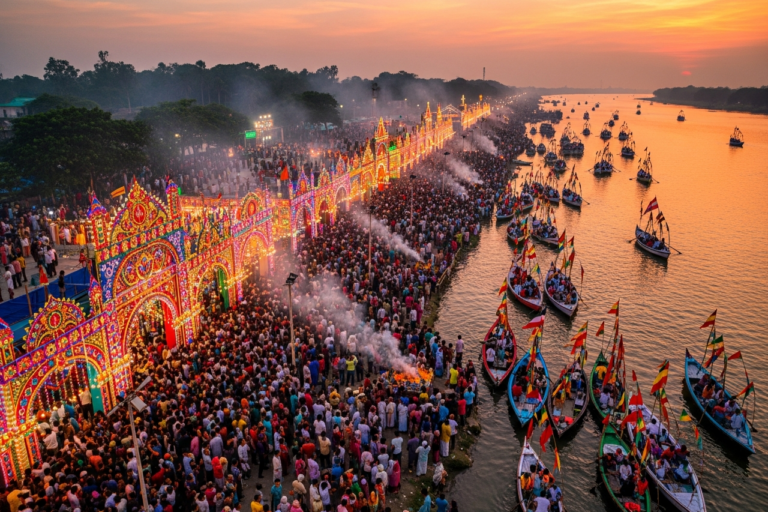
There are a few gods that are most important for Bangladeshi Hindus. These include Durga, Kali, and Krishna. Festivals play a big role in daily life, and people celebrate them with lots of excitement. Durga Puja is the biggest Hindu event. It lasts for several days. During this time, cities and villages get bright lights, music, and big community meals. These celebrations often bring people from all faiths together.
Although the constitution says there is religious freedom, the Hindu community sometimes faces problems. There have been issues with moving from their land and with fights over property. But even with these challenges, Hindus are still a big part of the country. They help make the arts, writing, and business in Bangladesh rich and lively.
Buddhism – Heritage and Modern Presence
Buddhism has been in Bangladesh for a very long time. It goes back over a thousand years. At one point, this place was one of the main spots for Buddhist learning and culture. Now, most Buddhists here follow the Theravada school of Buddhism. That means they still hold on to the old ways and customs.
You see modern Buddhism mostly in the southeastern part of Bangladesh. Most Buddhist communities live in the Chittagong Hill Tracts. There, you will find many religious institutions, like monasteries and temples, called viharas. These places are very important to the people. They bring the community together and help keep their culture alive.
The main festivals are Buddha Purnima, which marks the Buddha’s birth, enlightenment, and death, and Prabarana Purnima, which celebrates the end of the rainy season retreat. People celebrate these times in both simple and joyful ways. The festivals show how deep and strong Buddhism is in Bangladesh.
Christianity – Denominations and Influence
The Christian community in Bangladesh is small, but it has deep roots. Christians have been in Bangladesh since the 1500s, when Portuguese traders first came. As one of the religious minorities in the country, the Christian community adds to the mix of people and faiths there. They belong to different groups, but most are part of the Roman Catholic Church.
There are other groups too, like the Protestant denominations. Some of these are Baptists and Anglicans. The Christian religious leaders work hard, not just in the church, but also to help people in daily life. The Christian community is known for its work in education and healthcare. It runs some of the top schools and hospitals in the country.
Even with all these good things, Christians, like other religious minorities, often face a complicated social scene. The idea of religious freedom is there, and it lets people practice the faith they choose. But, social pressure can still be a challenge. Christian people celebrate Christmas and Easter out in the open. Many times, friends and neighbors from other faiths join in these times. This shows that the Christian community and others can come together, share, and enjoy moments of peace.
Other Minority Religions (Sikhism, Bahá’í Faith, Jainism)
Besides the main faiths, there are some smaller religious minorities in Bangladesh. These groups include Sikhs, Baháʼís, and Jains. They add to the country’s mix of different beliefs, even though there are not many people in each group. Every group has its own story and place in the country.
Sikhism has been in Dhaka since the time of the Mughal Empire. There is a gurdwara at Dhaka University that is a key spot for the people who follow Sikhism. The Baháʼí Faith also has a few people who come together as a group and they work to make sure different faiths can talk with one another.
The fact that these smaller faiths are in Bangladesh shows the long history of diversity here.
-
Sikhism: A small, old group of people who gather around gurdwaras in some big cities.
-
Baháʼí Faith: A group that is getting bigger and works for unity and service, with local meetings across the country.
Jainism used to have more people, but now almost no one in Bangladesh follows it. These faiths are the smallest religious minorities in the country.
Irreligion and Secularism in Bangladesh
The ideas of irreligion and secularism are not easy to talk about in Bangladesh. Secularism was one of the first main points of the state policy after the country became free. The goal was to stop religious groups from causing trouble. It was also to keep public order and to give equal rights to all people, no matter what they believe.
But not following any religion, called irreligion, is not something many people in the country get or talk about. It is often looked down on by others. People talk more about what secularism means in politics, but it can still be hard for someone who does not believe in any faith. The next parts will talk about how many people do not follow a faith, how the idea of secular principles fit in the country, and what most people think about someone who is not religious.
[public order], [state policy], [fundamental principles of state policy]
Irreligion: Prevalence and Public Perception
It is hard to know just how many people in Bangladesh do not follow any religion. In this country, religion is mixed with who people are and how they live. So, it is rare for someone to say they are an atheist or agnostic. If you do not believe in religion here, people can look at you in a negative way. Many who do not believe often face social isolation and stigma.
There is no official political status or any kind of government recognition for atheists in Bangladesh. This subject does not come up much in public discussions. It is only talked about when something controversial happens. Many people keep their non-religious views to themselves. If they share these thoughts, they may be pushed away by their own family or the community. Because of this, many keep this part of their lives secret.
In the last few years, social media made it possible for some non-believers to meet and talk about these things even if they do it without using their real names. This is helpful, but it also means they can face strong reactions or worse. Some bloggers and activists meeting through social media have even been hurt or killed for sharing their views. These events show how hard and risky it can be to talk about having no religion in Bangladesh today.
Secular Principles in National Identity
Secularism became a main idea in Bangladesh’s first constitution in 1972. The aim was to bring the country together with a shared language and culture, not just by religion. The leaders wanted all citizens to have the same political rights. This idea came as a response to religious nationalism seen in Pakistan.
But the place of secularism in the country’s state policy has not been steady. In 1977, one change took away secularism from the constitution. Later, in 1988, Islam was named as the state religion. The supreme court gave back secularism as a key idea in 2010. Still, Islam is the state religion, and this situation gives a contradiction in the text of the constitution.
This mix shows the tension in the society of Bangladesh. A lot of people in the country say that they want a tolerant and open kind of national identity. But many also want their religion to get a big place in state policy. This debate keeps shaping political rights and daily life in the country.
Societal Attitudes Toward Non-Religious Groups
People in Bangladesh usually do not accept those who are not religious. The life of the community in this country is built around religious ways. So, if you choose not to follow a religion, you may face big problems with other people. Many non-religious people cannot join in family get-togethers and community times. They often feel shut out and alone. This becomes social isolation for them.
The constitution in Bangladesh says people have the right to choose a religion. But many people think this only means you can pick a religion, and not that you can be free of all religion. There are no laws that protect atheists or agnostics. If you talk openly about not believing in any religion and someone feels hurt by what you say, you may get in trouble with the law. There are rules to keep public order, and they can be used against non-religious people.
Non-religious groups in Bangladesh face these main problems:
-
Social Stigma: If people call you an atheist, it can hurt your name and how others treat you.
-
Safety Concerns: People who speak out as atheists or who call themselves secular can get threats. Sometimes they face violence from strong religious groups.
-
Lack of Legal Recognition: The legal framework that gives rights to people is not clear or strong for non-religious folks. It helps people with religion more.
These conditions show that full human rights and freedom of religion are not there for all
Constitution and Legal Framework on Religion
The legal framework for religion in Bangladesh comes from its constitution. This main law is not always simple. It has rules that sometimes seem to go against each other. For example, the constitution says that Islam is the state religion. This gives it a special place. At the same time, it promises freedom of religion and gives equal status to every faith.
Because of this mix, there have been many talks and court cases. Many times, the supreme court must say what these rules mean and how they work together. To really know the official place of religion in Bangladesh, you have to look at the constitution and the laws. Now, let’s look at the articles that shape religious life in the country.
Constitutional Provisions for State Religion
Article 2A in the Constitution of Bangladesh says, “The state religion of the Republic is Islam.” This line was put in the law in 1988. People still talk about it a lot in legal and political circles. It makes Islam the top religion for the country.
But the same article also says the State “shall ensure equal status and equal right in the practice of the Hindu, Buddhist, Christian and other religions.” This part is there so that people from minority groups know they have the right to follow their religion. The state religion of the republic does not take away their freedom.
Because of this rule, Bangladesh has a special setup. The state religion is Islam, but the law is there to protect and give equal status to other religions, too. This mix affects how the government sets public holidays and deals with religious education in schools that get money from the state.
Freedom of Religion and Legal Protections
Freedom of religion is clearly stated in Article 41 of the Bangladesh Constitution. Every citizen in the country has the right to follow, take part in, and talk about their religion. This must be done in line with the law, and also with respect for public order and basic ideas of right and wrong. In addition, each group can have the right to open and run its own religious institutions.
Even with the rules in the Constitution, there are still problems with religious freedom. The country’s penal code has some parts that can be used against anyone seen as “hurting religious feelings.” This is meant to help keep public order, but it is sometimes used to go after smaller groups or those who think differently. The result can be a feeling of caution for some people.
Reports from international groups and the Ministry of Foreign Affairs talk about the legal rights and the day-to-day problems people face with religious freedom. The government says it supports religious freedom. Still, there are stories of problems between groups and the use of tough laws that make it hard for the idea to always work well. This means the real situation is often a mix, with both good things and challenges.
Changes in Laws Impacting Religious Practices
The legal framework in Bangladesh has rules that come from each religion, and this affects everyday life. These laws deal with things like marriage, divorce, and getting property when someone in the family dies. For Muslims, family law is based on Sharia rules. These laws cover many parts of Muslim marriages and inheritance rights.
Religious minorities also have their own personal laws. Hindus, Christians, and Buddhists all use a different set of rules for family problems. This lets each group keep their own ways, but many people think these laws are old and sometimes unfair, especially to women.
People have argued for changes over the years, and some updates have happened.
-
The Child Marriage Restraint Act: This law tries to stop child marriage in all communities. But, it has been hard to put this law into action.
-
Hindu Inheritance Law: More people now say Hindu family law should change so women get equal rights to property. Still, some in the community do not want these changes.
All this shows the legal framework is slowly getting more modern. It is hard to change family law for all groups and for Muslim marriages, but people keep talking about ways to make it work better for both religious minorities and the majority.
Religion and Society
Religion is not just something people believe in private in Bangladesh. It has a big role in the daily lives of many people. It shapes the whole society in the country. You can see how it affects routines, family life, big festivals, and even different parts of culture. There are religious leaders who have a lot of say in their communities. They help guide people on things that matter to both their faith and daily life.
The daily life of people often follows the religious calendar. Family law in Bangladesh is also mostly shaped by religious traditions. Because of this, you need to understand how important faith is to really know how life works in Bangladesh, both in public and at home. Now, let’s look at how religion is part of daily life, festivals, and how different faith groups get along.
Role of Religion in Daily Life and Family Structures
For most people in Bangladesh, religion is a big part of daily life. Many Muslims in the country shape their days around the five calls to prayer. Those who are Hindus often do daily worship, known as pujas, at home. These daily rituals help people feel comfort and make sure they stay close with others in the community.
Religion is also important in family life and big moments. Major events, like birth, marriage, or death, are marked with religious ceremonies. Family law in Bangladesh is based on what religion a person follows. This means religious rules shape Muslim marriages, inheritance, and divorce, tying religion closely to family life.
Religious education is also a big part of life for many. Many children learn about their faith at home. Some get lessons at community centers or go to special schools for this. It gives each new generation a way to understand their values and keep their family’s faith strong.
Religion’s Influence on Festivals and Rituals
Festivals are one of the most lively ways that religion shows up in the society of Bangladesh. The people celebrate religious festivals as big events. There is a lot of energy and happiness when these happen, not just from the groups who lead them, but people from other groups often join, too. The country gives these festivals public holiday status. They are a big part of the calendar in Bangladesh.
For Muslims, Eid-ul-Fitr and Eid-ul-Adha are the biggest events. There are prayers, time with family, and help is given to those in need. The Hindu community celebrates Durga Puja. This festival goes on for days, and it is full of art, culture, and love for their beliefs. For Buddhists, one special day is Buddha Purnima. Christians come together for Christmas, each group bringing something special to the nation’s life. Religious leaders are very important in these events. They help guide the prayers and all the special parts of the festivals.
These celebrations are much more than only a time for religious activity. They help build close community ties and bring people together in the society of Bangladesh.
-
Eid-ul-Fitr: This festival shows the end of Ramadan with lots of food and family visits.
-
Durga Puja: A bright festival with decorated stands and many fun shows.
-
Christmas: People gather for church time, sing songs together, and meet with friends and family.
Interfaith Relations and Community Harmony
For many years, people of different faiths have lived next to each other in Bangladesh. This kind of life has helped the people build a strong tradition of living together. They take part in each other’s festivals and stand with one another during good times and hard days. The spirit of community and getting along with others is something people value deeply.
A lot of civil society groups and religious leaders try to help people of different faiths come together. They work to build better understanding between different groups. They focus on what all people share: peace, kindness, and fairness.
But, this good feeling can sometimes be weak. There are times when political problems, money issues, or extreme ideas can break this peace. This often affects religious minority communities the most, and it can lead to trouble or even violence. To keep people together and make these bonds stronger, people at all levels of society have to try their best. This means everyone—from people working close to home to the nation’s top leaders—must keep working, especially in the Chittagong Hill Tracts where things can be more tense.
Intersection of Religion and Politics
In Bangladesh, the mix of religion and politics is strong. Political parties often use words about faith to get more votes. Religious leaders also talk about the big issues in politics. The main parties, like the Awami League and the Bangladesh Nationalist Party, have close ties with religion. Sometimes, they stand for secular ideas. Other times, they follow what people want in faith.
Some political parties, like Islami Oikya Jote, have roots in religion. This mix of faith and politics helps shape the country’s rules, campaigns, and how people talk about the issues. The next sections will look at how religion has played a part in politics, what different parties stand for, and the talk that goes on about secularism.
Historical Overview of Political Role of Religion
The role of religion in politics in the region goes way back. At the time of British rule, there was a focus on religious identity. This helped lead to the 1947 split that made Pakistan, which was mostly Muslim and included East Pakistan. Religion was the main idea of the state, but people’s issues with language and culture soon became bigger.
The 1971 Liberation War was about being Bengali, not religion. Bangladesh became independent and chose secularism as its main state policy. The country wanted to avoid the religious politics used in Pakistan. Leaders also wanted to show religious minorities they would have equal rights in Bangladesh.
But the secular time did not last long. Military rulers in the late 1970s and 1980s changed the constitution. In 1988, they made Islam the state religion. Many saw this as a way to look good to the people and build power. This change strongly affected the link between the state and religion.
Political Parties and Religious Platforms
The political scene in Bangladesh has many political parties. These parties have different views on faith. The top two parties are the Awami League (AL) and the Bangladesh Nationalist Party (BNP). They both try to get support from people who want secular ideas and people who care about faith.
The Awami League says it stands for secularism. But the party also uses Islamic symbols and has kept Islam as the state religion. The Bangladesh Nationalist Party is known for teaming up with other parties that have strong religious views. The BNP often talks about faith more than the AL to stand out. Because of this, there is strong rivalry between the two main political parties. They both use faith to help reach their goals in politics.
Alongside the big parties, there are some political parties that focus only on faith.
-
Jamaat-e-Islami: This was once seen as one of the key parties in favor of Islamic rule. It speaks for using Islamic law, but it is not registered as a party now.
-
Islami Oikya Jote: This is a group made from smaller parties that share the same religious ideas. It works close with big political parties to share its faith message.
These groups want to guard religious values and religious identity. They often question ideas about religious freedom and being open to other faiths, such as for minorities.
Debates Surrounding Secularism and Political Identity
The debate about secularism is at the core of Bangladesh’s fight to shape its own political identity. There are people who support secularism. They say it is important to protect minority rights and make sure everyone has equal treatment. They think it helps stop the misuse of religion in politics, just like the country’s first constitution described. These people say that secularism is the only way to have a country that welcomes all.
On the other side, some people see secularism as something that comes from the West. They feel it does not fit with the fact that most people in Bangladesh are Muslim. They want state policy to follow the religious values of the people who live there. This group includes people who want religion to play a bigger role in public life. It also has some who want the nation to be ruled by Sharia law.
This fight over ideas happens in the parliament, the courts, and in the streets. Each government, even the one led by the current prime minister, has to find a way through this divide. The way the constitution keeps both secularism and has a state religion shows how the country has not settled this big question about its soul.
Education and the Role of Religion
Education in Bangladesh has a strong link to religion. The national school plan includes religious education that everyone must learn. There is also a group of religious schools called madrasas, which run at the same time as regular schools. Every educational institution, no matter if it is public or private, must find out how faith fits into what they teach.
The Ministry of Religious Affairs and the Ministry of Education both help guide what religious subjects are shown to students. This mix shows how much people in the society of Bangladesh value both moral and spiritual growth. Now, we can look at how religion is part of school work, the madrasa system, and learning at a higher level.
Religious Content in School Curricula
In Bangladesh, students must take religious education classes up to a certain grade in the mainstream education system. The curriculum is made to teach moral and ethical lessons based on each student’s religion. So, Muslim students learn about Islam, Hindu students learn about Hinduism, and the same goes for others.
The government develops the content for these classes, with the ministry of religious affairs giving input. The goal is to build religious values and knowledge as part of a full education. Each educational institution needs to follow this curriculum.
This policy shows that religion is important in the society of Bangladesh. Still, it has started a debate. Critics say the quality of religious content changes from place to place. They also feel that since the classes are split by religion, students do not learn much about other faiths.
Madrasa Education and Contemporary Changes
The madrasa system is a big part of religious education in Bangladesh. It centers on Islamic studies. You can find madrasas that are small and local. There are also big universities. These schools teach millions of students, especially living in rural and less wealthy places.
In the past, madrasas taught only religious texts. But in the last few years, there has been a push to change and modernize things. The country’s education plan has asked madrasas to add subjects like English, math, and science. The goal is to help students get more chances at good jobs in the future.
Now, the madrasa system has two main types:
-
Alia Madrasas: These are run by the government. They use a modern curriculum that mixes religious and regular subjects.
-
Qawmi Madrasas: These are supported by private money. They are more independent and focus on religious education. But lots of them are now starting to add regular subjects too.
All these changes show the effort to fit traditional Islamic learning with the needs of today’s world and highlight how important religious education is in Bangladesh.
Interplay of Religion and Higher Education Institutions
The way religion and higher education mix in the society of Bangladesh can be complex. At most public universities, the space is mostly secular. Students study science and liberal arts, and the main focus in class is not religious education. Still, the students and teachers come from a country where religion matters to many people. So, you can often see this on campus.
On campus, there are times when people take part in religious and cultural festivals. Some student political groups also have religious ties and can be active in the universities. While students do not usually learn about religion in the classroom, the main campus culture often shows the influence of the largest group’s faith. Each educational institution in Bangladesh handles this in its own way.
Lately, there has been growth in new private universities. Some of these have a clear focus on religion or what they see as strong values. This change, along with public talks about whether society should be more or less secular, means that the role of religion in higher education will keep being a subject people talk about in the society of Bangladesh.
Recent Trends and Future Outlook
Looking at the new trends gives us a picture of where religion in Bangladesh might go. The latest census shows small but important changes in the population of Bangladesh when it comes to religion. Issues about religious freedom and the rights of religious minorities are still at the center of talks in the country.
How things turn out depends on how the nation deals with these problems. Social media, economic growth, and political stability will affect how each religious group grows or shrinks. These things will also shape how people of different faiths get along. Now, let’s take a closer look at the recent trends.
Growth and Decline of Religious Groups
The religious makeup of Bangladesh changes over time. Some groups get bigger while others get smaller. Based on recent census numbers, the Hindu population has been getting smaller for years. But the latest numbers show that this trend has slowed down a bit.
The Muslim population keeps growing. Now, they make up most of the people in Bangladesh. Groups like Buddhists and Christians are called religious minorities. Their numbers stay about the same, with only small changes. These changes matter in both social and political areas.
Many things lead to these trends. This includes how many babies are born, people moving in or out, and people changing their religion. The growth of social media also gives people new ways to talk about religion. Still, we do not know what this means for the future of religious affiliation. How strong religious institutions are also helps keep people together in their communities.
Contemporary Issues and Challenges in Religious Freedom
Even though the constitution says there should be religious freedom in Bangladesh, it can be hard for everyone to get it. People in minority religions like Hindus, Buddhists, and Christians sometimes face unfair treatment and intolerance in society. Those issues include land being taken from them, attacks on their places of worship, and people feeling pressure from others. These problems make it hard for these communities to feel safe.
The legal system has problems too. Some laws about “hurting religious feelings” can be used in the wrong way. They can hold back free expression and target people who belong to a minority faith or those with secular beliefs. Human rights organizations report about this a lot and show that there is a big difference between what the law says and what actually happens.
One big issue now is the presence of more than a million Rohingya refugees from Myanmar. Bangladesh has given them a safe place, as they are a persecuted Muslim minority. But it is not easy, because having so many refugees brings new social, economic, and security issues. Handling this humanitarian crisis, while sticking to the idea of religious freedom, is a big challenge for Bangladesh.
Comparison with Religious Diversity in Neighboring Countries
When compared to its neighbors in South Asia, Bangladesh has a unique religious profile. While it is a Muslim-majority country, it is not as overwhelmingly monolithic as Pakistan. At the same time, it has a much larger Muslim majority than India, which is Hindu-majority but has the world’s third-largest Muslim population.
The historical and cultural ties with West Bengal in India mean that its religious minority profile is distinct from other parts of the Indian subcontinent. The presence of significant Buddhist communities in the east also distinguishes it from its immediate neighbors.
Here’s a simplified comparison of the dominant religious groups in the region:
|
Country |
Dominant Religion |
Largest Minority Religion |
|---|---|---|
|
Bangladesh |
Islam (Sunni) |
Hinduism |
|
India |
Hinduism |
Islam |
|
Pakistan |
Islam (Sunni) |
Hinduism |
|
Myanmar |
Buddhism |
Christianity/Islam |
This table shows how Bangladesh fits into the broader religious mosaic of the region.
Conclusion
In the end, knowing the different sides of religion in Bangladesh helps people see how rich and varied its culture is. The history and today’s changes both play a big role, and this keeps the religious world moving forward with the values and beliefs held by its people. When you look at the many ways people follow their faith and see how it affects their lives, government, and schools, you see how much faith matters in daily life. These different beliefs bring people together and build strong groups in the country. If we keep learning about these changes, we can help make a friendlier world where people respect and value each other. If you want to know more or ask questions, please reach out!
Frequently Asked Questions
What are the largest religious groups in Bangladesh today?
The largest religious groups in Bangladesh right now are Islam, Hinduism, and Buddhism. Close to 90% of people say they are Muslim. About 8% say they are Hindu, and around 1% say they are Buddhist. These groups play a big role in the country’s culture and the way people live together.
How do religious laws affect everyday life in Bangladesh?
Religious laws in Bangladesh play a big part in how people live every day. These laws affect how people act with each other, shape rules in the community, and guide how people should behave. They also have an effect on the country’s laws and what is thought to be right or wrong. You can see this mix of beliefs and what society expects in both cities and the countryside.
What are some current issues facing religious minorities in Bangladesh?
Religious minorities in Bangladesh go through many problems. They often face unfair treatment from their neighbors. It is hard for them to have a good say in politics. Many worry about being safe where they live. There are also trouble with land and some are forced to change their faith. All of this makes it tough for religious minorities to follow their beliefs and hold onto their ways of life.



