

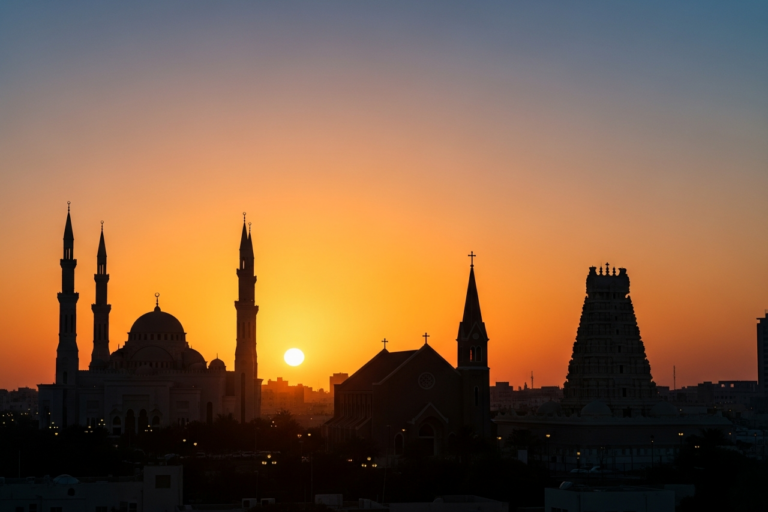
Key Highlights
Here are the key points about religion in Bahrain:
-
Islam is the official religion. Most of the citizen population is Muslim.
-
The constitution gives religious freedom. This helps many faiths live together in peace.
-
The main religions people practice are Islam (both Sunni and Shi’a), Christianity, Hinduism, and some other smaller faiths.
-
Non-Muslims can usually practice their religion freely. There are many places of worship like churches and temples.
-
The government supports religious tolerance. This makes Bahrain a good example of peaceful coexistence in the region.
Introduction
Let’s take a closer look at the religious landscape of Bahrain. This island country is in the Middle East. It shows how the old ways and the new mix together. Islam is the official religion in Bahrain. But the constitution of Bahrain gives people the freedom of religion. This means people can follow their own religious beliefs. You will find many people here who practice different religions without fear.
Are you wondering how this small nation deals with so many types of faiths? Come with me and let’s look into the lively and rich world of religion in Bahrain.
Overview of Religion in Bahrain
Bahrain is in the Middle East and is known for having people from many different faiths. Most of the total population follows Islam, but you can also find other religious groups here. There is a good-sized Christian community. Some people practice Hinduism, Buddhism, and other religions. Many of these groups are people who came to Bahrain from South Asia and other places.
Data from the World Religions Database shows that each religious group adds to the country’s mix of cultures and ideas. This overview looks at the religious make-up of Bahrain and how these groups get along. We will also talk about religious life in Bahrain and see how it has grown through the years.
Bahrain’s Religious Landscape in Context
Bahrain stands out from many other Arab countries because of its religious tolerance. People of different faiths have lived together in the country for many years. This way of life brings peaceful coexistence, and the leaders of Bahrain also support it. The country lets people be open about their beliefs, which is something that is not always seen in the region.
This feeling of acceptance makes the people proud. Leaders from different religious groups often talk with each other and join in different events to show respect. One person from the Bahrain Association for Religious Coexistence and Tolerance said the country is like a garden with many flowers. Each flower, like each faith, makes the garden more beautiful.
In arab states by the Gulf, Bahrain’s way lets non-Muslim people live and practice their faith openly. The strong commitment to religious diversity makes Bahrain different. Because of this, people often look at it as a good example of social harmony in the Islamic world.
Historical Development of Religion in Bahrain
The history of religion in Bahrain has many layers. Islam came in the 7th century. Since then, it has been the main faith in the country. Over many years, both Sunni and Shi’a groups grew here. These groups helped shape the culture and society of Bahrain.
As trade started to grow and then the oil business took off, Bahrain saw more people arrive from many places in the world, especially from South Asia. When these new people came, they brought their own religions. You can now find Christianity, Hinduism, and Sikhism in Bahrain. Over time, these faiths have grown and become a part of Bahrain’s life. This helped make Bahrain a mix of different religions.
The royal family has always played a big part in keeping this mix together. They have encouraged people from all groups to live side by side. The royal family set rules and systems so people can be tolerant and get along. This has helped keep peace among different faiths in Bahrain. Because of this, Bahrain stands out from other Islamic countries.
Major Religions Practiced in Bahrain
Bahrain is a place where you can find many big religions. Each group has its own strong community and different ways to show faith. Islam is the main religion in the country. But Christianity, Hinduism, and some other belief systems also have many followers. This mix of religions is a big part of life in Bahrain.
The religious leaders of these groups often meet and talk to each other. They join together in open talks and attend events about different cultures. Because of this, it is safe for people to take part in religious rites, and there is a spirit of respect among all. Next, we will look more at each group and see what they bring to life in Bahrain.
Islam as the Dominant Faith
Islam is the official religion of Bahrain. It is at the heart of the country’s way of life, rules, and culture. The country’s law says Islam is the only state religion. It also says that the fundamental beliefs of Islamic doctrine should stay safe. About 77.7% of people in Bahrain are Muslim. This number includes both full citizens and some people who have come from other places.
The government keeps an eye on the nation’s Islamic affairs. It uses different groups to make sure that any religious practice fits with the country’s values. The Shura Council, also called the Consultative Council, is a part of the legislative branch. What happens in this council shows the country holds its Islamic roots close. The state also helps run mosques and backs Islamic education.
This strong link between Islam and public life can be seen in many ways. It shapes things like national holidays and family law. For the people of Bahrain, faith is more than just a personal view. It is a key part of what brings them together and how their society works.
Sunni and Shi’a Muslims: Key Differences
Bahrain has two main groups of Muslims: Sunni and Shi’a. They both believe in the main ideas of Islam. But, there are some differences in their history, what they believe about their religious leaders, and the rules they follow. The Al Khalifa family, who rule Bahrain, are Sunni. But most Bahraini Muslim citizens are Shi’a.
These differences show up in daily life. For example, laws about personal status—like marriage, divorce, and inheritance—are not the same for everyone. Each group has its own courts for these things. Both Sunnis and Shi’as have their own places to pray, such as Sunni mosques and Shia mosques, and they celebrate some holidays in special ways.
Key differences include:
-
Succession: The biggest split happened because people did not agree about who should take over after Prophet Muhammad.
-
Religious Authority: Shi’as give more importance to their religious leaders called Imams, who they see as perfect guides for the faith. On the other hand, Sunnis look to decisions agreed on by groups of scholars.
-
Legal Interpretations: In Islamic jurisprudence, a Sunni woman might have different personal status laws from a Shi’a woman.
Christian Communities
Christianity has been in Bahrain for a long time. The community here is full of people from many different places. Most Christians are expatriates who came from other parts of the world. This has led to a mix of churches with different beliefs. You can find many places of worship in the country.
Some of the main groups are Roman Catholic, Protestant, and Orthodox. The Orthodox groups include Syrian Orthodox and Mar Thoma, which comes from South India. These churches are usually free to run their own community and worship as they think is best.
Having so many churches shows Bahrain’s strong religious tolerance. These places of worship are more than spiritual spots. They also act as meeting spaces for people. This helps expatriates hold on to their culture and faith while they live in Bahrain.
Hindu, Buddhist, Sikh, and Other Minorities
Bahrain is not only a home for Islam and Christianity. The country also has many other religious minorities. Many of these people come from south asia. One of the oldest groups is the Hindu community. They have been in Bahrain for over a hundred years. There are Hindu temples for this group. The most well-known one is in Manama.
Bahrain also has Buddhists, Sikhs, and Baha’is. These groups help make the country’s religious life richer. Most of these people are from south asia, and many are workers who moved to Bahrain with their families. The government lets them follow their faiths. People from these groups can go to their own places of worship. The government has said it is okay to build these places.
-
Hinduism: This group is mostly from south india, and they have at least one big temple that has been there for many years.
-
Sikhism: The Sikh community has a Gurdwara. This is where they pray and meet as a community.
-
Baha’i Faith: The Baha’i group is small, but the government knows about them and lets them have their own center.
Religious Demographics and Population Statistics
To get a good idea of the religious mix in Bahrain, you have to look at the census data. This data shows clear facts about different faiths in the country. There is a big difference between the citizen population, who are mostly Muslim, and the total population, which has many people from other countries with many religions.
These numbers help us see what is going on with people moving in and out of the country, and with culture and who people are in this Gulf country. In the next parts, we will talk more about the percent of Muslims, the number of people who are not Muslim, and how these numbers have changed over the years.
Percentage of Muslims in Bahrain
According to the most recent census data and estimates from the World Religion Database, Muslims make up the vast majority of Bahrain’s population. As of 2025 estimates, approximately 77.73% of the total population follows Islam. This figure includes both the local Bahraini citizens and a significant number of expatriates from other Islamic countries.
Within the Muslim population itself, there is a notable split between the Shi’a and Sunni communities. The data suggests that Shi’a Muslims constitute a larger portion of the Muslim population, though figures can vary depending on the source. Islamic studies are a mandatory part of the curriculum in public schools, reflecting the faith’s central role.
Here is a breakdown based on the World Religion Database (2025):
|
Muslim Group |
Percentage of Total Population |
|---|---|
|
Shias |
43.72% |
|
Sunnis |
34.02% |
|
Total Muslims |
77.73% |
Size of Non-Muslim Populations
The non-Muslim population in Bahrain is both large and mixed. It makes up almost a quarter of all people living in the country. The people in this group are nearly all foreigners who have come to Bahrain from other places. The World Religions Database says that Christians are the biggest non-Muslim religious group. They are about 12% of the total population.
After Christians, Hindus come next. They are more than 8% of the population, and most Hindus are from India. There are also people in Bahrain who are Buddhists, Baha’is, Sikhs, or Jews, but there are fewer of them. Still, each of these faiths helps make the culture in Bahrain bright and busy.
These religious groups are strong and well-organized. They each have their own places of worship and groups for social connection. There are many churches, temples, and other places of worship around Bahrain. This shows how many non-Muslim people there are and how active they are too.
Changing Demographics Over Time
Bahrain’s religious mix has changed a lot in the past few decades. This change is mostly because of strong economic growth and many people coming in to work there. In the middle of the 20th century, almost everyone in Bahrain was Muslim. But the arrival of workers from South and Southeast Asia, and other regions, has helped make the country open to more faiths.
Now, more people in Bahrain are Christian and Hindu. This new mix brings some challenges for the government. There are social and legal things to think about, especially with rules for family issues. For example, when it comes to child custody for family members who come from other countries and have a different religion, their cases are often decided by the laws of the country they are from, or through civil agreements. These cases may not go to the local Sharia courts.
Bahrain works with the international community, like the United States, and follows some international agreements. This has shaped the way the government manages growing diversity. The government needs to support people from many backgrounds and religions while still keeping its own traditions.
The Role of Religion in Bahraini Law and Government
Religion is a big part of Bahrain’s legal system and how the government works. The constitution says Islam is the state religion. It also lists Islamic law, or Sharia, as a main part of the rules that run the country. These beliefs shape everything from court laws to religious education in schools.
The government has to find a way to keep its Islamic traditions while meeting the needs of a political society with many different people, including a lot who are not Muslim. In the next parts, I will show what the constitution says about religion, how Sharia law is involved, and the way people’s beliefs connect to political and civil life in Bahrain.
Constitutional Provisions for Religion
Bahrain’s constitution tries to find the right mix between its Islamic roots and the need to protect religious minorities. Article 2 says very clearly that Islam is the state religion. Still, Article 22 says people have freedom of conscience, the right to worship, and the freedom to perform religious rites and hold religious meetings.
These rights for freedom of religion are important for people in Bahrain because the country has some different groups living there. These rules help non-Muslims practice their religion in the open without any worry. The constitution also says no one can be treated in a bad way because of their religion or what they believe. It tells people in Bahrain that all citizens have to be equal in front of the law.
But there is more to think about. The constitution also says that using these freedoms must not go against the fundamental beliefs of Islamic doctrine or cause problems in public life. In Bahrain, national identity documents do not usually say what a person’s religion is. This might help make religious differences less obvious in everyday life and government documents.
Influence of Islamic Law (Sharia)
Islamic law, called Sharia, is one of the main sources for new laws in Bahrain. It shapes the way the legal system works, especially when it comes to personal status. This includes things like marriage, divorce, inheritance, and child custody for people who are Muslim. The country has different Sharia courts for Sunni and Shi’a groups. These courts handle cases using their own ideas from Islamic jurisprudence.
The Ministry of Justice and Islamic Affairs is the one that runs the courts and makes sure these rules are used in the right way. When it comes to business or civil laws, these are based on more than one legal system. But the penal code also uses some rules from Sharia. For example, if someone does something against Islamic morals, they can be punished by law.
For those who are not Muslim, Sharia rules usually do not apply. When expatriates have issues about personal status, their cases are often decided by the laws of their own countries or by civil courts in Bahrain. Still, the whole legal system in Bahrain is built on its deep roots in Islam.
Religion in Political and Civil Life
Religion is closely linked to both politics and daily life in Bahrain. Many political groups and societies mainly serve either Sunni or Shi’a interests. This shows up in how people vote during parliamentary elections and can shape their political alliances.
Religious leaders have a lot of power in public talks and can encourage people to take part in social and political activities. The government knows this and often talks with religious leaders to help keep the country calm. But the government also keeps a close eye on political activities so that sectarianism does not grow and hurt national unity.
Religion also touches much of civil life. Many NGOs and community groups have a religious base, and they support their own communities in different ways. These groups do an important job for the public, but the government still checks and sometimes limits what they can do so that their actions fit the nation’s policy.
Religious Freedom and Legal Protections
Bahrain has a system for religious freedom that is built on legal protections set out in the constitution. The government is involved in watching over religious activities. These actions are done to make sure they fit with the country’s safety and keep public order.
This way of mixing freedom and rules is important in Bahrain’s human rights story. In the next parts, you will see how national laws protect religious practice. You will also learn about the government offices that have a role in watching these things. There is a process for places of worship to be registered. There are also some limits on what people can do with their religious activities.
National Laws Safeguarding Religious Practice
Bahrain has laws to keep religious freedom safe. These laws come mainly from the country’s constitution. Article 22 gives people freedom to follow their own beliefs and pray as they wish. This is the main rule that lets many religions and groups exist in Bahrain.
The country’s penal code says it is a crime to offend or insult religions that are recognized officially. This law tries to stop problems between different religious groups. It also helps people show respect for each other’s faiths. The Ministry of Justice has the job to make sure these laws are followed. They have to keep religious activities from causing trouble in the community.
But these laws can also be used to control what people say or do about religion. For example, the penal code defends recognized beliefs, but it may also make it hard for people to speak their mind if they criticize Islam. So, the government tries to protect religious practice in Bahrain, but it also controls it at the same time.
Government Oversight and Religious Organizations
The government of Bahrain keeps a close watch on religious groups and what they do. The Ministry of Justice and Islamic Affairs is in charge of this. It is responsible for watching over mosques, religious money, and teaching about Islam. For Muslims, the Supreme Council for Islamic Affairs helps decide on religious rules and gives guidance on fatwas or religious answers.
This control is not just for Muslim groups. Non-Muslim groups can do their work, but they usually have to sign up with a government office and the government will check what they do. The government says this control is needed to make sure religious groups do not start political activities that might upset the country. They also want to stop the spread of extreme ideas.
For many religious groups, government control is both good and bad. It gives these groups a way to be known and can keep them safe. At the same time, it can limit what they do on their own, how they raise money, and what they say in their talks or lessons. This is to make sure what they say and do matches up with what the state wants.
Registration of Worship Places
In Bahrain, if you want to set up places of worship, you need to register them with the government. For non-Muslim groups, this means you have to apply for a license or ask for land from the right authorities, like the Ministry of Justice and Islamic Affairs. You must go through this official process before you can build or run a church, temple, or any other center where people come to pray.
In the past, the government has been open to these steps. Groups like the Christian and Hindu communities have often gotten the support they need. One big sign of religious tolerance in Bahrain is that the country’s leaders have given land to help build these places of worship. That’s why now, you can find many churches and temples there.
But, there are times when getting registered takes a while. There can be paperwork or other hurdles set by the government. The government controls where these places of worship go, how big they can be, and how many you can have. This makes sure they fit with city plans and the country’s needs for safety. Even with these rules, the government has tried to respect and help the different religious groups that live in Bahrain.
Limitations and Permitted Religious Activities
Bahrain lets people take part in many types of religious activities, but there are clear limits. The government lets worship, lets religious education be done in community groups, and lets cultural celebrations take place. Still, the government controls things that can hurt public order or national unity.
The government does not let non-Muslims try to convert others. At the same time, changing to another religion from Islam is not called illegal in law. Religious leaders and their meetings are often watched by security services. They want to be sure that there is no political talk or speech that could start trouble between groups. Security forces step in when there are religious parades or protests that do not get permission first.
You can do allowed religious activities, but most of the time, these must be inside places of worship or in private homes. Some limits put in place are:
-
Political Speeches: The government says religious leaders cannot use their place for giving political talk against the government.
-
Public Processions: If there are big religious parades with the Shi’a group or any other, you have to get government permits and these parades are checked by the government.
-
Fundraising: Religious groups may not be free to raise money without checking. They want to be sure the money is not used for any political work.
-
Ad Hoc Decrees: The government can announce an ad hoc decree to stop certain gatherings, if they think it may be a risk to safety.
Interfaith Relations and Social Harmony
Bahrain puts a lot of focus on peaceful coexistence and getting along with all the different religious groups in the country. For many years, people in Bahrain have come from many backgrounds. They have lived and worked together. The people and the government keep this going with many plans and events that help everyone feel welcome.
Talking with each other about faith is a key part of what makes Bahrain special. In the next parts, we will look at how Sunnis and Shi’as live together in peace, how non-Muslims are part of life in Bahrain, and what the country does to help people from all walks of life build strong ties.
Coexistence of Sunnis and Shi’as
Sunni and Shi’a Muslims live side by side in Bahrain. This is a big part of life in the country, and it can sometimes be a little hard. For many years, these two groups have lived near each other. They often share neighborhoods, jobs, and what it means to be a Bahraini. You see sunni mosques and shia mosques close to each other. Many people in the same areas meet or talk to members of both groups every day.
Even though there are often political problems, people still mix with each other. Sometimes, members of the two groups get married, though it’s not very common. There are families that have both Sunni and Shi’a members. Day-to-day life ties people together, which helps lessen sharp divides and helps everyone feel they belong as Bahrainis.
But living together is not always easy. Politics can cause trouble between groups at times.
-
Shared Spaces: The people from both groups work together and spend time with each other in the same places.
-
Religious Observances: Shi’a have some special religious parades, but people from both groups show respect for each other’s main holidays.
-
National Identity: Many people in Bahrain think of themselves as Bahrainis first, before thinking about which group they come from. This helps them get along in daily life.
Non-Muslims within Bahraini Society
Non-Muslims are a well-integrated part of Bahraini society. They work mostly in the economy, making up a big part of the expatriate group. They live and work with their Muslim neighbors, and there is generally peaceful coexistence. Members of the Christian, Hindu, and other groups can be seen in malls, homes, and jobs all over the country.
The government has a policy of tolerance. This lets non-Muslims practice their faith without being afraid. This welcoming way makes Bahrain a good place for foreign workers and professionals. People can go to church, visit a temple, or join in special events for their community. This gives them comfort and helps them feel stable.
Even if they are guests in the country, many non-Muslims say they feel safe and respected. Everyday moments between the different groups are mostly friendly. This helps Bahrain be known for being one of the most open places in the Gulf region.
Interfaith Events and Initiatives
Bahrain works hard to help people from different religions talk and understand each other. Many events and programs are set up to bring people together. The royal family and government bodies support and take part in these. They see keeping peace between religions as very important for the country. One well-known group is the Bahrain Association for Religious Coexistence and Tolerance. This group helps bring leaders of many faiths together.
The main goal of these projects is to help people get along and show respect to each other. There are conferences, cultural meetups, and religious events with leaders from different backgrounds. For example, leaders from Islamic, Christian, and Hindu religions talk at forums about common values and problems.
These steps show that Bahrain is serious about letting people from the country believe what they want.
-
Leadership Dialogues: Dr. Hong Tao-Tze of FOWPAL met with Bahrain’s religious leaders to talk about peace and tolerance. This shows that people all over the world are interested in how Bahrain runs things.
-
Peace Forums: Religious leaders come together for peace forums and culture events, so people can understand each other better.
-
International Recognition: The UN passed a resolution, led by Bahrain, for an “International Day of Conscience.” This proves that the country’s efforts are noticed all over the world.
Non-Muslim Religious Sites in Bahrain
Bahrain stands out in the Gulf because there are so many non-Muslim places of worship. Many people from other countries live here, and these sites are for them. These places are where people go for faith and to be with others from their community. The fact that these sites are here shows Bahrain values religious tolerance and has allowed this for years.
In Bahrain, you can find old Christian churches, Hindu temples, and even a synagogue. These places show that people who live here can worship how they want. The next parts will show you more about these sites and talk about the many different faiths that make their home in the kingdom.
Churches and Chapels
Bahrain has many churches and chapels. These places of worship serve a large Christian group that is very mixed. There are big cathedrals that were built for this reason. There are also small chapels made for certain groups. Most Christians in Bahrain are people who moved there from other countries. There are roman catholic, protestant, orthodox, and evangelical believers here.
The Sacred Heart Church is a roman catholic parish. It started in the 1930s. It is one of the oldest and most well-known churches in the Gulf. St. Christopher’s Cathedral is an Anglican church. It became the main place for that group in the middle of the 1900s. These historic churches show that Christians have been in Bahrain for a long time.
Besides these bigger churches, there are many other groups that meet in their own buildings or share spaces. These churches are more than places to meet and worship. They also help people by offering schools, social services, and community support to their members.
Hindu Temples, Synagogues, and Other Sites
Bahrain is home to many churches, but it also has some key places that are important to people who are not Muslim. The most famous is the Shrinathji Temple in Manama. This Hindu temple is one of the oldest in the Gulf. It has been here for over 200 years and serves the Hindu community, most of whom came from India. The temple is a busy spot for both prayer and events tied to their culture.
There is something special about Bahrain in the Gulf, as it also has a small and old Jewish community. There is a synagogue in the capital city. Even though the group of Jewish citizens is small, this site is kept as a way to honor Bahrain’s rich and mixed history. In recent times, there has been more work to fix up the synagogue. People are also starting to talk more about what Jewish people, including a Jewish member of the Shura Council, have given to Bahrain’s past.
-
Hindu Temples: The main holy place for Hindus in Manama is well-known in Bahrain. There are now plans to build an even bigger temple.
-
Sikh Gurdwara: The Sikh people have their own holy place, called a Gurdwara. It is there to support the group and help them do what they need to do.
-
Jewish Synagogue: There is a synagogue in Bahrain. It might not always be busy, but it shows how different the country is. At one time
Recent Developments in Building Non-Muslim Places of Worship
In recent years, Bahrain has kept up its support for non-Muslim groups. The government has approved new places for them to worship. One of the biggest signs of this is the new Cathedral of Our Lady of Arabia. This huge Roman Catholic church was built on land given by the king. It is now one of the largest churches in the Gulf. It gives the region’s Catholic people a place to come together.
The Hindu community in Bahrain also got good news. They received both a go-ahead and land for a new temple complex. This new temple will be bigger than the old one in Manama’s old market area, which has become too small. The government mentions these actions when it talks about religious freedom and its promise to include all people.
These projects happen with help from the government. Many areas, like the Ministry of Justice, work together to sort out permits and get everything approved. The fact that the government gives land and support for these big projects shows how much it wants to meet the needs of its many different people. It also helps Bahrain build up its good name for tolerance and openness.
Religious Holidays and Cultural Celebrations
Bahrain has a calendar full of religious holidays and cultural events. These events show how diverse the people are in this country. The government makes sure Islamic holidays are national holidays, but it also lets people from other faiths celebrate their own festivals. This helps create a lively and welcoming place for all.
You can see both special religious days and fun celebrations all year long. This is part of what makes living in Bahrain feel unique. In the next parts, you will learn about big Islamic holidays. You will also read about how non-Muslim festivals are honored and how the government helps with many religious events.
Islamic Observances and National Holidays
Islamic events are a big part of Bahrain’s yearly calendar. The main dates are public holidays for everyone in the country. These days honor important moments in the Islamic faith. People in the Muslim community pray, spend time with family, and do charitable acts.
The biggest celebrations are Eid al-Fitr, which happens after Ramadan, and Eid al-Adha, known as the festival of sacrifice. Some other key Islamic days are the Islamic New Year and Ashura. Ashura is a very special day of sorrow for Shi’a Muslims and brings large public processions.
These holidays started from the Islamic tradition, but now they are part of the country’s culture. Their celebration changes the everyday life of all people there.
-
Eid al-Fitr: A happy time after fasting for a month.
-
Eid al-Adha: Remembers sacrifice and comes when the Hajj journey takes place.
-
Ashura: A serious day to honor memories, especially for Shi’a Muslims.
-
Prophet’s Birthday (Mawlid): Many Muslims celebrate this day by thinking and reflecting.
Non-Muslim Festivals and Their Recognition
Although these are not public holidays, non-Muslim festivals are well known and celebrated in Bahrain. The country is open and lets people from other places live by their own religious and cultural ways with happiness. You can see this during the big times like Christmas and Diwali.
When it is Christmas, malls in Bahrain put up lights. Hotels also have special Christmas brunches. The Christian people get together at their churches for services and other fun times. For Diwali, also called the “Festival of Lights,” the Hindu people spend time with their families, share sweets, and light up lamps. Many shops and restaurants also get in on these happy days.
Letting these festivals get noticed out in the open and even in stores helps make things friendly for everyone.
-
Christmas: You see this holiday in malls and with people who are Christian.
-
Diwali: The Hindu day of lights means families and special events take place.
-
Other Festivals: Some smaller groups, like the Buddhists, celebrate things like Vesak at their places with their own people.
Government Support for Religious Events
The government of Bahrain gives help for religious events in many ways. This shows its policy of religious tolerance. The support can be about giving security at big public gatherings, or it can be about officials coming to celebrations to show respect and unity.
When there are big Islamic religious events like the Ashura processions, the government works with the event organizers to keep everyone safe and make sure things run smoothly. The government manages traffic, uses security services, and makes sure the events happen in a peaceful way. This kind of help is very important, especially for big events.
For communities that are not Muslim, the government’s support is more quiet but just as important. The government gives permits for events. They make sure the people can get to their places of worship during important festivals. There are also public comments from leaders that talk about how important these celebrations are to the communities. This official support helps protect and make these religious events real.
Education and Religion in Bahrain
Religion plays a big role in Bahrain’s education system, especially in public schools. The ministry of education is in charge of making a school plan that has required religious studies for Muslim students. This matches with the country’s Islamic background. The goal is to help young students learn the main ideas of their religion.
But, Bahrain schools also have to think about many students from different backgrounds and faiths. In the next parts, we will talk about the religious lessons in public schools, what choices there are for students in minority groups, and how international schools help bring more religious variety.
Religious Curriculum in Public Schools
In Bahrain’s public schools, students learn about Islam in their religion classes. All Muslim students, from first grade to high school, have to take these classes. The ministry of education makes and checks the curriculum for these courses. Students learn the main beliefs of Islam, the life of Prophet Muhammad, and what is right and wrong in the Islamic way.
Islamic studies in public schools follow the Sunni point of view. The ruling family is Sunni, and the state sees this as its main faith. Some Shi’a people in Bahrain think their beliefs are not shown well in these classes.
Students who are not Muslim usually do not have to attend these classes.
-
Mandatory Subject: All Muslim students in public schools must take islamic studies.
-
Curriculum Content: Classes teach the Quran, Hadith (sayings of the Prophet), and how to act based on Sunni beliefs.
-
Family Education: Some lessons, like those in grade 10 about family, are taught using Islamic beliefs.
Options for Minority Students
Minority students in Bahrain have different ways to learn. They can go to public schools. In these schools, they do not have to take islamic studies. Most families who are not Muslims, or who are from other countries, would rather send their kids to private schools. The country offers a lot of private schools for many kinds of people and learning styles.
Many private schools are made for certain groups. For example, you have the Indian School. Another school is St. Christopher’s School, which follows the British plan. These schools match the culture and belief that students and their families have. Instead of islamic studies, they may teach moral or ethics classes.
The strong private school choice helps minority students get good schooling. They do not need to fit into the public system that mostly meets the needs of Muslim students. Families find it easier to pick a school that goes with what they value and believe.
International Schools and Religious Diversity
International schools in Bahrain help manage and celebrate different religions. These schools have many students from different countries and backgrounds. Because of this, they are very multicultural and have people of many religions.
Most of these schools use a way of teaching that is open to all. They might give classes about different religions or about how people can get along. The focus is on helping students see and respect all faiths. This gives the students a chance to learn about each other’s traditions. It helps them get used to a culture of tolerance when they are young. When there are big festivals like Christmas, Diwali, or Eid, everyone in the school usually takes part.
These schools offer education that is good for the world stage and for the people who have moved to Bahrain. They also help Bahrain reach its goal of peaceful coexistence. These schools are a small reflection of Bahrain’s diverse society. They get the new generation ready to do well in a world where people are from many backgrounds.
Bahrain’s Approach to Religious Diversity Compared to Other Gulf Countries
Bahrain treats people from different religions in a way that’s often called more open than other Gulf countries. In arab states, Islam is the official religion. But not every country gives the same freedom to people who are not Muslim. Bahrain has had groups from different religions being officially recognized for more time than its neighbors.
Looking at Bahrain compared to other arab states gives a bigger picture for its policies. Next, we will talk about the rules that protect minorities in the region. We will also compare Bahrain to saudi arabia, the UAE, and Qatar. After that, we will show some steps Bahrain has taken to support tolerance.
Legal Protections for Religious Minorities in the Region
Legal protections for religious minorities are not the same across the Gulf. In some places, people who are not Muslim have to keep their faith private. They cannot show it in public. In other countries, there is a better system in place. Here, people from different religions have more rights and help from the state.
Bahrain, the UAE, and Qatar all have laws that say people can build places of worship and practice their faith if their religion is recognized. This is not how it works in Saudi Arabia. In Saudi Arabia, it has been the rule that there are no public non-Muslim places of worship.
-
Bahrain: The constitution says people should have freedom of conscience and worship. So, you can see churches and temples here.
-
UAE: The UAE acts much the same way. There are many churches and temples. The country even chose a minister for tolerance.
-
Saudi Arabia: Public non-Muslim worship is not allowed in Saudi Arabia. Still, there has been some slow change because of new social rules.
People in these countries face very different situations when it comes to where and how they can follow their faith, build a place of worship, or talk about freedom of conscience. This is most clear when you think of Saudi Arabia and what rules are in place for non-Muslim people.
Comparative Analysis with Saudi Arabia, UAE, and Qatar
A comparative analysis shows that while Bahrain, the UAE, and Qatar share a similar path of official tolerance, there are key differences. The United Arab Emirates has recently been very vocal in promoting its model of tolerance, hosting the Pope and opening an interfaith complex. Qatar also allows churches on government-donated land but is generally seen as more conservative than Bahrain or the UAE.
Saudi Arabia remains the most conservative in the region, although it has made recent strides in promoting interfaith dialogue and curbing extremist rhetoric. However, it still lacks the public places of worship for non-Muslims that are common in the other three countries.
Bahrain’s approach is distinguished by its long history; its oldest church and temple predate the modern statehood of its neighbors.
|
Country |
Public Non-Muslim Worship |
Government Stance |
|---|---|---|
|
Bahrain |
Allowed and historic |
Actively promotes tolerance |
|
UAE |
Allowed and expanding |
High-profile tolerance initiatives |
|
Qatar |
Allowed in a specific complex |
Permitted but less public |
|
Saudi Arabia |
Not permitted publicly |
Slowly opening to dialogue |
Notable Initiatives Advancing Tolerance
Bahrain has started many big projects to show the world that it is a place of tolerance and peaceful coexistence. One of the main steps is setting up The King Hamad Global Centre for Peaceful Coexistence. This center works to support religious freedom and help people from different faiths talk to each other. It holds events and prints out materials about how people can live together in peace.
The country is active in the United Nations too. It helped make April 5th the “International Day of Conscience” after working with others to pass a special rule. This shows that the government wants to share its idea of people living together in peace with the rest of the world. Many other countries, like the United States, see these steps as good work for human rights in the region.
Inside Bahrain, the government also supports building new and large places of worship. There is a new Catholic church, which shows a visible example of how religious freedom is supported. These projects are meant to make it clear that different groups are welcome. This shows that Bahrain is ready to support its people no matter where they come from or what they believe.
Conclusion
To sum up, Bahrain is a country where many religions are found. The people live together in peace and respect each other’s beliefs. Most of the people there follow Islam, but you also see Christians, Hindus, and other groups. Bahrain is different from some of its neighbors in the Gulf because it allows people from all backgrounds to practice their faith. There are laws in place to protect these rights.
When you visit Bahrain, it is important to see and understand the things that make its culture special. If you want to know more about how people in Bahrain practice their religion, or if you plan to see some beautiful places for non-Muslims, you can reach out for a free consultation.
Frequently Asked Questions
Is Bahrain safe and welcoming for non-Muslims?
Yes, Bahrain is seen as safe and friendly for non-Muslims. The government works to help people live together in peace. It protects religious freedom. People who move there can freely follow their own faith. This focus on peaceful coexistence is an important part of the country’s human rights policy. It helps make life better for both the people who live in Bahrain and those who come from other places.
Are there any restrictions on religious practices in Bahrain?
Yes, the government does protect religious freedom. But, there are some limits. The government sets rules for religious activities to keep public order. Non-Muslims are not allowed to try to convert others. The penal code says you must not say things that insult religion. Security services watch religious gatherings. They do this to make sure things do not turn political or hurt a certain group. This helps to stop any problems before they start.
How are religious minorities treated in Bahrain?
Religious minorities in Bahrain usually get respect and protection by law. The government helps keep peace in the community and makes sure non-Muslim groups can follow their faith. This means that the government lets places of worship be built and tries to create a space where people accept and live with others.



