

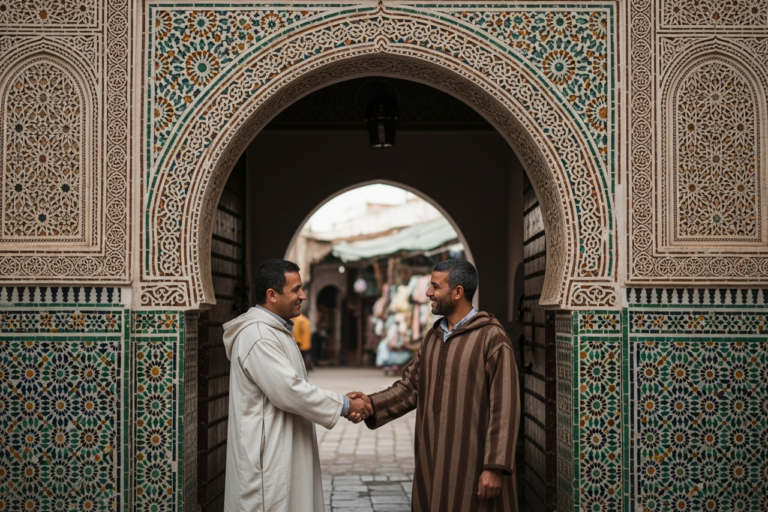
Key Highlights
Here are the main points you should remember from this guide about greeting people in Morocco:
-
The greeting “Salam alaikum” is used the most in Morocco. People often say “Salam” when speaking in casual settings.
-
In moroccan culture, it is good to ask follow-up questions like “Ki dayr?” (How are you?) after you greet someone.
-
The way you greet people can change. It depends on things like gender, age, and the type of relationship. Handshakes and kisses are more common with people of the same gender.
-
People do not only use moroccan arabic (Darija) when saying hello. In rural areas, you also hear Berber (Amazigh) greetings.
-
Always use your right hand when you greet someone or make a gesture. The left hand is not clean in moroccan culture.
-
People think it is very important to show respect, especially to elders, as part of the greeting way in morocco.
Introduction
Welcome to the exciting world of Moroccan culture! If you want to visit Morocco, knowing how to say hello is a great way to meet people and show that you care about their traditions. A simple greeting can open doors for new friends and show that you respect the local ways. In this guide, you will learn the different ways people greet each other in Morocco. You will see common words in Moroccan Arabic and also learn about the small things they do, like non-verbal gestures. This is a good way to get to know their life better. Get ready to make your trip better by learning these greetings and enjoying what Moroccan culture is all about.
Common Ways to Say Hello in Morocco
In Morocco, people usually say “Salam alaikum” when meeting someone. It means “peace be upon you.” You will hear this greeting a lot in Morocco. Many say a shorter form, “Salam,” when talking with friends or in day-to-day life. This greeting is simple and works well in almost every situation. It is both friendly and respectful.
If you learn a few words in Moroccan Arabic, which is also called Darija, it will help you a lot. There are different ways to greet people, and using these shows that you care about the local culture. The people in Morocco will notice this. These small things do not take much, but they go a long way and help you have real talks with locals.
Traditional Moroccan Arabic Greetings
The main way to greet people in Moroccan Arabic is by saying “Essalamo 3alikom.” This is the formal and full way to use the word “Salam.” When someone says this to you, the right answer is “Wa 3alikom essalam.” This means “And peace be upon you, too.” This greeting shows politeness in Darija and is used often.
In Moroccan Arabic, people say different things at different times of the day. These words help you connect better and sound more like you know the language.
-
Good morning: “Sba7 elkhir” or “Sba7 ennor”
-
Good evening: “Msa elkhir” or “Msa ennor”
If you use these greetings at the right time, you show respect and that you care. For example, when you walk into a store in the morning, you can say “Sba7 elkhir” to start a friendly talk. People will like that, and it is easy to learn. This is a simple way to show you know some moroccan arabic, and it is a good way to get smiles from others. Using salam and other polite phrases helps build a good feeling in every day talks.
Popular Berber (Amazigh) Greetings
While a lot of people in Morocco speak Moroccan Arabic, the Berber (Amazigh) languages are a big part of moroccan culture. You will hear them most in rural areas and in mountain places, like the Atlas Mountains. If you travel to these parts of morocco, you may notice the greeting words sound different from the common darija ones. Picking up a few Amazigh greetings can help you connect with the people there.
The greetings you hear can be different, depending on which local tamazight (the Berber language) dialect people speak. But just like in arabic, saying hello and greeting someone means a lot to people. A greeting is something you can always use.
-
One berber way to say “hello” or “peace be upon you” is “Azul.”
-
If you want to ask “how are you,” you may hear “Manza gin?”
Saying these words is a good way to show you care about the rich languages in moroccan culture. Don’t be shy—trying these greeting words will make most people happy, and your effort to notice Amazigh culture will make your talks even better.
Everyday Greeting Etiquette in Morocco
Knowing the right way to greet someone is just as important as the words you use. In Moroccan culture, a greeting means more than saying hello. It is an important way to connect with people and show respect. Taking the time to greet someone in the right way is a kind act. People really value this in their daily life.
When you meet locals, greetings often do not stop at just a quick hello. People will ask questions about how you are, as well as about your family. This back-and-forth shows real care and is an important part of local culture. By following this greeting, you make it easier to get along with people and fit into the way of life in Morocco.
Greetings Between Friends, Family, and Strangers
The way people greet each other in Morocco depends on how close they are. When it is between close friends or family members, the greeting is often warm and open. There is usually a hug or a kiss on the cheek. After the first “Salam,” people ask questions that show they really care.
In everyday life, these extra questions are important. After saying hello, people like to ask how you are feeling, about your family, and how your kids are doing. This shows real care and helps build a strong bond.
-
How are you?: “Ki dayr?” (for a man) or “Ki dayra?” (for a woman)
-
Are you well?: “Labas 3lik?”
-
What about the family?: “Mmaline eddar?” or “El3a2ila?”
When people greet strangers, things are more simple. You just say “Salam,” maybe nod your head or give a handshake if you are both men. Knowing these small details helps you leave a good impression in everyday life.
Handshakes, Kisses, and Gestures—What’s Polite?
Non-verbal communication plays a huge role in Moroccan greetings. Politeness is conveyed not just through words, but also through gestures like handshakes and kisses. However, the rules for these can be complex, especially concerning gender. Generally, a handshake is a common and polite form of greeting, particularly between men.
When shaking hands, use your right hand, as the left hand is traditionally considered unclean. The handshake should be gentle, not firm. After shaking hands, some people may touch their heart with their right hand as a sign of warmth and sincerity. Kisses on the cheek are common between close friends and family members of the same gender, but are not typically exchanged between men and women in public unless they are close relatives.
|
Gesture |
Who It’s For |
Context |
|---|---|---|
|
Handshake |
Men with men; sometimes women with women. |
Formal or informal meetings. A man should wait for a woman to extend her hand first. |
|
Cheek Kisses |
Close friends and family of the same gender. |
Informal, warm greetings. Usually involves two to four kisses, starting with the left cheek. |
|
Hand on Heart |
Anyone |
A sign of sincerity and respect, often used after a handshake or as a non-contact greeting. |
Gender and Respect in Moroccan Greetings
Yes, gender matters a lot when it comes to how people greet each other in Morocco. In Moroccan culture, there are clear ways that men and women say hello. These ways are shaped by old customs and being respectful. If you are a visitor, it is good to know about these things. This will help you not feel strange or show disrespect by mistake.
Most of the time, you will see that men and women in Morocco do not touch each other in public if they are not family. This does not mean that people are not friendly. It is just the way it is in Morocco. If you want to fit in and follow the rules in Moroccan culture, you need to know and follow these lines between men and women. The next parts will talk more about how greeting works in Morocco.
Greeting Men vs. Women and Elders—Key Differences
Men usually greet each other with a handshake. Sometimes, they put a hand on their heart after they shake hands. If two men are close friends, they may also give a quick kiss on the cheek. For women, cheek kisses are a common way to greet other women, especially with friends or in family. People can give one or more cheek kisses, but this is seen as a simple and usual sign of caring.
When a man greets a woman in Moroccan culture, things are a bit more careful. A spoken greeting and a nod is always a good idea. A man should not try to shake her hand unless she reaches out first. If she does not want to shake hands, he should put his hand over his heart. This is a respectful way to say hello.
In Morocco, people show a lot of respect for elders during greetings. If an elder walks in, you should stand up if you are sitting down. You should speak to them in a kind, polite way. Sometimes, people even kiss an elder’s hand or forehead to show deep respect. You always want to use a soft and respectful tone with older people.
Moroccan culture puts a big focus on greeting in a polite and caring way.
Responding to Greetings and Making Conversation
Knowing how to answer a greeting is as important as knowing how to start one. In Morocco, it is good to respond in the right way, as this helps the talk continue. It also shows you are part of the chat. When someone in Morocco greets you by saying “Salam alaikum,” the right response is “Wa alaikum salam.” In a casual setting, if someone says “Salam,” you just answer with “Salam.”
After these first words, people often ask about your well-being. It helps to have some simple replies ready in Moroccan Arabic. This will make it easy for you to join in and make a good impression. Now, let’s look at some common phrases and ways to keep your talk going in both casual settings and when using Moroccan Arabic.
Typical Replies in Moroccan Arabic and Berber
When someone asks you “Ki dayr?” or “Labas 3lik?” (How are you?), it helps to know what to say back. The most used and kind way to reply is “Labas, el7amdo lillah.” It means “Fine, praise be to God.” People say “el7amdo lillah” a lot in daily life because it shows you feel thanks for what you have. If you want to keep it simple, you can just say “Labas” (Fine).
After you answer, it’s good to ask how they are too. If you talk to a man, say “W nta?” (And you?). If you talk to a woman, say “W nti?” (And you?). This lets them know you care about their well-being.
-
Question: “Ki dayra?” (How are you? – to a female)
-
Response: “Labas, el7amdo lillah. W nta?” (I am fine, praise be to God. And you? – to a male)
When you are with people who speak Berber, someone may ask “Manza gin?” (How are you?). You can answer with “Labas.” You can also say the Arabic answer “Labas, el7amdo lillah” because most people get what you mean. You do not need to stress about how good your pronunciation is. People will like that you try.
This is how
Friendly Phrases to Continue a Greeting
After you share the first “how are you” with someone, Moroccan greetings often turn into a nice talk about life. Using a few more phrases in Moroccan Arabic can help make the conversation more real and warm. These words show that you really care. They are also good for turning a normal greeting into a good chat.
One popular phrase is “Kolshi bikhir.” This means “Everything is fine.” People use it to let others know that all is going well, or as a question—”Kolshi bikhir?”—to ask if everything is okay. It’s a useful line. You can say and hear this phrase in many friendly talks in Morocco.
To keep things lively, you can add some of these lines to your greeting in Moroccan Arabic:
-
Neharek mebrouk: Have a blessed day.
-
Rebbi ikhellik: May God protect you. (This is often said as a way to thank someone.)
-
Ash kat3awd? / Ash kat3awdi?: What’s up? / What have you been up to? (for a man / for a woman)
Saying these greetings in Moroccan Arabic, with a real smile, will help grow your travel lust. You will find that you connect better with other people while you are there.
Mistakes to Avoid: Greeting Dos and Don’ts
Moving to a new place always has a learning curve. It is common to make small mistakes. When you are in Morocco, it helps a lot to know the right way to greet people. There are some dos and don’ts in greeting in Morocco that you should know to avoid any awkward times and show respect. People in Morocco value being polite, and having a bit of this knowledge will go a long way.
You do not have to be perfect. You just need to be careful. There are simple steps, like knowing which hand to use or how to have physical contact when greeting. These simple things can make a big difference. Now, let’s talk about common greeting mistakes in Morocco and what to avoid, so you can feel good in your talks with others.
Common Faux Pas and Polite Practices
One common mistake people make when they visit is using their left hand when meeting others. In Moroccan culture, and many Muslim cultures, the left hand is used for things like cleaning yourself, so people see it as not clean. You should always use your right hand when you shake hands, give or get something, and when you eat.
Be careful with touching people of the other gender. It is best not to start any touching like handshakes or hugs if the other person is not the one to start it. This is extra important if you are with people who are conservative or when you are in a formal place.
-
Do: Greet people with a warm “Salam” and a smile.
-
Don’t: Rush when you say hello. Take time to ask how people are.
If you practice this in your planning stages, it can help you get ready. When you are in casual settings, most people know that you are a tourist and will forgive little mistakes. Still, when you try to do things the Moroccan way, people see and like it.
Greetings to Avoid in Morocco
Moroccans welcome guests, but the way you greet people in Morocco is important. Try not to be too close or friendly right away. If you just met someone, it is not right to jump to kissing on the cheek. It is better to use a simple greeting or give a handshake. Use a handshake only if it feels right for the moment. Get to know the person first before being more friendly.
When you are meeting people, do not be too loud or act over the top. This is important, especially if you are in rural areas or someplace quiet. Staying calm and showing respect is the best way. A handshake is good but do not make it too strong. In Morocco, people like a lighter handshake.
-
Avoid: Using words or jokes from your culture if they are too relaxed or may not make sense.
-
Avoid: Asking for help or talking about what you need from someone right away. Start with a kind greeting first.
When you follow these tips, talking with people in Morocco will be much easier and show that you respect them. Whether you are in a big city or in the rural areas and desert, showing good manners in your greeting can give you a better time on your trip.
Conclusion
To sum up, it is good to know how to greet people in Morocco. It helps you have a nice and respectful time. There are warm greetings in Arabic and Berber. You will also notice some rules in the way friends, family, and even strangers say hello. When you pay attention to the right way to greet, you get to build better links with people. Remember, greeting in Morocco can change by gender and out of respect, so you need to watch out for these things. As you meet more people, think about what you should—or should not—do so you do not make any mistakes. If you join in with the greeting style in Morocco, you will get more out of your trip and show you care about their many traditions. Enjoy your travels!
Frequently Asked Questions
Is it respectful to shake hands with everyone in Morocco?
A handshake is a normal greeting in Morocco, but it is not given to all. Men in Morocco shake hands with other men most of the time. When a man wants to greet a woman, he should let her reach out her hand first. If she does not do that, it is fine in moroccan culture to nod and place your hand on your heart. This is another way to show respect as a greeting in morocco.
What greeting should I use with elders or respected people?
When you greet older people in Morocco, it is good to show extra respect. Say a polite word like “Salam alaikum.” Some people in Morocco also kiss an elder’s hand or forehead to show they care. As a visitor, you can use a warm voice and give a small nod. This is a nice and polite way to greet someone.
Are there any greetings specific to different regions in Morocco?
Yes, people use different greetings in different parts of Morocco. Moroccan Arabic is used in many places, but in some rural areas, like the Atlas Mountains, you may hear Berber greetings instead. For example, in many Amazigh groups, people say “Azul” to say hello. Using these greetings in those rural areas shows you know and care about their culture.
Moroccan Arabic and the local Amazigh greetings are both a part of daily life in these rural areas.



