

Key Highlights
-
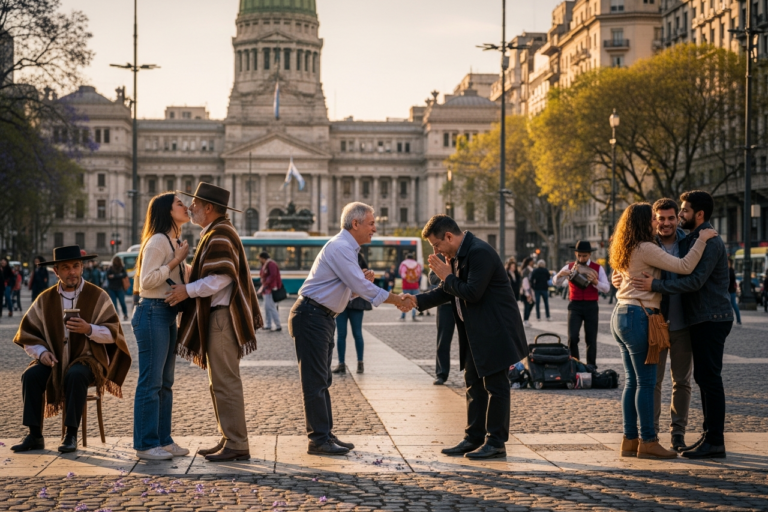
People in Argentina often greet each other in a very warm way. This is an important part of the culture and can mean some physical contact.
-
The most common greeting is one kiss on the right cheek, even if you do not know the person.
-
In formal or business meetings, a handshake is the greeting that Argentinians use.
-
Friends will use informal slang when greeting, such as, “¿Qué onda?” or “¿Qué hacés, che?”.
-
Argentinians say “vos” and not “tú” for the word “you,” so this makes the verb form different when they speak.
-
It is just as important to say goodbye as it is to say hello. To say goodbye, people usually say “chau,” and may also give a friendly cheek kiss.
Introduction
Are you thinking about a trip to Argentina? If you are, knowing the local customs is a great way to get close to the people there. People in Argentina are warm and friendly. Greeting someone is an important part of argentine culture. It is more than a simple hello. It is a common greeting that shows you respect and care about the other person. The argentine way of saying hello might be different from what you are used to. It can feel more personal. With this guide, you will learn how to greet people in argentina. You will know just what to do to make a good first impression and feel welcome wherever you go.
Understanding Greeting Customs in Argentina
In Argentina, greetings are a big part of how the people of Argentina show they are warm and like to be with others. It is not like some places where a handshake or a simple nod is enough. Here, people want to have more close contact when they meet, and this is normal for both men and women. They do it with friends, family, or even someone they just got to know.
You will see these ways of saying hello in every part of the country, from big cities to small towns. If you learn some basics of Spanish, like argentine Spanish, and also some main rules people follow, it will help you a lot. This will let you walk into new places and get along with people fast. It also shows that you have respect for their ways. Now, let’s see why greetings mean so much here, and how things can be different if it is a formal or a casual time.
Why Greetings Are Important in Argentine Culture
Greetings are very important in Argentine culture. They help people feel close and welcome right away. It shows good manners to greet everyone at a social gathering, even if you do not know all of them. If it is your first time meeting someone, a good greeting helps you have a better start and makes the whole talk go well. For Argentinians, taking the time to say hello is a way of showing you see and respect the people around you.
When it comes to formal times, the greeting may be a bit more careful or serious. But it is still just as important. Saying a proper hello shows that you have respect and know how things should be done. When you are with friends or at a family barbecue, the greetings are much more relaxed, warm, and can be even more physical. This lets you see how close people can be with each other. If you skip the greeting, it can look rude, so it is best to learn this custom as soon as you can.
No matter if you go to a business meeting or join a barbecue, the way you say hello matters a lot. Greetings are a big part of the culture. They help every meeting start with a friendly welcome and good feeling.
Key Differences Between Formal and Informal Greetings
Knowing when to use a formal or informal greeting is key to navigating social interactions in Argentina. The context of the situation and your relationship with the person will determine the appropriate way to say hello. A formal situation, like a business meeting with a new business partner, typically calls for a firm handshake. It’s a sign of professionalism and respect.
On the other hand, informal settings with friends, family, or even new acquaintances in a casual environment are much different. Here, the cheek kiss is the standard greeting for both men and women. It might feel unusual at first if you’re not used to it, but it’s a very common and friendly gesture. Using an informal greeting in a formal setting, or vice versa, can create an awkward moment.
To help you understand the difference, here is a simple guide:
|
Situation |
Common Greeting |
Who It’s For |
|---|---|---|
|
Formal |
A firm handshake |
Business partners, new professional contacts, older individuals |
|
Informal |
A single cheek kiss on the right cheek |
Friends, family, acquaintances, people your age, often even strangers in social settings |
Common Ways to Greet Someone in Argentina
When you get to Argentina, you will see there are many different ways to say hello. One way people greet each other all over the country, from busy Buenos Aires to small towns, is with some kind of physical touch. This is a warm and friendly thing people do. It helps you feel welcome right away.
Saying “hola” is always fine, but many locals use other words and gestures too. If you learn these, you will feel good and make stronger connections with the people there. Next, let’s go over the main words and gestures you should know when you want to give a greeting in Argentina.
Saying Hello and Goodbye: Essential Phrases
While gestures do matter, it is good to know some words in Argentine Spanish. The most important and simplest word is “hola,” which means “hello.” You can say it in almost every kind of meeting. When you want to leave, people often say “chau.” This comes from the Italian word “ciao.” People use “chau” when talking regular or very proper too.
If you want to greet someone based on the time of day, say “buenos días” for “good morning.” Use “buenas tardes” for “good afternoon.” At night, say “buenas noches” for “good evening.” Many times, you will hear Argentinians say just “buenas.” This short greeting can be used at any time of day. When you listen, you may hear the pronunciation stretch out the first part, like “bueeeenas.” It helps people sound warm and friendly.
Here are some phrases you should know, if you want to speak the Argentine way:
-
Hola: The all-purpose “hello.”
-
Buenas: A casual greeting suitable for any time of day.
-
¿Qué hacés, che?: An informal “Hey, what’s up?” (“Che” is a very Argentine way to say “hey” or “pal”).
-
Chau: The standard way to say “goodbye.”
-
Nos vemos: A common way to say “see you later.”
Popular Gestures: The Cheek Kiss and Beyond
The most common way to greet someone in Argentina is with a cheek kiss, called a “beso.” People do this with friends, family, and even when meeting someone for the first time in a social place. You just give one, light kiss on the right cheek. Don’t worry about it being a real kiss. Most of the time, it’s just touching cheeks and making a soft kissing sound. This greeting shows warmth and it is seen as good manners.
Everyone uses this custom in Argentina. Women greet both women and men with a kiss on the cheek. Men also greet other men this way. If you try this for the first time, it may seem new or even a bit much, but you get used to it. Not giving a cheek kiss can look cold or distant to Argentinians.
Besides the kiss, handshakes are sometimes used too, but mostly in business or formal times. Hugs are a great way for people close to each other to show they care, and often go with the cheek kiss. Doing these things is a great way to show you are open and friendly when greeting people in Argentina.
A Beginner’s Guide to Greeting Like an Argentinian
Ready to meet someone the Argentine way? If this is your first time, it might feel a bit different, but you will get used to it fast. The main thing is to stay open, friendly, and watch what others do. Argentinians are often kind to people trying something new, so you do not have to worry about doing things just right at the start.
This guide will help you to feel sure about using Argentine Spanish greetings in your daily life. You will learn what you need at first, and then we will show you each part so you can greet people like locals do.
What You Need to Get Started with Argentine Greetings
To greet people in Argentina, you just need to know a few things. The most common way to say hello is to use a simple phrase with a friendly gesture. You don’t have to be great with Spanish, but knowing some key words makes a good impact and shows you’re trying.
Other than saying “hola,” try picking up some local slang and casual ways of speaking. In Buenos Aires and in other parts of the country, people often say “¿Todo tranqui?” This means “Is everything cool?” and using things like this makes your greeting feel more real. It’s good if you use the right phrase, like “good morning,” for the time of day you meet someone. People like it when you do that.
Here are the main things you should know:
-
A few key phrases: Learn words like “hola,” “buenas,” “chau,” and an easy question, such as “¿Cómo estás?” (How are you?).
-
Confidence with the cheek kiss: Be ready to give or get one kiss on the right cheek when you are at a social event.
-
An understanding of context: Know if it is better to use a formal handshake or do an informal cheek kiss.
Using these tips for saying hello in Argentina, like learning a little local slang or using the right greeting for the time of day, will help you feel like one of the people there.
Step-by-Step Guide to Argentine Greeting Etiquette
Figuring out how to greet people in a new place can be hard. But this guide will make it easy for you to learn greeting in Argentina. If you follow these steps, you will seem polite and show respect in all kinds of situations. This goes for meeting someone at work or hanging out with friends.
You just need to pick the right greeting, use the proper gesture, and reply in the right way. When you do things step by step, you feel more ready and don’t worry as much. Let’s learn how to greet people in Argentina, so you can fit in like a local.
Step 1: Choosing the Right Greeting for the Situation
The first thing you should do is look at the situation. Is it a formal situation, like meeting a business associate for the first time or talking with someone much older? If yes, it is best to stay more formal. The best way is to offer a handshake and say “buenos días” as your greeting. This shows good manners and is safe to use in these cases.
At almost any other type of social gathering, you can be less formal. If you meet a new acquaintance at a party, join a group of friends, or get introduced to someone new, a cheek kiss is the usual way people greet each other. Both men and women greet this way, so it does not matter about gender.
It is good to think about the time of day before you greet someone. If it is in the morning, say “buenos días.” In the afternoon, use “buenas tardes.” In the evening, try “buenas noches.” But do not worry if you are not sure—”hola” or “buenas” are both very common and will work at almost any time and in both formal situation and casual ones. These greetings help you fit in and show respect with just a few words.
Step 2: Mastering Gestures—Cheek Kisses, Hugs, and Handshakes
After you pick the right kind of greeting, it’s time to learn the best way to do it with your body. If you go for a handshake, make sure it is firm and you look the other person in the eye. That is what most people do when meeting a business partner or in any work situation. It shows you have respect and that you mean business. If your handshake is weak, people might think you do not feel sure of yourself.
The cheek kiss is the kind of greeting most people use. To do a cheek kiss, you lean left so that your right cheek touches the other person’s right cheek. You do not actually kiss their cheek—it is just an air kiss with the sound near the cheek. It happens fast and is light. You just give one kiss, not two like in Spain or France. In almost all social situations, the cheek kiss is seen as good manners.
People also give hugs, but that is more with people you really know well, like family or a close friend. Many times, there is a hug after or along with a cheek kiss. Do not be shocked if a nice talk ends with a big, warm hug.
Step 3: Responding Correctly to Different Greetings
Knowing how to answer a greeting is just as important as starting one. If someone comes in for a cheek kiss, lean in too. Turn your head a little to your left and offer your right cheek. Do not look surprised or move away, because that can look unfriendly. Just copy what the other person does. After a few times, this will feel easy and normal.
If someone greets you with Spanish words, like “¿Cómo estás?” or “¿Todo bien?”, you can answer with “Todo bien, ¿y vos?” (All good, and you?). If your Spanish is not strong, you can say “bien, gracias” (good, thank you). You do not have to keep talking for long in Spanish. A short answer shows you are friendly.
When you are ready to go, saying goodbye is simple too. You use the word “chau.” As you say “chau,” you will often do the same cheek kiss you used when you got there. If your first greeting was a cheek kiss, say your goodbye with one as well.
Keywords: right cheek, cheek kiss, greeting, spanish, chau, gracias
Step 4: Regional Variations—Buenos Aires vs. Other Areas
In Argentina, giving a single cheek kiss is a custom across the country. The way people speak can change a bit in different places. In Buenos Aires, people use a type of Argentinian Spanish called Rioplatense Spanish. You’ll hear a special accent and words here, because Italian has had a big impact on the language. In this dialect, the “y” and “ll” are said like “sh.”
For example, people in Buenos Aires often greet each other with “¿Qué hacés, che?” This friendly greeting is used a lot in the city. It might not be as common in other parts, but almost everyone in Argentina will know what it means. Every province may have its own local ways and slang, yet the main greeting — and the habit of the cheek kiss — stays the same. No matter if you’re in the countryside or Buenos Aires, you’ll see that people are warm and will greet you just the same.
You don’t need to stress about learning every bit of every dialect. Saying simple greetings, like “hola,” “buenas,” and giving a cheek kiss, works everywhere in Argentina. If you are friendly and open, Argentinians will be happy to see you make the effort to share in their culture.
Frequently Asked Questions (FAQ)
If you want to know how people greet each other in Argentina, you are not alone. Many people who visit for the first time want to find out about the common greeting. Usually, a warm “hola” is great when you are in a casual place. If you need something a little bit more formal, you can use “buenas tardes” or “buenas noches.” Argentinians often greet with a cheek kiss, and it starts with the right cheek. This can surprise people who are new in Argentina, but it’s a special part of argentine culture.
You may also wonder about other local words and expressions. People say “chau” when they say goodbye or use “muchas gracias” to thank someone. Using words like these can help you fit in and show that you want to respect argentine culture. A simple greeting like “hola” or a friendly “gracias” really will let people know you care.
Is it appropriate to greet strangers with a kiss on the cheek in Argentina?
Yes, it is usually okay, especially when you are with other people. If you meet someone for the first time through a friend, a cheek kiss is a common greeting. You would not kiss a stranger you see on the street. But when you are in a social group, it is seen as good manners and a friendly way to say hello.
What are some informal greetings used among friends?
Argentinians use a lot of slang when they talk with friends. In Buenos Aires, you might hear things like “¿Qué onda?” which means “What’s up?”, or “¿Qué hacés, che?” to say, “Hey, what are you doing?” Sometimes people say “¿Todo tranqui?”, which means, “Everything cool?”. These are all common ways to speak in argentine spanish. Many of these colloquial expressions come from a local dialect called Lunfardo. This type of slang is a big part of how people in Argentina use Spanish every day.
How can I avoid common greeting mistakes as a visitor?
The biggest mistake people make is being too shy. You should not pull away from a cheek kiss if it’s expected in a social setting. Also, offering a handshake when people expect a kiss may feel awkward. But, do not try to give a cheek kiss in a very formal business meeting. If you are not sure what to do, look at what others do. Then, follow their lead.
Are there different customs for greeting elders in Argentina?
It’s seen as good manners to use a more formal greeting with elders. This is true when you first meet them or when you don’t know them well. Start with a simple greeting like “buenos días” and offer a handshake. But, sometimes they might go in for a cheek kiss. This is their way to show warmth and welcome.
Conclusion
To sum up, getting to know how people greet each other in Argentina is a good way to feel closer to argentine culture. A common greeting is the cheek kiss, and there are small things to notice between formal and informal ways to say hello. These greetings show how important people and friendship are in the country. When you take time to learn about each greeting, you make your talks better and show that you care about the local ways. So, if you plan to visit argentina or want to spend time with friends from there, get used to these greeting habits. This will help you build good connections. Want to get deeper into argentine culture? Get a free consultation to find out more about how to enjoy your time there!



