Key Highlights
Tu B’av is recognized as a day in the Jewish and happens on the 15th day of the Hebrew in the Hebrew. The day of Tu is commonly associated with celebration in the full calendar found in the Hebrew of the Jewish. In the context of the Jewish, Tu from Tu
Introduction
Among all jewish holidays, Tu B’av is seen as calm and full of hope. Many people know it as the Jewish Day of Love. The name comes from old ways and stories, but this day still means a lot now. In Israel, people celebrate it with happy moments. They come together for love, joy, and time with others. If you live in the UK and wonder what Tu B’av is, when the day happens in 2026, or how jewish communities enjoy it, this simple guide is here to help you know all about the Day of Love.
The Origins and Historical Significance of Tu B’Av
Tu B’av has a rich meaning in Jewish tradition. People started following this day in the Second Temple period, before Jerusalem was taken in the year 70 C.E. The day marked the beginning of the grape harvest and was known for being a happy public day in Israel.
As time went on, Tu B’av became known as the Jewish day of love. The day is not just about romance but is more about community, hope, and coming together for shared customs. To know why it is called that, one needs to look at the older ways that people marked the day, as written in the Bible and remembered later by Jewish teachers.
Early Roots and Ancient Traditions
Tu B’av falls on the 15th day of Av. The early image of this day is full of joy, movement, and people coming together. Many see it as the Jewish Day of Love, as there is an old tradition that links it to courtship and meeting with others from the community. The Talmud notes that Tu B’av is not only for private moments but is a special day for all.
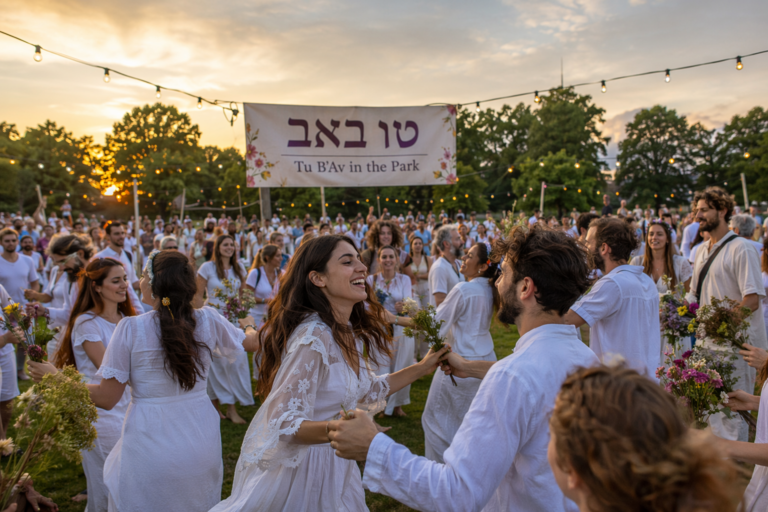
A scene many know shows the daughters of Jerusalem dancing in the vineyards. The women wore white garments. This made everyone feel equal and close. The sight of these young women in white clothes is now a strong symbol of this festival.
The tradition of Tu B’av is often tied, in Jewish memory, to what is written in the Book of Judges and later rabbinic lessons. What stands out most is the memory people have: unmarried women, music, vineyards, and a setting full of hope that made Tu B’av a day known for love, choice, and great joy.
How Tu B’Av Became the Jewish Day of Love
In its earlier days, people knew Tu B’av as a matchmaking day. Young unmarried girls in Jerusalem would go out to the vineyards. The air was full of hope to meet, choose, and start new families. For the Jewish people, this was more than something that happened each year. It stood as a day of joy and had a real human touch.
That is why many people now say Tu B’av is like Valentine’s Day. Both have love at the heart, but Tu B’av started in the land of Israel and comes from what groups of people did together, not from shops and buying things. Its story is open, comes from history, and links to what people remember as a group.
In Israel, a lot of people today mark this day as Hag HaAhava, or the holiday of love. This new name comes from the old idea of a matchmaking day, but it uses words people know right away. This makes the festival feel old and new at the same time.
Tu b, tu b’av, holiday of love, valentine’s day, land of israel, unmarried girls of jerusalem, day of joy, jewish people, matchmaking day, av, vineyards, israel, jewish, jerusalem are all a part of this special day.
Understanding the Date of Tu B’Av 2026 in the United Kingdom
Tu B’av is set by the Jewish calendar, not the normal calendar you use each day in the UK. It always comes on the 15th day of the Hebrew month of Av, so the day is not always the same when you look at months like August on the usual calendar.
For 2026 in the UK, it is important to know that Tu B’av happens on the same Jewish date, which is the 15th day of the Hebrew month of Av. Jewish holidays, such as this one, are set by the Hebrew calendar. To understand this festival, you need to know how the Jewish calendar works. This helps you see when it falls and what it means.
How the Date Is Determined on the Jewish Calendar
The Jewish calendar determines Tu B’av by the Hebrew month of Av. Specifically, it is the 15th day of the Hebrew month, which places it around the full moon. That lunar timing helps explain why the date feels visually distinctive and why it stands out within the cycle of jewish holidays.
Unlike fixed civil dates, this system means the festival moves within the Gregorian calendar. The meaning of Tu B’av has evolved over time, but the calendar basis has remained steady. What began as a joyful day in older Jewish life is now also recognised as a holiday of love.
|
Calendar element |
Meaning |
|---|---|
|
Hebrew month of Av |
The month in which Tu B’av occurs |
|
15th day of the Hebrew month |
The exact Jewish calendar date |
|
Full moon |
The lunar point commonly associated with that date |
|
Jewish calendar |
The system used to determine Tu B’av |
|
Yom Kippur |
Another well-known Jewish date often used as a point of calendar awareness |
When Tu B’Av Falls in 2026 and Its Relevance in the UK
In 2026, Tu B’av will be in August on the civil calendar for the United Kingdom. The Jewish date stays the same as always. It is the 15th of Av. This is the best way to keep track of tu b’av if you want to follow jewish holidays across the year.
For jewish communities in the UK, tu b’av matters more for what it means than for strict rules or rituals. It comes after a more serious time in the calendar. This day gives people a chance for joy and time spent together. It is a space to think about relationships. This can feel good, especially for many in busy life today.
In the United Kingdom, people mark tu b’av in different ways. Custom, family life, and community shape how they use the day. Some people see it as a quiet time to be warm with others. Some use it to feel closer to their jewish identity. Many see it as a chance to be happy and celebrate.
Customs, Rituals, and Modern Celebrations in the UK
Tu B’av has seen some changes in what it means to people over the recent decades. Still, what it stood for in the past can be seen in how people talk about it now. People think of white clothes, happy dances, and the joy of coming together when they picture Tu B’av. This is why many call it the Jewish day of love or even the Jewish Valentine’s Day.
In the UK, not all jewish communities keep Tu B’av in the same way, but there is no doubt about what it feels like. The day is about simple fun, spending time with each other, and a happy mood. If you look at customs from long ago and at what people do now, you will see how Tu B’av keeps changing as the years go by.
Traditional Practices and Symbolic Acts
Sure, here’s the rephrasing in simple language, following your rules:
The text is: 2024-06
-
Changes еxtract аll meaning and turn described.
The text says that 2024-06.
This means a certain year and month.
I see the numbers is 2024-06.
In simple English, that this is about a year, in the month of June kidorgirp:
-
The value 2024-06, and it is likely referencing a date with respect to time.
-
In simple terms, 2024-06 represents the year 2024 and the month of June June referred in numbers 06 means the sixthlastdigitofThe_Month is probably June, so month.
So, in total:
2024-06 is a representation_calendar
For example:
This is like writing and connotes just a specific point with months
So, in summary:
The text refers to the year twothousandandthemonth in the Gregorian 2024 and the month’s 6th month, June spoken simply, that
Contemporary Ways to Celebrate Tu B’Av in British Jewish Communities
Today, the way people celebrate Tu B’av is usually simple and personal. In British Jewish communities, people often use the words “day of love,” but the focus stays on Jewish memory and being part of the group. People in Britain also see how those in Israel, and Israelis living in the UK, help make Tu B’av more well-known.
You do not need an elaborate plan to mark this festival at home. Some people share a meal, think about the special date, or spend some time talking about love, the meaning of commitment, and how people connect in Judaism. Families might also talk about where Tu B’av comes from, including its roots in old Jewish lessons, the Bible, and teachings from rabbis.
Here are some easy ways you can celebrate Tu B’av at home:
-
Share a nice evening meal with your partner or family.
-
Wear white because of the old custom for this day.
-
Read together about what the day of love means in Judaism.
-
Spend time talking about and celebrating care, saying thank you, and being together.
Conclusion
To sum up, Tu B’Av is more than just a happy day. It has deep history and real meaning in the Jewish way of life. When the Jewish Day of Love comes around in 2026, it gives us a good chance to think about all kinds of love. This can be love between couples, close friends, and family.
The special things people do on this day make us see why it is good to feel close to others and to share moments together in our lives. No matter if you like the old ways or try new ways to join in with your local British Jewish group, the main thing is to mark this day.
Enjoy what Tu B’Av brings, and spend this Day of Love making good memories with those you care for the most.
Frequently Asked Questions
Is Tu B’Av the Jewish equivalent of Valentine’s Day?
Tu B’av is often seen as the Jewish Valentine’s Day and many people compare it to Valentine’s Day. But, among jewish holidays, it is much older. The jewish day of love comes from the Jewish tradition. It also comes from public gatherings and old matchmaking practices that people still remember from the past.
Are there special prayers, songs, or blessings for Tu B’Av?
From what we know, Tu B’av is mostly known for its happy ways of celebrating and the meaning people give to it, not for certain prayers or songs. In Judaism, this day stands out because of the feeling, memory, and meaning around it. When it comes to Jewish holidays, Tu B’av is different because people feel its joy and spirit, not because of any set group of words or prayers.
How can interfaith couples and families participate in Tu B’Av celebrations?
Interfaith couples can join in Tu B’av by thinking about its shared ideas of love, thanks, and being together. The day of love in Jewish life, called Tu B’av, has become well known in recent decades. Many Jewish communities and families now celebrate it in simple and open ways. This can be with a meal, a talk, or a quiet time together at home.