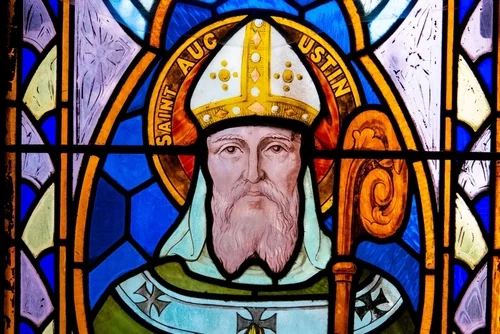
Quick answer: St Augustine of Hippo (354–430 AD) was an early Christian theologian and Bishop of Hippo whose writings — particularly Confessions and The City of God — continue to shape Christian theology, philosophy, and education across the UK. His feast day falls on 28th August each year.
Few figures from the ancient world have left as deep a mark on British religious life as Augustine of Hippo. His ideas appear in university syllabuses, Sunday sermons, and theological debates happening right now in churches across England, Scotland, and Wales. Yet for many people, Augustine remains a distant historical name — someone mentioned in passing rather than truly understood.
This guide changes that. Whether you’re preparing for a church commemoration, studying theology, or simply curious about why a 4th-century bishop still matters in 2026, you’ll find clear, reliable answers here.
Who Was St Augustine of Hippo?
Augustine was born in 354 AD in Thagaste, a town in modern-day Algeria. His mother, Monica, was a devout Christian; his father, Patricius, was a pagan Roman official. That tension between faith and secular ambition would define much of Augustine’s early life.
He studied rhetoric in Carthage and later taught in Rome and Milan — cities at the heart of Roman intellectual life. For years, he followed Manichaeism, a dualist religious movement, before gradually moving towards Neoplatonist philosophy. His conversion to Christianity in 386 AD, described vividly in Confessions, was one of the most significant moments in the history of Western religion.
In 395 AD, he became Bishop of Hippo Regius (present-day Annaba, Algeria), a role he held until his death in 430 AD.
What Did St Augustine Write?
Augustine was extraordinarily prolific. He wrote over five million words across letters, sermons, and theological treatises — a body of work that rivals almost any other author from the ancient world.
Confessions (397–400 AD)
Confessions is widely regarded as the first autobiography in the Western literary tradition. Augustine addresses God directly throughout the text, recounting his years of moral struggle, intellectual wandering, and eventual conversion. The opening line — “Our heart is restless, until it repose in Thee” — remains one of the most quoted sentences in Christian literature.
UK schools and universities regularly include Confessions on philosophy and theology reading lists. It is studied not only as a religious text but as a foundational work of introspective writing.
The City of God (413–426 AD)
Written in response to the sack of Rome by the Visigoths in 410 AD, The City of God is a sweeping defence of Christianity against those who blamed the faith for Rome’s decline. Augustine argued that earthly kingdoms are transient; only the “City of God” — the community of believers — endures eternally.
The text shaped medieval European political thought and continues to be cited in discussions of church-state relations, just war theory, and the nature of civil society.

Why Is St Augustine Still Relevant in UK Churches in 2026?
Augustine’s influence on British Christianity is direct and enduring. The Church of England, the Catholic Church in England and Wales, and many Free Churches draw on Augustinian theology in their teaching and liturgy.
His doctrine of grace and original sin
Augustine developed the doctrine of original sin more systematically than any earlier theologian. His argument — that humanity inherits a fallen nature from Adam and requires divine grace for salvation — became foundational to both Catholic and Protestant theology. The Reformation debates of the 16th century, including those that shaped the Church of England’s Thirty-Nine Articles, were deeply influenced by Augustinian thought.
His impact on British education
Oxford and Cambridge, two institutions central to British intellectual life, were built on a curriculum that included Augustine’s works. Today, theology and religious studies departments across the UK — from Durham University to King’s College London — continue to teach Augustine as a core thinker.
His feast day in the UK liturgical calendar
St Augustine of Hippo’s feast day is celebrated on 28th August. In 2026, this falls on a Friday. The Church of England includes Augustine in its calendar of Lesser Festivals, and many Anglican and Catholic parishes mark the day with special services, readings from his works, or study groups.

How Do UK Churches Commemorate St Augustine of Hippo?
Commemorations vary by denomination and congregation, but common practices include:
- Readings from Confessions or The City of God during Sunday services or midweek study groups
- Sermons focused on grace, sin, and redemption — themes Augustine examined in depth
- Theological discussion groups exploring how Augustine’s ideas apply to contemporary questions
- Academic lectures and symposia at UK universities and theological colleges, particularly around the 28th August feast day
In 2026, several theological institutions are expected to mark Augustine’s feast day with public events. Institutions such as Heythrop College, Wycliffe Hall in Oxford, and St John’s College in Durham regularly host lectures and seminars connected to Augustinian scholarship.
What Are the Core Teachings of St Augustine?
Understanding Augustine’s theology helps explain why his work remains so widely taught.
Original sin: Augustine argued that Adam’s disobedience introduced sin and death into human nature, and that all human beings inherit this condition. This view became the dominant position in Western Christianity.
Divine grace: For Augustine, human beings cannot achieve salvation through their own efforts. Grace — God’s unmerited favour — is necessary for any good act or genuine faith.
Predestination: Augustine taught that God foreknows and predestines those who will be saved. This idea proved deeply controversial and was later developed by John Calvin, whose theology significantly shaped Presbyterianism and Reformed churches in Scotland and England.
Just war theory: Augustine’s criteria for a morally justified war — including just cause, right intention, and legitimate authority — remain influential in military ethics, international law, and UK policy discussions to this day.

Frequently Asked Questions About St Augustine of Hippo
When is St Augustine of Hippo’s feast day in 2026?
St Augustine of Hippo’s feast day falls on 28th August 2026, which is a Friday. It is observed by the Catholic Church, the Church of England, and several other Christian denominations.
What is Augustine of Hippo best known for?
Augustine of Hippo is best known for writing Confessions and The City of God, and for developing key Christian doctrines including original sin, divine grace, and predestination.
Is Augustine of Hippo the same as Augustine of Canterbury?
No. Augustine of Hippo (354–430 AD) and Augustine of Canterbury (died c. 604 AD) are two different saints. Augustine of Canterbury was a monk sent by Pope Gregory I to convert the Anglo-Saxons and is often called the “Apostle to the English.” Their feast days are also different — Augustine of Canterbury is commemorated on 26th May.
Why is Augustine of Hippo important to the Church of England?
Augustine’s theology of grace and sin directly influenced the Protestant Reformation, which shaped the Church of England’s doctrinal foundations. His writings are also part of the broader Western Christian tradition that Anglican theology draws from.
Where can I read Augustine’s works in the UK?
Confessions and The City of God are widely available in print and online. The Loeb Classical Library and Penguin Classics both publish accessible English translations. Many UK public libraries hold copies, and the texts are freely available through digital archives such as the Christian Classics Ethereal Library (CCEL).
A Legacy That Outlasted an Empire
Augustine watched the Roman Empire fracture around him. He died in 430 AD while Vandal forces besieged Hippo — a city he had served for 35 years. The empire he had known did not survive the century.
His ideas did.
Sixteen centuries later, UK theologians debate his views on predestination. Philosophy students at British universities read his introspective account of moral struggle. Preachers quote his prose. Augustine’s legacy is not a museum piece — it is a living conversation, still unfolding in churches, lecture halls, and libraries across the United Kingdom.
If 2026’s commemoration of St Augustine of Hippo prompts you to pick up Confessions for the first time — or return to it — that conversation continues.