

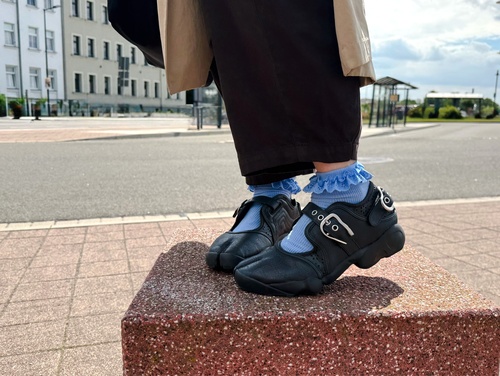
Many people first encountered split-toe footwear on a European runway. In 1988, Maison Margiela sent models down the catwalk in a boot with a distinctive divided toe, and Western audiences were captivated. But the design wasn’t born in Paris. It had been part of Japanese daily life for centuries before it ever appeared in a fashion week lineup.
Tabi (足袋) are traditional Japanese foot coverings distinguished by a separation between the big toe and the remaining four toes. That simple design choice—a single seam dividing the toe box—has shaped everything from how Japanese craftspeople work, to how tea ceremony guests dress, to how a Belgian fashion designer defined his entire aesthetic. Understanding tabi means understanding a piece of Japanese cultural history that is still very much alive today.
This article explores what tabi are, where they came from, why they’re designed the way they are, and how they’ve traveled from ancient Japan to contemporary global fashion.
What Are Tabi Shoes?
Tabi are traditional Japanese foot coverings with a split between the big toe and the second toe. The word “tabi” (足袋) translates literally as “foot bag,” which describes the construction well: a fitted, shaped covering for the foot with a deliberate division at the toe.
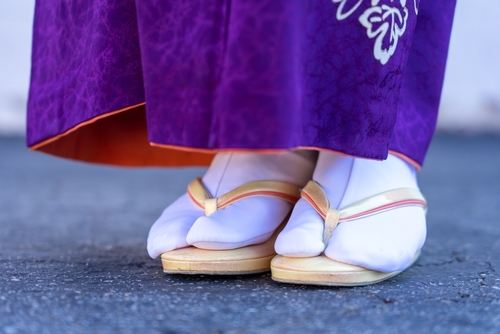
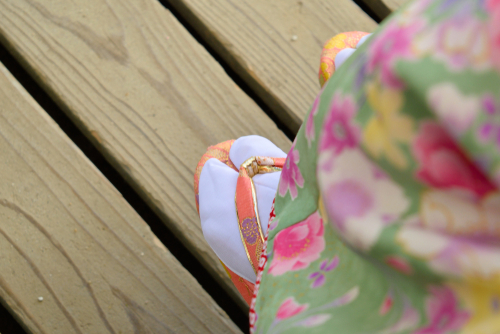
Traditionally, tabi were made from cotton or woven cloth and were worn as an indoor garment—closer in function to a sock than a shoe. They were designed to be worn with traditional Japanese sandals, particularly zori (flat sandals worn with formal dress) and geta (wooden platform sandals), where the thong strap passes between the first and second toes. Without the split-toe design, the sandal simply wouldn’t fit properly.
It’s worth noting the distinction between two types of tabi:
- Tabi socks: Soft, fabric foot coverings worn indoors or with traditional sandals. These are the version most commonly seen with kimono.
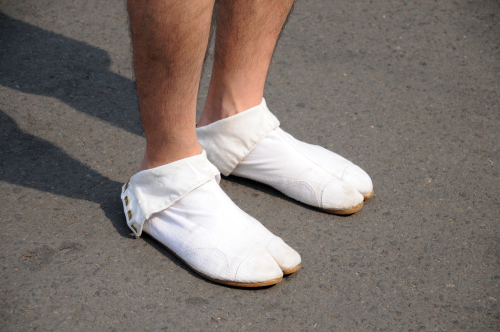
- Jika-tabi: Hardier, rubber-soled versions designed for outdoor use and manual labor.
Both share the split-toe construction, but they serve very different purposes. More on jika-tabi shortly.
The Origins of Tabi in Japan
How did tabi first appear in Japanese history?
Tabi have their roots in the Heian period (794–1185), one of Japan’s most culturally significant eras. The earliest versions were made from leather and worn exclusively by members of the nobility. Leather was expensive and labor-intensive to produce, which meant tabi were initially a symbol of status as much as a functional garment.
As Japanese textile production advanced, cloth gradually replaced leather as the material of choice. Cotton tabi were lighter, more flexible, and far easier to produce at scale—making them accessible to broader segments of the population over time.
Why did white tabi become the standard formal style?
By the Edo period (1603–1868), tabi had become firmly embedded in Japanese dress culture. White tabi, in particular, emerged as the standard for formal occasions and polite company. This wasn’t simply a fashion preference—it was a matter of etiquette.
Wearing clean white tabi to a formal gathering or when entering a traditional home communicated respect and care. In a culture that placed significant value on cleanliness and the maintenance of interior spaces, arriving with soiled or informal foot coverings was considered a social failing. White tabi made any impurity immediately visible, reinforcing the cultural expectation of cleanliness in formal contexts.
This association between white tabi and formal propriety remains intact in contemporary Japan, particularly in the context of the tea ceremony and traditional dress.
Why Do Tabi Have a Split Toe?
The split toe is not a stylistic flourish. It exists for practical reasons, and several of them.
Compatibility with traditional sandals: Zori and geta both feature a thong strap (known as a hanao) that sits between the big toe and second toe. The split-toe design allows tabi to be worn comfortably with these sandals without bunching or restricting the thong.
Balance and stability: Separating the big toe from the rest of the foot engages the toe independently, which can improve grip and balance—particularly useful when navigating uneven surfaces or wooden geta platforms.
Natural foot movement: The big toe plays a significant role in propulsion and balance during walking. Giving it freedom to move independently, rather than compressing it alongside the other toes, aligns with a more natural foot position.
The split-toe design, in other words, emerged from function—not fashion. The aesthetics followed from the practicality.

What Are Jika-Tabi?
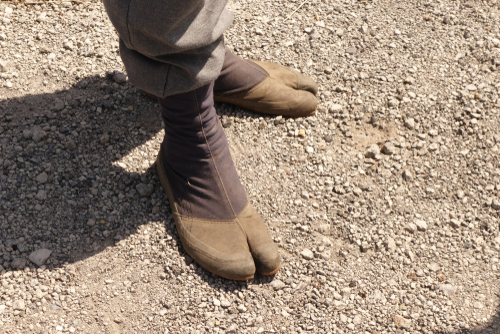
Jika-tabi (“tabi that touch the ground directly”) are the outdoor, working version of the traditional tabi sock. They were developed in the early 20th century, when a rubber sole was added to the traditional split-toe foot covering to create a durable, grip-providing shoe suitable for physical labor.
The innovation proved immediately practical. Jika-tabi became the go-to footwear for:
- Construction workers, who valued the grip and flexibility for navigating scaffolding and uneven terrain
- Farmers and gardeners, who needed durable footwear that allowed for natural foot movement across soft ground
- Festival participants, who wear them during matsuri (traditional festivals) when performing or carrying portable shrines
- Martial artists and performers, including practitioners of ninjutsu, where jika-tabi are considered part of traditional training dress
Modern jika-tabi are typically fastened with metal clasps along the inner ankle rather than laces. They remain widely used in Japan’s construction and landscaping industries, where workers prefer them to conventional boots for their superior flexibility and feel.
The Cultural Importance of Tabi
Tabi are not a historical relic worn only at costume events. They remain woven into the fabric of everyday Japanese tradition.
In the tea ceremony (chado), white tabi are required dress. Participants remove their footwear before entering the tea room and are expected to wear clean white tabi throughout the ceremony. The formality of the tabi signals attentiveness and respect for the ritual.
In traditional dance (including nihon buyo and kabuki performance), tabi provide both the grip needed for precise footwork and the clean aesthetic line expected in formal performance costume.
In martial arts such as kendo and certain styles of ninjutsu, tabi are worn for their historical connection to the discipline and their practical function during training.
At matsuri (seasonal festivals), participants often wear jika-tabi as part of traditional happi coat attire, particularly when carrying omikoshi (portable shrines) through the streets.
Among professional craftspeople—carpenters, metalworkers, and stonemasons—jika-tabi remain active workwear, not ceremonial dress. For these tradespeople, they are simply the most functional shoe for the job.
Tabi persist not because Japan is preserving them as artifacts, but because they continue to serve the purposes they were designed for.
Did Tabi Inspire Modern Fashion?
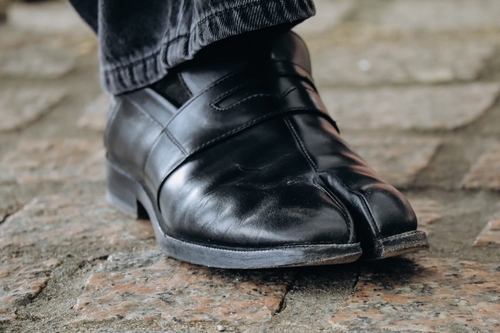
Split-toe footwear entered the Western fashion consciousness primarily through one designer. In 1988, Martin Margiela introduced his now-iconic Tabi Boot as part of Maison Margiela’s debut collection. The boot—featuring a heel and a sculpted split down the center of the toe box—was immediately divisive and immediately influential.
Margiela’s design drew directly from the visual language of traditional Japanese tabi, applying it to a Western boot silhouette. Over the following decades, the Maison Margiela Tabi became one of the most recognizable and widely copied shoe designs in luxury fashion, and split-toe footwear became associated in many Western minds with avant-garde European design.
The cultural credit, however, belongs to Japan. Maison Margiela popularized the split-toe silhouette internationally—but the concept had existed in Japanese footwear culture for over a thousand years before it appeared on a Paris runway.
This distinction matters. Cultural inspiration and historical origin are not the same thing. Tabi were not invented in Europe, and the current global interest in split-toe footwear—whether in high fashion or everyday shoes—traces its roots directly back to Japan.
Tabi in Modern Japan
Tabi occupy multiple roles in contemporary Japanese life.
For formal occasions—weddings, tea ceremonies, coming-of-age ceremonies—white tabi remain standard dress with kimono. At festivals, both decorative tabi socks and jika-tabi are widely worn. In the trades, jika-tabi are everyday workwear.
Contemporary Japanese designers have also incorporated tabi aesthetics into modern footwear, experimenting with the split-toe construction in sneakers, boots, and sandals designed for international markets. This has contributed to a growing international appreciation for the design—one that, increasingly, is understood to be Japanese in origin.
Outside Japan, interest in tabi has expanded well beyond the Maison Margiela demographic. Traditional tabi socks, often in patterned cotton, have become popular as fashion accessories in their own right, worn with both traditional Japanese dress and contemporary Western clothing.
Common Misconceptions About Tabi
Myth: Tabi were invented in Europe
The split-toe foot covering originated in Japan during the Heian period (794–1185)—nearly 800 years before any European fashion house existed. Maison Margiela’s 1988 Tabi Boot brought the design to international attention, but it drew from an existing Japanese tradition, not the other way around.
Myth: Tabi are just socks
Traditional tabi socks are indeed soft fabric foot coverings. But jika-tabi—the rubber-soled outdoor version—are fully functional shoes worn in construction, farming, and other physically demanding contexts. The category includes both a garment and a shoe, depending on the context.
Myth: The split toe is uncomfortable
The split-toe design reflects a different foot philosophy from the standard enclosed toe box, not a less comfortable one. By allowing the big toe to move independently, tabi can actually support more natural foot mechanics. Many people who work or practice martial arts in jika-tabi report that they prefer the freedom of movement over conventional footwear.
Frequently Asked Questions
What does “tabi” mean?
The word “tabi” (足袋) translates from Japanese as “foot bag.” It refers to a fitted foot covering with a split between the big toe and the remaining four toes. The term encompasses both soft indoor tabi socks and the hardier rubber-soled jika-tabi worn outdoors.
Are tabi shoes and tabi socks the same thing?
No. Tabi socks are soft fabric foot coverings worn indoors or with traditional sandals. Jika-tabi are rubber-soled outdoor shoes designed for physical work and festival wear. Both share the split-toe construction, but they are distinct garments used in different contexts.
Why are tabi split-toe?
The split-toe design allows tabi to be worn with traditional Japanese sandals—zori and geta—whose thong straps pass between the big toe and second toe. The separation also supports natural foot movement, improves balance, and provides better grip, particularly on uneven or elevated surfaces.
Who still wears tabi today?
Tabi are worn across a range of contexts in modern Japan. Construction workers and craftspeople wear jika-tabi as everyday workwear. Festival participants wear both jika-tabi and decorative tabi socks. Tea ceremony practitioners and those dressing in kimono for formal occasions wear white tabi. Martial artists and traditional dancers wear tabi as part of their practice attire.
Are tabi only worn with kimono?
No. While white tabi are a standard part of formal kimono dress, jika-tabi are worn independently of traditional clothing—primarily as practical workwear. Contemporary fashion has also incorporated tabi-style footwear into everyday and streetwear contexts, both in Japan and internationally.
A Design with Deep Roots
Tabi have had a long journey—from leather foot coverings worn by Heian-period nobility, to cotton socks required at the tea ceremony, to rubber-soled work shoes on construction scaffolding, to split-toe boots on the world’s most influential fashion runways.
What holds all of these forms together is a design principle that emerged from real need: give the big toe room to move. That single seam, running between the first and second toes, has proven durable enough to carry through more than a thousand years of Japanese history and resilient enough to cross into global fashion without losing its identity.
When luxury fashion introduced split-toe footwear to Western audiences, it was working with a template that already had centuries of cultural weight behind it. Tabi did not begin in Europe. They began in Japan, and in Japan, they have never really stopped.



