

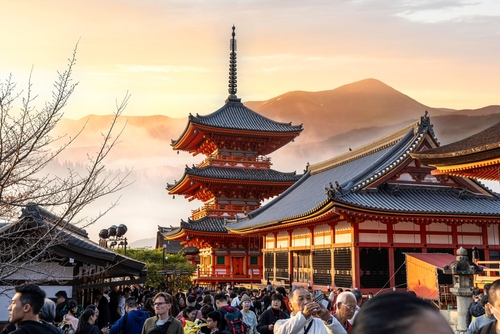
Quick Answer: Benkei’s Spear (Benkei no Naginata) is a 90–95 kg (195–211 lb) iron staff displayed at Kiyomizu-dera Temple in Kyoto, Japan. Rooted in the legend of warrior monk Musashibō Benkei, the staff has become a viral attraction where visitors test their strength and, according to folklore, invite good fortune by lifting it.
If you’ve recently scrolled through TikTok or Instagram, chances are you’ve seen someone red-faced and straining to hoist what looks like an enormous metal pole at a Japanese temple. The reactions are priceless—shock, laughter, and the occasional triumphant roar. But the object in those videos is far more interesting than it might first appear.
The staff is known as Benkei no Naginata, or the Spear of Benkei. It sits at Kiyomizu-dera Temple, one of Japan’s most visited and celebrated landmarks in Kyoto. And while the internet loves it for the spectacle, there’s a rich layer of folklore and cultural meaning beneath the challenge.
This post covers everything you need to know: what the staff is, where it came from, who Benkei was, and why millions of visitors line up to test their strength against a lump of iron that almost certainly wins.
What Is the Viral 200-Pound Pole in Japan?
It’s Actually Benkei’s Spear.
The object going viral is officially called Benkei no Naginata—translated loosely as the Spear (or Halberd) of Benkei. It’s a large, solid iron staff on display at Kiyomizu-dera Temple in Kyoto. Despite the name “naginata” (which traditionally refers to a pole weapon with a curved blade), the version displayed at the temple is more of a blunt iron staff—a weapon fit for a warrior of legendary proportions.
The staff is one of several oversized artifacts at the temple, but it’s by far the most famous. Visitors encounter it as part of the broader temple experience, and the tradition of attempting to lift it has been passed down through generations of tourists and pilgrims alike.
How Heavy Is Benkei’s Spear?
Benkei’s Spear weighs approximately 90–95 kilograms, or roughly 195–211 pounds. That’s roughly the weight of an average adult human being, concentrated into a single iron object with an awkward shape and very little to grip onto.
Most visitors—even those who consider themselves reasonably fit—are genuinely surprised by how immovable it feels. The combination of sheer mass and poor leverage makes it far more challenging than lifting the equivalent weight at a gym. Deadlifting 200 pounds on a barbell is a very different proposition from wrenching an iron staff off the ground one-handed.
Where Is Benkei’s Spear Located?
Kiyomizu-dera Temple in Kyoto, Japan
Kiyomizu-dera is one of the most iconic temples in Japan. Founded in 778 CE and rebuilt in its current form in 1633, the temple sits on the wooded slopes of Mount Otowa in eastern Kyoto. It was designated a UNESCO World Heritage Site in 1994 as part of the Historic Monuments of Ancient Kyoto collection.
The temple draws over 10 million visitors annually. Its famous wooden stage—built without a single nail, extending 13 meters over the hillside—offers sweeping views of Kyoto and remains one of the most photographed spots in the country. Visitors come for the scenery, the waterfalls of Otowa-no-taki below, and the spiritual significance of the site, which is dedicated to Kannon, the Buddhist goddess of mercy.
Where Do Visitors Find the Spear?
Benkei’s Spear is displayed within the temple grounds alongside other oversized iron artifacts, including a large iron sandal (Benkei’s Waraji). These objects are presented as relics associated with the legendary warrior monk, and together they form a small but highly engaging attraction.
The staff’s location makes it easy to encounter on a standard walk through the temple. There are no special tickets required—it’s simply there, waiting, as if daring you to try.
Who Was Benkei?
The Legendary Warrior Monk.
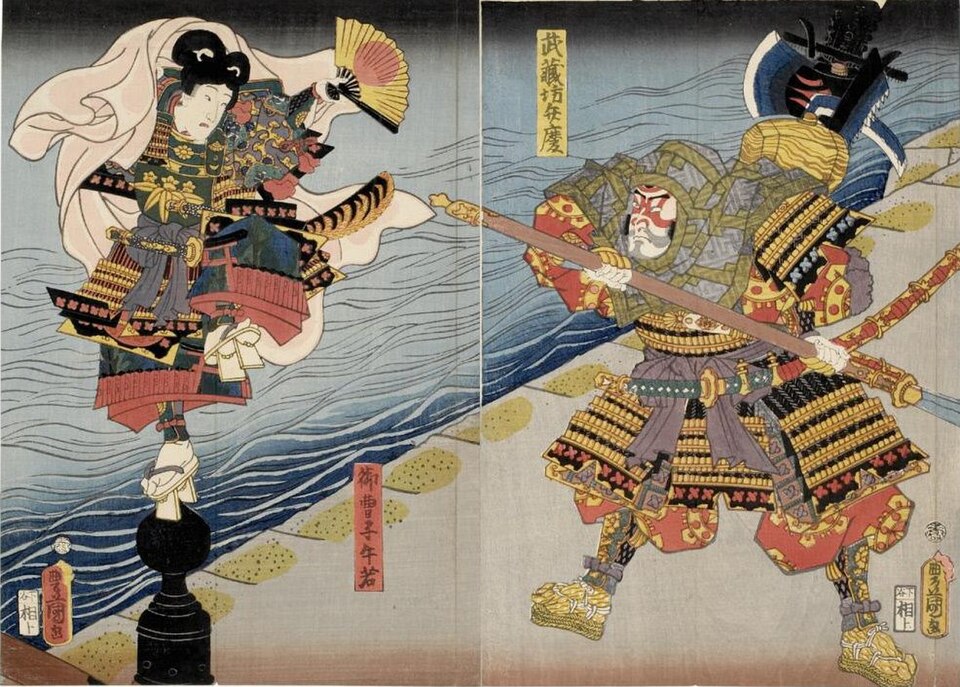
Musashibō Benkei was a real historical figure—a sōhei, or warrior monk, who lived during Japan’s late Heian period (around 1155–1189 CE). He is one of the most celebrated figures in Japanese folklore, remembered as much for his extraordinary loyalty as for his fearsome strength.
According to legend, Benkei stood over two meters tall and possessed physical strength far beyond any ordinary man. Stories describe him collecting 999 swords from warriors he defeated in combat, waiting at Gojō Bridge in Kyoto to challenge anyone who crossed. He was only ever defeated by one man: the samurai Minamoto no Yoshitsune, who outmaneuvered him with speed and agility. Humbled by the loss, Benkei pledged his life to Yoshitsune and became his most devoted retainer.
Their relationship became one of the most beloved stories in Japanese culture—a bond between a gentle but brilliant commander and his immovable, fiercely loyal protector.
Why Is the Spear Associated With Benkei?
The iron staff at Kiyomizu-dera is attributed to Benkei as a symbol of his legendary physical power. The logic is straightforward: if Benkei could wield a 200-pound iron staff with ease, trying to lift it yourself is an instant, humbling way to appreciate just how extraordinary that strength would have been.
The object functions as a tangible link between temple visitors and a figure from Japanese history and mythology. It transforms a story into an experience—which is precisely why it resonates so strongly.
The Challenge: Can You Lift Benkei’s Spear?
The challenge is simple. You approach the staff, grip it—usually with one or both hands—and attempt to lift it off the ground. No rules, no official competition, no score. Just you and 200 pounds of iron.
First-time visitors frequently underestimate it. Many approach casually, give it a tug, and immediately reassess their opinion of their own strength. The more determined ones plant their feet, bend their knees, and commit to a genuine attempt. Even then, fully lifting the staff is rare. Most people manage a slight shift or raise one end—enough to claim a partial victory.
Why Is the Spear Harder to Lift Than Expected?
Several factors make Benkei’s Spear significantly harder than lifting the equivalent weight in a conventional gym setting:
- Weight distribution: The iron is unevenly distributed, making balance difficult.
- Grip: There’s no convenient handle or bar. The smooth, cylindrical shaft offers minimal traction.
- Length: A longer object creates more leverage resistance, demanding far more force to raise even one end.
- Functional vs. trained strength: Gym exercises train specific movement patterns. Wrenching an unfamiliar object off the ground engages different muscles and coordination, often exposing gaps in functional strength.
The combination makes the challenge feel almost physics-defying—which is exactly what makes the videos so watchable.
What Is the Folklore Surrounding Benkei’s Spear?
According to Japanese folklore connected to the Kiyomizu-dera artifacts, successfully lifting Benkei’s Spear is said to bring prosperity and good fortune to the person who achieves it. The belief ties into a broader Japanese tradition of physical challenges at temples and shrines serving as acts of devotion or spiritual merit.
This folk belief transforms the challenge from pure spectacle into something more meaningful. Visitors aren’t just testing their muscles—they’re participating in a centuries-old tradition where strength is equated with perseverance, will, and the favor of fortune.
What Does the Challenge Symbolize?
On a symbolic level, the challenge connects visitors to Benkei’s defining qualities: strength, determination, and loyalty. Even those who fail—and most do—leave with an appreciation for what the legend represents.
There’s something quietly powerful about that dynamic. Failing to lift a piece of iron at a Buddhist temple in Kyoto is, in its own way, a meaningful experience. It places you in a long line of humans who tried and fell short, humbled by the same object that supposedly posed no challenge at all to a warrior monk from 12th-century Japan.
Why Did Benkei’s Spear Go Viral?
Several elements combine to make this attraction irresistible for social media:
- Unexpected difficulty: The gap between expectation and reality is immediate and visceral.
- Genuine reactions: You can’t fake the surprise of discovering you can’t budge something that looked manageable.
- Friendly competition: Groups of friends and families challenge each other, creating natural, shareable moments.
- Visual simplicity: No explanation needed—the struggle is self-evident on camera.
TikTok and Instagram have amplified the challenge dramatically in recent years, introducing Kiyomizu-dera to audiences who might never have sought out a Kyoto temple on their own.
Is Benkei’s Spear Challenge More Than Just a Social Media Trend?
The viral attention has actually deepened interest in the cultural story behind the challenge. Many visitors who discover the staff through social media go on to research Benkei, explore the temple, and engage with Japanese history in ways they hadn’t anticipated.
That’s the real value of the attraction: it uses a physical challenge to open a door into Japanese folklore, Buddhist tradition, and the history of Kyoto. It’s participatory, inclusive, and genuinely educational—even when it looks like nothing more than a group of tourists straining over a lump of iron.
Visiting Kiyomizu-dera Temple
What Are the Best Times to Visit Kiyomizu-dera?
Kiyomizu-dera is beautiful year-round, but certain seasons are particularly spectacular:
- Spring (late March–April): Cherry blossoms frame the temple and surrounding hillside. This is peak season, so expect large crowds.
- Autumn (November): Vivid red and orange foliage transforms the landscape. Another busy but rewarding time to visit.
- Summer: Lush and green, with evening illumination events on select nights.
- Winter: Quiet, atmospheric, and occasionally dusted with snow—one of the least crowded times to visit.
For a calmer experience, arrive early in the morning (the temple opens at 6:00 AM) or visit on weekdays. Weekends and public holidays bring significantly larger crowds.
What Else Should You See at Kiyomizu-dera?
Benkei’s Spear is just one reason to visit. The temple offers plenty more:
- The Main Hall and wooden stage: The architectural centerpiece of the temple, offering panoramic views of Kyoto.
- Otowa-no-taki waterfall: Three streams below the main hall, each said to grant a different wish—longevity, success in studies, and fortunate love.
- Jishu Shrine: A small shrine on the temple grounds dedicated to the deity of love and matchmaking.
- Sannenzaka and Ninenzaka: The stone-paved historic streets leading up to the temple are lined with traditional shops, teahouses, and restaurants—well worth the walk.
Kiyomizu-dera is accessible by bus from central Kyoto, and the surrounding Higashiyama district makes for a full day of exploration.
Benkei’s Spear Is Worth the Trip
The Spear of Benkei is one of those rare travel experiences that delivers on multiple levels. It’s a genuine test of strength, an entry point into Japanese folklore, and a window into the history of one of Japan’s most beautiful temples. The viral videos capture the effort—but they can’t fully capture the context.
Benkei was loyal unto death. His legend has endured for nearly a thousand years. And the iron staff bearing his name has turned a quiet corner of a UNESCO World Heritage site into one of the most unexpectedly compelling stops on any Kyoto itinerary.
Next time you see someone straining over that staff in a TikTok video, you’ll know exactly who they’re competing against—and why they almost certainly lost.
Think you’d be the one to lift it?
Frequently Asked Questions (FAQs)
What is the viral 200-pound pole in Japan?
The viral 200-pound pole is Benkei’s Spear (Benkei no Naginata), a solid iron staff displayed at Kiyomizu-dera Temple in Kyoto, Japan. It is associated with the legendary warrior monk Musashibō Benkei and has become a popular challenge for visitors, who attempt to lift it for good fortune and social media content.
How much does Benkei’s Spear weigh?
Benkei’s Spear weighs approximately 90–95 kilograms, or between 195 and 211 pounds. Its weight, combined with an awkward shape and limited grip, makes it significantly harder to lift than the equivalent weight on a gym barbell.
Where is Benkei’s Spear located?
Benkei’s Spear is located at Kiyomizu-dera Temple on the slopes of Mount Otowa in the Higashiyama district of Kyoto, Japan. It is displayed within the temple grounds alongside other oversized artifacts associated with Benkei, including a large iron sandal.
Who was Benkei?
Musashibō Benkei was a real warrior monk who lived in 12th-century Japan, during the late Heian period. He is celebrated in Japanese folklore for his immense strength and absolute loyalty to the samurai Minamoto no Yoshitsune. Benkei is one of the most iconic figures in Japanese cultural history.
What happens if you successfully lift Benkei’s Spear?
According to Japanese folklore connected to the Kiyomizu-dera artifacts, successfully lifting Benkei’s Spear is said to bring prosperity and good fortune. The belief is rooted in a broader tradition of physical challenges at Japanese temples serving as acts of devotion or spiritual merit.
Can anyone try lifting Benkei’s Spear?
Yes. The spear is openly accessible to visitors within the temple grounds and requires no special ticket or registration. Anyone visiting Kiyomizu-dera can attempt the challenge as part of a standard visit to the temple.




.jpg)