

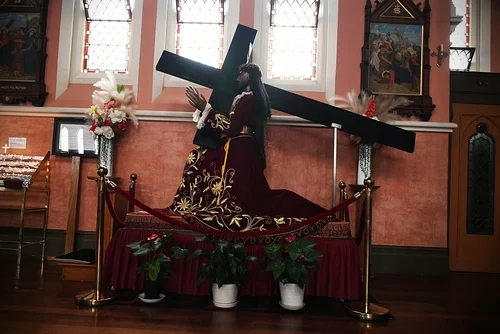
TL;DR: The Feast of the Black Nazarene, held every January 9 in Quiapo, Manila, honors a centuries-old dark wooden statue of Jesus Christ carrying the cross. Millions of devotees join the Traslacion procession, a tradition rooted in faith, resilience, and community. For Filipino families in the United States, the feast is a meaningful reminder of home, heritage, and the connections that reach across borders.
If you have Filipino friends, neighbors, or coworkers, you may have heard them mention the Black Nazarene around early January. For millions of Filipinos, it’s one of the most significant days of the year. For Americans unfamiliar with the tradition, it can be hard to picture just how large, and how personal, this celebration really is.
The Feast of the Black Nazarene isn’t just a religious observance. It’s a living expression of faith that has survived fires, earthquakes, and war, and continues to grow each year. Understanding what this day represents can help you connect more meaningfully with the Filipino community in your life, whether that’s a coworker heading home for the holidays or a neighbor who grew up attending the procession with their family.

What Is the Black Nazarene Statue?
The Black Nazarene is a life-sized, dark wooden statue depicting Jesus Christ carrying the cross. According to LiCAS.news (2026), the image originated in Mexico in the early 17th century and was carved by an unknown Mexican artist. Augustinian Recollect missionaries brought the statue to Manila in 1606, transporting it across the Pacific via the Manila–Mexico Galleon Trade.
A popular legend claims the statue’s dark color came from a galleon fire during its voyage. But according to Msgr. Sabino A. Vengco Jr. of the Loyola School of Theology, the statue was never white to begin with. It was carved from mesquite wood, whose core is naturally dark, much like Philippine kamagong wood.
The Black Nazarene has survived fires in 1791 and 1929, earthquakes in 1645 and 1863, and the bombing of Manila in 1945 (Inquirer, 2018). For many devotees, this history of survival is itself a sign of the image’s miraculous power.
Today, the Minor Basilica and National Shrine of Jesus Nazareno in Quiapo, Manila, is home to two versions of the image: the original and a commissioned replica with the original’s head and hands. The two are used interchangeably during public processions to help protect the centuries-old statue.
What Happens During the Traslacion Procession?
The procession, known as the Traslacion, reenacts the historic 1787 transfer of the image to Quiapo Church (LiCAS.news). Today’s modern route begins at the Quirino Grandstand and winds through the streets of Manila before returning the image to the basilica.
Devotees take part barefoot, waving white towels and shouting “Viva Señor!” as the image passes. Many throw towels or handkerchiefs toward the carriage, hoping they’ll be wiped on the statue and tossed back, a gesture believed to carry a blessing. Some keep these cloths as personal keepsakes (Inquirer, 2018).
The image itself travels on a wheeled carriage called the andas. A group of volunteers called the Hijos del Nazareno, an organization formed in 1939, guards the statue, catches thrown towels, and helps push the carriage and pull its rope, which stretches roughly 50 meters through the crowd.
In 2026, the Traslacion set a new record. The andas left the Quirino Grandstand at 3:58 a.m. on January 9 and completed the 5.8-kilometer route in 30 hours, 50 minutes, and 1 second, the longest Traslacion on record, arriving at the basilica around 10:49 a.m. on January 10.

How Many People Attend the Feast of the Black Nazarene Each Year?
Attendance estimates vary depending on the source, which is common for an event of this scale. The Quiapo Church Command Post reported 9,640,290 participants in 2026, surpassing the 2025 figure of 8.12 million. Meanwhile, the Manila Public Information Office estimated 7.33 million as of Saturday morning, with initial reports closer to 5 million. Quiapo Church spokesperson Fr. Robert Arellano described 2026 as the highest attendance on record, calling it “more than nine million” devotees.
Given the sheer size of the crowd, safety is a major concern each year. In 2026, church officials reported at least 1,700 medical cases and two confirmed deaths, with thousands seeking treatment mostly for cuts and abrasions. The Department of Health noted that medical resources were stretched thin after more than 24 hours of continuous activity. Delays during the procession were partly caused by devotees climbing onto the andas despite rules against it; at one point, a thick rope tore along Quezon Boulevard and had to be replaced.
Fr. Ramon Jade Licuanan, rector of Quiapo Church, appealed to devotees’ safety during the event, saying, “God is also concerned about the welfare of our body, our physical body. That, too, is a gift from the Lord”.
Why Do Devotees Participate in the Feast of the Black Nazarene?
For many Filipinos, the Traslacion is deeply personal. According to Fr. Francis Lucas, devotees take part for a range of reasons, including claimed miracles and healings, a desire to identify with the suffering of Christ, and a broader expression of personal spirituality. LiCAS.news notes the image holds special meaning for the poor, who often see it as a symbol of suffering, perseverance, and hope.
The 2026 Traslacion carried the theme “Dapat Siyang Itaas at Ako Nama’y Bumaba” (“He must increase, and I must decrease”), drawn from the words of St. John the Baptist. Fr. Licuanan noted that devotion to the Black Nazarene is growing, both within the Philippines and among Filipino communities abroad, who have formed their own devotee groups. He expressed hope that this devotion also inspires a greater sense of social conscience among participants.
How Can Filipino Americans and Their Communities Mark the Occasion?
While large-scale Traslacion processions take place in Manila, Filipino communities around the world, including in the United States, often find smaller, meaningful ways to honor the feast. This might mean attending a local Filipino Catholic parish, joining a devotee group, or simply watching livestream coverage of the event from home.
If you have Filipino American friends, coworkers, or neighbors, this is a good time to ask about their traditions and family connections to the feast. For many, January 9 is a day to reflect on faith and home, no matter how far they are from Quiapo.
And if you’re sending remittances to family in the Philippines around this time of year, whether for travel costs, offerings, or simply to share in the season, Remitly makes it simple to send money quickly and securely to loved ones abroad. With transparent pricing and fast delivery, you can focus on the connection, not the logistics.

Frequently Asked Questions
What is the Feast of the Black Nazarene?
The Feast of the Black Nazarene is an annual Catholic celebration held every January 9 in Quiapo, Manila, honoring a centuries-old dark wooden statue of Jesus Christ carrying the cross.
What is the Traslacion?
The Traslacion is the procession held during the Feast of the Black Nazarene. It reenacts the 1787 transfer of the image to Quiapo Church and draws millions of devotees each year (LiCAS.news).
How many people attend the Feast of the Black Nazarene?
Attendance estimates vary by source. In 2026, the Quiapo Church Command Post reported 9,640,290 participants, while the Manila Public Information Office estimated 7.33 million (LiCAS.news, 2026).
Why is the statue called “black”?
The statue’s dark color comes from the mesquite wood it was carved from, not from fire damage as some legends claim, according to Msgr. Sabino A. Vengco Jr. (Inquirer, 2018).
Can Filipino Americans participate in the feast from the United States?
Yes. While the Traslacion itself takes place in Manila, Filipino communities abroad, including in the US, often form their own devotee groups and mark the occasion through local parishes and gatherings (Radio Veritas Asia, 2026).
A Tradition Worth Understanding
The Feast of the Black Nazarene is more than a single day on the calendar. It’s a tradition built on centuries of faith, resilience, and community, one that continues to grow with each passing year. For Filipino Americans, it’s a thread connecting them to home, family, and heritage.
Whether you’re learning about this tradition for the first time or deepening your understanding of a loved one’s culture, taking the time to recognize what January 9 means can go a long way. And if your own celebration includes sending support to family in the Philippines, Remitly is here to help you do it quickly, securely, and with the transparency you can count on.


