

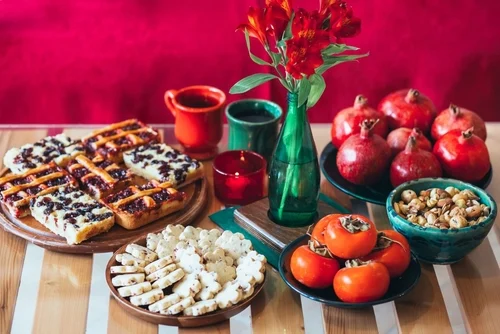
Quick answer: Yalda Night 2026 begins on the evening of Monday, December 21, and continues into Tuesday, December 22. Also known as Shab-e Yalda or Shab-e Chelleh, it marks the seasonal shift from autumn to winter. Families gather for symbolic foods, poetry, and storytelling, often staying up late together to welcome the year’s longest night.
Pomegranate seeds scattered across a tablecloth. A grandparent reaching for a worn copy of Hafez’s poetry. Cousins piled onto a couch, trading stories that get taller with every retelling. For many Iranian and Afghan families, this is what the last night of autumn looks like.
You might remember scenes like this from childhood. You might see them every December in your own community, or in a neighbor’s home down the street. Or maybe you’re hearing about Yalda Night for the first time and wondering what all the warmth is about.
This guide explains when Yalda Night 2026 falls, what it means, and how people observe it — whether they’re gathered in Tehran, Kabul, or a living room in the United States. You’ll also find practical ways to mark the occasion yourself, and to stay close to loved ones celebrating somewhere else entirely.

What is Yalda Night?
Yalda is a traditional celebration marking the last night of autumn and the arrival of winter. At its heart are themes of light, warmth, hospitality, and gathering — the kinds of things that matter most when the days grow short and cold.
The United Nations Educational, Scientific and Cultural Organization (UNESCO) has recognized Yaldā/Chella’s shared cultural heritage, noting that it’s practiced in both Iran and Afghanistan and passed down informally through families, generation after generation. It’s not a holiday confined to any single institution or region — it lives in homes, carried forward by the people who choose to keep it.
You’ll likely encounter a few different names for the occasion, depending on who’s telling you about it:
- Shab-e Yalda — a common name used widely among Iranian communities.
- Shab-e Chelleh — another term tied to the Persian calendar, referring to the “forty” nights of deep winter that follow.
- Shab-e Chella — a form often used in Afghanistan.
None of these is the single “correct” English spelling. They reflect regional language and tradition, not competing versions of the same holiday.
When is Yalda Night in 2026?
| Detail | Information |
| Evening celebration | Monday, December 21, 2026 |
| Continues into | Tuesday, December 22 |
| Iranian calendar date | Night of 30 Azar 1405 |
| Seasonal significance | Transition from autumn to winter |
If you’re in the US and looking for a community event, don’t be surprised if it’s scheduled for the weekend closest to December 21 rather than that exact evening. Organizers often work around calendars, venue availability, and work schedules — the celebration’s spirit travels well, even if the date shifts by a few days.

Is Yalda always on the same date?
Not exactly. Yalda Night is tied to the solar calendar and the astronomical winter solstice, not a fixed Gregorian date. That means it typically falls around December 20 or 21, depending on the year (taghvimshamsi.ir). Don’t assume it’s December 21 every single year — check a current Iranian calendar if you want precision for a specific year.
Where is Yalda celebrated?
Yalda is observed in Iran and Afghanistan, and it travels with diaspora communities to places like the United States and Canada. Some related traditions appear in other communities as well, shaped by shared regional history.
The way Yalda looks can vary widely — by language, region, and even from one household to the next. Some families lean into elaborate spreads and all-night gatherings. Others keep it simple: a phone call, a shared poem, a handful of pomegranate seeds. UNESCO’s recognition of the tradition reflects its reach across both Iran and Afghanistan, not a holiday owned by one nationality or uniformly practiced everywhere within either country.
Afghan families bring their own customs to Yalda, from specific foods to particular ways of telling stories through the night. These perspectives aren’t a footnote — they run through the whole tradition, not just one section of it.

How do people celebrate Yalda Night?
Gathering with family and elders
The evening is built around togetherness. Families gather — often at the home of grandparents or the eldest relative — to share a meal, swap memories, and simply be in each other’s company. Staying up late is closely associated with the occasion, as the long night itself is part of what’s being marked. That said, nobody’s required to stay awake until sunrise. The point is making time together, not passing an endurance test.
Reading poetry and telling stories
Poetry holds a special place in many Iranian celebrations, and the 14th-century poet Hafez is central to Yalda gatherings in particular. One well-known custom is fal-e Hafez: someone opens Hafez’s collected poems, known as the Divan, to a random page and reflects on what the verse might mean for them. It’s best understood as a reflective, playful tradition — a way of sparking conversation and connection — rather than a literal method of predicting the future.
Music, games, and conversation
Beyond poetry, Yalda evenings often include music, card games, and plenty of conversation. The exact mix depends on the household. Some families put on traditional songs and dancing; others keep things low-key with board games and storytelling. There’s no single “correct” way to fill the hours — the gathering itself is what matters.

What foods are served on Yalda Night?
| Food | How to introduce it |
| Pomegranates | A familiar red fruit on many Yalda tables |
| Watermelon | Another recognizable fruit associated with the celebration |
| Nuts and dried fruit | Foods shared throughout the evening |
| Sweets | Varieties differ by household and region |
| Soups or other dishes | Some gatherings include a fuller meal |
UNESCO’s documentation associates red fruits like pomegranates and watermelon with warmth, one of several symbolic elements on a traditional Yalda table. That symbolism is worth noting, but it isn’t universal — not every household assigns the same meaning to the same food, and there’s no basis for claiming any dish wards off illness or guarantees good fortune.
Think of the Yalda table as a gesture of welcome rather than a mandatory shopping list. Smaller gatherings, simplified spreads, and ingredient substitutions are all part of how real families celebrate.
How to celebrate Yalda Night in the US
You don’t need a large Iranian or Afghan community nearby to mark the occasion. Here’s how to start:
- Ask about your family’s traditions. If you have relatives who celebrate, ask which foods, stories, or poems matter most to them. Specifics make the evening feel personal.
- Prepare a simple table. Choose foods that fit your household and your budget. A bowl of pomegranate seeds and some nuts goes a long way.
- Share a poem or story. If you don’t read Persian, look for a reputable English translation of Hafez to read aloud.
- Invite friends to learn. A short explanation of what Yalda means and what to expect turns curious guests into willing participants.
- Look for community events. Cultural organizations, libraries, and university programs — including Persian studies departments — sometimes host public Yalda celebrations. Search for confirmed 2026 listings closer to the date, since schedules aren’t typically set months in advance.

A first Yalda gathering, step by step
Picture someone hosting Yalda for the first time. They invite a few friends over, set out a bowl of pomegranate seeds and mixed nuts, and ask a relative to recommend a favorite poem to read aloud. Before serving dinner, they explain, in a few sentences, why the evening matters to their family and what their guests can expect.
Nobody needs a elaborate production for this to work. A meaningful Yalda gathering can be entirely simple, and it can still carry real weight for the people at the table.
Staying connected with loved ones abroad on Yalda
For families spread across borders, Yalda is also a chance to close the distance for an evening, even without being in the same room. A few ways to do that:
- Coordinate a call that works with each household’s local time.
- Read the same poem together, even from different continents.
- Exchange voice recordings of family stories, so they can be replayed long after the night ends.
- Share photos of each household’s Yalda table.
- Ask an older relative to teach a tradition to the younger generation, over video if needed.
Gifts or financial support sometimes come up around holidays like this, and that’s entirely optional — Yalda doesn’t call for it as a custom. What matters most is the time and attention families give each other, wherever they happen to be.

Is Yalda the same as Nowruz?
No. They’re distinct celebrations with different timing and different customs.
| Celebration | Main seasonal connection |
| Yalda | End of autumn and arrival of winter |
| Nowruz | Arrival of spring and the Persian New Year |
Yalda marks the longest night of the year and leans on themes of light, gathering, and warmth against the cold. Nowruz, celebrated around the March equinox, centers on renewal and the start of a new year. Both matter deeply to Iranian and Afghan communities, but conflating them overlooks what makes each one distinct.
Frequently asked questions about Yalda Night
When is Yalda Night in 2026?
Yalda Night 2026 begins on the evening of Monday, December 21, and continues into Tuesday, December 22, corresponding to the night of 30 Azar 1405 on the Iranian calendar.
What is the meaning of Yalda Night?
Yalda marks the last night of autumn and the arrival of winter. It centers on themes of light, warmth, hospitality, and gathering with family.
Who celebrates Yalda?
Yalda is observed in Iran and Afghanistan, as well as by diaspora communities in places like the United States and Canada. Customs vary by region, language, and household.
Why are pomegranates and watermelon associated with Yalda?
These red fruits are traditionally linked to warmth on the Yalda table, though symbolism and specific dishes vary between families and communities.
Why do people read Hafez on Yalda Night?
Poetry holds an important place in Iranian celebrations, and many families practice fal-e Hafez — opening a copy of Hafez’s poetry to a random page for reflection. It’s a cultural custom meant to spark conversation, not a literal fortune-telling method.
Do you have to stay awake all night?
No. Staying up late is associated with the tradition since it marks the year’s longest night, but it’s not a requirement. Many families simply spend as much of the evening together as they can.
How can someone unfamiliar with Yalda participate respectfully?
Ask questions, listen to how the people around you celebrate, and avoid assuming one household’s customs apply to everyone. A simple, sincere effort to learn goes further than trying to recreate every tradition perfectly.
Making time for what matters
At its core, Yalda Night is about food, stories, and conversation shared with the people you care about most. Families have carried this tradition across generations and across borders, adapting it along the way without losing what makes it meaningful. Whether you’re keeping a lifelong custom alive or discovering it for the first time this December, the heart of Yalda is simple: make time for each other, however that looks for you.


