

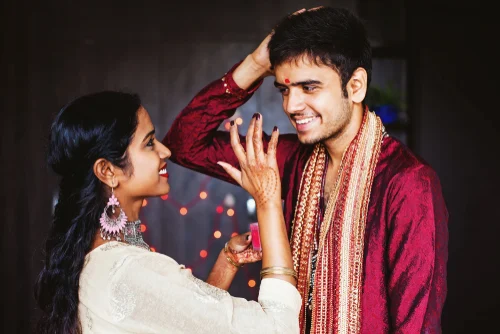
TL;DR: Bhai Dooj is a Hindu festival honoring the bond between brothers and sisters, observed on Kartika Shukla Dwitiya, the second day of the bright lunar fortnight of Kartika. Sisters apply a tilak to their brothers’ foreheads, share a meal, and exchange gifts—often money. Celebrated under different names across India and Nepal, it follows closely after Diwali.
If you’ve spent time around Indian or Nepali communities in the fall, you may have noticed celebrations that look a little like a smaller, family-focused Diwali encore. That’s likely Bhai Dooj, a festival dedicated entirely to the relationship between siblings.
For families living in the United States, Bhai Dooj offers a meaningful way to stay connected to loved ones back home, even across time zones and oceans. Whether you’re planning a video call tilak ceremony or mailing a gift back to a sibling abroad, understanding the festival’s origins and customs can help you celebrate it with intention.
This guide walks through what Bhai Dooj means, the story behind it, how families celebrate, and practical ways to honor the tradition from the United States.

What Does Bhai Dooj Mean?
Bhai Dooj translates roughly to “brother’s second day.” The word “Dooj” comes from “Dwitiya,” the Sanskrit term for the second lunar day of a fortnight. The festival falls on Kartika Shukla Dwitiya—the second day of the bright (waxing) fortnight of the Hindu month of Kartika.
Bhai Dooj goes by several names depending on region and language:
- Bhaiya Dooj in North India
- Bhau Beej or Bhav Bij in Maharashtra
- Bhai Phota or Bhai Phonta in Bengal
- Bhai Tika in Nepal, where it marks the final day of the Tihar festival
It’s also known by the Sanskrit names Yama Dwitiya (or Yamadvitiya) and Bhratri Dwitiya, both pointing to the mythological story behind the celebration.
How Is Bhai Dooj Connected to Diwali?
Bhai Dooj typically falls within the days following Diwali, as part of a broader cluster of autumn festivals. In 2026, for example, the sequence in New Delhi ran as follows: Dhanteras on Friday, November 6; Narak Chaturdashi and Lakshmi Puja (Diwali) on Sunday, November 8; Govardhan Puja on Tuesday, November 10; and Bhai Dooj on Wednesday, November 11.
That means Bhai Dooj landed three days after Diwali in 2026, not two. The exact gap between the two festivals shifts slightly from year to year based on the lunar calendar, so “two days after Diwali” is a helpful rule of thumb, but it doesn’t hold precisely every year. Bhai Dooj always follows Govardhan Puja by one day, regardless of the specific dates involved.
Because timing depends on lunar calculations and can vary by location, families are encouraged to check a local panchang (Hindu astrological calendar) for the exact date and auspicious timing in their area.
What Is the Story Behind Bhai Dooj?
The most widely recognized origin story comes from the Skanda Purana, specifically the Kartikamasa-mahatmya section of the Vaishnava Khanda (Chapter 11, “The Efficacy of Yamadvitiya”). According to this account, Yamuna—a river goddess—repeatedly invited her brother Yama, the god of death, to visit and eat at her home. His responsibilities kept him away for a long time, but he finally visited on Kartika Shukla Dwitiya.
When Yama arrived, Yamuna bathed him, anointed him with sacred marks, and prepared a meal in his honor. In return, Yama gave her ornaments and clothing. According to the Skanda Purana, the text states that anyone who eats at their sister’s home on this day is protected from an untimely death—a belief many families continue to hold as part of the tradition today.
A related version of the story, found in the Markandeya Purana, identifies Yama and Yamuna as twins, children of the sun god Surya (also called Vivasvan) and his wife Sanjna.
A second, widely told story involves Lord Krishna visiting his sister Subhadra after defeating the demon Narakasura. While this version is popular in family retellings, it hasn’t been traced back to a specific scriptural source—so it’s best understood as a beloved folk tradition rather than a documented Puranic account.

How Do Families Celebrate Bhai Dooj?
While customs vary by family and region, a typical Bhai Dooj celebration follows a similar pattern:
- Morning preparations. Many families begin the day with a ritual bath. Those near the Yamuna River sometimes take a dip, known as Yamuna snan, as part of their observance.
- The tilak ceremony. In the afternoon, during an auspicious window determined by the local panchang, the sister applies a tilak to her brother’s forehead using roli (a red powder) mixed with akshat (unbroken rice grains).
- Aarti. The sister performs an aarti, circling a lit lamp in front of her brother as a blessing.
- A shared meal. The sister prepares a special meal, often accompanied by sweets, and offers a prayer for her brother’s long and healthy life.
- Gift exchange. Brothers traditionally give gifts in return—the Skanda Purana mentions garments and ornaments, though in modern celebrations, money is a common and cherished gift.
Some households extend the ritual to include worship of Yama himself, along with Chitragupta (Yama’s scribe) and the Yamadutas (Yama’s messengers), though this additional step varies from family to family.
How Do Regional Celebrations Differ?
Bhai Dooj traditions take on distinct local flavors across India and Nepal:
- Maharashtra: The brother sits inside a square drawn by his sister on the floor. In some households, he bites into a bitter karith fruit before the tilak is applied, a custom tied to the Narakasura legend.
- Bengal: The sister fasts until the ceremony is complete. She applies a “phota” made of sandalwood paste, kajal, and ghee instead of the roli-rice tilak used elsewhere.
- Nepal: As the final day of Tihar, Bhai Tika features a seven-colored tika and a garland made of makhamali (globe amaranth) flowers, followed by sweets, walnuts, and sel roti, a traditional rice doughnut.
- Mathura: Brothers and sisters bathe together at Vishram Ghat along the Yamuna River and visit the Yama-Yamuna temple to worship.
What If Someone Doesn’t Have a Sister?
The Skanda Purana addresses this directly. According to the text, a person without a sister can observe the tradition by sharing a meal with a father’s sister, an elder sister, a paternal uncle’s daughter, a mother’s sister, or a maternal uncle’s daughter. If none of these relatives are available, the Purana even extends the custom to include a woman regarded as a sister in spirit, or symbolic observance with a cow, river, or forest.
How Can Families in the United States Celebrate Bhai Dooj?
Distance doesn’t have to get in the way of honoring the bond at the heart of Bhai Dooj. Families in the United States often adapt the tradition in practical ways:
- Video calls for the tilak ceremony. Siblings separated by distance can still perform the tilak ritual together over a video call, with each person following the steps on their own end.
- Mailing gifts ahead of time. Since shipping takes time, many families send gifts, sweets, or tilak kits in advance so they arrive before the festival date.
- Celebrating on the nearest weekend. When the exact date falls on a weekday and schedules don’t align, some families shift their celebration to the closest weekend.
- Sending money as a gift. Money remains one of the most common and meaningful gifts exchanged between siblings on Bhai Dooj, whether given in person or sent digitally across borders.
For siblings separated by countries, sending money for Bhai Dooj isn’t just about tradition. It’s also about making sure a gift arrives safely and quickly, no matter where a brother or sister lives. A reliable money transfer service can help make that exchange simple, letting you focus on the celebration instead of the logistics.

Keeping the Tradition Alive, Wherever You Are
Bhai Dooj is a reminder that some relationships are worth celebrating on their own, outside the shadow of bigger holidays. Whether your family follows the Maharashtrian square-sitting tradition, the Bengali phota, or the Nepali Bhai Tika, the heart of the festival stays the same: gratitude for the people who’ve been there since childhood.
If your celebration this year involves sending a gift across borders, take the time to check timing, delivery options, and fees in advance so your gift arrives when it matters most.
Frequently Asked Questions About Bhai Dooj
What is the difference between Bhai Dooj and Raksha Bandhan?
Bhai Dooj centers on a tilak ceremony and shared meal at the sister’s home, tied to the legend of Yama and Yamuna. Raksha Bandhan, observed in a different month, involves a sister tying a rakhi thread around her brother’s wrist as a symbol of protection.
When does Bhai Dooj typically fall each year?
Bhai Dooj falls on Kartika Shukla Dwitiya, the second day of the bright lunar fortnight of Kartika, which generally places it within days of Diwali. Because it follows a lunar calendar, the exact date shifts each year, so checking a local panchang is the most reliable way to confirm timing.
Do people only celebrate Bhai Dooj with biological siblings?
No. According to the Skanda Purana, those without a sister can observe the tradition with a father’s sister, an elder sister, a cousin, or another woman regarded as a sister.
Is the Krishna and Subhadra story part of the official Bhai Dooj scripture?
Not according to traceable sources. While many families share the story of Krishna visiting his sister Subhadra after defeating Narakasura, this version hasn’t been traced to a specific scriptural text. The Skanda Purana account of Yama and Yamuna is the most documented origin story.
What do siblings typically give each other on Bhai Dooj?
Traditionally, brothers give sisters gifts of clothing or ornaments, as described in the Skanda Purana. In modern celebrations, money is a widely exchanged gift between siblings in both directions.


