

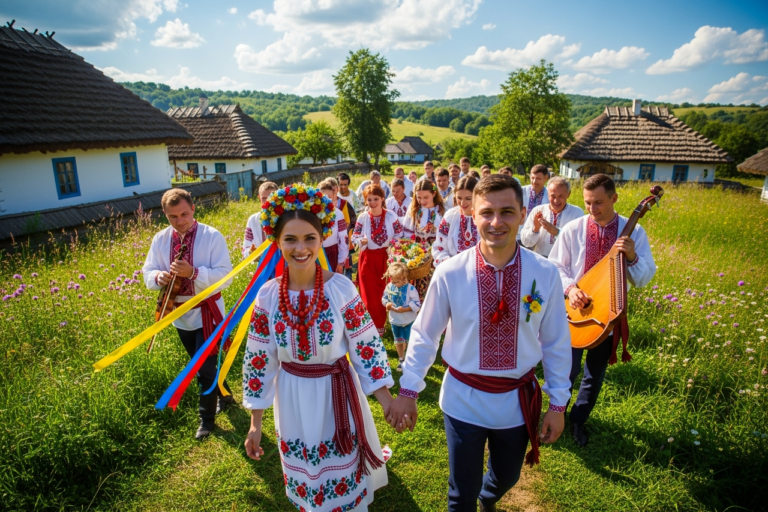
Key Highlights
Here are some key highlights of Ukrainian wedding customs:
-
The traditional Ukrainian wedding is a big event that goes on for several days. It starts with things like matchmaking and getting engaged. Many of these have strong meaning.
-
On the wedding day, there are special things that happen. For example, there is paying a ransom for the bride. The couple also steps together on an embroidered cloth called a rushnyk.
-
Getting blessings from both the bride’s and the groom’s parents is very important during the wedding ceremony.
-
One special food is the wedding bread, or korovai. People bake it with fancy designs, and it stands for a happy life for the couple.
-
There will be music, folk dances, and party songs like “Mnohaya Lita” during the celebration. These are big parts of the wedding day.
-
Ukrainian wedding traditions are a mix of old folk customs and religious acts, which is why the special day is different from others and hard to forget.
These parts all work together to make the Ukrainian wedding ceremony full of meaning and joy.
Introduction
Ukrainian wedding traditions bring together stories from old times, bright colors, and deep meaning. A traditional Ukrainian wedding is more than a wedding day. It is a long journey that happens across more days, with many steps that help two families join their lives. This special wedding ceremony has parts that start from the matchmaking and last until the last dances. Every moment in the wedding is important for the new couple and their families. Do you want to know about the wedding traditions that make Ukrainian weddings different? Let’s look at what makes a traditional Ukrainian wedding so full of life.
Key Elements of Ukrainian Wedding Traditions
The heart of Ukrainian wedding traditions is a group of special events that show the couple’s journey into married life. These events come in three main cycles. There is the pre-wedding, the wedding, and the post-wedding time. Each has different rituals. This order makes sure each moment is special, from when the couple first agrees to marry all the way to the last big party.
On the wedding day and during all the celebrations, you see both joy and deep, meaningful customs. These traditions have come from older generations. They are what make a traditional Ukrainian wedding special for everyone there. Now, let’s take a closer look at some key elements of these Ukrainian wedding traditions.
The Role of Engagement and Matchmaking
Before the wedding ceremony, the first step for a young couple would be to have matchmaking. In the past, a young man would visit the bride’s house with some respected married men called starosty. They would sometimes bring bread and other things. This visit was important because the young man’s family asked for the bride’s family’s blessing for the wedding.
If the girl’s parents said yes, they would give their blessing. The bride would give the groom a special embroidered towel called a rushnyk. She would also tie towels to the mother and father of her soon-to-be husband. This showed that she accepted the young man. But if she did not want to get married, she would give him a pumpkin. This was a way to say no in a clear way.
Next came the engagement. Both families would meet and make the agreement official. People would often have a meal together and exchange gifts. The parents would bless the young couple, set the date, and plan for the wedding ceremony to take place.
Family Blessings and Their Importance
In Ukrainian culture, the blessing of the marriage from family members is very important. It is not just a small part of the wedding. This is one of the key traditions. Before the couple leaves for the church, they get a special blessing from their parents. This heartfelt moment usually happens at the bride’s home. Both of the parents get together and wish the couple a happy life.
The bride’s parents and the groom’s party have their own roles in this custom. The bride’s parents usually give their blessing first. They use icons and bread. These things stand for their support and good thoughts for the couple’s happy life ahead. This shows they give their approval and are ready to trust their daughter to a new family.
In the same way, the groom’s parents give their blessing too. They welcome the bride into their family. Both families share this blessing. This brings the two families together. It shows that in Ukrainian culture, a wedding is not just between two people, but two families. The support and blessing from all family members helps the couple build a good and strong future together.
The Tradition of Paying the Ransom for the Bride
One of the most fun and lively wedding traditions is the “buying out” or paying a ransom for the bride. This old custom happens on the morning of the wedding, when the groom and the people with him come to the bride’s house. Before the groom can see the bride, he has to show that he is good enough. The family members and friends of the bride block the door to test him.
The bridesmaids and the family members like to joke and make deals with the groom. They come up with a group of tasks and challenges for him. These often include the groom questions where he has to say how much he knows about the bride, sing a song, or even give small gifts and sometimes money to pay for his bride. All of this helps show his good intentions and makes everyone laugh.
The best man and the other friends of the groom help him get through these funny obstacles.
-
The groom may be told to say nice things about his bride with compliments.
-
He might be asked to pick out his bride’s kiss from a few lipstick marks on a piece of paper.
-
There could be a “fake” bride, which is usually a man dressed up with a veil, that makes this funnier.
When the ransom is paid and he does the tasks, the groom can go into the bride’s house.
This morning of the wedding is always full of good memories and laughter for everyone. Some wedding traditions like this bring people closer and help start the
Symbolic Rituals in Ukrainian Weddings
Ukrainian weddings have many rituals that mean a lot and link the couple to Ukrainian culture. Every wedding ritual is an important part of the wedding ceremony. They give blessings, show unity, and share hopes for a happy life ahead. People have kept these traditions and passed them on for hundreds of years.
You will see things like embroidered cloths and golden crowns at these weddings. These are not just pretty things to look at. Each one is a big part of the wedding ceremony. They turn the wedding into something more important and full of meaning. Here are some of the main symbolic rituals you might see in Ukrainian weddings.
Stepping on the Rushnyk (Embroidered Cloth)
A big part of the wedding ceremony is the rushnyk. This is a traditional embroidered cloth that means a lot in Ukrainian culture. During the wedding, the couple stands on a rushnyk. It shows their new life, shared path, and the future they will have together. People say that the one who puts a foot on the cloth first will be in charge at home.
This beautiful piece is often made by hand. The bride or her mother makes it, and it’s part of her dowry. The patterns you see on the rushnyk are not just there to look pretty. They are a symbol of purity and carry hidden hopes for the couple’s life ahead. Many of these rushnyks have birds in pairs to stand for the wedding couple.
Besides the main rushnyk, you see more of these traditional embroidered cloths in the celebration. They have different uses that show how important the art is in Ukrainian culture.
-
A rushnyk joins the couple’s hands, which tells everyone they are now together.
-
Another wraps the wedding bread, called korovai.
-
Parents use one to hold icons when they bless the new couple.
Exchanging Rings and Their Meaning
The exchanging of rings is a big moment in the Ukrainian marriage ceremony. This is also true for many other cultures. But in the Orthodox Church, this tradition has its own special ways. The priest first gives a blessing to the rings on the altar. These rings show never-ending love and commitment.
In the ceremony, the priest hands the rings to the couple. Then, the best man, who is called the starosta, swaps the rings between the bride and groom’s fingers three times. This is all done in the name of the Holy Trinity. It means that God blesses their union. It is the part when the couple steps toward their new life together.
In usual Ukrainian Orthodox weddings, people wear wedding bands on the ring finger of the right hand, not the left hand. People believe the right hand is the hand of blessing and power. The round rings show a promise that has no start and no end. It is a love that goes on forever.
The Divine Crown Ceremony
The crowning is one of the most beautiful and important parts of a traditional Ukrainian wedding in the church ceremony. During this time, fancy crowns, called the divine crown or vinchannya, are put on the heads of the bride and groom. These crowns show that they are like a king and queen of their new life and family.
The priest walks with the couple around the tetrapod table three times. This walk means the couple is taking their first steps together in marriage, with the church to guide them. While they walk, the choir sings songs. The best man and maid of honor often hold the crowns over the couple’s heads. This part of the church ceremony shows the couple are now ready to give all for each other in their new life.
There are prayers, readings, and the sharing of a cup of wine, which means the couple will share life together. At the end, the priest blesses the couple with holy water. This is to send them on their way with good wishes and the church’s care. The divine crown time is a special and lasting part of a traditional Ukrainian wedding.
Ukrainian Wedding Ceremonies: Church vs. Civil
In modern Ukraine, couples have the choice between a religious church ceremony and a legal civil ceremony, with many choosing to have both. The church ceremony is a deeply spiritual and traditional marriage ceremony, rich in ancient rituals and symbolism. In contrast, the civil ceremony is a more straightforward, legal process that officially registers the marriage with the state.
Each type of ceremony has its own unique process and significance, reflecting different aspects of a couple’s journey. While one is steeped in faith and tradition, the other is a modern legal necessity. On the wedding day, many couples will complete the civil registration first, followed by the more elaborate church service and reception.
|
Feature |
Church Ceremony |
Civil Ceremony |
|---|---|---|
|
Venue |
A church, typically Orthodox |
A government registry office (ZAGS) |
|
Officiant |
A priest |
A state official |
|
Focus |
Spiritual union before God, rich in rituals like crowning |
Legal recognition of the marriage |
|
Duration |
45-60 minutes |
15-30 minutes |
|
Legal Status |
Not legally binding on its own |
Legally binding marriage contract |
What Happens During a Traditional Church Ceremony
A traditional church ceremony is a special and serious event. It is full of many years of Orthodox Christian faith and traditions. The wedding ceremony starts with the Betrothal. Here, the priest blesses the rings and puts them on the right hands of the couple. This part of the church service often takes place at the entrance of the church. It shows that the couple is about to start a new chapter in their life.
The most important part of the church ceremony is called the Rite of Crowning. The bride and groom stand on a rushnyk, which is an embroidered cloth. Crowns are held over their heads. This means they are seen as the king and queen of their new family. It also shows they are ready to give to each other and stand by one another. The couple drinks from a common cup of wine. This says their life now will have both good and bad times, and both will share these moments together.
The church service ends with the priest guiding the couple around the altar three times in a special walk. These are their first steps as husband and wife. The wedding day is centered around this spiritual event. The couple asks for God’s blessing on their union. This ceremony is a strong show of faith, love, and promise to each other.
The Civil Ceremony Process
The civil ceremony in Ukraine is the part of getting married that is official by law. This event happens at a state office called ZAGS. The name ZAGS comes from Acts of Civil Status Registry Office. Unlike the bigger church service, this marriage ceremony is usually quick. The focus is on the things needed by the law to be married.
When the wedding couple comes in, their witnesses are with them. They all go into a special room for the ceremony. A state worker will give a short speech about marriage and family. Then, the couple is asked if they agree to get married to each other. When both say “yes,” they sign a big book with their names.
After they sign, they get a marriage certificate. It is a piece of paper that says they are now husband and wife by law. Some people keep this event small with only a few close friends or family there. Others like to have their loved ones and may put rings on each other’s fingers again. For most, this part is needed before they go on to have the church service and later have a big party or reception.
How Ceremonial Differences Reflect Ukrainian Culture
The presence of both church and civil ceremonies is a strong sign of Ukrainian culture. People in Ukraine like to honor their long history of faith, but they also need to follow the rules of modern life. This mix shows how the country has grown over time. It keeps old wedding traditions while adding new ways to get married. Many couples in Ukraine choose to have both ceremonies. They feel one is for God, and the other is for the government.
Different regions of Ukraine may see and value each ceremony their own way. In western Ukraine, the church ceremony is often very important. People there think it is the “real” wedding. In other places, like bigger cities, the civil ceremony is often the main one. The church wedding becomes a personal choice for some people.
All these ways show how wedding traditions in Ukrainian culture change in each area. People in different regions of Ukraine follow what they think is best or most meaningful for them.
-
The church ceremony stays important because Orthodox and Catholic faiths have a strong influence.
-
Having a civil ceremony is needed because of rules from the Soviet era. It is also part of the way the modern Ukrainian state works.
-
When couples do both, they are trying to honor every part of what makes them who they are—national, spiritual, and personal.
Iconic Foods and Breads at Ukrainian Weddings
No Ukrainian wedding is complete without its famous foods. One key item is the special wedding bread called korovai. It is not just a normal bread; the korovai is a piece of art and stands for good things like community, wealth, and hopes for the couple. At many weddings, this wedding bread is the star of the table, even more than the wedding cake you see today.
The korovai is made with wheat flour, and other dishes also use it too. These foods are a big part of the event. The work that goes into baking and showing this bread is just as important as the wedding day itself. Now, let’s look at what makes the Ukrainian wedding cake and other foods so special, and how every bite has meaning.
The Korovai: Symbolism and Baking Rituals
The korovai is a special symbol at a Ukrainian wedding. This wedding bread is a big, round loaf that stands for a happy life, community, and new beginnings. People decorate it with dough shapes. It is not just a simple cake. Its meaning comes from old farming and village customs.
The making of this wedding bread is important too. In the past, married women from the bride’s village would come together to bake it. These women, known for having a happy life and marriage, would sing songs as they worked the wheat flour. People thought that the joy in their lives would go into the bread. This would bring good luck to the new couple.
The bread is full of meaning. Each piece of decoration is a wish for the couple.
-
Birds, such as doves, stand for love and faithfulness.
-
The sun and the moon are signs of a good and bright time ahead.
-
Wheat stalks show wishes for wealth and plenty.
At the end, they cut the korovai and give everyone some. In this way, the couple’s joy is shared with all of their guests.
Other Traditional Wedding Dishes and Sweets
While the korovai is the main wedding bread, a Ukrainian wedding is known for having lots of food. There is a big table filled with many kinds of traditional wedding dishes. Everyone will find many tasty appetizers, hearty main dishes, and nice sides that show off Ukraine’s food history. No one will leave hungry.
There are other special breads made for the wedding, too. These include shyshky (they look like pinecones) and dyven. These smaller breads are sometimes given to guests or used with invitations. Shyshky are shaped like pinecones because they mean growth and starting a new family.
These days, you will also see a modern Ukrainian wedding cake at many weddings. But it is placed next to the korovai—the true wedding bread—instead of taking its place. The dessert table can be full of sweets, small cakes, and fruits. This helps finish the meal in a sweet way and gives the couple a happy start.
Customs for the Bride and Groom’s Families
The coming together of two people in a Ukrainian wedding also brings together two families. There are special customs and rituals that honor the bride’s parents and the groom’s party. These wedding traditions show a lot of respect between the two sides. They help the families join as one and give the new couple a strong support system.
From the very first blessing of the marriage to the ways people give gifts, the families are at the heart of every step. They are not just there to help. Their role is key, and they play a big part in the wedding day itself. Now, let’s look at how these family-focused customs work.
Parental Roles and Blessings for the Couple
Parental roles in a Ukrainian wedding go far beyond just being the hosts. The biggest part for both sides is the blessing of the marriage. Both the bride’s family and groom’s parents take part in giving this blessing. It is given with religious icons and bread. This is seen as a strong moment that gives approval to the marriage. It helps wish the new couple a good and bright future.
On the morning of the wedding, before any ceremony begins, the couple kneels in front of their parents to get this blessing of the marriage. The bride’s parents give the blessing first. Then, the groom’s parents give theirs. This is a way for parents to pass on their care. It also means that a new person is being welcomed into the family.
Parental involvement goes on through the day. Parents help the couple step by step—from when the groom’s party gets to the bride’s home, to when the parents greet the couple with bread and salt after the ceremony. All these acts show that marriage is shared with everyone. It is not just about two people but is a special time for both families and a way for them to support and cheer for the new pair.
Gift-Giving Traditions Between Families
Gift-giving is an important part of Ukrainian wedding customs. It helps bring two families together and shows their support for the young couple. In the past, families started this by giving a posah, or dowry. The bride’s family gave things like linens, clothing, and household items. These were to help the new couple get set for their home.
There are also many times during Ukrainian weddings for giving gifts. When the couple gets engaged, the groom will usually give gifts to the bride’s family. Later at the wedding party, there is a time for family members and other guests to give gifts to the young couple. This often happens in front of everyone, with guests saying kind words and sharing their hopes for the couple.
Another special part of Ukrainian wedding customs is when the bride gives gifts to her new in-laws. This shows she has respect for them and is ready to join the family.
-
The bride normally gives embroidered towels (rushnyky) to her new parents-in-law.
-
She may also offer small gifts to other important members of the groom’s family.
-
This is a way to show love for her new family and build good feelings from the start.
Music, Dance, and Celebration
Music and dance are at the heart of a Ukrainian wedding ceremony. They turn the special day into a happy and lively time for all. When guests walk in, to the time they say bye at the end, there is music in the air. It comes from wedding traditions that people love. There are folk songs and dances that make people get up and join in.
The music at a Ukrainian wedding covers a lot. You hear the quiet church service songs, then the loud and fun beats at the party. You’ll notice songs like the “Ukrainian wedding march” and the joyful “Mnohaya Lita” that play during big moments of the day. These songs make everyone feel close and help this be a day to remember.
Traditional Ukrainian Wedding Songs
Traditional wedding songs play a big part in the Ukrainian wedding ceremony. They are not just music playing softly in the background. They help tell the story of the day through their words. The lyrics explain the traditions, share advice with the wedding couple, and show how everyone is feeling at that time. One part that stands out is when a group of women, called svashky, sings while the bride’s hair gets braided.
When the wedding gets to the church service, the music changes. It now features beautiful and calm Orthodox hymns. After all the official parts are finished, things turn festive. You may hear the famous Ukrainian wedding march then. This song helps set the mood for the party that follows.
At any wedding ceremony in Ukraine, “Mnohaya Lita,” or “Many Years,” is one of the most important songs. Guests sing this uplifting song over and over, usually after people raise their glasses for toasts. This song is a way for everyone to wish the couple many years of a happy life, good health, and love together.
Folk Dances and Participatory Games
The party really gets started with traditional folk dances and games that get everyone involved. After the main dinner and speeches, people are expected to get up and join the dancing. Sometimes, you will see professional folk dancers do high-energy dances like the Hopak. But the best part is when everyone joins the fun on the dance floor.
All night, the master of ceremonies, or the tamada, will guide the guests through games and activities. These games are made to break the ice and get people to join in. They are fun, sometimes a little bit competitive, and people always look forward to them.
One of the moments people wait for is the single ladies dance and taking off the bride’s veil. This has a few parts:
-
The veil is taken off the bride to show she is now married.
-
The bride wears a special headdress called an ochipok.
-
The bride dances with the single ladies and gives each of them a piece of her veil for good luck in finding a husband.
Variations in Ukrainian Wedding Traditions by Region
Many wedding traditions in Ukraine are common in more than one place, but every region has its own way of doing things. The country has different areas, and each has its own customs, songs, and changes to the main rituals. This mix makes wedding traditions in Ukraine even richer.
You will notice the biggest difference between the weddings in cities and those in country towns. In rural places, weddings stay closer to old customs, and everyone in the town often joins in. In big cities, people might add new, Western-style ways to their weddings. Now, let’s see how wedding traditions can be different in different regions.
Differences between Urban and Rural Celebrations
The setting of a wedding, whether in a bustling city or a quiet village, significantly influences its style and traditions. Urban celebrations in cities like Kyiv or Lviv often blend traditional elements with modern, Western trends. You might see a bride in a contemporary wedding dress, a reception in a fancy restaurant, and a shorter, more streamlined schedule of wedding events.
In contrast, rural celebrations tend to adhere more closely to age-old wedding traditions. These weddings are often larger community affairs, sometimes lasting for several days. The entire village might be involved in the preparations and celebrations, with a stronger emphasis on folk music, traditional dress, and time-honored rituals like the baking of the korovai at home.
While both types of celebrations honor the core tenets of a Ukrainian wedding, the expression of these traditions can look quite different.
|
Aspect |
Urban Celebrations |
Rural Celebrations |
|---|---|---|
|
Duration |
Typically a one-day event. |
Can last for two to three days. |
|
Venue |
Restaurants, banquet halls. |
The family home, community hall. |
|
Guest List |
Often a more curated list of family and friends. |
Can include the entire village or community. |
|
Traditions |
A mix of traditional and modern/Western elements. |
Strong adherence to traditional rituals and customs. |
|
Attire |
Modern wedding dresses and suits are common. |
More likely to feature traditional embroidered clothing. |
Unique Customs Found in Western, Central, and Eastern Ukraine
When you look at the different regions of Ukraine, you find that each one has its own special wedding traditions. In western Ukraine, people live close to eastern Europe. There are strong Hutsul, Lemko, and Boyko roots there. Because of this, wedding traditions in western Ukraine are very unique. For example, Hutsul weddings are known for bright clothing, horse-drawn carts, and their own music style.
Central Ukraine is seen as the heart of the country. Here, traditional Ukrainian wedding customs, such as the korovai rituals and blessings from parents, are very strong. Many people think of these classic traditions when they picture a traditional Ukrainian wedding in their mind.
In eastern Ukraine, there is a bit more Russian influence. So while you will still see many core Ukrainian wedding traditions, you can notice some changes in things like songs, games, and the way the ceremonies are done. These facts show that the regions of Ukraine each have their own wedding traditions. This blend makes the country’s cultural story rich and vivid.
Conclusion
To sum up, Ukrainian wedding traditions show a lot of history and culture from Ukraine. There are many old customs and many special ways to do things. From the start, when two people get engaged, to the big parties full of music and dancing, every part helps bring families together and keep the heritage alive. When we learn about these traditions, we get to know more about Ukrainian culture. This also helps couples bring special ideas into their own weddings. You might be planning your wedding or just want to know more about wedding traditions in different places. Including these ukrainian wedding traditions can make your day feel special in a new way. If you want to add something from ukrainian culture to your American wedding, you can always ask for ideas and help!
Frequently Asked Questions
How can I honor Ukrainian heritage during my American wedding?
You can show love for your Ukrainian background by adding some key wedding traditions to your wedding ceremony. You could have a wedding bread called korovai. Try using special cloths called rushnyky in the ceremony, too. Your parents can also give the traditional blessing.
During your wedding ceremony, you may want to play Ukrainian music. Or you can ask someone to say a “Mnohaya Lita” toast. These ideas bring good luck to you and your partner and also bring the feeling of Ukrainian culture to your big day.
What makes the korovai unique compared to other wedding breads?
The korovai is special because it has a lot of meaning in old wedding customs. This wedding bread is not just any bread you serve at a wedding. Happy wives who want to give their good luck to others are the ones who bake it. The pretty designs are made mostly with wheat flour, and these shapes stand for a happy life ahead. This makes the korovai more meaningful than a wedding cake you might see at other weddings.
Have modern Ukrainian weddings changed from traditional celebrations?
Modern Ukrainian weddings look different now. Many couples keep important wedding traditions, but they add some things from Western culture. The wedding day is usually shorter. The bride may wear a modern wedding dress. The party is often at a restaurant. Still, there are usually some touches from a traditional Ukrainian wedding. These can be seen at most Ukrainian weddings today.



