

Key Highlights
-
A thai wedding stays rich with important steps that come from thai culture.
-
On the wedding day, the couple often picks the right date and brings honor with buddhist monks.
-
Some top traditional thai wedding steps are the khan mak procession, door games, and the sin sod (dowry).
-
The water pouring, known as rod nam sang, is the part that means the most in a traditional thai wedding.
-
Parents and older loved ones have a big part. They give their wishes and help the couple.
-
Things like flower chains (phuang malai) and special clothes are a key part of the wedding traditions.
Introduction
Have you ever thought about the beautiful steps in a thai wedding? A traditional thai wedding is full of life and meaning. It shows the heart of thai culture through its many unique customs. You will see bright parades, peaceful prayers, and every part has a reason from long ago. In this guide, you will find out more about thai wedding traditions. Get a closer look at how these wedding traditions bring two people together to celebrate love, family, and good fortune in their lives.
A Closer Look at Wedding Traditions in Thailand
The traditional Thai wedding is a lovely event filled with old customs and strong respect for family and faith. It is not like a Western wedding. In a Thai wedding, there are different steps. Each part has its own meaning and comes at its own time during the day.
For Thai people, these wedding traditions are more than simple rules. The traditions help them honor their roots and give the couple hope for a happy life together. Let’s look at the main events that help a Thai wedding stand out. They make the traditional Thai wedding so special and easy to remember.
1. Selecting an Auspicious Date and Making Merit
A Thai wedding starts with one key step. The couple must pick the right day for their wedding day. In Thai tradition, people talk to a monk or an astrologer. They help find the best or “auspicious time” for the big day. The date is picked using the couple’s birth dates and times. This helps make sure the day gives them good fortune and a good start for their married life.
After the date is picked, the ceremony usually starts early in the morning. The first step is called “making merit.” The couple invites Buddhist monks to join, and there are often nine monks. The number nine is known as a lucky number in Thai culture. Both families offer the monks food. The monks then chant and give their blessings to the couple.
A candle is lit and put in a bowl with lustral water. Later, this lustral water blesses the couple during the ceremony. The act of making merit is thought to bring good fortune and helps the couple begin their married life in peace.
2. The Engagement Tray (Khan Mak) and Procession
An important part of Thai wedding ceremonies is the engagement tray. This is also called “Khan Mak.” The name means “bowl of betel nuts.” These were used in the past to welcome guests. Now, the trays are full of gifts that stand for good health, long life, and a strong marriage. On the tray, there are betel nuts, betel leaves, mung beans, sesame seeds, and special flowers.
The presentation of gifts takes place during the Khan Mak procession. In this lively part of the thai wedding, the groom walks to the bride’s home with his family and friends. They make a small parade. There are drums and people who dance. This lets everyone know the groom is coming. People in the procession hold the Khan Mak trays and also bring other gifts for the bride’s family. This walk is full of fun and is a happy start to the day.
The bright and colorful Khan Mak procession is a clear show of the groom’s promise. It also shows how his family stands behind him. This moment is a joyful way to start the big wedding day and soon the groom will be welcomed by the bride’s family.
3. Door Games and Barring the Groom
One of the most fun parts of a traditional Thai wedding is the “door games.” When the groom shows up at the bride’s house, he does not get to see her right away. He has to pass through a few “gates” or “doors.” These could be gold or silver chains or strings of flowers that the bride’s female friends and family members hold.
To get through each gate, the groom needs to show how much he loves and values the bride. He may answer questions, do small tasks, or hand over a little money in envelopes as a toll. These tasks get harder with every new gate, and the amount of the toll usually goes up as he gets closer to where his bride waits.
The door games are a light and fun way to show the groom’s will to be with his bride. Wedding guests love watching the fun and teasing. It is a big and important part of traditional thai wedding and means a lot in any traditional thai wedding.
4. Sin Sod (Dowry Offering) and Honoring Ancestors
After the groom makes it through the gates, he gives the “sin sod,” or dowry, to the bride’s family. This is a part of a long Thai tradition. It shows thanks to the bride’s parents for raising her. The sin sod can be money, gold, or other valuable things. It gets shown and counted, so people see the groom can take care of their daughter.
Even though it is an important part of the event, the sin sod is often more of a symbol. Many times, the bride’s family will give the dowry back to the couple as a gift. This helps them start a new life and is said to bring good fortune. It also shows the family supports the new marriage.
This part also has a part where people honor the bride’s ancestors. This is to make sure the family’s spirits are respected and give their blessing for the marriage. It connects the past and the future for everyone there.
5. Buddhist Blessing Ceremony and Sai Monkhon Ritual
The Buddhist ceremony is at the heart of a thai wedding. In this religious ceremony, the couple kneels in front of the monks. They do this to get blessings for their married life. One important part of the ceremony is the “Sai Monkhon” or “Mong Kol” ritual. Here, a loop of white thread forms one big circle that goes over the heads of both the bride and groom. This connects them.
The white thread stands for the couple coming together as one. It shows that their lives will be linked from now on. Before using it, the monks bless the mong kol to fill it with prayer and good wishes for the couple’s future.
After this, an elder or someone special in the family will put three dots of blessed white paste on the bride’s and groom’s foreheads. This is meant to bring the couple good fortune and keep them safe as they begin their new life together.
6. Rod Nam Sang (Water Pouring Ceremony)
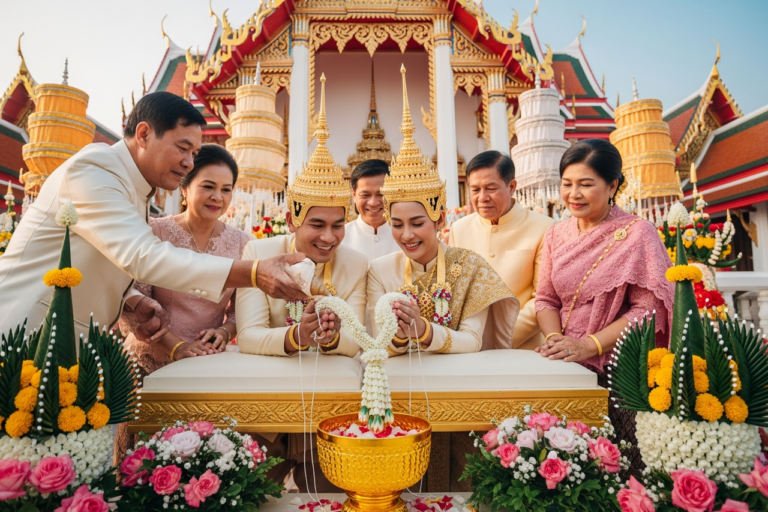
The Rod Nam Sang, which people also call the water pouring ceremony, is the most important part of a thai wedding. This is when the couple gets seen as husband and wife. The bride and groom sit at a table made for the ceremony. They hold their hands together above a tray of flowers, looking like they are praying.
First, the elders and parents, then other guests, come up to the couple. They use a conch shell filled with lustral water made special in a buddhist ceremony. Each person gently pours water over the couple’s hands. As they pour, they give their good wishes, blessings, and some advice for a happy marriage.
This water pouring part is very sweet and personal. It lets the family and friends take part in wishing the couple well. The water runs off the couple’s hands into a bowl of water and flowers. This shows that all the good wishes from everyone are now with the couple for their future together.
7. Phuang Malai (Floral Garlands) and Gift-Giving
Floral arrangements play a big role in thai wedding traditions. One special type is the “Phuang Malai,” or floral garlands. These pretty and fragrant garlands are often shared by the couple. It shows they both respect and love each other. The couple also gives these garlands to their parents and elders. This is a way to say thank you.
At a thai wedding, besides the Sin Sod, more gifts are given throughout the day. During the engagement part, the groom usually gives gold jewelry to the bride. These gifts are symbols of prosperity and show the groom’s promise to her. Sometimes, the couple also gives small keepsakes to guests. This is a nice way to thank people for coming to the wedding.
Some important flowers in these floral arrangements include:
-
Crown flowers, since the Thai word “dok rak” sounds close to “love.”
-
Globe amaranth, because it stands for eternal love. Its name means “never wilting.”
-
Marigolds, which are a sign of prosperity.
8. Traditional Thai Wedding Attire and Symbolic Accessories
The attire worn during a traditional Thai wedding ceremony is an important element that adds to the beauty and significance of the wedding day. Couples often choose from several styles of traditional Thai clothing, which are typically made of luxurious silk and feature intricate embroidery. The colors are often bright and celebratory.
The bride’s outfit, known as “Chut Thai,” is elegant and modest, while the groom wears a formal silk jacket with matching trousers or a traditional “chong kraben” (a wrapped lower-body garment). These outfits are not just beautiful; they are a proud expression of Thai heritage.
Symbolic accessories are also a key part of the traditional Thai ceremony attire.
|
Accessory |
Worn by |
Symbolism |
|---|---|---|
|
Mong Kol |
Both |
Unity and the joining of two souls into one. |
|
Phuang Malai |
Both |
Mutual respect, love, and honor for elders. |
9. The Role of Family and Elders in the Ceremony
In Thai society, family is very important, and you can see this clearly during a wedding. The parents of the bride and the groom’s parents are at the center of the whole event. They help with things like working out the engagement and giving their blessing, showing that they support the couple getting married.
Elders get a lot of respect in Thai culture. They are given special places at the wedding. During the Rod Nam Sang ceremony, elders are usually the first people to pour water over the couple’s hands. As they do this, they give advice and wish the couple well. This part of the day shows both families coming together. It also shows how much people care about their history and family roots.
Wedding guests are important, too. In Thailand, guests do not just watch the ceremony. They get involved in giving good wishes to the couple, especially in the water pouring tradition. When many people take part, it shows that the marriage has the support of not only the couple’s parents, but all their friends and community as well.
Conclusion
In the end, thai wedding traditions show how the people in Thailand value their families and their way of life. Each part, like picking a lucky day or the special water pouring, is important. These things are done to show respect to the couple, their families, and the ones who came before them. When you learn about these wedding traditions, you see how much love, respect, and togetherness mean in thai culture. If you go to a thai wedding, or if you just want to know more, it helps to understand these traditions. It makes the day more special. If you plan to be at a thai wedding soon, it is good to ask for tips about what will happen. This will help you enjoy the beautiful experience even more.
Frequently Asked Questions
What should foreign guests know before attending a Thai wedding?
When you go to a Thai wedding, make sure you dress in a way that is modest and respectful. Do not wear black clothes. It is good to give a cash gift in an envelope. Try to join in with the rituals, such as the water pouring. Learn a bit about Thai culture, like how to do the “wai” greeting. The hosts will be happy if you understand these things.
Keywords used: thai wedding, water pouring, thai culture
Are there regional differences in Thai wedding customs?
Yes, there are some regional differences when it comes to thai wedding traditions. For example, people in the northern part of Thailand, like Isaan, often add some special customs you might not see at a traditional thai wedding ceremony in Bangkok. The water pouring is one part you will almost always see, no matter where you go. But different areas add their own style and feel to thai wedding traditions.
How are Thai wedding traditions changing in modern times?
In today’s Thai society, wedding traditions are starting to change. Many couples choose to mix old customs with Western ones. You will often see a white dress at the reception. Most times, the ceremony and party take place on the same day to make things easy. Even with these new ways, the deep values of family and respect are still at the heart of Thai society and wedding traditions.



