

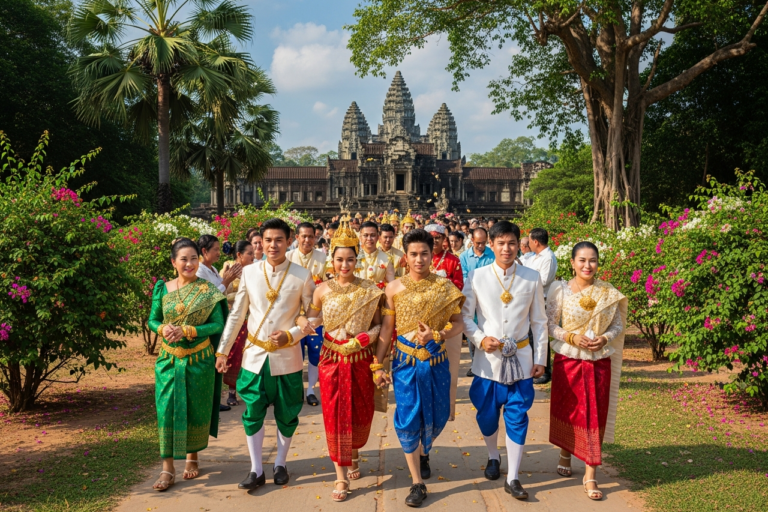
Key Highlights
-
A Khmer wedding is big and important. It often lasts three days and nights. Today, some weddings are not as long.
-
The traditional wedding is based on a nice story about Prince Preah Thong and the naga princess, Neang Neak.
-
Cambodian weddings have a lot of meaning. People do many special things like cutting hair and tying knots.
-
Couples wear many bright and fancy clothes to show each part of the wedding ceremony is special.
-
Family and the whole community help plan the event and take part in giving blessings to the new couple.
Introduction
Welcome to the bright and lively world of Cambodian weddings. A Khmer wedding is not just about two people joining together. It is a big celebration that has many old traditions, colorful clothes, and a lot of meaning in cambodian culture. For many, the wedding ceremony is one of the most important parts of life in Cambodia. It is a time when families, friends, and whole communities come together. Get set to see the special customs and meaningful steps that make a khmer wedding stand out as a wonderful and one-of-a-kind time to remember.
The Cultural Significance of Cambodian Weddings
Cambodian weddings are a big part of the culture. They mark an important point in the lives of young Khmer people. These events are not only for the couple. They are also a big gathering for families and the whole community to come together in a joyful way. A traditional wedding is full of activities and special customs that show respect for both the couple and their ancestors.
You can see the cultural importance in everything, from the fancy clothes to the specific steps of each ritual. These traditions let Khmer people honor where they come from. They also help make sure the couple starts their married life with many good wishes and luck. The ceremonies at cambodian weddings are made to keep everyone involved, so the guests can take part and help bless the couple’s new life as one.
Historical Roots of Khmer Wedding Traditions
The story of the traditional Khmer wedding comes from a famous legend about the first Khmer prince, Preah Thong, and a Naga princess named Neang Neak. The legend says that Preah Thong was an explorer who arrived on an island. There, he saw Neang Neak for the first time, and they fell in love right away.
To marry her, Preah Thong had to go to her father’s kingdom under the sea and ask for his blessing. The Naga King said yes. After that, the wedding was held and it lasted three days and three nights. People believe that the king used his power to create the land of Cambodia for Preah Thong and Neang Neak to lead together.
This well-known story is important in Cambodian culture. It has shaped the way the wedding ceremony happens. Many customs and parts of the traditional Khmer wedding today are thought to come from the love story of Preah Thong and Neang Neak. These ceremonies help keep a piece of old history alive in the way people in Cambodia get married now.
Core Values and Symbolic Meanings
At the heart of a khmer wedding ceremony, the focus is on family, respect, and the community. The wedding rings, which come from Western ways, show the couple’s unity and how they are joining together. But the most deep symbols come from old traditions.
Each wedding ceremony is full of signs and meaning. For example, there is a knot-tying part that uses red strings. The red strings show the bond between the two people and their everlasting love, as they come together to start a new life. Elders and people who are already married give blessings to wish the couple a good marriage and a happy life.
These wedding rituals are not just for looks. They help clear away old things from the past and let the couple get ready for a fresh start. The meaning inside a khmer wedding is a good way to show what the community wants for the couple—it is about health, happiness, and good things for their future together.
Major Phases of the Traditional Cambodian Wedding Ceremony
A traditional Khmer wedding is a big and colorful event. It has many phases, and each phase has its own customs and meaning. In the past, people would celebrate for three days and three nights. But, many Cambodian weddings today last only a day or a day and a half.
Even though weddings are shorter now, people still keep the main traditional Khmer wedding customs. The important parts, from the groom’s walk to the last blessings, show steps in the couple’s new life together. The next few sections will tell you about what happens before the wedding, the main part of the ceremony, and all the happy celebrations after.
Keywords: khmer wedding, cambodian weddings, traditional khmer wedding, traditional cambodian wedding customs
Pre-Wedding Rituals and Blessings
Before the main wedding event, there are some important pre-wedding rituals to show respect to family members from the past and to ask for good wishes for the couple. One of the biggest parts is called the Sien Doan Taa, or Tea Ceremony. In this ceremony, the couple gives tea to their ancestors’ spirits. They invite these spirits to join the celebration and to watch over them. It is a touching way to remember loved ones who are no longer here.
There is another key ritual called Soat Mun, where Buddhist monks give the couple a special blessing. The bride and groom kneel in silence, put their hands together for prayer, and the monks chant and sprinkle holy water on them. This is done to help make their new life pure and safe as they begin together.
All of these pre-wedding blessings mean a lot to the new couple and their families. They include:
-
Sien Doan Taa: A tea ceremony to remember the ancestors.
-
Soat Mun: Buddhist monks give blessings using chants and holy water.
-
Bang Chhat Madaiy: The couple says thank you to their parents by holding umbrellas over them. This shows their care and flips the role as the protectors.
Central Ceremony Customs and Procession
The wedding day truly kicks off with the Hai Goan Gomloh, the groom’s procession. This marks the symbolic arrival of the groom and his family at the bride’s home, bearing gifts. Guests join the parade, carrying gold trays of fruits and other offerings, representing the groom’s long journey to ask for his bride’s hand in marriage. This reflects past social norms when parents arranged marriages.
Once the groom is welcomed, several key ceremonies take place. One of the most well-known is the Gaat Sah, or symbolic haircut. This ritual doesn’t involve actually cutting hair but signifies cutting away the past for a fresh start. Family and friends take turns “cutting” the couple’s hair with golden scissors and spritzing them with perfume while offering blessings. The couple’s costumes are elaborate, changing for different ceremonies.
Here are some key moments of the central ceremony:
|
Ceremony |
Description |
|---|---|
|
Hai Goan Gomloh |
The groom’s procession to the bride’s home with gifts and gold trays of fruits. |
|
Gaat Sah |
The symbolic haircut ceremony to represent a fresh start for the couple. |
|
Sompeas Ptem |
The knot-tying ceremony where red strings are tied to the couple’s wrists. |
|
Bongvul Pbopul |
The passing of blessings ceremony where married couples pass sacred candle smoke over the newlyweds. |
Post-Ceremony Celebrations
After the detailed wedding customs, the fun keeps going. People feel happy and enjoy the celebration. The Bongvul Pbopul, called the “Passing of Blessings,” is a touching ritual done after the ceremony. The married couples stand in a circle around the new couple. They pass three candles that are lit. These candles go around seven times. Each person holds the candle, uses their right hand to slowly wave over the flame, and sends the blessings toward the bride and groom. This is the community’s way to wish the new couple a good life and share their best wishes.
The last part is the Chorng Dai, which is the knot-tying ceremony. Right after, guests toss white palm tree seeds on the new couple. This is a symbol of wishing them a fresh start filled with luck. To finish the wedding, the bride and groom walk in a circle three times. The groom holds a sword in his hand. This shows he will protect his bride during their life together.
When these special events end, the party starts. The new couple sits with everyone and eats a wonderful meal. There is music and people dance late into the night. This new couple and their family and friends all relax and share in the joy of the day.
The Role of Family and Community in Cambodian Marriage
In Cambodia, a wedding is about more than just the couple. The couple’s family members and the groom’s parents do a lot to help with the wedding. They are not just there for support. Their role in the event is important for everything to go well and feel true to the culture.
There are also close friends and others in the community who get to be part of the celebration. All of them are invited. The wedding lets people gather, enjoy time together, and give their blessings. Below, you will see more about how elders, family, and the community help in these wonderful events.
Arranging the Wedding: Elders and Matchmakers
In the past, parents and older family members in Cambodia often chose who would get married. Sometimes, there would also be matchmakers to help. Today, people getting married have more choice, but what elders say and want is still very important. The family’s leading woman, or family matriarch, is usually the first person who does a lot of the planning to make sure every old tradition is followed.
To get ready, families talk and decide together about dowry gifts. These gifts come from the groom’s family. They show that he cares about the bride and wants to support her. In Cambodian culture, the number three is an especially lucky number. It often affects things like how long the event lasts or how many gifts there are.
Elders get a lot of respect during the wedding day. For example, in the symbolic haircut ceremony, the family matriarch is the first person to cut, showing her wisdom and giving blessings to the couple. All of this shows how much people respect older family members and follow the family order in Cambodian culture.
Family Participation During the Ceremonies
Family members are not just watching during a Cambodian wedding. They take part in many main events. Their help is very important in giving blessings and keeping old ways alive. When the groom walks to the bride’s house, his family comes with him. They carry gifts and show their care and backing for him.
On this day, there can be many emotional moments of the newlywed couple and their families. One part is the Sien Doan Taa ceremony. Here, the bride and groom offer tea to the ancestors. This makes the family think about their past and those who came before them. The groom’s elders also get a lot of respect during the different steps.
Here are a few ways family members take part:
-
Honoring Parents: In the Bang Chhat Madaiy ceremony, the couple keeps umbrellas over their parents to show they are thankful.
-
Symbolic Haircut: Family members take turns “cutting” the bride and groom’s hair and giving good wishes.
-
Knot-Tying: Parents and relatives tie red strings on the couple’s wrists. This is to wish them happiness and luck in life.
-
Tea Ceremony: The newlywed couple or groom offer tea to the elders who are alive. This is to show respect and to ask for their blessings.
Community Involvement and Shared Festivities
A Cambodian wedding brings together the whole community, not just the close family. There is a large group of people at the event. These shared moments help everyone to feel joy and to support the new couple. The guests often do more than just watch—they take part in the ceremonies, which helps them feel important to the day.
Close friends have a big part in what happens. They may be there to give blessings at the hair-cutting part, or take part in the passing of blessings event. When close friends do this, you can see how strong the group’s ties are. It really shows the wish for the new couple to have a happy life together.
At the end, there is a big party or reception. The whole community comes together here, eating, dancing, and listening to music with the new couple. Many stay up late because it is such a happy time. This big group event brings people close and makes sure that the new couple starts their married life with the love and care of a lot of people around them.
Traditional Wedding Attire and Decorations in Cambodia
The look of a traditional wedding in Cambodia is hard to miss. There is so much color and beauty on display. This is mostly because of the bright Cambodian wedding clothing and the fancy decorations. People wear clothes with rich colors and smooth fabrics. These outfits have a lot of small, special details. This gives the wedding a royal and graceful feeling. Every outfit will be picked so it fits the part of the ceremony that is going on.
The venue changes a lot, too. Decorations make the place look lovely and special. There are nice altars and flower pieces with meaning. All the little things come together to make the wedding look even better. They also show off what the traditional wedding is about. In the next sections, you will get a closer look at the couple’s clothing, the things they wear with it, and the main decorations in Cambodia wedding styles.
Cambodian Bride and Groom Outfits Explained
One of the most fun parts of a Cambodian wedding is that the couple gets to wear different outfits through the day. The bride and groom change clothes a lot during the celebration. They often wear a new outfit for each part of the ceremony. These clothes are made from silk that looks rich and feels soft. They also have bright colors and pretty beads. Many times, the bride and groom wear matching or close colors to show that they belong together.
Traditional Cambodian wedding clothing is detailed and beautiful. The bride might put on a long skirt with a fold in the front. She also wears a top and a sbay, which is a special scarf. The groom wears pants called Sampot. When the groom goes to the bride’s house, both might pick a gold silk outfit. This gold silk outfit shows that they wish for good luck and wealth.
It is amazing how many different outfits the couple can wear in one wedding. Some of the main outfits include:
-
A gold silk outfit for when the groom comes over and during the ring exchange.
-
A newer style top with traditional pants for the hair-cutting part.
-
A fancy burgundy and gold look for the knot-tying event.
Unique Accessories and Symbolic Jewelry
The clothes at a Cambodian wedding are bright and beautiful. People add many special things, like jewelry and accessories, to finish the look. These are not only for style. The meaning behind each item is important. Brides wear big, pretty headpieces, necklaces, and bracelets. These things make them feel special, like royalty.
There is also the gold sword that the groom holds. This is one of the most special accessories. The gold sword shows he will care for and protect his new wife for all time. At the end of the knot-tying ceremony, he holds this sword high for all to see. This moment is not just a show—it means he is now her guardian and partner.
People now exchange wedding rings during the wedding too. But the rings are shared with other old symbols. The red strings tied on their wrists during the knot-tying part stand for the love that brings the couple together forever. Every item, like the wedding rings, red strings, headpieces, or the sword, is picked for a reason. All of them come together to show love, safety, and standing together as one at the end of the knot-tying ceremony.
Popular Venue Decor, Ceremony Setups, and Floral Symbols
The venue at a Cambodian wedding changes into a place full of beauty and tradition. The space feels both special and sacred. People set up an altar with gold plates, statues, and trays for offerings. These altars are the center of many important rituals. Often, families put up tents in their backyard and hang gold decorations.
Flowers show up everywhere during this time. There is flowered water used for blessings. People dip flowers in it and sprinkle it on the couple to wish them well. Every flower and fruit used can mean something. Lychee fruit, for example, is seen as bringing good luck, so people add it to the gift trays.
The style of the decorations often comes from Khmer stories, like a prince meeting a princess on a full moon night. There are a few main things you will see:
-
Gold Trays: These hold fruits and gifts, set out with care.
-
Ornate Altars: Decorated with gold statues and offerings for the family’s ancestors.
-
Floral Arrangements: People use white roses and the seeds from palm trees (pka sla) to help with blessings and joy.
Key Differences Between Cambodian and Western Wedding Customs
Both Cambodian and Western weddings celebrate two people coming together. But the way they do this is very different. Cambodian weddings follow old customs and bring in the whole community. There are many ceremonies, and they can go on for days. Western weddings, on the other hand, usually take just one day. They have a wedding ceremony and then a party. In khmer wedding customs, it is very important to honor ancestors. Family members also play a big role and help with the different rituals.
Even in contemporary wedding ceremonies that take place in urban areas, people keep these traditional parts. Newer Cambodian weddings in urban areas might add Western ideas like a white dress or the giving of rings. Still, khmer wedding traditions stay at the center of the celebration.
Here are the main differences:
-
Duration: Cambodian weddings go on for three days. In comparison, Western weddings usually last one day.
-
Ceremonies: Khmer weddings have more than one event. Each has a different purpose and special clothes.
-
Family Role: In Cambodian weddings, family and friends are not just there to watch. They take part in what is happening.
-
Attire: Cambodian couples wear two or more bright, classic outfits. In Western weddings, you often see just a white dress and a tuxedo.
Conclusion
In the end, Cambodian wedding traditions have a lot of meaning. These special moments come from a long history that shows the values of family, love, and community. Every part of the celebration, from the time before the wedding to the events after the big day, shows how important it is to follow the old ways and bring two families together. There are bright clothes, detailed decorations, and everyone joins in, from the elders to the whole community. This makes these customs stand out.
If you know more about these traditions, it helps you see why Cambodian culture is so special. It can also make the day better for everyone who is there. If you want to have your own Cambodian wedding or learn more about Cambodian culture, feel free to ask for a free talk.
Frequently Asked Questions
How long does a typical Cambodian wedding celebration last?
In the past, Cambodian weddings used to be a big wedding celebration that went on for three days and three nights. Many couples in urban areas now choose to have a shorter ceremony. These modern Khmer wedding celebrations take all the traditional Cambodian wedding customs and fit them into just one busy day. This way, the couple can enjoy their new life together without the need for many days to celebrate.
What customs should guests keep in mind at a Cambodian wedding?
Guests should wear nice clothes that are not too casual or too fancy. Be ready to join in and take part in the wedding ceremony. In Cambodian culture, many people from the community take part too. You might be asked to share your best wishes in a special part of the event. Show your respect when the Buddhist monks are giving their blessings. You can also join the dancing and enjoy the celebration.
How are Cambodian-American weddings celebrated in the United States?
Cambodian-American weddings often mix old and new customs. This helps make a nice multicultural wedding. Many couples in the United States choose to have a modern Cambodian wedding ceremony for one day. After that, they have an American-style party. These contemporary wedding ceremonies show love and respect for both sides of the family. They are a way to celebrate both cultures in one happy event.



