

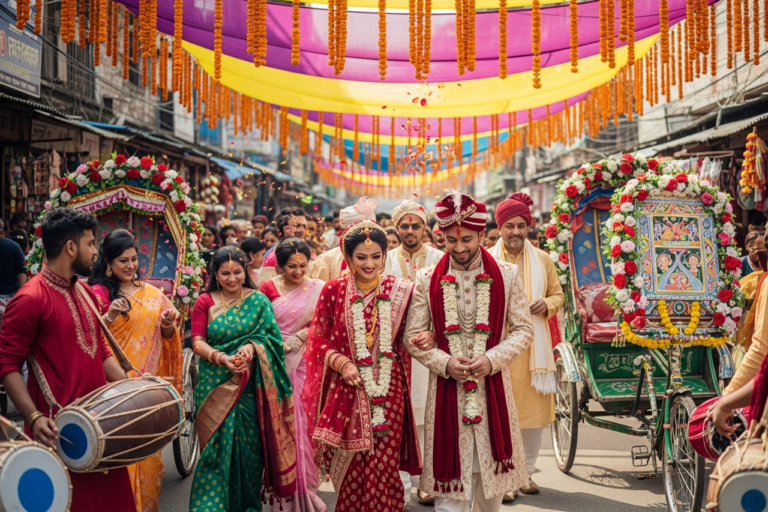
Key Highlights
Here are the key highlights of a Bangladeshi wedding:
-
A Bangladeshi wedding goes on for many days. It has important parts like the gaye holud, the wedding ceremony, and the bou bhat reception.
-
The gaye holud ceremony is where family and friends put turmeric paste on the couple. This brings good luck and keeps them safe.
-
Family bonds matter a lot in every part of the celebration. Relatives are always there and play a big part in each ritual.
-
The bride usually wears a bright red Benarasi silk saree. She pairs it with heavy gold jewelry.
-
Bengali wedding customs always have a big feast. People eat tasty food, and everyone enjoys the generous hospitality.
Introduction
Welcome to the lively and happy world of Bangladeshi wedding traditions. If you go to a Bangladeshi wedding for the first time or plan your own, you will find that it is a time you will always remember. These wedding celebrations are part of the deep culture of Bangladesh. They show true feelings and include many events that last for days. Starting from the pre-wedding rituals, there to the last goodbyes, every part is full of wedding traditions, fun, and family ties that only get stronger.
The Cultural Importance of Weddings in Bangladesh
In the culture of the Bengali people, a wedding is not just about two people coming together. It is about two families joining as one. The wedding day shows how strong family bonds can be. Elders are important on this day because they give their blessings to the couple and help keep old traditions alive.
There are many religious rituals on the wedding day. These customs are passed down from older people to younger ones, so that the couple can have a good and happy life. The whole community gets involved, too. This shows the pair that there are many people who care for them and will support them as they start this new part of life.
Historical Influences on Bangladeshi Wedding Traditions
Bengali wedding traditions have been around for centuries. They show the mixed culture of the Bengal region, which covers both Bangladesh and West Bengal in India. In South Asia, people are known for lively and bright celebrations. Bengali weddings are a great example, as they blend customs from Hindu and Muslim backgrounds.
Many Bengali wedding traditions have changed with time. The versions we see now took shape in the 19th and 20th centuries. Today’s customs are a lovely mix of old and new. This long history is what makes each bengali wedding tradition special and important.
The family’s religion can change how each ceremony goes. For example, Hindu bengali wedding events have many details and go on for days, with old Vedic steps. Muslim Bengali weddings use Islamic prayers and customs, but there is still a happy cultural mood from the Bengal region.
The Role of Family and Community in Celebrations
Family is right at the heart of a Bangladeshi wedding. As soon as the wedding date is fixed, family members are part of every plan and each event. The elders in both the bride’s and groom’s families come together. They give their blessings, which helps keep family bonds strong.
The whole community also plays a big part. Siblings, uncles, and other people close to the couple take part in major rituals, like carrying the bride at the wedding. This shows how important it is to pass traditions from one generation to the next. It helps the new couple get support from their families and others around them.
The big celebration is something everyone works on together. The host family welcomes every guest with kindness. The wedding is not just about the couple. It is about joining two families and welcoming someone into their new family, too. The couple will also feel the support of their community as they start this new part of life.
Key Pre-Wedding Ceremonies in Bangladeshi Culture
A Bengali wedding is not just a one-day event. It is made up of many lively wedding rituals that happen over several days. These pre-wedding ceremonies help people get excited and bring both families together as they get ready for the big wedding day. Every ritual stands out with its own meaning and mood.
One of the most famous pre-wedding celebrations is the Gaye Holud. This is a bright and happy event. From the engagement to the wedding day, each step has important customs. We will talk more about these special moments and what they mean, so you can see how exciting Bengali wedding celebrations can be.
Engagement Rituals and Formal Introductions
The wedding journey often starts with the engagement rituals, called Adan Pradan. This is the first wedding ritual. The groom’s family goes to the bride’s house. Then, the bride’s family also visits the groom’s family. These first meetings are a good way for both families to know each other and give their yes to the marriage.
The families give each other gifts. This is an important part of the event. The gifts show that both sides accept each other and feel happy about becoming one family. The things people give often include:
-
Sarees and other clothing
-
Gold jewelry and old family things
-
Sweets so everyone can share the good news
This first meeting helps build respect between both families. After this time, the families talk and pick a good date for the wedding. Now, the wedding plans begin.
Gaye Holud: Meaning, Rituals, and Significance
The Gaye Holud is one of the most loved and lively parts of the wedding. The name means “turmeric on the body.” It is when family and friends put turmeric paste on the bride and groom. The use of turmeric in this gaye holud ceremony stands for cleaning, blessings, and good luck for the couple’s new life. In the past, the bride and groom would have the gaye holud at different times. Now, many couples join together for this event.
At the gaye holud ceremony, people put turmeric paste on the couple and feed them sweets. The whole group has fun, with music, dancing, and old songs. The meaning of the gaye holud goes deeper than just a party. People say this gaye holud ceremony can:
-
Give the bride and groom’s skin a healthy glow before the wedding.
-
Show the blessings from married women, wishing them a happy life.
-
Help both families grow close in a happy and open way.
Other items, like betel leaves, are used in the rituals too. These are said to bring more good luck to the big day.
Wedding Day Traditions Across Bangladesh
The wedding day is full of color, joy, and important rituals. The main ceremony, called the Nikah for Bengali Muslims, is usually in the evening. It is both beautiful and important to the couple and their families. Other customs are also followed at this time.
After the wedding day, the celebrations go on with the Bou Bhaat. This is a party given by the groom’s family. All these moments show how both families and the couple are brought together as one. Now, let’s see how the religious and special rituals add meaning to the big day and the main ceremony.
The Nikah: Religious and Legal Aspects
For Bengali Muslims, the Nikah is at the center of the wedding ceremony. It is a formal part of a muslim wedding. The Nikah is a religious and legal agreement that brings the bride and groom together as one by Islamic law. This is one of the most important religious rituals for them. An officiant is there to say prayers and help the couple go through the steps.
The Nikah ceremony is usually small. Only close family and a few who act as witnesses come. The bride and groom both must say yes to the marriage. They sign a marriage contract that clearly tells the rules of their new life. Because of this legal step, the marriage is now known not just by religion but also by the law.
While a muslim wedding is built on the Nikah, it is not quite like a Hindu wedding, where people walk around a sacred fire. Both are full of cultural things that make the couple happy about starting a new chapter together.
Symbolic Rituals and Customs Observed on the Big Day
The wedding day has many sweet, symbolic rituals that bring more meaning to the event. One of the most playful and happy times on this day is the Mala Badal. This is the garland exchange. The couple swaps fresh flower garlands three times. Their family members often lift them up to make it more fun and joyful.
Another big custom on the wedding day is the Subho Drishti. This is the first time the couple looks at each other. It is a special and touching moment. After the groom arrives with his group, the bride comes in with her face covered by betel leaves. She stands in front of the groom, and they look at each other for the first time as bride and groom.
Other important symbolic rituals are:
-
Saptapadi: In Hindu weddings, the couple goes around a sacred fire seven times. As they walk, they speak promises of love and support to each other.
-
Sindoor Daan: The groom puts vermilion powder on the bride’s hair parting. This shows that she is married.
-
Shankha-Pola: The bride wears white conch shell bangles and red coral bangles. This is another sign that she is married.
These rituals make the wedding day special and help the family members, bride, and groom feel even closer. Each custom is a way to show love, joy, and the beginning of a new life together.
Traditional Attire and Accessories for the Wedding
Traditional clothing is a big part of any Bangladeshi wedding. The outfits add bright colors and beauty to the day. Both the bride and the groom choose what they wear with a lot of care. These clothes use nice fabrics and small details to make them special. The bride will usually wear a red Benarasi silk brocade saree with heavy gold jewelry.
At some Muslim weddings, the bride may wear more simple clothes like a salwar kameez. Each piece, from the fabric to what they put on for style, has meaning. Here, we will look at the styles and the stories behind these well-known Bangladeshi wedding outfits.
Bridal and Groom Outfits: Styles and Symbolism
The bride’s outfit is often the centerpiece of the wedding. For the main ceremony, she typically wears a red Benarasi silk brocade saree, a timeless and elegant choice that symbolizes love and marital bliss. This is often paired with an ornate golden veil. The groom complements her elegance with his own traditional attire, usually a silk dhoti and kurta. For the ceremony, he might switch to a sacred dhoti and upper cloth known as patta bastra.
For other events, the bridal and groom outfits may vary. During the Gaye Holud, both often wear yellow or red cotton outfits to accommodate the turmeric paste. At the reception, the bride might choose another elaborate saree or a lehenga, while the groom may opt for a formal suit or a sherwani.
The attire can also reflect religious and cultural variations. In Muslim weddings, the groom might wear a sherwani, and the bride may choose a salwar kameez or an ornate lehenga.
|
Event |
Bride’s Outfit |
Groom’s Outfit |
|---|---|---|
|
Gaye Holud |
Yellow or red cotton saree |
Yellow or red cotton kurta |
|
Wedding Ceremony |
Red Benarasi silk saree, golden veil |
Silk dhoti and kurta, or sherwani |
|
Reception (Bou Bhat) |
Fancy saree or lehenga |
Formal suit or sherwani |
Jewelry, Henna, and Iconic Accessories
Jewelry is a big part of how a Bangladeshi bride looks on her wedding day. She is covered in heavy gold jewelry. This makes her look beautiful, and it also shows her family’s status. It is the family’s way to send blessings for a good, happy life ahead. Many times, some pieces of jewelry are very old and have been passed from parents to their children. This makes them even more special for the bride.
There are other things, besides gold jewelry, that be important too. The bride’s hands and feet have detailed henna designs. This is a short-lasting art that shows beauty, joy, and love. The bride may place fresh flowers in her hair. This gives her a simple, natural look that stands out.
Some accessories have strong meaning and are tied to culture. The items below finish the bridal look:
-
Shankha-Pola: In Hindu wedding customs, the bride wears white conch shell bangles (Shankha) and red coral bangles (Pola). These show she is married.
-
Topor: The groom wears a conical headpiece made from shola pith. This is a key symbol in the culture.
-
Nath: This is a large, special nose ring worn by brides as one more traditional jewelry piece.
Evolving Practices and Regional Variations
While many Bengali wedding customs are common, there are some interesting differences and new ways people celebrate. The main rituals stay the same, but you can see changes based on a family’s religion and if they live in a city or in the countryside.
These differences help make Bengali weddings even richer and more colorful. For example, weddings in cities often include new and modern ideas. Rural weddings usually follow older traditions more closely. Let’s learn more about how these customs change from place to place.
Differences between Muslim, Hindu, and Christian Weddings
Many cultural ways in Bangladesh come together, but the main wedding rituals change a lot based on religion. A Muslim wedding is focused on the Nikah. This is the Islamic marriage contract. It makes the marriage official.
A Hindu wedding is different. It has several rituals from old Vedic customs. The couple walks around a sacred fire seven times, called Saptapadi. The ceremony uses chants and blessings from a priest. Christian weddings use Western ways, where vows are traded in a church.
Still, there the be many similar ceremonies in all these weddings. You will see these shared things:
-
The gaye holud ceremony happens in many groups.
-
Big feasts and receptions are part of every wedding.
-
Family and hospitality matter for all.
These create a bond and make Bangladesh weddings special, no matter the faith.
Urban vs. Rural Wedding Customs in Bangladesh
The setting of a wedding in Bangladesh can shape how big or stylish it is. Weddings in big cities like Dhaka often stand out with bigger, fancier parties. It is common to see professionally decorated venues with elaborate lighting. There can be meals with many courses, made for hundreds of people. These events often follow new trends in clothes and photography too.
On the other hand, weddings in small villages keep to older ways. They are usually more close, and the whole village may get together. The host family is very important. Everyone helps with the planning and the steps they follow. This makes the bonds between people in the village stronger.
No matter where the wedding is, the main thing is the same. The focus is always on family, welcoming others, and the good union of the couple. The way people celebrate only shows that life and what people have can be different across the country.
Festive Food and Reception Customs
Food is big in Bangladeshi hospitality, and you see this the most at a wedding. The wedding meal is a main part of the day. There will be many dishes to make guests happy and to show respect to the new couple. After the wedding, the party keeps going with the bou bhat, or wedding reception. This is when you see another big meal.
You will find dishes like biryani and sweets like sweet yogurt, called mishti doi, at each wedding. The sections below will show the favorite foods, and talk about the warm welcome people feel at these events.
Popular Dishes and Feasting Etiquette
A Bangladeshi wedding has a feast that people remember. One of the best parts is a biryani or pulao. It has rice that smells good, meat that is soft, and many spices that mix well. You will find full curries with lots of flavor. The feast can also give dishes with fish like shorshe ilish, hilsa fish cooked with mustard sauce. Mutton kosha, which is slow-cooked mutton curry, is also on the menu.
There are a lot of choices for vegetarians. A famous option is aloo posto. It has potatoes that cook with creamy poppy seed paste. The idea is to show the best of Bengali food, give everyone plenty to eat, and let people feel full and happy after eating.
No Bengali meal would be right without dessert. Sweets are a big part of the meal. Guests will see:
-
Mishti Doi: This is a smooth sweet yogurt with caramel flavor, known as sweet yogurt and loved in Bengali weddings.
-
Rosogolla: These are soft cheese balls in a mild sugar syrup.
-
Payesh: Creamy rice pudding with cardamom and nuts.
A bangladeshi wedding feast will have food and desserts like aloo posto and mishti doi that make every person feel good.
Hospitality and the Spirit of Welcoming Guests
In Bangladeshi culture, giving a big and tasty meal shows true hospitality. The wedding feast lets the host family share their joy and respect with their guests. The hard work that goes into planning the menu and cooking the food shows just how special this day is.
Having a meal brings family members and the community close. It makes the place feel warm and open, where everyone can celebrate together. You can feel the spirit of community as guests talk, laugh, and enjoy the wedding celebrations.
In the end, the big food spread stands for the families’ hopes for a good and full life for the new couple. When every guest is fed and feels welcome, the host family shows their kindness and strengthens family bonds, making memories that last.
Modern Changes in Bangladeshi Wedding Traditions
Bangladeshi wedding traditions have been in the country for a long time. But wedding celebrations are changing. Today, people mix the old customs with new and trendy ideas. Many couples want to make their bangladeshi wedding special and show who they are. At the same time, they do not forget their roots.
These new ideas show how people and life in Bangladesh are changing. The world also brings new things into bangladeshi wedding celebrations. Now, we can see that other cultures and countries near Bangladesh have an effect too.
Let’s see how modern trends and influence from neighbors shape these lasting bangladeshi wedding traditions.
How Contemporary Trends Are Shaping Celebrations
Contemporary trends are now making big changes in Bangladeshi wedding celebrations. One of the biggest shifts is how large and stylish these events have become. More couples are choosing to work with professional event planners who help with themes and decorations. Many people use elaborate lighting to make the event look nice for photos. For those who can spend more, destination weddings are getting more common too.
A new thing is how couples handle pre-wedding events. In the past, the bride’s family members and the groom’s family members would have their own separate Gaye Holud ceremonies. Now, many couples pick just one joint event. This way, both families get to mingle and have fun in a relaxed setting.
Technology is also changing the way people hold and share these celebrations. Most couples hire professional photographers and videographers for their wedding. They also like to share their wedding journey with friends and family on social media. Even with all these modern changes, the main focus is still on the family, the community, and being together.
Influence of Neighboring Countries on Modern Customs
The customs that people follow in Bangladeshi wedding celebrations also come from what is seen in nearby places, mostly India. Since there is a close connection with West Bengal, a lot of the traditions are much the same. Today, things like Bollywood movies and Indian TV shows have brought new styles for fashion, music, and how people decorate.
You can see this at weddings. Brides often pick a lehenga as much as a saree now, which is new. Family and friends also do planned dances, just like you might see at Indian weddings. This is now a big part of wedding celebrations in Bangladesh too. These things make the party more fun and give it a special look.
Even though these new things bring fresh ideas, people still mix them with old customs from Bangladesh. They do not forget the traditional rituals because of new trends. So, wedding celebrations end up showing both their deep roots and new styles. This makes each wedding both lively and special. It honors where the families come from and adds a little modern style at the same time.
Conclusion
In the end, Bangladeshi wedding traditions show rich colors from the past, family, and culture. All the steps, from Gaye Holud to what happens on the wedding day, are full of care with deep meaning. These events bring people together, show love, and let everyone enjoy a big celebration. What people wear has its own special meaning. The food served at a Bangladeshi wedding makes the day even better for everyone. Over time, some things change with new ideas and the ways of other cultures. But the main part of Bangladeshi wedding traditions stays strong. These important ways help us remember the old days and feel happy to start something new. If you want to know more about Gaye Holud or the full wedding day, or if you are planning your own party, feel free to ask for more help.
Frequently Asked Questions
How are Bangladeshi weddings different from Indian weddings?
While there are a lot of things that are the same, especially when you look at weddings in West Bengal, a Bangladeshi wedding has its own style. Many wedding rituals like the gaye holud happen in both places. But, each has different religious customs. A Bengali wedding in Bangladesh, for example, will often mix Islamic ways with the big, fun gatherings. This makes their celebration different from others.
What is the significance of the Gaye Holud ceremony?
The Gaye Holud is a big part of the Bengali wedding tradition. Families use turmeric paste on the bride and groom. This is done to bring them good luck, blessings, and to cleanse them for their wedding day. People say the use of turmeric gives the couple a nice glow. It is a happy event where families get together and have fun.
What are the main stages of a traditional Bangladeshi wedding?
A traditional Bangladeshi wedding has different parts. It starts with pre-wedding events, like the gaye holud ceremony. After this, the main wedding ceremony takes place. The ceremony has rituals like mala badal. The celebrations finish with bou bhat, which is a party held by the groom’s family members.



