

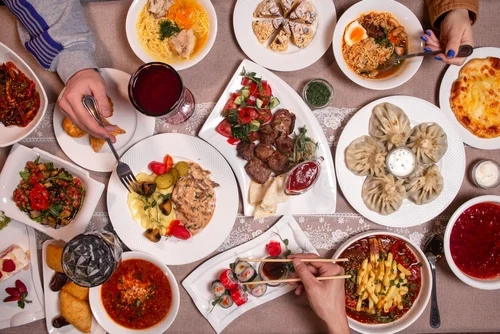
National dishes around the world: a quick definition (and why they matter)
A national dish is a food that’s become closely tied to a country’s identity, often through history, everyday ingredients, celebrations, or the traditions immigrant communities carry with them. Some hold official government status but most don’t. Which dishes count as “national” can shift over time. This guide explains what the term really means and rounds up iconic examples region by region.
Whether you’re planning a trip, cooking at home, or just curious about food traditions, this guide gives you a clear way to think about national dishes along with plus practical tips for finding and trying them here in the U.S.
How we chose these dishes:
We selected the dishes below based on how consistently they’re identified as a country’s signature food across culinary and travel sources, whether they carry official or widely recognized cultural status, and whether U.S. readers can realistically find or recreate them. Where a dish’s “national” status is disputed, we say so rather than presenting it as settled.
TL;DR
- National dishes can be official, widely accepted by consensus, or shaped by diaspora communities and modern branding, and the label can change over time.
- This guide covers 22 dishes across nine world regions, plus a beginner-friendly starter list for cooking at home.
- Look for U.S. sourcing tips throughout, from specialty grocers to easy ingredient substitutions.

What counts as a ‘national dish’? Official vs unofficial, and why it’s complicated
Not every “national dish” comes with an official seal. Countries land on their signature foods in different ways, which is why lists like this one don’t always agree.
- Official designation. A government or heritage body formally names a dish, or the knowledge behind it, as representative of the nation. This is rare. Most countries have never made it official.
- Cultural consensus. A dish becomes “national” simply because most people, inside and outside the country, agree it represents them, even without a formal decree. This is how most dishes on this list earned their spot.
- Diaspora and modern identity. Some dishes gain “national” status more recently, shaped by migration, tourism marketing, or how a country wants to be seen abroad. These associations can shift as fast as culture does.
Regional rivalries complicate things further. A dish claimed by one country is often just as beloved next door, thanks to shared history or the colonial-era movement of people and ingredients. Tourism boards and food media add another layer, promoting dishes that photograph well or fit a national brand, not necessarily what people eat most at home.
Myth-buster:
Not every widely cited “national dish” has official status. The hamburger is often called a national dish of the U.S., but that’s cultural consensus, not government decree. Paella is similar: it’s one of Spain’s best-known dishes. It is closely tied to the Valencian region specifically, though Spain has never officially declared a single national dish.

| Pathway | What it means | Example |
| Official designation | A government or heritage body formally recognizes the dish or the knowledge behind it | Couscous-related knowledge and practices, recognized by UNESCO across Algeria, Mauritania, Morocco, and Tunisia (2020) |
| Cultural consensus | Widely agreed upon by the public without a formal decree | Hamburger (United States) |
| Diaspora & modern identity | Shaped by migration, tourism, or national branding over time | Poutine (Canada), which started in rural Quebec before being promoted nationally |

Iconic national dishes by region (with quick ‘what it is’ descriptions)
Here’s a region-by-region look at 22 dishes commonly described as national or iconic, what they are, their key ingredients, when they’re typically eaten, and a tip for finding them in the U.S. Where a dish’s “national” status is disputed, we’ve noted it rather than stating it as settled fact.
| Country | Dish | What it is | Key ingredients | Typical occasion | US tip |
| Italy | Ragù alla bolognese | A slow-simmered meat and tomato sauce from the city of Bologna, tossed with tagliatelle | Minced beef, tomato, wine, soffritto | Sunday family meals | Look for tagliatelle (not spaghetti) at Italian delis or well-stocked grocers |
| Spain | Paella | A saffron rice dish cooked in a wide pan, often with rabbit, chicken, or seafood; closely tied to the Valencia region specifically rather than officially declared Spain’s national dish | Rice, saffron, olive oil, choice of protein | Weekend gatherings | Spanish grocers or well-stocked supermarkets often carry Bomba rice and Spanish saffron |
| United Kingdom | Fish and chips | Battered, fried fish with thick-cut fries, tied to 19th-century advances in North Sea trawl fishing and rail transport | Whitefish (cod or haddock), potatoes | Weeknight takeaway | Most British-style pubs in the U.S. serve a version. Try it with malt vinegar, the popular condiment. |
| Ukraine | Borscht | A ruby-red beet soup often finished with sour cream; UNESCO added Ukraine’s borscht-cooking traditions to its Intangible Cultural Heritage list in 2022 | Beets, cabbage, potatoes, meat or broth | Everyday and holiday meals | Eastern European delis often stock the beets and dill needed |
| Hungary | Goulash | A paprika-forward beef and vegetable stew, named for the herdsmen (gulyás) who made it | Beef, paprika, onions, potatoes | Family dinners | Hungarian paprika is available at specialty spice shops and online |
| Japan | Curry rice (kare raisu) | A mild, slightly sweet curry sauce over rice, adapted from a dish British traders introduced in the late 1800s | Curry roux, carrots, potatoes, meat | Weeknight home cooking | Japanese curry roux blocks are sold at most Asian grocers |
| South Korea | Kimchi jjigae | A spicy stew built around fermented kimchi, usually with pork or tofu | Kimchi, pork or tofu, gochugaru | Everyday meals | H Mart and other Korean grocers carry ready-made kimchi |
| China | Peking duck | Roast duck with crisp skin, traditionally served with thin pancakes, scallion, and hoisin sauce | Duck, hoisin sauce, scallion, pancakes | Special occasions | Many Chinese restaurants require advance ordering for whole roast duck |
| India | Biryani | Layered, spiced rice with meat or vegetables; recipes vary widely by state and family | Basmati rice, spices, meat or vegetables | Celebrations and family meals | Patel Brothers and similar Indian grocers stock basmati rice and biryani spice blends |
| Turkey | Döner kebab | Seasoned meat roasted on a vertical spit, sliced thin and served in bread with vegetables and sauce | Meat (lamb or chicken), bread, vegetables | Casual meals and street food | Turkish and Middle Eastern markets carry the spice blends used at home |
| Lebanon | Kibbeh | A bulgur and minced meat mixture, fried, baked, or served raw depending on occasion | Bulgur, minced meat, onion, spices | Special occasions | Middle Eastern grocers stock the fine bulgur most recipes call for |
| Morocco | Couscous | Steamed semolina grains topped with vegetables and meat; UNESCO recognized couscous-related knowledge and practices across Algeria, Mauritania, Morocco, and Tunisia jointly in 2020 | Semolina, vegetables, meat or legumes | Friday family meals | Look for a couscoussier (steamer pot), or start with instant couscous |
| Egypt | Koshary | A layered mix of rice, lentils, and pasta with chickpeas, topped with crispy onions and spiced tomato sauce | Rice, lentils, pasta, chickpeas, onions | Everyday street food | Egyptian and Middle Eastern grocers carry the pasta and lentils used |
| Nigeria | Jollof rice | A one-pot, tomato-based rice dish; Nigeria, Ghana, and other West African countries each have their own version, and the “best jollof” is a friendly, long-running debate | Rice, tomato, pepper, onion, spices | Celebrations and gatherings | West African markets carry the rice and Scotch bonnet peppers most versions use |
| South Africa | Bobotie | A spiced, minced-meat casserole with an egg-custard topping, reflecting Dutch, Malay, and African influences | Minced meat, curry powder, dried fruit, egg | Family dinners | Curry powder and fruit chutney are widely available at most U.S. grocers |
| United States | Hamburger | A ground beef patty in a bun; often called America’s national dish informally, though there’s no official designation | Ground beef, bun, toppings | Everyday meals and gatherings | Regional styles (California, Southern, and others) are easy to find nationwide |
| Canada | Poutine | Fries topped with cheese curds and hot gravy, originally from rural Quebec and now served nationwide | Fries, cheese curds, gravy | Casual meals | Cheese curds can be hard to find; fresh mozzarella pieces are a common stand-in |
| Mexico | Mole poblano | A complex sauce blending chili peppers, chocolate, and spices; often linked to a colonial-era convent legend, though its roots likely reach earlier Indigenous chili sauces | Chili peppers, chocolate, spices | Celebrations and special occasions | Jarred mole paste is available at most Latin grocers as a shortcut |
| Argentina | Asado | A slow-cooked barbecue centered on beef, prepared and shared over hours | Beef cuts, salt, wood or charcoal fire | Weekend gatherings | Cuts like vacío or entraña can be special-ordered at many butchers |
| Peru | Ceviche | Fresh fish marinated in citrus and chili, reflecting Peru’s coastal, mountain, and jungle ingredients | White fish, lime juice, chili, onion | Lunch, especially along the coast | Use sushi-grade fish and prepare it just before serving |
| Jamaica | Jerk chicken | Chicken marinated in Scotch bonnet peppers and allspice, traditionally grilled over wood | Chicken, Scotch bonnet peppers, allspice, thyme | Gatherings and celebrations | Caribbean markets carry jerk seasoning and Scotch bonnet peppers |
| New Zealand | Hāngi | A traditional Māori method of cooking meat and vegetables underground over heated stones | Meat, root vegetables | Community and ceremonial gatherings | Rare in the U.S.; an underground pit roast is the closest comparison |

How to try national dishes in the U.S. (without losing what makes them authentic)
- Learn the name and pronunciation first. Getting comfortable saying a dish’s name, even approximately, makes it easier to order with confidence and to search for recipes and reviews.
- Ask about regional origin. Many dishes have several regional versions. Asking “which region is this style from?” at a restaurant often leads to a richer conversation and a more specific dish.
- Try a restaurant version before cooking at home. A restaurant meal gives you a reference point for flavor and texture before you attempt your own version.
- Shop at a specialty grocer for key ingredients. Stores like H Mart, Patel Brothers, and 99 Ranch Market, plus smaller diaspora-owned markets, carry ingredients general supermarkets often don’t. For Indian dishes at home, our guide to simple ingredient substitutions for Indian cooking is a good place to start.
- Expect substitutions, and don’t treat them as failures. Home cooks worldwide adapt recipes based on what’s available. Using a substitution yourself is part of that same tradition, not a departure from it.
- Approach diaspora versions with curiosity, not correction. A dish made by a diaspora community may differ from what’s eaten in the country of origin today. Both are legitimate expressions of the dish’s identity.
Restaurant versions are often adapted for speed and a broader audience, while home versions, especially within diaspora communities, tend to reflect a specific family’s regional roots. Neither one is more “correct”. They simply serve different purposes.
Many national dishes contain common allergens such as shellfish, dairy, peanuts, or gluten, and exact ingredients vary by household or restaurant. If you have a dietary restriction, ask about ingredients directly rather than assuming based on a dish’s usual recipe.

A beginner-friendly ‘starter pack’: 10 national dishes to try first (with difficulty and ingredient availability)
| Dish | Country | Best way to try | Difficulty | Hard-to-find ingredient | US substitution |
| Hamburger | United States | Home or restaurant | Easy | None | — |
| Jollof rice | Nigeria | Home | Easy–Medium | Scotch bonnet peppers | Habanero peppers (milder, widely available) |
| Kimchi jjigae | South Korea | Home, with store-bought kimchi | Easy | Gochugaru (Korean chili flakes) | Sold at most Asian grocers; hard to substitute directly |
| Biryani | India | Restaurant first, then home | Medium | Whole spices (cardamom, mace) | Pre-made biryani spice blends |
| Fish and chips | United Kingdom | Restaurant or pub | Easy | Malt vinegar | White vinegar with a small pinch of sugar |
| Mole poblano | Mexico | Restaurant first | Medium–Hard | Dried Mexican chilies (ancho, pasilla) | Jarred mole paste as a shortcut |
| Poutine | Canada | Home or restaurant | Easy | Fresh cheese curds | Fresh mozzarella pieces |
| Koshary | Egypt | Home | Medium | Egyptian-style small pasta shapes | Small elbow macaroni |
| Jerk chicken | Jamaica | Home or restaurant | Easy–Medium | Scotch bonnet peppers | Habanero peppers |
| Ragù alla bolognese | Italy | Home | Medium | Tagliatelle | Fettuccine |
Diaspora neighborhoods and community food festivals are some of the best places to try a national dish. The reason is that the dishes are made by people with direct ties to their origins. Approaching those spaces as a respectful guest, asking questions, trying what’s offered, and supporting family-run kitchens, tends to lead to both better tasting food and a better sense of the dish’s history.

FAQ: National dishes around the world
What is a national dish?
A national dish is a food widely recognized as representing a country’s culinary identity. Some hold official government status, but most become “national” through cultural consensus, that is, a shared sense, inside and outside a country, that a food represents it. That status can shift as tastes, migration, and tourism change over time.
How are national dishes chosen?
Most national dishes aren’t formally chosen at all; they emerge from widespread agreement among a country’s population, food writers, and travelers. A smaller number carry official recognition, like UNESCO’s Intangible Cultural Heritage listings for couscous-related practices in parts of North Africa and for Ukraine’s borscht-cooking traditions.
Can a country have more than one national dish?
Yes. Many countries are associated with several dishes rather than a single official one. Large or culturally diverse nations especially tend to have multiple dishes considered “national,” usually reflecting regional variety rather than any contradiction.
What’s the difference between a national dish and a traditional dish?
A traditional dish has deep roots in a region’s history and cooking practices. A national dish is a traditional dish that’s come to represent the country as a whole, often in the eyes of outsiders as much as locals. Not every traditional dish becomes nationally identified, even within its own country.
Are national dishes always old, or can newer dishes qualify?
National dishes can be centuries old or fairly recent. Poutine, for example, only emerged in rural Quebec in the mid-20th century before becoming closely associated with Canada more broadly. A dish’s age matters less than how consistently people connect it to a country’s identity.
How can I find authentic versions of national dishes in the U.S.?
Diaspora neighborhoods, community-run restaurants, and specialty grocers are strong starting points, since they’re often run by people with direct ties to a dish’s origin. Food festivals hosted by cultural or immigrant community organizations are another reliable way to try dishes made close to how they’re prepared at home.
What are some of the most famous national dishes in the world?
Widely cited examples include paella (Spain), fish and chips (United Kingdom), borscht (Ukraine), jollof rice (claimed by several West African countries, including Nigeria), and the hamburger’s history as an American icon — though several of these, including the hamburger, hold that status through cultural consensus rather than an official government designation.
Key takeaways
- National dishes range from officially designated, to widely agreed upon by consensus, to shaped by diaspora communities and tourism branding, and that status can change over time.
- Regional rivalries and shared history mean many “national” dishes are also claimed, in some form, by neighboring countries.
- Specialty grocers, diaspora neighborhoods, and community food festivals are the most reliable starting points for trying authentic national dishes in the U.S.
- Presenting dishes with a country, dish, ingredients, and context format makes this kind of information easier to scan, verify, and reference than long-form narrative alone.
A taste of home — wherever you are
National dishes are edible stories, passed down through generations and carried across borders. For immigrants, they can taste like home. For everyone else, they’re a window into how another place lives, celebrates, and gathers.
You don’t need to work through all 22 dishes here to get something out of this guide. Picking one or two to try, whether at a restaurant or in your own kitchen, is a reasonable place to start. If you’d like to go deeper into the traditions behind some of these dishes, our guide to West African cuisine covers several more in the jollof rice family and beyond.
If a dish on this list reminds you of family back home, Remitly can help you stay connected to them, too.
Last reviewed: September 2026


