Every letter, character, or symbol you’ve ever read is the end point of a very long story. Writing didn’t appear all at once — it grew out of practical needs for counting, trading, and remembering, and it’s still evolving today, one keyboard and screen at a time.
Writing systems fall into four main types — logographic, syllabic, alphabetic, and abjad — each representing sound or meaning differently. The earliest known system, Sumerian cuneiform, developed around 3400 BCE in what’s now Iraq. Every major shift, from cuneiform to alphabets to Unicode, was driven by power, trade, and access. Some ancient scripts, including Linear A and the Indus script, have never been deciphered, but new AI tools are now helping historians read damaged or lost texts. This opens fresh questions about who gets to preserve — and access — the written record.
Writing Systems of the World at a Glance
- There are four types of writing systems: logographic, syllabic, alphabetic, and abjad.
- The first writing system, Sumerian cuneiform, was developed around 3400 BCE.
- Some writing scripts have never been deciphered or translated.
- The spread of some scripts, such as Latin, was a direct result of the spread of empires and colonisation.

What Are Writing Systems? (A Direct Answer)
Writing systems fall into four main types: logographic, syllabic, alphabetic, and abjad. Each one turns spoken language into a lasting, shareable record, using symbols that stand for whole words, syllables, individual sounds, or consonant sounds alone. The earliest known writing system is Sumerian cuneiform, developed around 3400 BCE in what’s now Iraq.
- Logographic — a symbol represents a whole word or concept, as in Chinese hanzi.
- Syllabic — a symbol represents a whole syllable, as in Japanese kana or the Cherokee syllabary.
- Alphabetic — a symbol represents a single sound, vowel or consonant, as in Latin or Greek.
- Abjad — a symbol represents a consonant sound only, with vowels optional, as in Arabic or Hebrew.
Linguists don’t agree on an exact count, but Ethnologue’s data suggests that of the 7,170 living languages, 4,153 have developed a system used to write them — most of the world’s languages either borrow another language’s script or have never had a standard written form at all.
That gap matters. Across history, the shift from one kind of writing system to another has rarely been just about efficiency — it’s tracked who could trade, who could pray, who could govern, and who could be governed. Writing has always been as much about power and access as it is about communication.

Sumerian Cuneiform: The World’s First Writing System
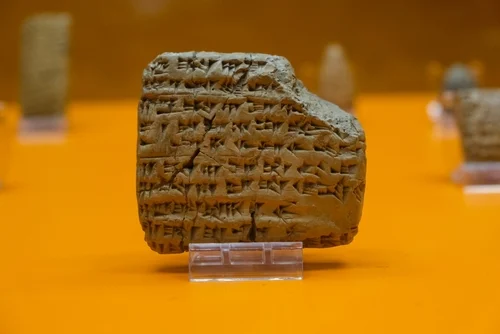
Cuneiform is the oldest writing system historians have found, and it didn’t start out as writing at all. In Mesopotamia’s early cities, in what’s now southern Iraq, merchants and temple administrators used small clay tokens to track goods like grain and livestock. Around 3400–3000 BCE, those tokens gave way to marks pressed into wet clay with a reed stylus — wedge-shaped signs that eventually represented sounds as well as objects, not just tallies.
One of the best-known cuneiform tablets held by the British Museum is a merchant’s complaint, sometimes called the Nanni tablet, in which a trader named Nanni writes to complain that the copper he’d ordered was the wrong quality — a reminder that plenty of ancient writing was about ordinary commercial life, not just kings and priests. If you’re interested in historical objects, our guide to the UK’s museums and galleries can help you find more to explore.
According to the Cuneiform Digital Library Initiative (CDLI), Cuneiform was used for around three thousand years, for everything from law codes to love poetry, before falling out of use as alphabetic scripts spread. New tablets are still surfacing: the CDLI continues to catalogue fresh finds and digitise existing collections, so scholars’ understanding of this earliest writing system keeps shifting even now.
Egyptian Hieroglyphs and the Rosetta Stone

Egyptian hieroglyphs appeared at roughly the same time as cuneiform, around 3200 BCE, and combined pictorial and phonetic elements from very early on — hieroglyphs could represent whole words, individual sounds, or categories of meaning, often within the same sentence. Alongside the formal hieroglyphs used on monuments, Egyptian scribes developed two faster, everyday scripts: hieratic, used for religious and administrative texts, and later demotic, used for everyday business.
For over a thousand years after Egyptian stopped being spoken day to day, nobody could read any of these scripts. That changed with the Rosetta Stone. The Rosetta Stone is a decree issued in 196 BCE, carved in three scripts side by side — hieroglyphic, demotic, and Ancient Greek. Because scholars could already read Greek, they could compare the three texts, and Jean-François Champollion cracked the phonetic structure of hieroglyphs in 1822. The stone has been held at the British Museum since 1802, and it remains one of the museum’s most-visited objects.
If you’re curious what the object actually is, it isn’t a mysterious code — it’s a fairly routine priestly decree honouring a teenage pharaoh, made memorable only by the fact that it happens to say the same thing three times over, in three different writing systems.
Early Chinese Writing and Independent Origins

Chinese writing developed independently of the scripts of the Middle East, with no evidence of contact between the two traditions. Some archaeologists point to symbols carved into tortoise shells at Jiahu, dated to around 6600 BCE, as possible precursors — but most linguists treat this as contested: the symbols may be early counting or ownership marks rather than writing in the fuller sense.
The safer starting point is the Shang dynasty, around 1400 – 1200 BCE, when oracle bone script appears on turtle plastrons and ox shoulder blades. These bones were used for divination: a diviner would inscribe a question, apply heat until the bone cracked, and read the pattern of cracks as an answer from royal ancestors. Oracle bone script already shows the logographic structure that carried through into modern Chinese, and it’s the earliest Chinese writing that scholars broadly agree represents full language, rather than isolated symbols.
Logographic Systems

A logographic system uses a single symbol to represent a whole word or concept, rather than building words out of smaller sound units. Modern Chinese hanzi is the clearest living example, alongside the older Sumerian logograms discussed above.
Logographic systems require a lot of memory — researchers generally put everyday newspaper literacy in Chinese at around 2,500 characters, well beyond the couple of dozen symbols an alphabet needs. In exchange, they offer something an alphabet can’t: because characters represent meaning rather than pronunciation, readers of Mandarin, Cantonese, and other Chinese varieties — which sound very different spoken aloud — can often read the same written text, even where they wouldn’t understand each other’s speech. It’s a genuinely useful property in a country with hundreds of mutually unintelligible dialects, a pattern we look at more broadly in our guide to language dialects across the world.
Syllabic Scripts (Syllabaries)

A syllabary uses one symbol per syllable — a unit of pronunciation built around a single vowel sound — rather than one symbol per whole word or single sound. Japanese uses two syllabaries side by side, hiragana and katakana, alongside kanji (Chinese-derived logographic characters); broadly, kanji carries core meaning, hiragana handles grammar, and katakana marks foreign or borrowed words.
The Cherokee syllabary is one of the more remarkable stories in writing history. Sequoyah, a Cherokee silversmith, created it in the early 1820s despite having no prior literacy in any language — English or North American Cherokee. Within a few years of its adoption, Cherokee literacy reportedly outpaced that of the surrounding settler population.
Not every syllabary survived intact. Linear B, used to write Mycenaean Greek, was deciphered in 1952 by Michael Ventris. Its relative, Linear A, used on Crete slightly earlier, has never been deciphered — nobody yet knows what language it records, which is a useful bridge into the lost ancient script and languages covered later in this guide.
Alphabetic Systems

An alphabet assigns one symbol to each individual sound, vowels included, rather than to whole words or syllables. The lineage most of today’s alphabets trace back to runs through Proto-Sinaitic script, used by Semitic-speaking workers in the Sinai around 1850–1550 BCE, through the Phoenician alphabet, and from there into Greek and Latin.
Greek’s key innovation, around the 8th century BCE, was adding dedicated vowel letters. Phoenician, like the abjads below, had left vowels largely to the reader. That single change made Greek genuinely easier to learn for people without specialist scribal training, and some historians link it to the wider spread of literacy, and civic participation, in the Greek world. It’s an early example of a writing system reshaping who got access to the written word, not just how words were written.
Latin, adapted from a western Greek alphabet via the Etruscans, went on to become the world’s most widely used script, carried first by the Roman Empire and later by European colonisation and trade — a spread that brought genuine practical benefits for global communication, alongside a difficult history for many of the languages and scripts it displaced. If you’re curious how these letters combine into the phrases you might hear day to day, our guide to common phrases in different languages is a good next stop.
Abjads: The Consonant-Only Scripts

Abjads work well for Semitic writing systems of the world because Arabic and Hebrew words are typically built around a three-consonant root, with vowel patterns layered on top to change meaning and grammar. This is a structure where the consonants alone often carry enough information for a fluent reader to fill in the rest. Arabic script isn’t only used for Arabic: it’s also adapted to write Persian, Urdu, and several other languages across a wide swathe of Asia and Africa. Ethnologue cites Standard Arabic as the fifth most-spoken language in the world.
Arabic and Urdu both have an established presence closer to home, too: England and Wales’s 2021 Census recorded around 270,000 people who use Urdu as their main language, one of the largest language communities in the country after English and Welsh.
Undeciphered Scripts and What They Might Tell Us
Some scripts have never been read, and every one of them represents a gap in the historical record — an entire civilisation’s laws, letters, and beliefs that nobody alive can currently access:
- Linear A — Crete, roughly 1800–1450 BCE. Used before Linear B; the underlying language remains unidentified despite decades of attempts.
- Indus script — Indus Valley Civilisation, roughly 2500–1900 BCE. Found on thousands of small stone seals; scholars still debate whether it encodes full language or a more limited symbol system.
- Rongorongo — Rapa Nui (Easter Island), documented from around the 19th century. Only around two dozen inscribed objects survive, and no confirmed translation exists.
- Proto-Elamite — ancient Elam, in modern-day Iran, roughly 3100–2900 BCE. One of the world’s earliest writing systems; some numerical signs are understood, but the script as a whole remains undeciphered.
Each of these represents more than an academic puzzle — it’s a civilisation’s own account of itself, still waiting to be heard.
Can AI Decipher Ancient Scripts?
Machine learning has become a genuinely useful tool for historical linguistics, though it works alongside human experts rather than replacing them. Ithaca, a deep learning model built by DeepMind together with Ca’ Foscari University of Venice, the University of Oxford, and the Athens University of Economics and Business, was published in the journal Nature in March 2022. Trained on Ancient Greek inscriptions, it can suggest text to fill damaged gaps, estimate where an inscription originated, and help date it. In its creators’ published trials, Ithaca restored damaged text with around 62% accuracy and identified an inscription’s likely origin with around 71% accuracy, working alongside a historian.
AI decipherment has real limits. These models generally need a related, already-understood language or a substantial bilingual text to anchor their predictions — they can’t currently pull meaning out of a script in total isolation. That’s part of why the Voynich Manuscript, a 15th-century text in an unidentified script and language, has resisted every decipherment attempt, human or machine, so far; scholarly opinion remains genuinely divided on whether it even encodes a real language.
Even so, tools like Ithaca represent one of the more significant developments in historical linguistics since the Rosetta Stone gave scholars their first way into Egyptian hieroglyphs two centuries ago — another reminder that access to the written past keeps depending on who has the right tools and training to unlock it.

Writing Systems Today: Digital Preservation and Endangered Scripts
Every script in daily digital use today depends on Unicode, the international standard that assigns a unique number to every character across the world’s writing systems so computers can display them consistently. The Unicode Consortium’s most recent standard, version 18.0, encodes more than 172,000 characters across 175 scripts — a scale that would have been unimaginable to the cuneiform scribes this guide opened with, and one that keeps expanding as more scripts are added.
Not every script has made that transition safely. Linguists and preservation groups warn that a meaningful share of the world’s endangered writing systems are at risk of falling out of active use within a generation or two, as speaker communities shift towards more dominant languages and scripts. The Endangered Alphabets Project, founded by woodworker and linguist Tim Brookes, carves and documents disappearing scripts to keep a physical, public record of them. In the UK, the British Library’s digital manuscripts programme is putting historic texts in scripts ranging from Anglo-Saxon runes to South Asian palm-leaf manuscripts online for researchers and the public alike. You can browse more of what’s held across the UK’s libraries in our separate guide. UNESCO continues to support this kind of documentation worldwide through its work on linguistic diversity.
Even emojis sit inside this story. They’re not a writing system in the technical sense because they can’t express grammar the way logographic characters can. But as a shared set of small pictorial symbols understood across language barriers, they’re a genuinely modern echo of the same instinct that produced the first pictographic scripts thousands of years ago.
FAQs
What are the main types of writing systems?
Writing systems generally fall into four types: logographic (a symbol per word or concept, as in Chinese), syllabic (a symbol per syllable, as in Japanese kana), alphabetic (a symbol per individual sound, as in Latin or Greek), and abjad (a symbol per consonant sound, as in Arabic and Hebrew).
What is the oldest writing system in the world?
The oldest writing system currently known is Sumerian cuneiform, which developed in Mesopotamia (modern-day Iraq) around 3400–3000 BCE, evolving from clay accounting tokens into wedge-shaped signs pressed into clay tablets. Egyptian hieroglyphs emerged at a similar time, while Chinese writing developed independently roughly two thousand years later.
What is the difference between a language and a writing system?
A language is a spoken (or signed) system that can exist with no written form at all. A writing system is a separate tool for recording that language visually. One language can be written in more than one script — Korean, for example, is now written almost exclusively in Hangul, but was historically also written using Chinese characters.
Can a language be written in more than one script?
Yes. Many languages have used, or still use, more than one script. Turkish switched from an Arabic-based script to a Latin alphabet in 1928. Serbian is regularly written in both Latin and Cyrillic scripts today. Multi-script writing is common where trade, migration, or religious tradition bring different writing communities into contact.
What are some undeciphered writing systems?
Several ancient scripts have never been read, including Linear A (Bronze Age Crete), the Indus script (Indus Valley Civilisation), Rongorongo (Rapa Nui/Easter Island), and Proto-Elamite (ancient Iran). Each was used by a real, literate society, but without a bilingual text or a closely related known language to work from, their content remains locked away from historians.
Can AI help decipher ancient scripts?
AI models can help, working alongside historians rather than replacing them. Ithaca, developed by DeepMind with several university partners and published in Nature in 2022, can suggest restorations for damaged Ancient Greek inscriptions and estimate their date and origin. AI still generally needs a related language or partial translation to work from — it can’t decipher a totally isolated script from scratch.
What happens to a writing system when it becomes endangered?
An endangered script is typically one whose community of active readers and writers is shrinking, often because a dominant language’s script is replacing it in schools, government, and daily life. Groups such as the Endangered Alphabets Project and institutions like the British Library work to document, digitise, and teach these scripts before that knowledge disappears entirely.
Conclusion
Writing has never been a neutral technology. Every shift covered in this guide — from clay tokens to cuneiform, from priestly hieroglyphs to a public alphabet, from print to Unicode — changed who could read, who could be read, and who got left out. That’s still true today: the same kind of AI tools now helping historians read the Nanni tablet’s three-thousand-year-old complaint about bad copper are also being trained, script by script, to tackle Linear A and the Indus script next. What’s certain is that scripts like Rongorongo and Proto-Elamite are still waiting, and that digitisation projects at places such as the British Library are racing to preserve endangered scripts for the future.
Key takeaways
- Writing systems fall into four main types: logographic, syllabic, alphabetic, and abjad.
- Sumerian cuneiform, developed around 3400 BCE in modern-day Iraq, is the earliest known writing system.
- Of the world’s more than 7,000 living languages, only a minority have a writing system.
- Scripts including Linear A, the Indus script and Rongorongo remain undeciphered.
- AI tools like Ithaca can assist historians with damaged or ancient texts.
If exploring how people express identity through shared, visual symbols interests you, our guide to national symbols looks at another way cultures do this. If you’re interested in languages because you’re settling into a new country, Remitly’s international money transfer service is designed to help you send money home simply.
Last reviewed: September 2026