What Are National Symbols?
National symbols are the flags, emblems, and traditions a country uses to represent its shared history and identity. If you’re new to the UK, you’ll spot these UK national symbols all over the show, like coins, in government buildings, and at major sporting events. This guide walks through what each one means and why it still matters today.
At Remitly, we know that settling into a new country often means learning to read symbols you didn’t grow up with, but once you’re able to recognise things like the Union Jack, the Royal Coat of Arms, and the national flowers of England, Scotland, Wales, and Northern Ireland, everyday British life starts to make a lot more sense.
At a Glance
- The UK’s core national symbols are the Union Jack, the Royal Coat of Arms, and the patron saints of England, Scotland, Wales, and Northern Ireland.
- Each of the four nations also has its own national flower, animal, and colours, from the English rose to the Scottish unicorn.
- You’ll come across these symbols on coins, in passports, and at events like the Six Nations and the Olympics. Together, they reflect a shared union built from four distinct national identities.
The Union Jack: Britain’s Most Recognised Symbol

The Union Jack is a cross combination of the St George’s red cross for England, St Andrew’s white saltire for Scotland, and St Patrick’s red saltire, added when Ireland joined the union in 1801. According to the College of Arms, the flag has no separate emblem for Wales, because Wales was already united with the English crown when the first version was created in 1606, following the union of the Scottish and English thrones under James VI and I. Our guide to Flags of the World is a good place to see how other nations’ designs compare.
You’ll see it flying over government buildings, at British embassies abroad, and behind athletes at the Olympics. It’s also part of an ongoing conversation that if Scotland were ever to become independent, most heraldry experts agree the design would need reconsidering, because it currently draws directly on Scotland’s saltire.
The Royal Coat of Arms: The Official Emblem of the UK

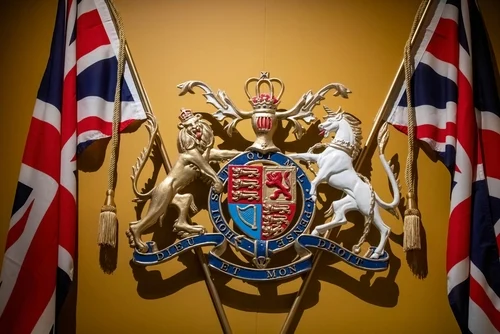
While the Union Jack is a flag, the Royal Coat of Arms is the monarch’s official coat of arms and Britain’s most formal state emblem. It appears on the front cover of UK passports, on royal warrants, and on government and legal documents.
The shield is divided into four quarters:
- Two quarters for England, each showing three gold lions on a red field
- One quarter for Scotland, showing a red lion within a decorative border on gold
- One quarter for Ireland, showing a gold harp on blue, reflecting Northern Ireland’s place in the union
The motto beneath the shield, Dieu et mon droit (“God and my right”), has been used since the reign of Henry V. A lion and a unicorn stand on either side as supporters, the unicorn having joined the English lion after the Union of the Crowns in 1603. Scotland uses its own version, granted by the Court of the Lord Lyon rather than the College of Arms, with the Scottish lion given greater prominence. If you’re newly settled and still working through paperwork, our guide to the UK Residence Permit is a great practical guide of everything you’ll need.
Patron Saints and National Days: The Four Nations

Each of the UK’s four nations has its own patron saint and national day, though not all of them come with a day off work. Celebrations are especially visible in the Biggest Cities in the UK, from Cardiff’s St David’s Day parades to Belfast’s St Patrick’s Day festivities.
| Nation | Patron Saint | National Day | Public Holiday? |
| England | St George | 23 April | No |
| Scotland | St Andrew | 30 November | Officially a bank holiday, though many banks, schools, and employers still operate as normal |
| Wales | St David | 1 March | No. Despite repeated campaigns, the UK government hasn’t granted it official status |
| Northern Ireland | St Patrick | 17 March | Yes |
National Flowers, Animals, and Colours of the UK’s Four Nations

Scotland’s national animal, the unicorn, might be the most surprising entry. It’s represented Scotland’s royal symbolism since the 1400s, chosen because medieval heraldry treated the unicorn as powerful and impossible to tame, a fitting stand-in for Scottish independence of spirit. England, Wales, and Northern Ireland have more familiar emblems, though Northern Ireland has no animal with official status. Heritage authorities, including Historic England, note that its symbols developed more informally than the other three nations.
| Nation | Flower | Animal | Colours |
| England | Rose | Lion | Red and white |
| Scotland | Thistle | Unicorn | Blue and white |
| Wales | Daffodil (and leek) | Red dragon | Red, white, and green |
| Northern Ireland | Shamrock (and flax) | Nothing official. the oystercatcher is sometimes used informally | Not formally designated |
How National Symbols Shape Everyday Life in the UK

You’ll come across these symbols more often than you might expect. Coins have the reigning monarch’s profile, currently King Charles III, following the tradition of each monarch facing the opposite direction to their predecessor. Passports have the Royal Coat of Arms on the cover, and since Brexit, the cover colour has moved from EU burgundy back to the dark blue used before the UK joined the EU.
Sport is where national identity becomes most visible. In the Six Nations rugby championship, England, Scotland, Wales, and an all-island Ireland team compete separately, each behind their own flag. At the Commonwealth Games, all four nations field their own teams, while at the Olympics they combine as Team GB and Northern Ireland, under the Union Jack.
It’s worth understanding the difference between “British” and the four national identities. British describes citizenship and shared institutions, while English, Scottish, Welsh, and Northern Irish describe more specific identities many people hold alongside, or instead of, a British one. How Immigrants Celebrate Their Culture in the UK is a useful next stop for seeing how other newcomers navigate this, and picking up a few Common Phrases in Different Languages can help regional distinctions too.

Frequently Asked Questions
What are the UK’s national symbols?
The UK’s core national symbols are the Union Jack, the Royal Coat of Arms, and the patron saints of England, Scotland, Wales, and Northern Ireland. Each nation also keeps its own national flower, animal, and colours. Together, they reflect a shared union built from four distinct national identities, rather than a single uniform culture.
Is the Union Jack the same as the English flag?
No. The Union Jack represents the whole United Kingdom, combining the crosses of St George, St Andrew, and St Patrick. England’s own flag is St George’s Cross, a plain red cross on a white background, and it’s flown separately at English sporting events and on St George’s Day.
Why is the unicorn Scotland’s national animal?
The unicorn has represented Scotland since the 1400s. Medieval heraldry saw the unicorn as untameable and fiercely independent, qualities that suited Scotland’s self-image. It appears on the Royal Coat of Arms as one of two supporters, alongside England’s lion.
What is the national flower of each UK nation?
England’s national flower is the rose, Scotland’s is the thistle, Wales’s is the daffodil (with the leek as an older alternative), and Northern Ireland’s is the shamrock, alongside flax as a nod to its linen industry.
Why did the UK passport change colour after Brexit?
UK passports moved from EU burgundy back to dark blue, the colour used before the UK joined the EU, marking the country’s departure.
Is St George’s Day a public holiday in England?
No. Despite being England’s national day, April 23rd isn’t an official public holiday, unlike St Patrick’s Day in Northern Ireland. Scotland’s St Andrew’s Day carries bank holiday status, though many employers keep it as a normal working day.
Do all UK national symbols represent the whole country equally?
Not quite. Symbols like the Union Jack and the Royal Coat of Arms represent the UK as a whole, while flowers, animals, and colours are usually specific to England, Scotland, Wales, or Northern Ireland individually, reflecting each nation’s distinct identity within the union.
Conclusion and Key Takeaways
Once you start noticing them, UK national symbols turn up everywhere: on your coins, in a rugby stadium, at a St Patrick’s Day parade in Belfast. Knowing what they mean, and which nation they belong to, is a small but genuinely useful part of settling into life in Britain. At Remitly, we’re glad to be part of that process, from sending money home to feeling a little more at home here.
Key Takeaways:
- The Union Jack and Royal Coat of Arms represent the UK as a whole, while patron saints, flowers, animals, and colours belong to individual nations.
- Wales isn’t represented on the Union Jack, because it was already united with the English crown when the flag was created in 1606.
- Scotland’s unicorn and England’s lion stand together as supporters on the Royal Coat of Arms.
- Only St Patrick’s Day is a full public holiday among the four patron saints’ days; St Andrew’s Day has bank holiday status with limited practical effect, and St George’s and St David’s Days aren’t official holidays at all.
- UK passports carry the Royal Coat of Arms regardless of cover colour, which changed from burgundy to dark blue after Brexit.
Last reviewed: September 2026