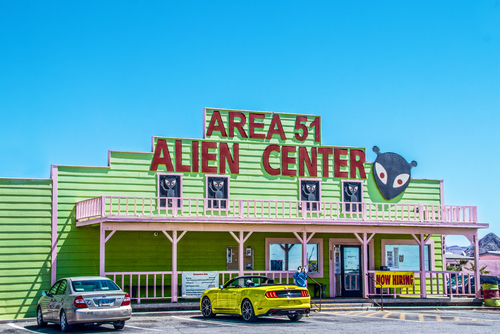
Area 51 is a classified US Air Force facility in southern Nevada, roughly 120 miles (193 km) north-west of Las Vegas, near Groom Lake, inside the Nevada Test and Training Range. The nearest public road is Nevada State Route 375, better known as the Extraterrestrial Highway, which runs along the base’s eastern edge on its way to the small town of Rachel.
This Remitly guide covers exactly where it is, its history and how close you can get.
In short:
- Location: southern Nevada, around 37°14′N, 115°48′W, roughly 120 miles (193 km) north-west of Las Vegas.
- History: established in 1955 to test the U-2 spy plane, later home to the SR-71 Blackbird and F-117 Nighthawk.
- Access: the public can get within about 25 miles of the perimeter via the Extraterrestrial Highway and Groom Lake Road.
- Reputation: the CIA didn’t officially confirm the base existed until 2013, which helped fuel the conspiracy theories that surround it.

Where Exactly Is Area 51? Location, Coordinates, and How to Find It on a Map
Area 51 sits inside the Nevada Test and Training Range, a large stretch of restricted military land in the southern Nevada desert. The name “Area 51” comes from an old map grid reference; officially, the site is registered as Homey Airport, with the ICAO code KXTA. At its centre is Groom Lake, a dry salt flat used as a natural runway long before the base had a paved one.
Its coordinates are often given as around 37°14′N, 115°48′W, since the exact boundary isn’t published officially. Heading north-west out of Las Vegas on US-93 takes you roughly towards the site, at a distance commonly put around 120 miles (193 km), though the road route most visitors drive to reach the perimeter is longer, as covered below.
The surrounding land is largely empty scrub and mountains, with almost no settlements for miles — part of the same stark scenery found among the world’s most extreme desert landscapes.

The History of Area 51: From Cold War Secret to Declassified Legend
Much of what once made Area 51 mysterious has since been declassified. The origins of the base are now a matter of public record, but decades of official silence helped fuel speculation.
How Area 51 Was Established and Why
The CIA selected the Groom Lake site in April 1955 to test the U-2 spy plane, a high-altitude aircraft built to photograph the Soviet Union. Richard Bissell, the CIA officer running the U-2 programme, identified the location; Lockheed’s chief engineer, Kelly Johnson, judged it suitable; and President Eisenhower approved the plan. None of this was officially acknowledged until 2013, when the National Security Archive at George Washington University published the CIA’s declassified U-2 programme history.
The Aircraft That Were Tested There
- U-2: the original reason for the base, built to fly above the reach of Soviet air defences.
- SR-71 Blackbird: a Mach 3-class reconnaissance aircraft; the Smithsonian’s National Air and Space Museum credits it with speeds of around Mach 3.2.
- F-117 Nighthawk: the first operational stealth fighter, developed and first flown from the base in the early 1980s.
These high-altitude test flights explain a good share of the early “UFO” reports in the area. In a Studies in Intelligence article that drew fresh attention in December 2014, the CIA acknowledged that more than half of UFO sightings reported across the US during the 1950s and 60s coincided with U-2 and, later, SR-71 test flights, aircraft that flew far higher than anything the public had seen before.

The Conspiracy Theories: What People Believe and Why It Persists
Three claims come up again and again: that the base holds a recovered alien spacecraft, that it holds alien remains, or that the government has suppressed evidence of extraterrestrial contact. None has any verified evidence behind it, but the claims themselves have a well-documented history.
The Most Widely Known Claims
Much of the modern mythology traces back to one man. In a 1989 television interview with KLAS-TV reporter George Knapp, a former contractor named Bob Lazar claimed he had worked on reverse-engineering an alien spacecraft near Area 51. He has never verified the academic credentials he claimed, and no independent evidence supports his account. His story found a new audience in 2018, when Netflix released the documentary Bob Lazar: Area 51 & Flying Saucers.
Why the Secrecy Fuels Speculation
Psychologists who study conspiracy belief, including Professor Karen Douglas at the University of Kent, point to a simple pattern: when official information is scarce, people fill the gap themselves. Area 51 is a near-perfect case study, the US government spent decades refusing to confirm the base even existed, only acknowledging it in 2013, and once an official denial turns out not to be the whole truth, the next reassurance tends to get treated with a little more scepticism.

Visiting Area 51: How Close Can You Actually Get?
You can’t get onto the base itself, but you can get close enough to understand why people make the trip. Most visitors follow the same basic route out of Las Vegas:
- Las Vegas to the Extraterrestrial Highway: head north on US-93 towards Alamo, then pick up Nevada State Route 375, renamed the Extraterrestrial Highway in 1996, heading west.
- Along the highway to Rachel: it’s roughly 98 miles of the Extraterrestrial Highway itself, running through open desert with almost nothing else along the way.
- Rachel, Nevada: the closest town to the base, with a population of around 50. It’s home to the Little A’Le’Inn, a motel, restaurant, and gift shop that’s served Area 51 visitors for decades and is still open today.
- Groom Lake Road to the perimeter: an unmarked dirt road leads roughly 25 miles south from Rachel towards the base, ending at a guarded gate marked with warning signs — as close as the public can legally get.
All told, it’s around 150 miles (240 km) by road from Las Vegas to the gate, closer to a three-hour drive than a quick detour, so it’s worth planning fuel and water stops in advance, since services along the route are limited.
For UK travellers, that usually means flying into Las Vegas, checking entry requirements and an ESTA before you go, hiring a car, and finding out whether you’ll need an international driving permit alongside your UK licence. The desert drive itself is worth treating as part of the trip, the scenery is as much a reason to go as the base at the end of it.

Area 51 in British and Global Pop Culture
Independence Day (1996) placed the base at the centre of its alien-invasion story, and television series have all folded it into their own plots — Doctor Who fans in particular will recognise Area 51 as recurring shorthand for a government secret best left buried.
Area 51’s fame extends well beyond the screen, drawing tourists, novelty shops, and roadside stops like the “E.T. Fresh Jerky” stand along the Extraterrestrial Highway. For a base most people will never see inside, it’s become shorthand for secrecy itself — “we can’t tell you” tends to be read as evidence of something extraordinary, rather than simply how classified work operates.
Frequently Asked Questions About Area 51
Where is Area 51 located?
Area 51 is in southern Nevada, inside the Nevada Test and Training Range, close to Groom Lake and roughly 120 miles (193 km) north-west of Las Vegas. It doesn’t appear on standard road maps, but its approximate location, around 37°14′N, 115°48′W, is well documented in declassified CIA records.
Can you visit Area 51?
You can’t enter the base itself, but you can drive the Extraterrestrial Highway (Nevada State Route 375) to Rachel and then along Groom Lake Road to a guarded gate about 25 miles further on. That gate marks the closest legal approach for the public.
What is Area 51 used for today?
Area 51 remains an active US Air Force test site within the Nevada Test and Training Range. Its current programmes are classified, but historically it has been used to develop and test experimental and stealth aircraft away from public and foreign observation.
Who made Area 51 famous?
Bob Lazar’s 1989 KLAS-TV interview with reporter George Knapp is widely credited with bringing Area 51 into mainstream conspiracy culture, later revived by a 2018 Netflix documentary. Films and shows including Independence Day and The X-Files cemented its reputation worldwide.
Why is Area 51 secret?
Area 51 tests experimental military aircraft, so its secrecy protects genuine national security interests rather than anything extraterrestrial. The base’s existence wasn’t officially confirmed until 2013, when the CIA released declassified U-2 programme documents.
How far is Area 51 from Las Vegas?
Area 51 is roughly 120 miles (193 km) north-west of Las Vegas as commonly measured. By road, following the Extraterrestrial Highway route most visitors take towards Rachel and the perimeter gate, the drive is closer to 150 miles (240 km), or about three hours.
Can you see Area 51 on Google Maps?
Google Maps shows the general area, including the Extraterrestrial Highway and the town of Rachel, but satellite imagery of the base itself is limited in detail, and the site’s internal layout isn’t mapped for public use.
Key Takeaways
- Area 51 sits in southern Nevada’s Nevada Test and Training Range, near Groom Lake, and wasn’t officially confirmed to exist until the CIA’s 2013 declassification.
- It was established in 1955 to test the U-2 spy plane, and later hosted the SR-71 Blackbird and F-117 Nighthawk.
- The public can get within about 25 miles of the perimeter via the Extraterrestrial Highway (Nevada State Route 375) and Groom Lake Road.
- Bob Lazar’s 1989 claims, revived by a 2018 Netflix documentary, remain the best-known source of the base’s alien mythology, though none of it is independently verified.
If a Nevada road trip is part of your wider US travel plans, it’s worth sorting the practical side before you set off, including a US SIM card for the patchy signal along the highway, and knowing what’s normal for tipping once you stop at a diner like the Little A’Le’Inn. We hope this helps you feel a little more prepared, wherever your next US trip takes you.