Quick answer: Sukkot 2026 begins at sundown on Sunday, 27 September and ends at nightfall on Sunday, 4 October. It is a week-long Jewish harvest festival celebrated by building a temporary outdoor structure called a sukkah, gathering the Four Species, and welcoming guests — a practice known as ushpizin.
Sukkot is one of the most joyful holidays in the Jewish calendar. Known in Hebrew as “the Festival of Booths” or “the Season of Our Rejoicing,” it has been celebrated for thousands of years — and in 2026, it falls in the final days of September.
Whether you are preparing to celebrate for the first time or looking to reconnect with familiar traditions, this guide covers everything you need to know. You will find the exact dates, the meaning behind the customs, practical tips for building a sukkah, and what Hoshana Rabbah and Shemini Atzeret mean in the context of the holiday.

When is Sukkot in 2026?
Sukkot 2026 begins at sundown on Sunday, 27 September and ends at nightfall on Sunday, 4 October. The holiday lasts seven days, in accordance with the commandment in Leviticus 23:42: “You shall dwell in booths for seven days.”
Here is a quick breakdown of the key dates:
| Date | Event |
| Sundown, 27 Sept | Sukkot begins |
| 28–29 Sept | Yom Tov (first two days, observed as holidays in the Diaspora) |
| 30 Sept – 3 Oct | Chol HaMoed (intermediate days) |
| Sundown, 4 Oct | Hoshana Rabbah (seventh day of Sukkot) |
| Sundown, 4 Oct | Shemini Atzeret begins |
| Sundown, 5 Oct | Simchat Torah begins (outside of Israel) |
Note that in Israel, Yom Tov is observed only on the first day, and Simchat Torah is celebrated on the same night as Shemini Atzeret.
What is Sukkot and Why is it Celebrated?
Sukkot commemorates two things simultaneously: the 40 years the Jewish people spent wandering in the desert after leaving Egypt, living in temporary shelters, and the end of the agricultural harvest season in the Land of Israel.
The Torah commands Jews to “rejoice before the Lord your God for seven days” (Leviticus 23:40). That spirit of gratitude and joy sits at the heart of everything — the communal meals, the festive prayers, and the act of stepping outside the comfort of a permanent home to sit beneath the stars.
The holiday carries a universal message, too. Sukkot is one of the three Jewish pilgrimage festivals (alongside Passover and Shavuot), and its themes of gratitude, hospitality, and transience resonate well beyond the Jewish community.
What is a Sukkah and How Do You Build One?
A sukkah is a temporary outdoor structure with open walls and a roof made of natural, unprocessed plant material — typically bamboo poles, branches, or palm fronds. This roof covering is called schach.
The key rules for a kosher sukkah include:
- Schach must be natural: cut plant material only, not synthetic materials or anything still attached to the ground.
- You must be able to see the stars: the schach should be sparse enough to allow starlight through at night.
- It must have at least two and a half walls: though most sukkahs have three or four walls.
- Minimum height is 80 cm: and the maximum is 20 amot (roughly 9.6 metres), though most are much smaller.
Many families decorate their sukkah with hanging fruit, paper chains, and illustrated artwork. Children often help with the decorating — it is one of the most hands-on parts of the holiday.

How long does it take to build a sukkah?
A basic sukkah can be assembled in a few hours with a pre-made kit. More elaborate structures may take a full day. Many families begin building immediately after Yom Kippur, which ends just a few days before Sukkot.
What Are the Four Species (Arba Minim)?
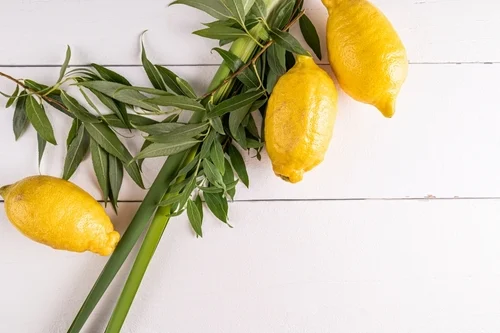
One of the central commandments of Sukkot is waving the Four Species, known in Hebrew as the Arba Minim. These four plants are held together and waved in six directions — east, south, west, north, upward, and downward — symbolising God’s presence throughout the universe.
The Four Species are:
- Etrog – a citrus fruit, similar to a lemon, held in the left hand
- Lulav – a palm frond, held in the right hand along with the myrtle and willow
- Hadassim – three myrtle branches
- Aravot – two willow branches
The lulav, hadassim, and aravot are bound together and held as one unit. The waving ritual is performed each morning of Sukkot, except on Shabbat.
What is Ushpizin?
Each night in the sukkah, many Jewish families observe a tradition called ushpizin (Aramaic for “guests”). This practice involves symbolically welcoming seven biblical guests into the sukkah: Abraham, Isaac, Jacob, Moses, Aaron, Joseph, and David.
In more progressive communities, the female counterparts — Sarah, Rebecca, Rachel, Leah, Miriam, Deborah, and Ruth — are welcomed alongside or instead of the traditional seven.
The tradition reinforces Sukkot’s emphasis on hospitality. Many families pair the symbolic ushpizin with the very real act of inviting friends, neighbours, and those in need to share meals in the sukkah.

What Happens on Hoshana Rabbah?
Hoshana Rabbah falls on the seventh and final day of Sukkot — in 2026, that is the evening and day of 4–5 October.
It holds special significance in Jewish tradition as a day of final judgement. According to Kabbalistic teaching, while Yom Kippur seals the decree for the coming year, Hoshana Rabbah is when that decree is handed down. Synagogue services on this day are longer, with special prayers and a ceremony in which the willow branches are beaten against the ground.
What is Shemini Atzeret?
Immediately following Sukkot is Shemini Atzeret, which begins at sundown on 4 October 2026. The name translates to “the Eighth Day of Assembly,” and while it follows directly after Sukkot, it is technically a separate holiday.
On Shemini Atzeret, the prayer for rain (Tefillat Geshem) is recited — a timely petition at the close of the harvest season, as communities in Israel look ahead to the winter rains.
Outside of Israel, Simchat Torah — the celebration of completing and restarting the annual Torah reading cycle — is observed on the following evening, 5 October 2026. In Israel, both are celebrated on the same night, 4 October.
Sukkot Foods to Enjoy
There is no specific feast required by Jewish law for Sukkot, but the holiday lends itself naturally to celebratory meals. Many families serve dishes that reflect the harvest theme:
- Stuffed vegetables (cabbage rolls, stuffed peppers) — the “stuffed” motif represents abundance
- Honey cake carried over from Rosh Hashanah and Yom Kippur
- Kreplach (dumplings with meat filling), traditional on Hoshana Rabbah eve
- Seasonal fruits and vegetables, often reflecting what is locally in harvest
Meals are traditionally eaten inside the sukkah, making each gathering part of the mitzvah itself.
Sukkot Greetings: What to Say in 2026
Not sure how to greet someone during Sukkot? Here are the most common expressions:
- “Chag Sameach” – Happy Holiday (used throughout the festival)
- “Moadim L’simcha” – Appointed times for joy (a traditional Sukkot-specific greeting)
- “Chag Sukkot Sameach” – Happy Sukkot (more specific)
Any of these are warmly received. If you are unsure, “Chag Sameach” is always appropriate.

How to Celebrate Sukkot If You Do Not Have a Sukkah
Not everyone has outdoor space or the resources to build a sukkah. That does not mean you cannot participate in the holiday.
Many synagogues and Jewish community centres build communal sukkahs that are open to everyone. Some urban communities organise sukkah-hopping events, where people visit multiple sukkahs throughout the week. Buying an etrog and lulav set — available from Jewish bookshops and online retailers starting in early September — is another accessible way to observe the holiday’s central commandment.
Sending Money Home for Sukkot 2026
For Jewish communities living abroad, Sukkot is often a time to stay connected with family back home. If you want to contribute to a family celebration — perhaps helping cover the cost of food, sukkah materials, or gifts — sending money internationally is a practical way to take part.
Platforms like Remitly make it straightforward. You can transfer funds to 170+ countries with no hidden fees and track your transfer in real time, so you know your contribution arrives before the holiday begins. With Sukkot starting at sundown on 27 September 2026, planning ahead gives your family the time they need to prepare.
What Sukkot Means Beyond the Holiday
The temporary sukkah carries a message that extends well beyond the seven days of the festival. Dwelling in a fragile structure — open to the wind, exposed to the night sky — is a deliberate act of humility. It is a reminder that security is never guaranteed, that the harvest is a gift, and that what matters most is the people gathered around the table.
That message travels well. Sukkot has inspired interfaith reflection, environmental thinking, and conversations about home, belonging, and resilience — all topics that feel as relevant today as they did in ancient times.
Frequently Asked Questions About Sukkot 2026
When does Sukkot 2026 start and end?
Sukkot 2026 begins at sundown on Sunday, 27 September and ends at nightfall on Sunday, 4 October. It is a seven-day festival, followed immediately by Shemini Atzeret on 4–5 October.
What is the difference between Sukkot and Shemini Atzeret?
Sukkot is a seven-day harvest festival. Shemini Atzeret is a separate one-day holiday that immediately follows it. Outside of Israel, Simchat Torah is observed on the second night of Shemini Atzeret (5–6 October 2026).
Do you have to build a sukkah to celebrate Sukkot?
Building a sukkah is a key mitzvah, but it is not the only way to observe the holiday. Attending a communal sukkah, waving the Four Species, and joining festive meals all count as meaningful participation.
What do you eat during Sukkot?
There are no strict dietary laws specific to Sukkot beyond keeping kosher. Common foods include stuffed vegetables, seasonal fruits, honey cake, and kreplach. All meals during the holiday are traditionally eaten inside the sukkah.
What is the significance of Hoshana Rabbah?
Hoshana Rabbah is the seventh and final day of Sukkot (4–5 October 2026). In Jewish tradition, it is considered the last opportunity for repentance before the divine judgement sealed on Yom Kippur is finally delivered. Special prayers and a willow-beating ceremony mark the day.
How do you greet someone on Sukkot?
The most common greeting is “Chag Sameach,” meaning Happy Holiday. “Moadim L’simcha” is a traditional Sukkot-specific greeting. Both are widely used and warmly received.