What Is Brazilian Food? A Quick Introduction
Brazilian food is a richly diverse cuisine shaped by Indigenous, African, and Portuguese influences, along with later waves of Italian, Japanese, and Middle Eastern immigration. Staple dishes include feijoada, pão de queijo, coxinha, and brigadeiro, while regional traditions range from Afro-Brazilian cooking in Bahia to churrasco in the south.
If you’ve moved to the UK from Brazil, or you’re simply curious about the food your Brazilian friends, neighbours, or colleagues grew up with, this guide is written with you in mind rather than for someone planning a trip to Rio. Brazilian restaurants, cafés, specialist grocers, and online retailers make many of these flavours accessible in Britain, while ingredients such as black beans, condensed milk, and tapioca starch can be sourced without travelling to Brazil. For a wider look at how food carries a country’s history, see our guide to national dishes from around the world.
At a glance
- Brazilian cuisine reflects Indigenous, African, Portuguese, and later immigrant influences, with strong regional differences.
- Feijoada, moqueca, churrasco, pão de queijo, coxinha, brigadeiro, and açaí are among the foods most closely associated with Brazil.
- Brazilian food is not uniformly spicy. Chilli heat is often added separately, including through malagueta-based sauces and condiments.
- In the UK, Brazilian restaurants and specialist grocers make it possible to try many dishes or source ingredients for home cooking.
- Fogo de Chão, formerly Fazenda, currently has restaurants in London, Leeds, Liverpool, Manchester, Birmingham, and Edinburgh.

Classic Brazilian Dishes Every Food Lover Should Know
These five dishes give a good sense of Brazil’s most-loved home cooking and its best-known restaurant classics.
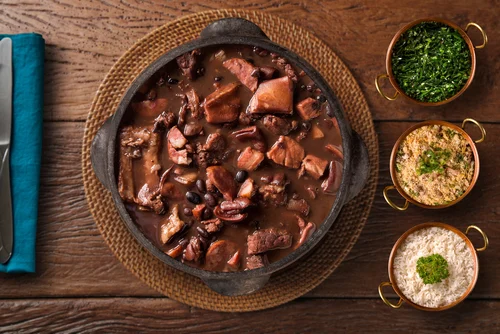
Feijoada: a slow-simmered stew of black beans and pork, often with additional cuts of meat, feijoada is widely regarded as one of Brazil’s most representative dishes. It’s commonly served with rice, sautéed collard greens (couve), orange slices, and toasted cassava flour (farofa). Recipes vary considerably between regions and households, but the combination of black beans, pork, and traditional accompaniments is central to the version most closely associated with Brazilian cuisine.
Moqueca: a fragrant Brazilian seafood stew with distinct regional versions. Bahia’s moqueca typically uses coconut milk and dendê oil, while Espírito Santo’s moqueca capixaba traditionally uses neither. Both showcase Brazil’s coastal cooking, usually combining fish or seafood with tomatoes, onions, peppers, and fresh herbs. The capixaba version is traditionally prepared in a clay pot, while the Bahian style is richer from coconut milk and palm oil.
Churrasco: Brazil’s tradition of grilling meats over an open flame is less a single dish than a style of cooking and eating. Cuts are typically seasoned simply and served in generous rounds. In the UK, Fogo de Chão, the chain formerly known as Fazenda, currently operates restaurants in London, Leeds, Liverpool, Manchester, Birmingham, and Edinburgh, serving churrasco in a rodízio-style format.
Brigadeiro: a rich, fudgy sweet made from condensed milk, butter, and cocoa powder, rolled into balls and coated in chocolate sprinkles, brigadeiro is a fixture at Brazilian birthday parties and one of the country’s best-loved treats. We cover it, and other Brazilian sweets, in more detail in the desserts section below.
Açaí: native to the Amazon, açaí berries are processed into a deep-purple pulp that can be served in bowls with toppings such as granola and banana. In Brazil, açaí is widely eaten as a snack or meal, although preparation varies significantly by region. In the UK, frozen açaí pulp and ready-made products are available from some supermarkets and specialist retailers, so it’s possible to recreate a simple bowl at home.

Popular Brazilian Street Food and Snacks
Street food is where Brazilian cooking shows its range, and the snacks below turn up in bakeries, markets, cafés, and street-food settings across the country. They sit alongside the international snacks and global flavours in the UK that reflect similar food traditions from around the world.
Pão de queijo: these small, chewy cheese breads get their distinctive texture from cassava starch rather than wheat flour, making traditional versions naturally gluten-free. They are strongly associated with Minas Gerais and are commonly eaten with coffee or as a snack. In the UK, the ingredients are straightforward to source from specialist Brazilian shops and many larger food retailers.
Coxinha: shaped like a teardrop and named for its resemblance to a chicken thigh (coxa), coxinha is a deep-fried croquette traditionally filled with shredded chicken, often with creamy cheese, and coated in breadcrumbs. A popular story links its invention to a nineteenth-century royal household in São Paulo, but this is better treated as folklore than documented history. Vegetarian versions may use cheese or hearts of palm.
Pastel: a thin, crisp pastry deep-fried until it blisters, pastel is typically filled with cheese, minced beef, chicken, or hearts of palm. Its closest UK relative is a spring roll, though the pastry itself is thinner and closer to a stretched empanada dough. Vegetarian fillings are common, so a meat-free option is usually easy to find, and pastel is a familiar sight at Brazilian street markets and fairs, sold hot from the fryer alongside sugar cane juice.
Acarajé: a speciality strongly associated with Bahia, acarajé is made from black-eyed peas and fried in dendê oil, then typically opened and filled with accompaniments such as vatapá and shrimp. It has deep roots in Afro-Brazilian and Candomblé traditions. In 2005, Brazil’s national heritage institute, IPHAN, registered the Ofício das Baianas de Acarajé, the traditional knowledge and practice associated with the women who prepare and sell acarajé, as Cultural Heritage of Brazil.
Tapioca: not to be confused with the tapioca pudding familiar in the UK, Brazilian tapioca is a crepe made from hydrated cassava starch, cooked on a hot griddle until it sets into a flexible, gluten-free wrap. It’s typically folded around a filling, coconut and condensed milk for something sweet, or cheese and ham for something savoury. Because it needs no wheat, eggs, or dairy in the base, it’s one of the easier Brazilian snacks to adapt for most dietary restrictions.

Brazilian Desserts and Sweet Treats
Brazilian desserts often make generous use of condensed milk, coconut, eggs, sugar, and tropical fruit, producing sweets that range from dense and fudgy to smooth and custardy. Many are closely associated with celebrations, family meals, bakeries, and everyday treats. For UK home cooks, this is one of the easiest parts of Brazilian cuisine to explore because several classics rely mainly on ordinary supermarket ingredients, with specialist grocers needed only for products such as guava paste or Minas-style cheese.
Brigadeiro: made by simmering condensed milk with butter and cocoa powder until thick, then rolling the mixture into balls and coating them in chocolate sprinkles, brigadeiro has a soft, fudgy texture. Its core ingredients are widely available in UK supermarkets, making it one of the more accessible Brazilian sweets to prepare at home.
Romeu e Julieta: this simple pairing combines guava paste (goiabada) with a mild, salty cheese, traditionally Minas cheese. The sweet-salty contrast is the point of the dish, and it needs no cooking. In the UK, guava paste is most reliably found through Brazilian or Portuguese grocers, while a mild firm cheese can work when Minas cheese isn’t available.
Quindim: a glossy, egg-yolk custard sweetened with sugar and coconut, quindim is baked until it sets into a wobbly, bright-yellow dome. Its texture sits somewhere between a crème caramel and a coconut macaroon, and its intense sweetness means it’s usually served in small portions, often baked in individual muffin tins rather than as one large dish.
Pudim de leite condensado: Brazil’s take on crème caramel, this dessert is made by baking condensed milk, eggs, and a caramel syrup together in a water bath, then turning it out to reveal a glossy caramel top. It’s one of the most common desserts on Brazilian family tables, and it translates easily to a British kitchen, since condensed milk, eggs, and sugar are all standard supermarket staples. It’s traditionally served well chilled, cut into wedges rather than individual portions.

Brazilian Food in the UK: Where to Find It
If you’d rather try Brazilian food before cooking it, several UK cities have Brazilian or Brazilian-style restaurants. Fogo de Chão, formerly Fazenda, currently operates rodízio-style churrasco restaurants in London, Leeds, Liverpool, Manchester, Birmingham, and Edinburgh. London also has Brazilian cafés, bakeries, and food businesses, particularly in areas with established Portuguese-speaking communities such as Stockwell, reflecting how immigration has shaped modern British food.
The community behind that food scene is substantial. Research published in Migration Studies, drawing on the Office for National Statistics Annual Population Survey, reports an estimated 119,000 Brazil-born people living in the UK in 2021. That figure is an estimate rather than a current headcount: the ONS has since discontinued its detailed country-of-birth series and warns that estimates below broad regional groupings carry greater uncertainty.
For ingredients, specialist Brazilian grocers and online food retailers in the UK sell staples such as tapioca starch, cassava flour, guava paste, dendê oil, guaraná drinks, and Brazilian coffee. Availability at mainstream supermarkets varies by product, store, and location, so it’s worth checking current ranges before shopping. Similar specialist options can be found through the UK’s multicultural markets and shops.
Home cooking is another practical way to explore Brazilian cuisine in the UK. Pão de queijo, for instance, uses cassava or tapioca starch with cheese, eggs, milk, and oil, while brigadeiro relies on condensed milk, cocoa, and butter. Feijoada takes longer but uses ingredients that are widely available, with specialist shops useful for items such as farofa, dendê oil, guava paste, and Brazilian-style cuts of meat. Availability varies, so check current retailer ranges before making a special trip.

Frequently Asked Questions About Brazilian Food
A few quick answers to the questions people most often ask about Brazilian food.
What is the national dish of Brazil?
Feijoada is widely regarded as one of Brazil’s national dishes. It’s a slow-cooked stew centred on black beans and pork, commonly served with rice, sautéed greens, orange slices, and farofa. Recipes vary considerably by region and household, reflecting the diversity of Brazilian cooking rather than one fixed national recipe.
What does Brazilian food taste like?
Brazilian food tends to be rich, earthy, and only mildly spiced, built around black beans, tropical fruits, coconut milk, and smoked or grilled meats. Coastal regions favour lighter, coconut-based seafood dishes, while the interior and south lean towards heartier, meat-focused cooking. Flavours are generally comforting rather than fiery, with sweetness and acidity used to balance rich dishes.
Is Brazilian food spicy?
Not typically. Many Brazilian dishes are mild, with chilli heat added at the table or through sauces rather than built into every recipe. Malagueta pepper, a small, fiery chilli, is one common way to add heat. Regional cooking varies, so the level of spice depends on the dish, location, and individual cook.
What are the most popular Brazilian snacks?
Pão de queijo (gluten-free cheese bread), coxinha (a teardrop-shaped chicken croquette), pastel (a thin, deep-fried pastry with savoury fillings), and tapioca (a griddled cassava-starch crepe) are among Brazil’s most popular snacks. All four are sold at bakeries and street stalls across Brazil, and versions of most are now available from Brazilian grocers and cafés in the UK.
Can you find Brazilian food in the UK?
Yes. Brazilian restaurants, cafés, specialist grocers, and online retailers operate across the UK. Fogo de Chão has restaurants in six UK cities, while independent Brazilian businesses are particularly visible in parts of London. Specialist retailers also sell ingredients such as cassava flour, guava paste, dendê oil, and guaraná.
What influences Brazilian cuisine?
Brazilian cuisine reflects Indigenous, African, Portuguese, and later immigrant influences. Cassava and açaí have Indigenous roots; acarajé and dendê oil show strong West African influence; Portuguese cooking contributed techniques and sweets; and later communities, including Japanese immigrants, added further traditions, particularly in cities such as São Paulo.
What is a typical Brazilian breakfast?
A typical Brazilian breakfast is light: sliced pão de forma (soft white bread) with butter or jam, fresh fruit, a mild cheese, and sometimes cold cuts, all served alongside a small, strong, usually sweetened coffee (cafézinho). It’s closer to a continental breakfast than the UK’s cooked, savoury-heavy version.
Conclusion: Exploring Brazilian Food
Brazilian food reflects the country’s size and layered cultural history, which is why cooking traditions vary so much between regions. Whether you’re trying feijoada for the first time or making pão de queijo at home, many Brazilian dishes and ingredients can now be found in the UK through restaurants and specialist retailers. If you’re also navigating money between the two countries, our guide to currency across South America offers useful background. When you need to support family or friends back home, you can also explore how to send money to Brazil from the UK with Remitly.
Key takeaways:
- Feijoada, a black bean and pork stew, is widely regarded as one of Brazil’s most representative dishes.
- Brazilian cuisine combines Indigenous, African, Portuguese, and later immigrant influences, with big regional differences.
- Popular snacks include pão de queijo, coxinha, pastel, acarajé, and tapioca.
- Brazilian food is not uniformly spicy; chilli heat is often added separately, including through malagueta-based sauces.
- Fogo de Chão currently operates in London, Leeds, Liverpool, Manchester, Birmingham, and Edinburgh, while specialist UK grocers sell ingredients for Brazilian home cooking.
Last reviewed: September 2026