

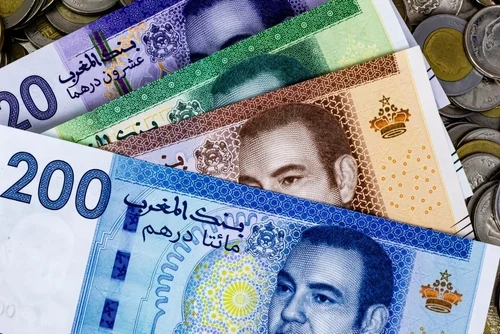
The official currency of Morocco is the Moroccan dirham (MAD). One dirham equals 100 santimat. The dirham is a closed currency, meaning it cannot be purchased outside Morocco. Australians should plan to exchange AUD for dirhams on arrival at a bureau de change or ATM.
TL;DR
- Moroccan currency: the dirham (MAD), issued by Bank Al-Maghrib
- 1 dirham equals 100 santimat
- It’s a closed currency, so you can only get MAD once you’re in Morocco
- Morocco runs largely on cash, so budget for ATM withdrawals and small notes

What Is Moroccan Currency?
The dirham is the official currency of the Kingdom of Morocco, with one dirham composed of 100 santimat. Morocco’s central bank, Bank Al-Maghrib, is the sole issuer of dirham notes and coins, and its name appears on every banknote.
Morocco is a multilingual nation, where many people speak French, Arabic, and other local languages, and so is its currency. The Arabic word “santim” translates to “centime” in French, while the plural “santimat” translates to “centimes.”
- Currency code: MAD
- Abbreviation: DH
- Coin denominations: 1, 2, 5, and 10 dirhams
- Banknote denominations: 20, 50, 100, and 200 dirhams
- Santimat/centimes: 5, 10, 20, and 50
Morocco’s dirham is one of dozens of currencies across Africa, each with its own history.

Is the Moroccan Dirham a Closed Currency?
The Moroccan dirham is a closed currency, which means you can’t buy it freely outside the country. Because of this, if you’re visiting Morocco, you should only exchange the amount you think you’ll need and spend all of it while in the country.
That means you won’t find dirhams at Australian banks or the airport before you fly. Plan to exchange your Australian dollars once you land, at a bureau de change or a bank ATM.
Keep in mind that AUD isn’t widely traded at bureaux de change in Morocco. Converting some AUD into USD or EUR before you leave gives you a backup that’s easier to exchange on arrival, if you’re not sure your dirhams will stretch far enough.
Can you buy Moroccan dirhams in Australia? Generally, no. Mainstream Australian banks and currency exchange counters don’t stock dirhams, so exchanging on arrival is the practical option for most travellers. If you are planning to visit, our guide on visas in Morocco can offer valuable insight.
Morocco isn’t the only country with a closed currency, either; the Vietnamese dong works much the same way.

A Brief History of Morocco’s Currency
The Arabic word “dirham” comes from the Ancient Greek word “drachma.” So, how did the term for Greek currency end up in Morocco? It’s simple: conquest and trade. At the height of the Byzantine Empire around 600 AD, the Greek realm stretched across Northern Africa, and the drachma entered other civilizations, including Persia, Moorish Spain, and the region that would later become the Ottoman Empire.
Until 1882, Morocco still minted coins using copper, silver, and gold. The silver coins are called dirhams.
The rial then became Morocco’s leading currency until 1912, when Morocco became a French protectorate, and the franc took over as the official currency.
The franc stayed in place throughout the protectorate years, and the dirham wasn’t reintroduced until 16 October 1960, this time as Morocco’s primary currency, according to Bank Al-Maghrib.
When the modern dirham was first introduced, the 100 and 50 dirham notes were overprints on the original franc banknotes: the 100 dirham note was printed over the 10,000 franc note.

Dirham Banknotes and Coins: What to Know Before You Go
If you’ve ever seen or held a dirham banknote, you may have noticed a man appearing on each one. That’s the monarch of the Kingdom of Morocco. Starting in 1987, the notes featured King Hassan II.
Since he passed away in 1999, a new note displays his successor, Mohammed VI, from 2002 onward. Morocco isn’t alone in featuring its head of state on its currency; the Egyptian pound carries similar imagery.
In Arabic, some words create a “broken plural,” which is when the middle sounds change; that’s why dirham becomes darahim. It’s OK if you stick to just using “dirham.” In tourist-friendly cities such as Casablanca, Tangier, and Marrakesh, residents are familiar with the English or French versions of the word.
You can still hear some locals calling 5 santimat a “rial” and 1 santim a “franc.” This is likely because when the new currency appeared in the 1960s, one dirham equaled 100 francs.

Using Cash in Morocco: Practical Tips for Australians
Generally, you’ll need cash for marketplaces, small shops, and locations outside the major cities. You should be able to use your card at most mid-to-large hotels, restaurants, and malls, which typically accept Visa and Mastercard, though contactless payment is less widely available outside major cities.
Watch for dynamic currency conversion too, where a terminal offers to charge you in AUD at a poor rate; paying in dirhams avoids it.
The easiest way to get cash is to use an ATM to convert your Australian dollars into dirhams directly. ATM fees are usually lower than at a currency exchange office, though this depends on your bank, so check its international fees before you travel.
Services like Wise and Revolut, both available in Australia, are worth comparing alongside your regular bank for lower withdrawal fees.
- Break 100 and 200 DH notes when you can.
- Vendors prefer small notes like the 5, 10, and 20 DH.
- Keep exact change for taxis.
- If your restaurant bill doesn’t include a tip, consider giving around 10%.
- Leave travellers’ cheques at home, as most Moroccan banks won’t accept them.

FAQ: Moroccan Currency Questions Answered
What is the official currency of Morocco?
The official currency of Morocco is the Moroccan dirham (MAD), issued by Bank Al-Maghrib. One dirham is divided into 100 santimat, and you’ll see it abbreviated as DH on price tags and menus.
Can you buy Moroccan dirham in Australia?
Not easily. The dirham is a closed currency, so mainstream Australian banks and travel money providers don’t stock it. Plan to exchange your Australian dollars once you’ve arrived in Morocco.
What do Moroccan dirham banknotes and coins look like?
Current banknotes come in 20, 50, 100, and 200 dirhams and feature King Mohammed VI. Coins run from 1 to 10 dirhams, plus smaller santimat coins.
Do you need cash in Morocco?
Yes, for the most part. Souks, taxis, small riads, and tips are usually cash-only, so it’s worth carrying small dirham notes even if you plan to use a card elsewhere.
What does it cost Australians to exchange money in Morocco?
Costs vary by provider. ATM withdrawals through your bank or a service like Wise are generally cheaper than airport counters or hotel exchange desks, so it’s worth checking your bank’s fees first.
Key Takeaways
- Morocco’s currency is the dirham (MAD), issued by Bank Al-Maghrib.
- It’s a closed currency, so you’ll exchange AUD for dirhams after you land, not before you leave.
- Morocco runs on a cash-first economy, and ATMs are usually the easiest way to get dirhams.
- Current banknotes feature King Mohammed VI, in denominations of 20, 50, 100, and 200 dirhams.
- In rural markets, you might still hear informal terms like “rial” and “franc” for small change.
Conclusion
Morocco’s cash-first economy and closed currency mean a little planning goes a long way: leave the currency exchange until you land, lean on ATMs and cards day to day, and keep small dirham notes for markets and taxis. If you’re curious about how other currencies compare, our round-up of the world’s most beautiful currencies is a good place to start.
Remitly makes it easy to send money to Morocco and dozens of other countries from Australia, so friends and family back home can access funds when they need them.
Last reviewed: September 2026



