

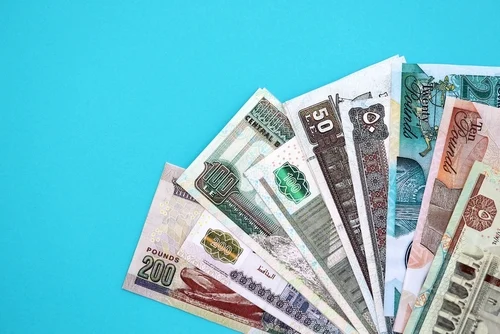
What Is Egypt’s Official Currency?
Egypt’s official currency is the Egyptian pound (EGP), divided into 100 piasters. Banknotes range from 25 piasters to 200 pounds; coins come in 10, 25, and 50 piasters and 1 pound. Cash is widely used throughout Egypt.
In Arabic, the currency is called gineih, while piaster translates to qirsh.
You’ll often see it written as “LE” (from the French Livre Égyptienne) or “E£.” For Australians travelling to Egypt or sending money home to family there, it helps to get familiar with the pound early.

Egyptian Pound Denominations: Notes and Coins
According to the Central Bank of Egypt, these denominations are current as of 2026.
Banknotes:
- 200 EGP
- 100 EGP
- 50 EGP
- 20 EGP
- 10 EGP
- 5 EGP
- 1 EGP
- 50 piasters
- 25 piasters
Coins:
- 1 EGP
- 50 piasters
- 25 piasters
- 10 piasters
Note size increases with value, and every note is bilingual, with Arabic on one side and English on the other. Day-to-day spending mostly runs through 10, 20, 50 and 100 EGP notes.
If you enjoy banknote design, our round-up of beautiful world currencies covers more notes worth a look.

A Brief History of the Egyptian Pound
According to the Central Bank of Egypt, the Egyptian Pound currency has evolved over nearly two centuries. Legislation in 1834 introduced a bimetallic system of silver and gold, and the pound entered circulation in 1836. Egypt moved to the gold standard around 30 years later, formalised by an 1885 reform. The National Bank of Egypt was established in 1898, and it issued the country’s first banknotes on the 3rd of April 1899. A 1914 decree made banknotes legal currency, which led to the pound becoming the primary monetary unit and gold coins being removed from circulation. The Central Bank of Egypt began issuing banknotes towards the end of 1967, with larger denominations introduced over the following decades, leading to the array of notes used in Egypt today.

Fascinating Facts About the Egyptian Pound
1. Note size reflects value
Physical banknote dimensions directly reflect monetary value—larger denominations are taller and wider, with 200-pound notes being largest and 25-piaster notes smallest.
2. Every note is bilingual
Each note has an Arabic and an English side. Notes typically pair Islamic architecture, such as mosques and historic buildings, with Arabic on one side, and ancient Egyptian sites and monuments, such as temples and pharaonic statues, with English on the other.
3. Coins draw on ancient Egyptian history
Coins feature pharaohs, pyramids, and historical dynasties including Tutankhamun, Cleopatra, and the Pyramids of Giza.
4. Notes carry security features
Watermarks first appeared on banknotes in 1930. Subsequently, in 1968, metallic threads replaced watermarking. The Central Bank of Egypt has continued to update security features on newer notes, especially larger denominations, so it’s worth taking a moment to check any note you’re unsure about.
5. The pound has some playful nicknames
Egyptians also use informal nicknames for pound notes and coins. A pound is sometimes called a bolbol (nightingale) or a gondi (soldier), and you might also hear baku, arnab (rabbit) or feel (elephant) for different denominations.
The Egyptian pound is one of many distinctive currencies across the continent and our guide to currency in Africa is a good next stop.

Using Egyptian Currency: Practical Tips for Australian Travellers
Cash is still the practical choice for many situations— markets, small vendors and tipping (locally known as baksheesh) — though cards are increasingly accepted at hotels, larger restaurants and shops in Cairo and other tourist areas.
A few pointers for Australian travellers:
- Australian banks and exchange providers don’t typically hold EGP, so many travellers convert a small amount before departure and the rest on arrival, at a bank, exchange bureau or the airport.
- AUD isn’t accepted directly in Egypt, so you’ll need EGP for most purchases — plan to convert before you need cash in hand.
- Keep a mix of smaller notes and coins (5, 10, 20 and 50 EGP) for tipping, taxis and small purchases, since larger notes can be hard to break in markets.
- ATMs are widely available in Cairo, Luxor, Aswan and other major tourist areas, though a backup card or some spare cash is worth having in case of network issues.
If you’re travelling more widely, our guide to the South African rand walks through similar basics for another destination.

Visiting Egypt: What to Expect
Egypt offers a wide range of experiences depending on where you go:
- Cairo: home to the Egyptian Museum and close to the Pyramids of Giza. Allow two to three days to see the highlights.
- Luxor: known for the Valley of the Kings and Karnak Temple, and a common base for Nile-side ancient sites.
- Aswan: a quieter Nile city, a popular starting point for cruises and day trips to Abu Simbel.
- Red Sea coast (Hurghada, Sharm El Sheikh): the go-to spots for diving, snorkelling and beach time.
- Sinai: home to Mount Sinai and popular with travellers combining beach time with hiking.
Since Australia’s seasons are reversed, Egypt’s cooler months (roughly October to April) tend to suit Australian travellers best. Most Australians fly via hubs like Dubai or Doha, with total travel time typically upwards of 20 hours. Before you travel, consider checking the Australian Government’s Smartraveller advisory for Egypt.
Planning a wider trip through the region? Our guide to Moroccan currency covers another popular North African stop.

Frequently Asked Questions About Egyptian Currency
What is Egypt’s currency called?
Egypt’s official currency is the Egyptian pound, usually abbreviated as EGP or LE. It’s divided into 100 smaller units called piasters.
Can I use my Australian bank card in Egypt?
Cards are accepted at many hotels, larger restaurants and shops, but smaller vendors, markets and taxis often expect cash. It’s worth carrying EGP for everyday spending and a card as backup for bigger purchases.
Should I bring cash or rely on cards in Egypt?
A mix of both works well. Cash covers markets, tipping and smaller purchases, while a card suits hotels and larger bills. Small EGP denominations make day-to-day spending easier outside major tourist areas.
Where can I get Egyptian pounds before travelling from Australia?
Egyptian pounds aren’t widely stocked by Australian banks or currency exchanges. Most travellers convert a small amount before departure, then exchange more on arrival in Egypt.
What does “baksheesh” mean, and is tipping expected in Egypt?
Baksheesh refers to tipping or a small gratuity, commonly given to service staff, guides and porters. It’s a normal part of everyday transactions in Egypt, so it’s a good idea to keep small notes and coins on hand.
Conclusion
The Egyptian pound (EGP) is the backbone of everyday spending in Egypt, from markets and taxis to hotels and restaurants. For Australians travelling to Egypt or sending money to family there, understanding the currency (its denominations, where to get it, and how it’s used day to day) makes the experience smoother.
Remitly enables international money transfers to Egypt from Australia and other countries. Recipients can collect funds from familiar locations nationwide or receive deposits to Egyptian bank accounts and debit cards.
Key Takeaways
- Egypt’s official currency is the Egyptian pound (EGP), divided into 100 piasters.
- Cash remains the most practical option for everyday spending, tipping and markets across Egypt.
- Egyptian pounds can be hard to source in Australia, so most travellers convert some cash on arrival.
- ATMs are widely available in major cities and tourist areas like Cairo, Luxor and Aswan.
- Checking the Smartraveller advisory before you go helps you stay across current entry and safety information.
Last reviewed: August 2026



