

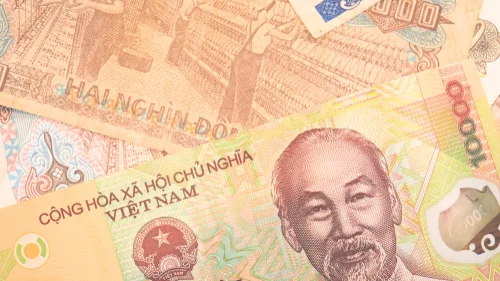
Vietnamese currency is the đồng, written as VND and represented by the symbol ₫. It’s issued by the State Bank of Vietnam, and banknotes range from 100 VND to 500,000 VND, all featuring Ho Chi Minh on the front. Coins exist but are rarely used in everyday transactions. Cash still dominates day-to-day spending in Vietnam, though card and mobile payments are growing quickly in the cities.
Whether you’re travelling to Vietnam or sending money home to family, getting a handle on VND makes budgeting easier. At Remitly, we hear from Vietnamese-Australians and Australian travellers alike who have questions about the đồng, so this guide covers what the notes and coins look like, practical tips for handling cash, and why Vietnamese banknotes carry such large numbers.
Quick facts:
- Currency: đồng (VND), issued by the State Bank of Vietnam
- Banknotes: 100 VND to 500,000 VND, all featuring Ho Chi Minh
- Coins: legal tender, but rarely used in practice
- Payments: cash is standard; card and mobile payment apps are growing in the cities

What is Vietnamese currency?
The official currency of Vietnam is the đồng, written as VND and represented by the symbol ₫. The State Bank of Vietnam is the sole issuing authority. The name comes from the Vietnamese word for copper, a reference to the metal historically used in the country’s earliest coins. VND is written using Vietnam’s modern script, and if you’re curious how that developed, our guide to the Vietnamese alphabet covers it in more detail. For Australians, it’s worth knowing that VND floats against the Australian dollar (AUD). Rates move with the market, so it’s best to check a current source before you travel or send money rather than rely on a fixed figure.
A brief history of the Vietnamese đồng
The đồng’s history is a big part of why its numbers look so large today:
- 1946: the Việt Minh government introduces the đồng, replacing the French Indochinese piastre used under colonial rule.
- Early 1950s: following the country’s division, the State of Vietnam in the south issues its own separate currency, distinct from the đồng circulating in the north.
- 1975: after the fall of Saigon and national reunification, South Vietnamese currency is withdrawn, and a single đồng circulates nationwide.
- 1985: the government carries out a revaluation, setting one new đồng equal to ten old đồng, as part of wider economic reforms.
That history of revaluation without a change in scale is a big reason VND amounts look so large today: everyday purchases routinely run into the tens or hundreds of thousands of đồng, much as small totals in cotton and polymer notes stack up in your wallet.
VND banknotes and coins: what to expect
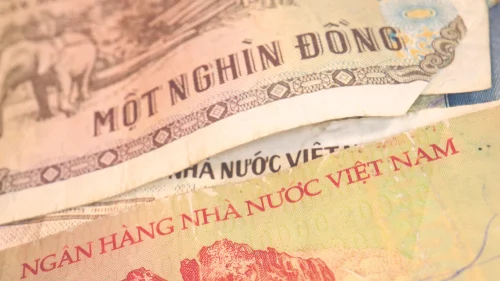
Vietnamese banknotes are divided into two families, and coins play a much smaller role than the sheer number of denominations might suggest.
Vietnamese banknotes: denominations and what they look like
Cotton banknotes cover the lowest-value notes and wear out fairly quickly with regular handling, while polymer banknotes are more durable and cover the denominations you’ll use most often day to day, similar in principle to Australia’s own polymer note system.
All Vietnamese banknotes feature Ho Chi Minh’s portrait on the front. The reverse side varies by denomination.
- 100 VND: Blackish-brown cotton paper with Pho Minh Tower on back, now rarely seen in circulation.
- 200 VND: Reddish-brown cotton paper featuring agricultural tractor imagery
- 500 VND: Dark red cotton paper displaying ships
- 1,000 VND: Purple cotton paper with timbering operation image
- 2,000 VND: Dark brown cotton paper showing weaving workshop
- 5,000 VND: Dark blue cotton paper depicting Tri An Hydropower Plant
- 10,000 VND: Dark brown and green polymer material with oil rig imagery
- 20,000 VND: Dark blue polymer material featuring Pagoda Bridge
- 50,000 VND: Red and purplish-brown polymer showing Nha Rong Port
- 100,000 VND: Dark green polymer with Temple of Literature image
- 200,000 VND: Brownish-red polymer depicting Ha Long Bay
- 500,000 VND: Blue and purple polymer featuring Ho Chi Minh’s home in Kim Lien

Are Vietnamese coins used in practice?
Rarely. The State Bank of Vietnam mints coins in denominations from 200 to 5,000 VND, but coins are hard to spend in daily life. Most vendors and banks treat them as legal tender in name only, and you’re unlikely to receive them as change at all.
Practical tips for using cash in Vietnam
A few habits make everyday cash handling in Vietnam much simpler, whether you’re visiting or sending money home to family:
- Keep a mix of denominations on hand. Markets and street food stalls often can’t break large notes, so a supply of smaller notes makes everyday purchases much easier.
- Break large notes at supermarkets, convenience stores, or petrol stations, where change is easier to come by than at small stalls or with individual vendors.
- Separate notes by value in different wallet compartments. Polymer notes look similar and can stick together, so mixing up a 20,000 and a 200,000 VND note is an easy mistake to make.
- Use ATMs in cities and larger towns for cash withdrawals. Availability can be patchier in rural areas, so it’s worth planning ahead if you’re heading outside major centres. Timing your trip around the best time to travel to Vietnam can also make logistics like this easier.
- Consider mobile payment apps such as MoMo, ZaloPay, and VietQR, which are increasingly accepted alongside cash at cafes, restaurants, and shops in Vietnam’s larger cities, reflecting a broader shift towards digital payments that the State Bank of Vietnam has been tracking in recent years.
- Sort out health and travel preparations before you go. If you’re visiting family or exploring beyond the main cities, checking current vaccination recommendations for Vietnam is worth adding to your planning list alongside your cash and card arrangements.

The Vietnamese-Australian connection to VND
Vietnamese-Australians make up one of Australia’s larger and more established migrant communities. According to the Australian Bureau of Statistics’ 2021 Census, 320,758 people in Australia reported speaking Vietnamese at home. That’s a sign of just how connected many Australian households are to Vietnam and, by extension, to VND.
For many in this community, VND is more than a travel currency. Sending money to family in Vietnam is a regular part of life. Supporting parents or relatives, contributing towards a family member’s education, or helping with a property purchase are all common reasons for a transfer. Sending money for Tết, Vietnam’s Lunar New Year, is one of the most common of all, as families set aside extra for gifts, celebrations, and reunions around this time of year.
If you’re planning a visit to family in Vietnam, checking current visa requirements for Vietnam early is worth doing, since requirements can change and vary depending on how long you plan to stay.

Frequently asked questions about Vietnamese currency
What is the currency of Vietnam?
Vietnam’s official currency is the đồng, abbreviated VND and represented by the symbol ₫. It’s issued by the State Bank of Vietnam, and banknotes range from 100 VND up to 500,000 VND, all featuring a portrait of Ho Chi Minh. Coins also exist, though they’re rarely used in day-to-day transactions.
Are coins used in Vietnam?
Rarely. Vietnamese coins are legal tender, but most people and businesses rely on banknotes for everyday purchases instead. If you happen to receive coins as change, you may find them harder to spend than notes, particularly once you’re outside the larger cities.
Can I use Australian dollars in Vietnam?
Generally, no. Most shops, markets, and transport operators in Vietnam expect payment in đồng, though some tourist-focused businesses may accept US dollars for larger purchases. It’s best to carry VND for everyday spending and to exchange currency at a bank or a licensed exchange counter.
Why does Vietnamese currency have such large numbers?
Vietnam’s đồng carries high nominal values partly because of historical inflation and a 1985 revaluation that set one new đồng equal to ten old đồng. As a result, everyday amounts routinely run into the tens or hundreds of thousands of đồng, even for small purchases.
Is cash or card better in Vietnam?
Cash remains the more reliable option, especially at markets, street stalls, and in rural areas where card readers aren’t common. Card acceptance is growing in the cities, particularly at hotels, larger restaurants, and shopping centres, so carrying both cash and a card tends to give you the most flexibility.
Key takeaways
- Vietnam’s currency is the đồng (VND), issued by the State Bank of Vietnam, with banknotes ranging from 100 VND to 500,000 VND.
- Coins are legal tender but rarely used and cash remains the everyday standard, though mobile payment apps like MoMo, ZaloPay, and VietQR are gaining ground in Vietnam’s cities.
- A 1985 revaluation set one new đồng equal to ten old đồng, which is a big reason VND amounts look so large today.
- The 2021 Census recorded 320,758 people in Australia speaking Vietnamese at home, and VND plays a regular role in remittances for family support, Tết, and other milestones for this community.
Whether you’re planning a trip or supporting family back home, our Vietnam travel and living guide for Australians can help you get ready for what’s ahead.
Last reviewed: September 2026



