Key Highlights
-
At a jewish wedding in Israel, there are a few traditions you will see on the wedding day. People take part in the ketubah, chuppah, sheva brachot, yichud, and the breaking of the glass.
-
A lot of wedding traditions in Israel let family members stay near the couple before, during, and after the main ceremony.
-
The jewish marriage contract, known as the ketubah, will be signed before the main ceremony. This document follows old jewish civil law.
-
At most Israeli celebrations, you can see a packed dance floor. People enjoy good food, plenty of dancing, and a lively feel.
-
If you are from Australia and go to one of these weddings, you should get ready for meaningful events, the support of the jewish people, and many saying “mazel tov” with warmth and joy.
Introduction
If you are an Australian guest or couple who wants to know about a jewish wedding in Israel, it is good to learn what makes an israeli wedding special. These wedding traditions mix faith, family, history, and joy together. This can feel both old and new at the same time. You might see a short ceremony, some customs that change the way people walk up the aisle, and more focus on being with the whole community. Once you get the basics, the whole thing will be easier to understand and enjoy.
Understanding Israeli Wedding Traditions
Modern Israeli wedding traditions usually focus on a jewish wedding ceremony. The event often includes the ketubah signing, standing under the chuppah, saying the sheva brachot, giving the ring, time alone in yichud, and the breaking of the glass. These jewish wedding customs are well known to the jewish people and still play a big role in many israeli wedding celebrations today.
But jewish marriage in Israel is about more than just the party. It is shaped by jewish law and what the community does. For a jewish couple, this is not only about the two people getting married. It is about family, history, and the deep meaning they share through their jewish tradition. If you want to know why these wedding customs are important, you have to look back at how they started and what they mean in the jewish wedding.
The Cultural Roots of Jewish Weddings in Israel
A jewish wedding in Israel goes back to ancient times, and the meaning is more than it first looks. The customs you see are old, but they still show more than just two people making a legal bond. They also bring in their families, show support from friends, and mark the start of a new home.
In jewish tradition, symbols are important. The chuppah is about building a new home together. Blessings over wine are there for joy and how holy the day is. Things like the bride’s veil, the ring, and going in a circle around the groom are all there for reasons people still talk about today. These actions have meaning. They are not there just for show or style.
That’s why a jewish wedding in Israel has a deep feeling that goes all the way back to ancient times. Couples today might like to change the look, or where the wedding is, but the old ideas about what it means to make a promise, remember, and belong are still there. For Australians, seeing that strong tie between ancient jewish tradition and the new wedding day is part of what makes an Israeli ceremony special.
Historical Influences Shaping Modern Israeli Ceremonies
Jewish history has shaped the way a modern jewish wedding happens. You can see the history in the jewish wedding ceremony. One clear part of this is the breaking of the glass, which many people link to the destruction of the second temple in Jerusalem. Even in a happy time, there is still that sense of remembrance in the day.
The law of moses and jewish civil law also play a big role in the ceremony. The ketubah started from jewish civil law. It lists what the groom has to do, what the bride can expect, and offers protection to both in the marriage. While it is symbolic, you can see it is about law and thinking as well.
All these things help show us why the main rituals in Israel at a jewish wedding look the way they do. The couple signs the ketubah. They stand together under the chuppah. There are blessings, rings are swapped, and it all finishes with the breaking of the glass. Every step comes from a long history, not just what people like now, and that’s why the jewish wedding has its deep meaning.
Differences Between Israeli and Australian Wedding Customs
For Australians, some jewish wedding customs in Israel might seem a bit different from what you know on a wedding day here. The jewish wedding ceremony in Israel is often much shorter, usually lasting just 15 to 20 minutes. The move from the end of the ceremony to the celebration can be much quicker as well.
You will see some different traditions when it comes to the aisle and people’s seats. Many times, in Israeli jewish wedding customs, the couple will walk in together or with their parents, not with bridesmaids and groomsmen like you might expect. After the glass is broken, most guests will head straight to the wedding feast or wedding reception at once.
-
Seating at the chuppah can be limited and not every guest will have a seat.
-
Often, there is no first dance or cake-cutting moment at the wedding reception.
-
Guests may crowd the couple as soon as the ceremony finishes.
All in all, these are just some ways a jewish wedding in Israel can feel new for Australian guests, with people moving quickly to celebrate the new couple after the end of the ceremony.
Pre-Wedding Rituals and Preparations
Before the wedding day, there are a few pre-wedding rituals that help set the mood. They also bring close family and friends together. These engagement customs and get-togethers are more than just steps you have to take for the big day. They pull in family, friends, and the community as you get ready for the wedding day.
In Israel, people really feel that sense of everyone being involved. You feel this from the first blessings right before the ceremony to working out plans for guests coming from other countries. This kind of preparation often feels both social and part of getting things done. The next traditions show how all this comes together in real life.
Engagement Customs and Matchmaking (Shidduch)
When people talk about jewish couples, you might come across the word shidduch. This word means matchmaking. The info here does not give every detail about the modern process for shidduch in Israel, but it does show that jewish marriage can still have some formal rules. These rules often come from jewish law and what the community expects.
For people from other countries, the first thing is not always the matchmaker. It is mostly about what kind of ceremony can happen. If both people fit what the Orthodox Rabbinate wants, they can get married with a religious service that will be legal. If they do not fit those rules, they might do a more open or non-religious service in Israel. Then, they finish the legal marriage somewhere else.
This is why getting expert help is good. A wedding planner can help jewish couples from other countries pick the right vendors, find a place, work through contracts, and help with timing for all the legal stuff. If you have a jewish marriage and you want to marry in Israel from Australia, those first choices you make about the type of ceremony, papers, and finding support in Israel will decide the way the rest goes.
The Aufruf: Family Blessings and Celebrations
The aufruf is a good example of how a jewish wedding brings in family members and the community even before the marriage ceremony starts. The word aufruf means “to call up.” It is about the bride and groom getting called up to the Torah to get a blessing right before the wedding.
After this, the Rabbi gives a Misheberach, which is another blessing for the couple. In many places, people will throw sweets or candy over the couple. They do this to wish them a sweet and good life together. It is a warm and open way for people to show support for the couple before the big day.
So, what does this tell us? Well, in Israel and other jewish wedding traditions, there is time for blessings before anyone says vows. Family members, friends, and the whole group are there to join in. This is why when you hear a simple mazel tov, you feel all the love and happiness that comes from everyone being together.
Preparing Invitations and Attire for Israeli Weddings
If you are joining the wedding from Australia, you should start thinking about your invitation and what to wear right away. People who plan the day from another country often make a wedding website. This helps guests know where to stay, how to get around, what the weather will be like, and how fancy the event is.
For people who are not Jewish, there can be things that are new to you. Israeli weddings can have different customs. Some details are important. Jewish brides may have a veil for the bedeken part, and the wedding band is often just a simple piece of metal with no stones. The chuppah canopy sometimes has a family prayer shawl as well.
-
Check the invitation or the wedding website to know what to wear and what time things start.
-
Pick comfortable clothes and ones that are good for the weather. This is important if parts happen outside.
-
Watch for simple but special things—a plain wedding band, a veil, or a prayer shawl under the chuppah.
Essential Elements of the Israeli Wedding Ceremony
The main ceremony at an Israeli wedding usually has a few key parts, and they happen in the same order each time. You will see the jewish marriage contract signed first. Then, the couple stands together under the wedding canopy, called the chuppah. When they are there, blessings are said for them. There is a final act done at the end to finish the main ceremony.
Every couple may like to add their own touch, but these parts make an Israeli wedding easy to recognise. If you know about these steps, you can keep up with what is going on and what it means. In the next parts, we will talk about the ketubah, chuppah, bedeken, and the moving in a circle.
Signing the Ketubah: The Jewish Marriage Contract
Ketubah signing usually happens right before the wedding ceremony. The ketubah is a jewish marriage contract, and it sets out what the groom must do for the bride. It also lists her rights and some protections for her. This contract includes the basics of what happens if the couple gets divorced.
This paper is not just something nice to look at or keep. The ketubah is part of jewish civil law and not a prayer, so you will not see any blessings from God written in it. The couple signs it, along with two Jewish witnesses. Often, someone reads the contract out loud during the wedding ceremony.
For guests, seeing the ketubah signing helps explain something about jewish law and what jewish marriage looks like in Israel. The day is full of emotion and fun, but the event has a strong formal side, too. By the time the glass gets broken and the cheering starts, the marriage has already been put into words and these rules are now in place.
Under the Chuppah: Symbolism and Setup
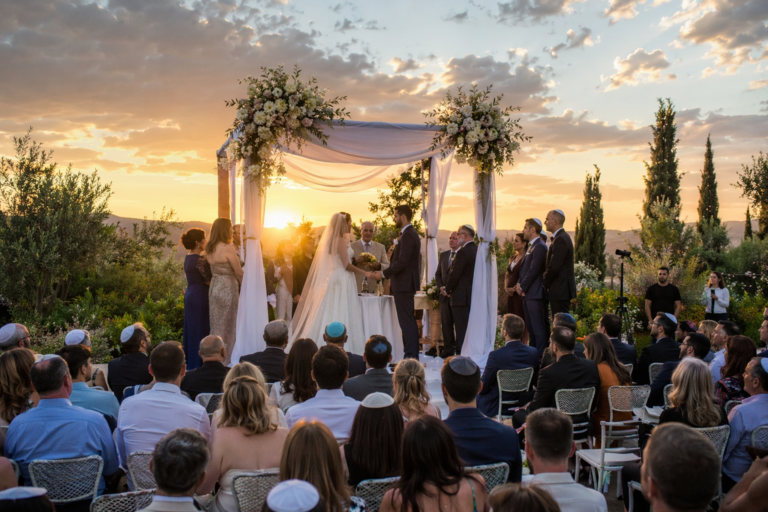
The chuppah is often the visual centre at many Israeli ceremonies. This wedding canopy, which has four corners and a covered top, stands for the new home that the couple will build together. In jewish tradition, this image of an open, welcoming home is very important.
Sometimes the wedding canopy is plain, with just four poles and some fabric. Other times, people decorate it with flowers. Friends might stand and hold the poles to show they support the couple in their future life. The covering can also be a family prayer shawl. This adds a special and personal touch.
You might hear people talk about having the chuppah under an open sky. This helps show the feeling of blessing, openness, and being connected. Whether it is simple or fancy, the chuppah makes sure the ceremony keeps its main meaning: two people coming together to make a new home.
Bedeken: Veiling of the Bride
Bedeken is when the bride gets veiled, and it usually happens as the ketubah signing takes place. At this time, the groom walks up to the bride, has a look at her, and then puts the veil over her if she has one. It is a short ritual, but it is full of meaning.
In jewish tradition, people often say bedeken is a way for the groom to show he cares about the bride’s inner beauty. It is also tied to the old story in the bible about Jacob. In that story, Jacob married the wrong sister because the bride’s face was hidden by a veil.
That old tale still plays a part in how things go today. When the groom puts the veil on the bride with his own hands, it shows he is sure and means what he does. This shows guests how stories from a long time ago still shape Israeli weddings. While the ritual looks simple, it carries a lot of memory and symbolism.
Circling the Groom: Ritual and Significance
In some jewish wedding ceremonies, mostly in Ashkenazi practice, the bride goes around the groom three or seven times while they stand under the chuppah. People call this part circling the groom, and it’s still one of the most unique things people see on the wedding day.
People have many views on what this ritual means. Some say it is a way to put up a wall against the evil eye, or to keep away harm and temptation. Others talk about it as the start of a new family circle. There is also a thought that the three times around stand for the virtues of marriage: righteousness, justice, and loving kindness.
If the bride does seven circles, people often say this links to a biblical concept, as the number seven often means completeness or perfection. Not every couple in Israel will do this, but when you see it, you notice how the same movement means many different things. It helps guests at the event see how ritual lets people think deeper about what’s going on.
Ritual Highlights During the Ceremony
There are a few moments in a jewish wedding that most people will notice because they mix sound, meaning, and feelings. On the wedding day, guests usually watch carefully when the blessings are given, when the ring is shared, and, at the end, when there is the breaking of the glass.
These big moments are a part of older wedding traditions. These come from jewish law and the memories of the jewish community. Even if it is a short ceremony, each step has its own reason. If you look at these one by one, it makes the whole jewish wedding ceremony easier to follow for guests.
Sheva Brachot – The Seven Blessings
Sheva brachot means the seven blessings. It is one of the most meaningful parts of a jewish marriage. These blessings come from old teachings. People often read them in both Hebrew and English, so more guests can follow what is happening.
The blessings start with one over a cup of wine. After this, the words talk about more things like joy, peace, and being together. There is also hope that the married couple will be happy with each other. As you listen, the words move from a simple start and grow, sharing bigger ideas about their life together.
Family and friends are often asked to read the sheva brachot as well. This makes the ritual feel like everyone is part of it. You do not just sit there and listen to formal words. You get to hear a group speak loving kindness, happy wishes, and hopes for lasting joy over the married couple.
Breaking the Glass: Meaning and Interpretations
Breaking of the glass is one of the things that non-Jewish guests know first about a Jewish wedding. But there is more to it than most people think. At the end of the ceremony, you will see the groom step on the glass wrapped in a cloth bag. Sometimes, both partners do it. Everyone then shouts mazel tov.
The primary reason for this is that people should remember even on a happy wedding day, there are things to think about. Jewish tradition says not to forget big memories, or that life can be fragile. It is a way of taking on responsibility. Many also say the breaking of the glass is about the destruction of the temple in Jerusalem.
-
The glass can stand for the pain from the destruction of the temple and the sadness it brought.
-
It shows that marriage will have hard times as well as joyful ones.
-
After the breaking of the glass, people give good luck notes and say congratulations for the years ahead.
Presentation of the Ring (Betrothal)
The way the ring is shown is an important part of a jewish wedding betrothal. The wedding band is usually plain. It is made from gold, silver, or platinum with no stones in it. In the past, this simple look helped people know its value just by checking the weight of the ring.
Some people put the ring on the left forefinger. They think a vein from that finger goes right to the heart. This shows how even a small thing can mean a lot in the ceremony and how old customs stick around over time.
When guests watch, the ring part of the jewish wedding looks common, but the way it is done and explained is special. The ring goes along with other things like the ketubah, the blessings, and later, the glass. So, the wedding band is not just a symbol of betrothal. It is also one part of a bigger tradition.
Celebration and Festivities at Israeli Weddings
Once the ceremony is over, the mood changes pretty quick and turns into a big celebration. At an Israeli wedding, the wedding feast or wedding reception is all about good food, lots of energy, and a dance floor that fills up fast. People do not stay formal for long at this part. It turns into a social time, and everyone gets right into it.
This is where family and friends really shine again. At the wedding feast, you see people eating, singing, dancing, and calling out mazel tov with a lot of excitement. For Australians, that big feeling of shared happiness is often one of the best things they remember about an Israeli wedding.
Traditional Dances: Hora and Mezinke
The hora is the most well-known dance at many celebrations and is big part of jewish wedding traditions. At jewish weddings, guests hold hands and dance in a circle. This gets everyone moving and full of energy. It is hard for people to stand still for long when they see the dance. There is so much happening that most get involved.
One classic part of these wedding traditions is when the bride and groom are lifted up on chairs. They hold each end of a handkerchief or napkin, and everyone cheers around them. This is often the biggest moment of the wedding day, as the dance brings a lot of laughter and joy. It is something people remember long after. You see everyone, young and old, come together to celebrate a good time for the couple.
There is also another dance called the mezinke. This is special for the parents when their last child is getting married. It is a way to show love to the parents and makes the wedding more about the family. These jewish wedding dances mean the reception is not just another party. Both dances give people a way to join together, have a good time with the couple, and make new memories with family and friends at the wedding day.
Feast, Toasts, and Community Customs
The wedding feast is one of the strongest ways people come together at Israeli celebrations. Right after the ceremony, guests usually move to dinner. The event can go on for hours. For many people, having great food and lots of time with others is one big part they remember.
This part of the night is not really about any one formal event. It is more about everyone enjoying time together with the couple. Jewish couples often use this time to bring family and friends in one room. This is a good way to connect with people, especially if some have travelled from overseas.
-
Guests often head straight to the meal after the ceremony. They do this instead of waiting for the first dance.
-
The couple may have their first meal alone during yichud before they join all the guests again.
-
People give good luck wishes, many toasts, and keep saying mazel tov, which helps everyone feel a sense of community.
Yichud: The Couple’s First Moments Alone
Yichud is a short time when the newly married couple is on their own right after the jewish wedding. Tradition says the couple should be alone for at least eight minutes, but some couples spend ten to twenty minutes together. This helps give the couple a break after the busy wedding.
For the two of them, this is their first time by themselves on the wedding day since becoming husband and wife. They get a chance to breathe, think, and understand what has just happened. This quiet is a nice balance after all the noise of the ceremony and the party.
It is common for the couple to have their first meal together in yichud. It’s a simple thing, but it means a lot. The married couple shares this special private moment before going out to everyone again. Then they proudly come back to the party as a newly married couple.
Modern Trends and Regional Variations
Not every Jewish wedding ceremony in Israel looks the same. Jewish wedding customs are not always alike, because of what people believe, where their family comes from, and how religious or secular they are. Because of this, Australians may get to see different traditions during weddings, even if they are in the same place.
The main difference is often about Orthodox and Reform practice, as legal marriage in Israel is under Orthodox religious authority. Where people or their families come from can change things too. The following shows how these different traditions show up, while the heart of the celebration stays the same.
Blending Religious and Secular Practices
Many Israeli couples mix everyday ways with wedding traditions that everyone knows. The information shows that some people want to have a free or non-religious wedding in Israel, even if that does not give them an Israeli marriage certificate. For these couples, the look and feel of the day may be as important as the legal document.
Religious couples who meet the rules set by the Orthodox Rabbinate can finish the legal steps in Israel. Some people like to have a main ceremony in Israel as a special moment, and then do the legal paperwork in another country. With both ways, the main ceremony has the things most couples want, like the chuppah, blessings, and marriage contract.
You can also see this mix in how the wedding looks and how people plan the day. Couples who come from other countries may look for special places, great local views, and new ideas for how things can look, but they keep the heart of the ritual. This means the wedding still feels like Israel, but does not stick to one hard-and-fast way across the whole event.
Orthodox vs Reform Traditions in Israeli Weddings
There are some important ways that orthodox and reform groups in Israel look at legal recognition. If both people in a couple meet the rules set by the Orthodox Rabbinate, they can have a jewish wedding that is legal in Israel. But not everyone can go down that path.
The information also says you can have a Reform or Masorti ceremony in Israel. Still, you will not get a legal Israeli marriage paper from those ceremonies. Some religious couples are happy with that. For others, it means they have to rethink how to plan the marriage ceremony.
|
Tradition area |
Orthodox |
Reform |
|---|---|---|
|
Legal status in Israel |
Can be legally binding if the couple meets Rabbinate rules |
Ceremony possible, but not legally recognised by Israel |
|
Eligibility |
Requires both partners to qualify under Orthodox standards |
More flexible in ceremony planning |
|
Marriage ceremony planning |
Involves Rabbinate registration and documents |
Often paired with legal registration abroad |
Unique Customs Distinct to Israeli Jewish Communities
Israeli Jewish communities have a lot of core wedding customs, but the style and feel can be pretty different because of local ways and the region. The info here points out a few things about how things work and what guests from Australia might notice, even if they have been at Jewish weddings before in other places.
For example, the ceremony is often short and people move fast from the glass to cheering for the couple and starting dinner. Another thing is the chuppah. In Israel, the chuppah can be much simpler. Ashkenazi tradition can shape things like the act of circling, but the way the party feels will really be shaped by local culture at these events.
-
Couples might walk in together or with their parents. You might not see a big bridal party take ages walking in.
-
Right after the glass, guests usually rush up to the couple. It’s a quick and happy start, with everyone getting into the celebration at once.
-
Venues in Israel also stand out. Ceremonies can be in old Jaffa houses, Jerusalem ruins, or out in the open fields.
These wedding customs come together to give the day a special Israeli touch. You will get local style mixed in with tradition, especially things like the glass, Ashkenazi tradition, and how the event unfolds.
Beginner’s Guide: How Australians Can Experience an Israeli Wedding
If you’re going to an israeli wedding, it helps to get ready before the big day. The key things are knowing how the ceremony will go, what to wear, and when to arrive. Be ready for a quick change from the ritual part to the celebration on the wedding day.
For australian couples who want a wedding day in Israel, there are some basics to think about. You will need to know about venue permits, what type of ceremony to have, what paperwork is needed, and where to get advice. The next parts will make all the key things clear, with a guide anyone can use.
What You’ll Need: Invitations, Attire, Understanding Local Traditions
Start with the basics. Read the invite well and see if the couple has a wedding website. At a destination event in Israel, many couples will share ideas for places to stay, notes for getting there, how to dress, and also talk about what the weather can be like—all in one spot.
What you wear should fit the place and season. In Israel, weddings happen at beaches, in forests, villas, the desert, and big towns, so what you wear depends on where the wedding will be. Some jewish wedding customs will shape what you see, like the veil, a simple ring, or even a plain chuppah instead of a big aisle.
-
Confirm the spot, the start time, and any info about travel early.
-
Dress for both the weather and the place, not just how formal the invite is.
-
Expect jewish wedding customs that are not the same as Australian weddings.
Step-by-Step Guide to Participating in an Israeli Wedding
If you want a simple guide, break the wedding day into three key times: before the ceremony, during the main ceremony, and after the ceremony. This way, it is easier to keep up with the wedding day, especially for those new to jewish wedding customs.
Before things get going, try to learn the main names, like kabbalat panim, ketubah signing, and bedeken. At the main ceremony, pay attention to the chuppah, the blessings, the giving of the ring, and of course, the glass. When it is done, most people will give their best wishes, then enjoy food, and get out on the dance floor, not wait around for something formal.
-
Try to arrive knowing what to expect, so you get what makes each moment special and it’s not confusing.
-
After the main ceremony, just move with the group as things often happen fast.
-
When the party moves onto the dance floor, you can join in and have fun, but do it in a respectful way.
Step 1: Preparing for Pre-Wedding Rituals
Step 1 is getting ready for the pre-wedding rituals. One of the key things to know is a jewish wedding can really get going—both for how people feel and act—even before the main ceremony. People may hear about kabbalat panim, which is the pre-ceremony welcome, along with the ketubah signing or bedeken.
If you are a guest, try to get there early so you have time to settle in and see what is happening. If you are planning from another country, this is when paperwork, talking with people nearby, and lining up your vendors are really important. In Israel, having a planner can help a lot when there might be language gaps or different ideas about how things should go.
For people coming from overseas, there is another early step to think about. Work out whether the wedding will be legally recognised by the Rabbinate or if it will be just a symbolic celebration. That choice will change the documents, timing, and everything that needs to happen well before the big day.
Step 2: Attending the Ceremony Under the Chuppah
Step 2 of a jewish wedding is the marriage ceremony under the wedding canopy. After the couple walks to the chuppah, people set their eyes on the main symbols of this day. Often, you will see the parents with the bride and groom, not a big group of attendants.
As the marriage ceremony goes on, keep an eye on how things happen. You might see the reading of the ketubah, some blessings made over the wine, the rings being given, the bride walking circles, and then the famous breaking of the glass. Israeli jewish weddings are usually short, so every part comes and goes fast.
If you are a guest from somewhere like Australia or Canada, you should just watch and go along with what you see. There is no need to wait for a long walk at the end or for long stops in the action. In Israel, people go right from the sacred marriage ceremony to the big happy party straight away.
Step 3: Joining the Festivities and Traditional Dances
Step 3 is easy: join in the celebration. After the ceremony, the guests will often head right to the wedding feast and reception. You might get to say mazel tov to the couple just after the glass gets broken.
The traditional dances play a big part in the night, with the hora being the main one. If the dance floor fills up quickly, that is how it usually goes. You do not need perfect moves to join in. The idea is for everyone to feel joy, not to show off or be perfect. Just giving a happy mazel tov means a lot.
People who come from other places will usually follow the room’s lead. If you see people on the dance floor moving in circles, clapping hands, and lifting the couple up on chairs, that is a big part of the wedding. Step in kindly and enjoy the fun and friendly spirit of it.
Conclusion
To sum up, knowing about Israeli wedding traditions is important for Australians who want to take part in these special events. The different parts, like signing the Ketubah or walking around the groom, show the history and culture behind every israeli wedding. These wedding traditions bring the family and friends together for a happy celebration. If you get to know what happens at these weddings, you can join in and enjoy everything more. This is true whether you are a guest or you will have your own special day. Being open to israeli wedding traditions will help you feel even more part of this lively culture. If you want to find out more about what to do or expect at an israeli wedding, you can reach out for help anytime!
Frequently Asked Questions
What should non-Jewish guests expect at an Israeli wedding?
A non-Jewish guest at an Israeli wedding can expect some special wedding customs. The ceremony will be short but have strong meaning. After that, there is a lively party. Jewish people are close with their family and the community, so the tradition at an Israeli wedding feels warm and open. People there get to join in from start to finish.
How do ancient customs influence modern Israeli weddings?
A modern jewish wedding in Israel still shows pieces of ancient times. You can see this in things like the bedeken, chuppah, circling, sheva brachot, and the glass. These wedding traditions are still strong today. Jewish law, history, and memory keep shaping how jewish people see marriage even now.
Are Israeli weddings different for Orthodox and Reform couples?
Yes. In an Israeli wedding, orthodox couples who follow the Rabbinate rules can get a marriage that is legal, while reform couples can still have a jewish wedding in Israel, but it will not be seen as legal there. Many jewish wedding customs can be the same for both, but the legal way to marry is not the same.
What are the main steps involved in planning a wedding in Israel for Australians?
For Australian couples, planning an Israeli wedding often begins with picking the type of ceremony. You also need to check if all the legal parts are covered. After that, booking a planner helps a lot. It is good to make sure you have all the right venue permits. It also helps to give guests the details they need for travel. When you follow these steps, the wedding day goes better and makes it easy to keep all the wedding traditions.