TL;DR: Janai Purnima 2026 falls on the full moon of Shravana (Shrawan Purnima), expected in late July or early August. Hindu men renew their sacred thread (janai), and rakhi threads are tied between siblings. As Australia’s Nepali community continues to grow rapidly, Janai Purnima has become one of the most widely observed Nepali cultural events across the country.
Across Australia, Nepali families are gathering each year to mark one of the most meaningful days in the Hindu calendar. Janai Purnima—sometimes called Raksha Bandhan or Gunhu Punhi—is more than a religious date on the calendar. It’s a day of renewal, protection, and family ties. And as Australia’s Nepali population grows at one of the fastest rates of any diaspora community, this festival is finding a confident new home far from the Himalayas.
Whether you’re Nepali-Australian celebrating for the first time in a new country, or simply curious about the traditions of your neighbours, colleagues, or friends, this guide covers everything you need to know about Janai Purnima 2026.

When Is Janai Purnima in 2026?
Janai Purnima falls on the full moon (Purnima) of the Nepali month of Shravana, known in Sanskrit as Shravana Purnima. In 2026, this date is expected to fall in late July or early August, consistent with the Bikram Sambat lunisolar calendar used in Nepal. The exact date is confirmed annually by Hindu religious authorities and may vary slightly depending on regional calendar conventions.
Because the date shifts each year in alignment with the lunar cycle, many Nepali-Australians rely on community organisations, temples, or cultural associations to confirm the official observance date each year.
What Is the Significance of Janai Purnima?
Janai Purnima is rooted in two deeply intertwined Hindu traditions: the renewal of the sacred thread and the tying of the rakhi bracelet.
What is the janai, and why is it changed on this day?
The janai is a sacred thread worn by Hindu men—particularly those of the Brahmin, Chhetri, and Vaisya castes—across the upper body. Investing or wearing the janai is known as the Upanayana ceremony, a rite of passage marking a young man’s transition into religious duty. Every year on Janai Purnima, men who wear the janai are required to replace it with a new one, symbolising spiritual renewal and the recommitment to one’s dharma.
This ritual is performed by a priest or elder, accompanied by prayers and sacred mantras. The discarded thread is ceremonially disposed of, often cast into a river or body of water.
How are rakhi threads connected to Janai Purnima?
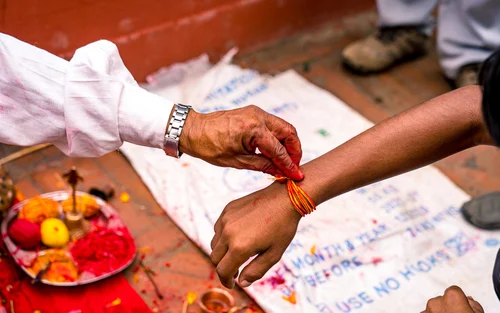
Alongside the sacred thread ceremony, Janai Purnima coincides with Raksha Bandhan—the festival of sibling protection. Sisters tie a rakhi (a colourful thread or bracelet) around their brothers’ wrists as a symbol of love and a prayer for their protection. Brothers, in turn, offer gifts and pledge to look after their sisters.
This dual observance—one centred on personal spiritual duty, the other on family bonds—gives Janai Purnima its particular emotional depth. It’s a day that connects the individual to something larger: their faith, their lineage, and the people they love most.

How Is Janai Purnima Celebrated in Australia?
Australia is home to one of the world’s fastest-growing Nepali diaspora communities. According to the Australian Bureau of Statistics, Nepal-born residents in Australia have increased substantially over the past decade, with significant concentrations in Melbourne, Sydney, Brisbane, and Canberra. This demographic shift has brought Nepali cultural life—including its festivals—into mainstream Australian cities.
Where do Nepali-Australians celebrate Janai Purnima?
Community celebrations are typically organised through Nepali cultural associations, Hindu temples, and university student groups. Cities with active Nepali communities often host public gatherings that include:
- Sacred thread ceremonies led by visiting or resident Hindu priests
- Rakhi-tying rituals within families and community groups
- Sel roti and festive food prepared communally or at cultural events
- Cultural performances, including music, dance, and prayers
Hindu temples in Melbourne and Sydney often hold morning puja (prayer) services, and community halls may be booked for afternoon celebrations. Events are widely promoted through social media groups, community Facebook pages, and Nepali diaspora networks.
How do Nepali families adapt the celebration to life in Australia?
Living far from Nepal adds a layer of creativity and meaning to how families observe Janai Purnima. Many families conduct the sacred thread ceremony at home, with elder family members or community priests officiating. For the rakhi ritual, sisters who are separated from their brothers—by geography, or because siblings remain in Nepal—often send rakhis by post in the weeks leading up to the festival.
Video calls have become a central part of the celebration for transnational families, allowing the rakhi thread to be tied symbolically while watching via screen. Some families even coordinate simultaneous rituals across time zones, ensuring no distance diminishes the meaning of the day.
What Food Is Traditionally Eaten on Janai Purnima?
Food is an essential part of any Nepali celebration. On Janai Purnima, the most iconic dish is kwati—a mixed bean soup made from nine types of sprouted beans, including black-eyed peas, chickpeas, soybeans, and mung beans. Kwati holds both nutritional and spiritual significance; it is believed to cleanse the body and mark the changing of seasons.
Sel roti, a ring-shaped sweet rice bread fried in oil, is another Janai Purnima staple. It is often prepared in large batches by families and shared with guests throughout the day.
In Australian Nepali households, both dishes are prepared using ingredients sourced from Indian and South Asian grocery stores, which are now well-stocked in most major Australian cities.

Why Janai Purnima Matters Beyond the Nepali Community
Cultural festivals enrich the communities they’re celebrated in—and Australia’s multicultural identity depends on these moments of sharing and connection. Janai Purnima offers non-Nepali Australians a meaningful opportunity to understand the values at the heart of Nepali culture: reciprocity, renewal, and the importance of family.
Schools, workplaces, and community spaces that recognise and acknowledge festivals like Janai Purnima contribute to more inclusive environments for Nepali-Australian residents. As Australia’s Nepali community continues to grow, awareness of these occasions only deepens mutual respect.
Carrying Tradition Forward
Janai Purnima is not simply a ritual preserved out of habit. For Nepali-Australians, it’s a living tradition—one that adapts to new environments while maintaining its essential meaning. The thread tied on this day, whether sacred or celebratory, is a reminder that identity travels. It crosses borders, adjusts to new calendars, and finds its rhythm in new cities.
As 2026 approaches, communities across Australia will once again gather to renew their threads, share kwati, and celebrate the ties that hold families and cultures together.